
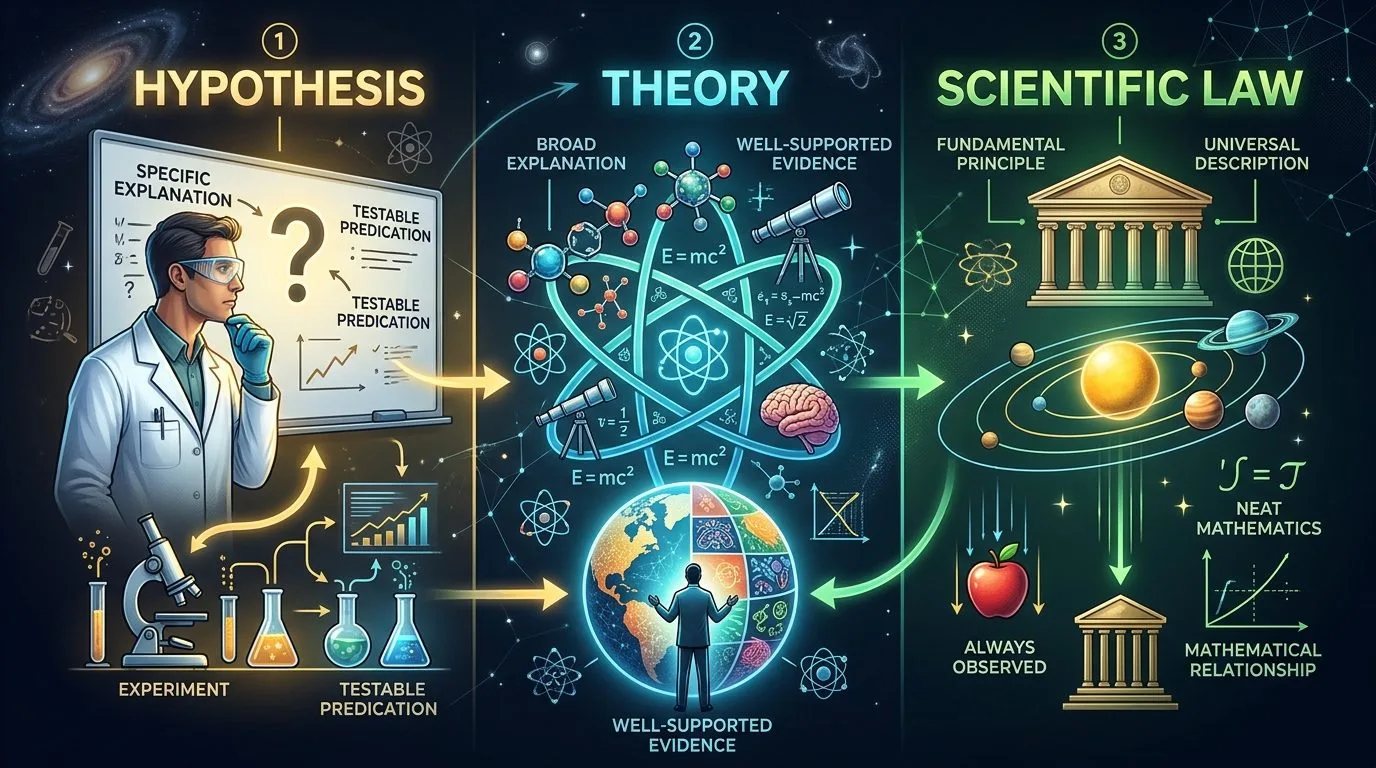
What is the difference between a hypothesis, a theory and a scientific law? A hypothesis is a proposed explanation or relationship that can be investigated with evidence. A scientific theory is a broad, well-supported framework that explains a range of observations and generates testable expectations. A scientific law describes a consistent pattern or relationship in nature, often using a concise mathematical statement and specifying the conditions under which it applies. A theory does not become a law when it gathers enough evidence.
These three ideas are related, but they do different jobs. Consider gravity: scientists can test a focused hypothesis about a falling object's motion; Newton's law of universal gravitation describes a mathematically useful relation between masses and distance; and Einstein's theory of general relativity offers a more extensive explanation of gravitation in terms of spacetime. They are not three levels of one certificate. The National Academy of Sciences and OpenStax explicitly reject the common “hypothesis → theory → law” ladder.
This guide explains hypothesis vs theory vs scientific law in plain English, compares familiar examples from biology, chemistry and physics, and includes a short classification exercise with answers. It also shows why the words “fact”, “model” and “prediction” are not interchangeable with the other three terms.
Hypothesis vs theory vs scientific law: comparison chart
| Feature | Hypothesis | Scientific theory | Scientific law |
|---|---|---|---|
| Main role | Proposes a testable explanation or relationship | Explains and connects many findings | Describes a recurring relationship or regularity |
| Typical scope | Often narrow or specific | Usually broad and integrative | Focused on a pattern under stated conditions |
| Evidence | May be new, partly tested or well supported within its scope | Supported by substantial converging evidence and testing | Supported by repeated observations within its applicable domain |
| Key question | Could this account for what we observe? | How do these phenomena fit together? | What relationship describes the observations? |
| Common form | Clear explanatory statement and associated predictions | A network of explanatory models, principles and evidence | Concise words or an equation |
| Example | Seedlings exposed to less light will make less chlorophyll under otherwise comparable conditions | Theory of evolution by natural selection | Boyle's law for gas pressure and volume |
| Can be revised? | Yes | Yes, as better evidence or explanations emerge | Yes; its conditions or range of validity may be refined |
| Does it “graduate” into another category? | No automatic promotion | Does not become a law | Not a higher stage than a theory |
The table is a teaching guide, not a rigid set of labels that everyone uses identically. Some scientists use “theory” in a specialised or more tentative sense, while an individual hypothesis can become strongly supported. The important distinction is the function, scope and evidential support of the particular claim, rather than a supposed hierarchy of scientific prestige. For a foundational discussion, see the National Research Council's framework for science education .
What is a scientific hypothesis?
A scientific hypothesis is a proposed, empirically testable explanation or relationship. It connects a question to evidence we can collect. Hypotheses often arise from previous observations, existing theories and creative reasoning, rather than appearing as unsupported guesses. They can be examined using controlled experiments, natural observations, measurement, modelling or other suitable methods.
For example, imagine noticing that seedlings growing near a bright window appear greener than seedlings kept in a dark cupboard. One possible hypothesis is: “Under otherwise comparable growing conditions, differences in light exposure contribute to differences in chlorophyll production.” You could develop a prediction about measurable greenness or chlorophyll content and plan an investigation that also considers seed variety, temperature, watering and time.
A well-framed hypothesis specifies what could count against it. It should not be designed so that every possible outcome is called a success. But testability does not mean every hypothesis is tested with one simple school experiment. Scientists sometimes depend on instruments, long-term datasets or predictions about phenomena they cannot directly manipulate.
Hypothesis versus prediction: not quite the same thing
A hypothesis suggests an explanation; a prediction says what an observer should expect under specified conditions if the explanation is useful. In the seedling example, “light availability affects chlorophyll production” is the hypothesis. “After ten days, seedlings with adequate light will show greater measured chlorophyll content than comparable seedlings grown in darkness” is a prediction.
The familiar “If…then…” sentence is a helpful classroom structure, but not a requirement. An explanation does not stop being a hypothesis because it uses another sentence form. Moreover, a prediction can sometimes follow from a scientific law or model without being an explanatory hypothesis on its own. OpenStax's process-of-science chapter explains this distinction.
Are hypotheses always untested guesses?
No. Some hypotheses are proposed before evidence is gathered; others are based on a strong background of prior research and have already survived important tests. “Hypothesis” describes the role of a claim in an investigation, not merely a low confidence level. A narrow, thoroughly supported research hypothesis may remain a hypothesis rather than being relabelled a “law”.
What is a scientific theory?
A scientific theory is an extensively tested explanatory framework that brings together observations, findings and mechanisms into a coherent understanding of some aspect of nature. It often supports new questions and predictions: if the theory is useful, it should explain existing evidence and guide investigation of things not yet observed.
The National Academy of Sciences defines theories as well-supported explanations that can incorporate evidence, tested hypotheses and laws. They are neither personal opinions nor simply tentative guesses. The phrase “it's only a theory” uses the everyday sense of the word, not the standard scientific meaning in examples such as evolutionary theory.
Example 1: the theory of evolution
Evolutionary theory explains changes in heritable characteristics of populations across generations and the diversification of living organisms. Natural selection is one important mechanism, alongside processes including mutation, genetic drift and gene flow. Evidence comes from genetics, fossils, comparative anatomy, biogeography and observations of evolving populations.
A scientist might test a narrow hypothesis about how a particular inherited trait affects survival under specified environmental conditions. The result contributes to a larger theoretical framework; the entire theory is not put to the test by one classroom exercise. OpenStax Biology 2e explains the evidence and the difference between scientific and conversational uses of “theory”.
Example 2: germ theory of disease
Germ theory explains why particular infectious diseases are caused by microorganisms. It helped transform medical investigation and public-health practices, but it does not say that every disease has a microbial cause. A specific hypothesis—for example, whether a particular pathogen is responsible for a particular illness in a particular setting—can be investigated within that broader framework.
This example shows why theories are powerful: they do not merely list cases. They help connect mechanisms, observations and testable expectations while allowing researchers to identify exceptions and causes outside the theory's scope. Chemistry LibreTexts uses germ theory as a familiar illustration of an established explanation.
Example 3: general relativity
Einstein's general theory of relativity describes gravitation using the geometry of spacetime, and it produces precise predictions that can be compared with observations. It has explained aspects of Mercury's orbital motion, the behaviour of light near massive objects and other measurable effects. The Harvard & Smithsonian Center for Astrophysics explains why general relativity is considered a well-tested scientific theory.
The word theory here is not a warning that the explanation has weak support. It is a label for an explanatory framework with a broad body of evidence behind it.
What is a scientific law?
A scientific law expresses a reliably observed relationship in nature, often under clearly specified conditions. Many laws take the form of mathematical equations, although not all must. They can be highly useful for describing regularities, calculating outcomes and making predictions.
For teaching purposes, it is helpful to say that laws generally describe patterns whereas theories more broadly explain them. However, the contrast is not absolute: a law may sit inside an explanatory theory, and theories can describe as well as explain. Scientific terminology has a history, and not every named “law” or “theory” fits a simple slogan. What matters is exactly what a particular statement predicts, why it applies and where it is limited.
Example 1: Boyle's law
Boyle's law describes the inverse relation between the pressure and volume of a given amount of gas when temperature is held constant, in conditions where the approximation is appropriate. It is commonly represented by PV = constant, or P₁V₁ = P₂V₂ when comparing two states.
If a sample changes from 4 litres at 100 kilopascals to half its volume at the same temperature, the law predicts about 200 kilopascals, assuming the gas behaves suitably and the amount remains fixed. This is an illustrative calculation, not a new measurement. The OpenStax Chemistry 2e gas-laws chapter explains the relationship and its conditions.
The kinetic-molecular theory helps explain why the pressure rises: when gas particles occupy less space, collisions with the container walls occur more frequently under the idealised model. The law and the theory work together, rather than one being a more advanced version of the other. OpenStax's kinetic-molecular theory chapter connects the descriptions with a particle-level explanation.
Example 2: Newton's law of universal gravitation
Newton's law gives a mathematical relation for the gravitational attraction between two masses, commonly written as F = Gm₁m₂/r² in its standard point-mass form. Here F is gravitational force, G the gravitational constant, m₁ and m₂ the masses, and r their separation. It remains useful for many calculations involving ordinary conditions, including spacecraft trajectory planning.
Yet Newtonian gravity is not the last possible word on gravitation. General relativity provides a broader framework that gives nearly the same predictions in many weak-field situations but differs where relativistic effects matter. The OpenStax discussion of Einstein's theory illustrates the limited but enduring usefulness of Newton's relationship.
SuperEducational's published guide, How Do Gravity Assists Work? Why Spacecraft Fly Past Planets to Change Course , offers a real-world application of gravitational modelling and predicted motion.
Why a theory never “graduates” into a law
One of the most persistent classroom mistakes is drawing a ladder: guess → hypothesis → theory → law. It wrongly suggests that scientific knowledge changes its label solely when it becomes more certain.
In practice, a hypothesis can be proposed to test an aspect of an existing theory. Many hypotheses may support, challenge or refine that theory. A law may summarise regularities that the theory helps explain. All three can coexist and interact: they are different scientific tools, not promotions through grades.
Consider gas behaviour again. Boyle's law describes a relationship between pressure and volume. The kinetic-molecular theory explains the observed pattern using particle motion. Research hypotheses might investigate deviations from ideal-gas behaviour at particular temperatures and pressures. No amount of additional evidence requires the kinetic-molecular theory to be renamed Boyle's law.
Both the OpenStax biology text and the National Center for Science Education explicitly reject the ladder analogy.
How are hypotheses, theories and laws connected in real research?
Suppose an established framework predicts that different environments can influence the distribution of certain species. A biologist might hypothesise that a particular insect is more abundant at higher elevations because of a temperature-related mechanism. Field sampling, repeated measurements and analysis can test that focused explanation, while broader theory helps the researcher decide which variables and competing explanations matter.
Meanwhile, a physicist studying satellite orbits might use mathematical relationships that accurately predict motion under certain conditions, together with a broader gravitational model. Neither field necessarily follows a single fixed sequence. The common principle is that observations, models, explanations and predictions must remain accountable to evidence.
That distinction also matters when scientists investigate inaccessible locations. SuperEducational's guide to mapping valleys beneath Greenland's ice illustrates how researchers combine measurements and models to infer features they cannot directly inspect.
What is the difference between a scientific fact and a theory?
A scientific fact is an observation or finding confirmed strongly enough for a particular purpose. A theory is an explanatory framework that helps us understand why and how observed things happen. These are not competing labels. A theory can explain many well-established facts; calling it a theory does not reduce those observations to guesses.
For example, populations of organisms change over generations, and extensive observations support common descent and evolutionary mechanisms. Evolutionary theory explains these phenomena and generates further predictions. Facts and theories therefore support different aspects of scientific understanding. The National Academy of Sciences distinguishes facts from explanatory theories in its educational material.
What about scientific models, principles and predictions?
| Term | What it usually means | Example or caution |
|---|---|---|
| Observation or fact | A finding supported by measurement or observation | A measured gas pressure at a stated volume and temperature |
| Hypothesis | Proposed testable explanation or relation | A specified environmental factor explains an observed result |
| Prediction | Expected finding under specified conditions | If gas volume is halved at constant temperature, pressure should rise under Boyle's approximation |
| Model | A simplified representation used to explain, simulate or predict | The ideal-gas model; all models have assumptions |
| Scientific theory | A broad, evidence-supported explanatory framework | Evolutionary theory or general relativity |
| Scientific law | Generalised relationship observed under stated conditions | Boyle's law or Newton's gravitation law |
| Principle | A broader word for a foundational idea or rule | Its meaning depends on the discipline and historical usage |
Not all scientists use these terms exactly alike in every specialty. A mathematical model may represent a theory, a law or both. A prediction may come from a hypothesis or an established model. Asking what does this statement do, and what supports it? is more productive than trying to rank every term on a single ladder.
Can theories and laws be wrong or revised?
Yes. Scientific confidence does not mean permanent immunity from correction. A strongly supported theory can be refined in light of unexpected observations, a better explanatory framework or new instruments. A useful law can have a well-defined domain in which its predictions work and limitations outside that domain.
Newton's gravitational equation is an important example: it remains highly accurate for many ordinary calculations, even though general relativity gives a more complete account under a wider range of circumstances. Scientists do not need to discard every useful Newtonian calculation to recognise the conditions in which relativistic corrections are required.
Revisability is a strength of science, not a sign that evidence is arbitrary. Many established theories remain remarkably reliable within their tested range. New findings may extend, qualify or occasionally overturn particular explanations, but they must themselves be tested and compared with the available evidence. National Research Council describes this continuing scrutiny.
How to tell whether a claim is genuinely scientific
When evaluating a statement online, in an advertisement or in a classroom discussion, do not accept or reject it solely because it contains the word “theory”. Instead ask:
- Is the claim defined clearly? “This always works” is harder to evaluate than a measurable relationship under stated conditions.
- Can evidence bear on it? What observations could support or challenge the claim?
- What is the source? Is it a peer-reviewed study, textbook, credible scientific institution, or unattributed social post?
- What kind of evidence exists? Is it one anecdote, a repeated measurement or many independent lines of evidence?
- Are the assumptions stated? An equation may work within a specified temperature, pressure, speed or scale but not beyond it.
- Have alternatives been considered? Could another explanation produce the same result?
- Is uncertainty reported honestly? Does the claim distinguish observed findings from speculation and acknowledge limitations?
Scientific reasoning includes comparing alternative explanations and correcting mistakes. The Stanford Encyclopedia of Philosophy explains why there is no universal five-step recipe that captures every legitimate scientific investigation.
Five common misconceptions, corrected
| Misconception | Evidence-based correction |
|---|---|
| “A theory is just a guess.” | A scientific theory such as evolution or general relativity is an extensively tested explanatory framework. |
| “A proven theory becomes a law.” | No. Laws and theories do different jobs and can coexist. |
| “A hypothesis is always a weak idea.” | Hypotheses are testable proposals; some are strongly supported within a narrow scope. |
| “Laws explain everything about a phenomenon.” | A law generally summarises a relationship; explanations may require broader theories and models. |
| “A law can never be revised.” | Its limits and applicable conditions can be refined when better evidence or models emerge. |
Practice quiz: hypothesis, theory, law or something else?
Read each statement and decide which label fits it best in the context given. The answers are below so students can test their understanding rather than memorise the names.
- “Under the same conditions, seedlings exposed to more light will produce more chlorophyll.”
- “A given amount of suitable gas at constant temperature shows an inverse relation between pressure and volume.”
- “Living populations evolve through mechanisms that include natural selection and genetic drift.”
- “If the volume of a gas is halved at constant temperature, its pressure will approximately double.”
- “The measured temperature in the classroom at noon was 27°C.”
- “Mass and energy affect spacetime geometry, helping explain gravitation.”
Answer key with explanations
- Hypothesis or prediction, depending on use. It is a focused testable relationship; in a planned study it can serve as a prediction derived from a broader hypothesis about chlorophyll production.
- Scientific law. This describes Boyle's relationship, with the relevant conditions specified.
- Scientific theory. This summarises part of the larger evolutionary framework; it is not a single experimental prediction.
- Prediction. It is a particular consequence of Boyle's law, not a separate new law.
- Observation. It is a reported measurement; its accuracy depends on the instrument and method.
- Theoretical explanation. This is a simplified description of general relativity, not a law that supersedes the need for a theory.
Some statements can play multiple roles depending on context. For that reason, a good answer explains why a label fits instead of assuming every sentence has exactly one permanent category.
Frequently asked questions
What is the main difference between a hypothesis, theory and law?
A hypothesis proposes something testable; a theory broadly explains many observations; and a law describes a consistent relationship in nature under stated conditions. They are complementary, not hierarchical.
Does a hypothesis become a theory after testing?
Not automatically. Some hypotheses contribute to the development or refinement of broader theories; others remain narrower explanations. The scientific label is not awarded after a fixed number of experiments.
Can a theory ever turn into a law?
No. A scientific theory is not a temporary version of a law. A law and a theory can both be strongly supported and can inform one another while serving different purposes.
Is the theory of evolution only a theory?
It is a scientific theory in the technical sense: a well-supported explanatory framework integrating extensive evidence from several biological disciplines. The conversational phrase “only a theory” misrepresents that meaning.
Which is more important, a law or a theory?
Neither automatically outranks the other. The importance depends on the problem. A law may provide a precise calculation; a theory may explain how several results fit together and predict new phenomena.
What are three examples of scientific laws?
Boyle's law, Newton's law of universal gravitation and the law of conservation of energy are familiar examples. Each should be understood within the physical assumptions and contexts in which it is applied.
What are three examples of scientific theories?
Evolutionary theory, germ theory of disease and general relativity are established explanatory frameworks. Their scopes differ, and each continues to be studied and refined.
What is the difference between a scientific law and a legal law?
A scientific law describes an observed regularity in nature; a legal law is a rule established or recognised by a human legal system. The shared word does not mean scientific laws are commands that nature consciously obeys.
Conclusion: different tools for understanding nature
Understanding hypothesis vs theory vs scientific law helps students and readers evaluate scientific claims accurately. A hypothesis proposes an explanation or relationship that can be checked. A theory draws together substantial evidence into a broader explanation. A law summarises a dependable pattern, often using mathematics. None automatically graduates into another category as evidence accumulates.
The most useful question is not “Which one sounds most certain?” but “What does the claim explain or describe, what evidence supports it, and what are its limits?” That approach helps us make sense of everything from gas behaviour and spacecraft orbits to evolution, medicine and everyday science news.
References and further reading
- National Academy of Sciences — Teaching About Evolution and the Nature of Science
- National Research Council — A Framework for K–12 Science Education: Scientific and Engineering Practices
- OpenStax — Concepts of Biology: The Process of Science
- Chemistry LibreTexts — Hypothesis, Theories and Laws
- National Center for Science Education — Hypotheses, Theories and Laws
- OpenStax Biology 2e — Understanding Evolution
- OpenStax Chemistry 2e — Gas Laws and the Ideal Gas Law
- OpenStax Chemistry 2e — The Kinetic-Molecular Theory
- OpenStax University Physics — Einstein's Theory of Gravity
- Harvard & Smithsonian Center for Astrophysics — Einstein's Theory of Gravitation
- Stanford Encyclopedia of Philosophy — Scientific Method