
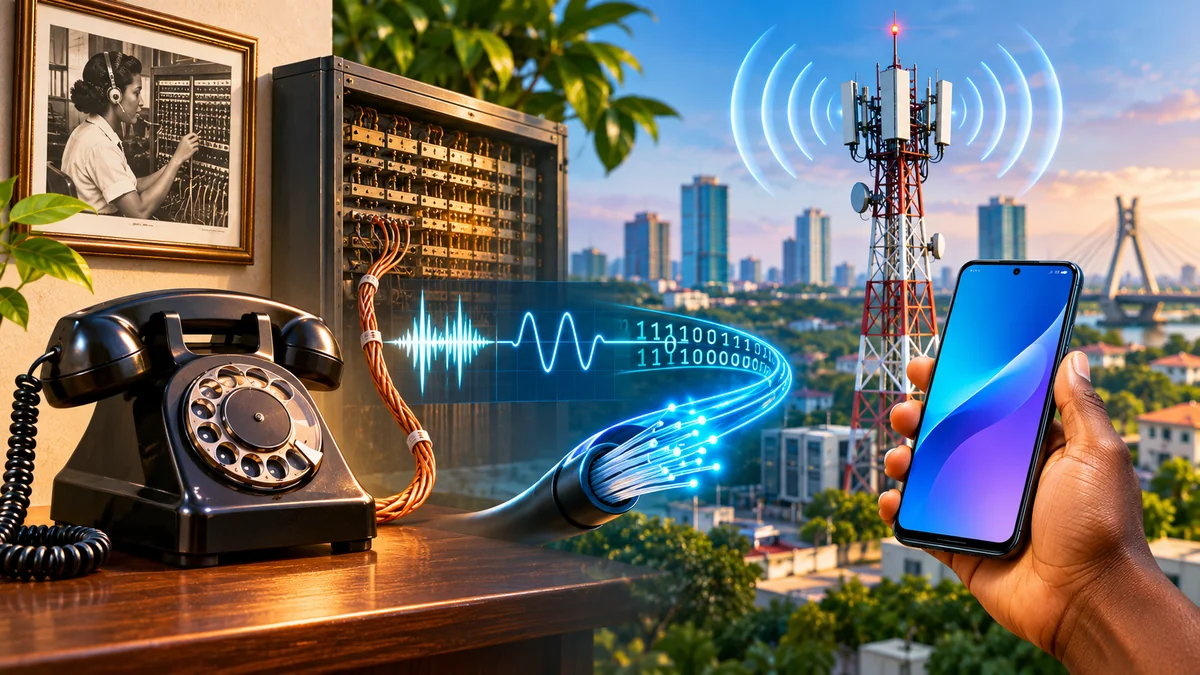
A telephone works by turning the sound of your voice into a signal, transporting that signal to another person, and turning it back into sound. That basic job has hardly changed since the nineteenth century. What has changed is the network: early instruments sent changing electrical currents through copper wire, while modern phones usually process speech digitally and may carry it through fibre-optic links, mobile radio networks or Internet Protocol (IP) connections.
When you speak, air-pressure vibrations reach a microphone. Electronics convert them into a signal representing your voice. Network equipment identifies where the call should go and transports the information. At the destination, a speaker recreates audible vibrations. The process takes place in both directions so that two people can hold a conversation.
Understanding how a telephone works, from landlines to mobile networks, means exploring sound waves, microphones, switching, radio transmission and today's 4G and 5G voice systems. This guide follows one spoken sentence all the way across a telephone network, using research from the Smithsonian , International Telecommunication Union , GSMA and other authoritative technical sources.
How a telephone works in five simple steps
- Sound is produced: Speaking makes air molecules vibrate in patterns corresponding to the sounds of words.
- A microphone detects the vibration: The handset converts the pressure changes into a varying electrical signal, which modern devices usually turn into digital information.
- The call is directed to its destination: A telephone exchange, mobile-network control system or internet-calling platform identifies the person or service being called.
- Voice information travels: Copper wires, fibre optics, cellular radio links and packet-based networks may carry different parts of the call.
- The destination reproduces sound: The receiving phone decodes the information and drives a speaker, producing pressure waves the listener can hear.
The caller and recipient do all this in both directions. The microphone does not need to send literal sound waves all the way through a cable or across the country. Instead, the system transports a representation of the sound.
The science behind sound: why microphones matter
A voice begins as sound waves—fluctuations in air pressure caused by moving vocal cords and shaped by the mouth and throat. These pressure changes make the delicate sensing element of a microphone move or respond electrically.
A transducer converts information or energy from one form to another. The microphone is a transducer from sound to an electrical signal. The earpiece or loudspeaker performs the reverse conversion, moving a small diaphragm that pushes surrounding air and recreates audible sound.
In early telephones, carbon microphones could use changes in electrical resistance to represent the vibration. Modern mobile handsets commonly use tiny microelectromechanical microphones and electronic processing. The underlying mechanisms differ, but both allow spoken words to become signals that circuitry can handle.
Consider the spoken word “hello”. The pattern of the sound wave is not a single steady tone: it is a complicated mixture of changing air pressures. A telephone system must preserve enough information about that pattern for a distant ear and brain to recognise the word. No telephone needs to preserve every characteristic of the original sound perfectly to make speech intelligible.
How the first telephones transmitted speech
The experiments that produced working electrical telephones took place during an era dominated by the telegraph, which sent coded electrical messages rather than carrying ordinary conversation. Alexander Graham Bell received US Patent 174,465 on 7 March 1876 and demonstrated an intelligible telephone message with Thomas Watson on 10 March 1876. Other inventors, including Johann Philipp Reis and Elisha Gray, worked on related ideas, so the invention's history is broader than one person acting alone.
The US Library of Congress describes Bell's successful patented design while acknowledging competing work. The Smithsonian's description of his 1876 telephone explains how speaking caused a diaphragm to vibrate, creating changes in an electrical current. At the receiving instrument, those changes drove a second diaphragm that recreated the sound.
Early devices had limited range and were sometimes difficult to hear. Better microphones, more reliable wiring, electrical amplifiers and organised telephone exchanges made telephony practical for ordinary businesses and households.
Why did telephone exchanges become necessary?
Imagine a village with 100 telephones. If every instrument required its own separate cable to every other telephone, the wiring would be expensive and difficult to manage. Instead, subscribers could each connect to a central telephone exchange, which would set up the required connection on demand.
Early human operators used switchboards and cables to connect callers manually. Later exchanges used electromechanical switching equipment and eventually digital computers. The fundamental idea is switching: recognising a destination number and arranging a suitable path or session.
Interconnected telephone exchanges and carriers form the public switched telephone network (PSTN). The PSTN is a logical public telephone service system, not necessarily a single uninterrupted copper wire. Modern telephone calls can pass through different technologies on the same journey.
What happens when you make a traditional landline call?
- You lift the handset: On a classic copper-wire system, taking the phone off-hook changes the local electrical circuit, alerting the exchange.
- The exchange provides a dial tone: This signals that it is ready to receive the number, although the exact behaviour varies by system.
- You dial the number: Older rotary telephones sent electrical pulses; push-button phones can send dual-tone multifrequency (DTMF) signals.
- The exchange selects a destination: The call may pass through one or more other exchanges or connected operators.
- The recipient's telephone rings: The destination side sends the appropriate incoming-call alert.
- Speech moves in both directions: Once answered, each phone converts speech and incoming signals throughout the conversation.
- The call ends: Hanging up releases network resources.
The physical connection from a home or business to the local exchange is often called the local loop. Traditional analogue landlines often used two copper conductors and received power from telephone-network equipment, meaning some such telephones could operate without separate mains power. However, newer services marketed as landlines may run over fibre or VoIP adapters and require powered routers, terminals or backup batteries.
The US Federal Communications Commission distinguishes traditional local-exchange service from interconnected VoIP even where both offer familiar telephone numbers.
How did telephones move from analogue signals to digital voice?
Analogue voice is represented as a continuously varying electrical pattern. Digital voice is represented by numbers. A common way to convert analogue speech into digital form is to take repeated measurements, called samples, and assign coded values to those measurements.
For example, the classic ITU-T G.711 pulse-code modulation (PCM) standard represents narrowband telephone speech using 8,000 samples each second, with 8 bits for each encoded sample. This produces an encoded voice bit rate of 8,000 × 8 = 64,000 bits per second, or 64 kbit/s.
That figure applies to the classic G.711 encoded signal. It is not the data consumption rate of every 4G call or app call: modern codecs can compress sound differently, while network packets also contain overhead.
Once digitised, many conversations can share high-capacity fibre-optic and other digital transport systems. Fibre carries optical pulses or other modulated light signals that represent information. Digital switching makes it easier to combine large volumes of communication traffic and connect many destinations without a dedicated separate long-distance copper pair for every conversation.
How does a mobile phone work without being connected by a wire?
Instead of needing a fixed cable to reach the nearest exchange, a cellphone transmits data over radio-frequency electromagnetic waves. The International Telecommunication Union calls a mobile handset a low-power, two-way radio with both a transmitter and a receiver. It exchanges information with a base station, which connects to the mobile operator's larger network.
Your words do not simply fly as ordinary audible sound to a tower. The phone's microphone and processing chips encode speech into information, and its radio and antenna send signals that the cell-site equipment can interpret.
Why are they called cellular networks?
A mobile operator divides its coverage area into many cells, each supported by radio equipment at a base-station site. Those antennas might be on tall towers, rooftops, street furniture or indoor systems. Actual radio coverage is irregular; the hexagon shapes often shown in textbooks are diagrams, not literal boundaries on the ground.
Cells allow radio frequencies and capacity to be managed across a geographic area. The network monitors coverage conditions and allocates radio resources, while the handset measures nearby signals. A phone generally communicates with a suitable serving cell rather than trying to reach every other subscriber directly.
What role does the SIM or eSIM play?
A SIM or eSIM profile supports identification and authentication of the mobile subscription. It helps the operator establish that a device is entitled to register for particular services. It does not act as the microphone, speaker or radio antenna, and it is not the component that physically carries a person's voice across the air.
Follow a mobile phone call from beginning to end
Suppose a caller using an eligible mobile network rings someone using another cellular service. The exact network implementation depends on the technology and operators, but the broad sequence is:
- Calling begins: The handset submits the intended telephone number and requests a call using appropriate mobile-network signalling.
- The network checks the request: The subscriber's service permissions and destination information are assessed.
- The receiving user is located: Network systems direct an incoming-call notification to the serving area of the receiving handset.
- The recipient answers: The network establishes the necessary speech path or packet-based media session.
- The microphones capture both voices: Each phone converts sound into electronic information and encodes it for transmission.
- Radio and network connections carry the voices: Information travels from each phone to its serving base station and onward through connected transport and core systems.
- Speakers reproduce the conversation: Each device receives and decodes the incoming speech and converts it back into sound waves.
After the brief radio hop between handset and tower, the rest of the route may use fibre-optic cables, microwave backhaul or other wired and wireless network links. Most of the distance between two mobile callers is not necessarily carried over radio through open air.
What changed between 2G, 3G, 4G and 5G?
| Technology | How conventional carrier voice is handled | What makes it different? |
|---|---|---|
| 2G | Digital speech through predominantly circuit-switched voice services | Digital cellular voice and wider mobile adoption |
| 3G | Often circuit-switched voice alongside packet data | Improved data services with older voice switching still used |
| 4G LTE | VoLTE on supported networks, or supported fallback to earlier systems | Carrier calls can use IP-based, packet-switched networks |
| 5G | VoNR on supported standalone networks, or 4G VoLTE/fallback arrangements | Native 5G packet voice is possible but not universal |
Ericsson's technical overview explains the change from circuit-switched 2G and 3G calling to packet-based Voice over LTE (VoLTE) and Voice over New Radio (VoNR). Some older networks remain in service, while others are being retired; availability varies by country and provider.
What is VoLTE?
VoLTE is Voice over Long-Term Evolution. It allows a regular carrier voice call to operate over a suitable 4G LTE connection using a managed IP-based service and systems such as the IP Multimedia Subsystem (IMS). Benefits can include quicker call setup, improved voice clarity and more efficient integration with mobile data, depending on the network and device.
The GSMA implementation guide describes VoLTE's IMS-based approach and service-continuity techniques. It should not be confused with making a call inside an unrelated messaging app: a normal VoLTE call generally retains the mobile operator's familiar telephone-number experience.
Does a 5G icon guarantee a 5G voice call?
No. A supported 5G standalone deployment can use Voice over New Radio (VoNR). Other 5G configurations may use 4G VoLTE for voice or temporarily move the phone to LTE using EPS fallback. Thus, a device may display 5G for data without using VoNR for its conventional phone calls. Ericsson's 5G voice guide describes these different deployment arrangements.
How does a mobile phone call a landline?
Telephone providers connect their systems using interconnection equipment and signalling arrangements. If someone calls an ordinary fixed-line number from a cellphone, the mobile network routes the call towards the fixed network. That network then delivers it to the relevant customer, whether the final connection uses analogue wiring, a digital exchange or an IP telephone adapter.
Network gateways can translate between different audio formats and signalling protocols where necessary. The subscriber need not know the technology at the other end; compatible networks handle the required interworking.
How do internet calls and Wi-Fi calling differ?
With Voice over Internet Protocol (VoIP), speech is encoded into information carried in IP packets. Those packets travel over internet or other IP networks to the receiving device or provider, where they are decoded and played. Some services connect app accounts; other interconnected VoIP services also reach ordinary telephone numbers.
Carrier Wi-Fi calling is different from an ordinary app-to-app call. Where supported, it allows the carrier's normal phone service to use Wi-Fi as the connection into the operator's voice platform. A supported phone can still use its regular number, but account charges, emergency calling and movement between Wi-Fi and cellular networks depend on the provider.
What affects call quality and why do calls drop?
The quality of a phone conversation depends on the whole path, not just the microphone. Important factors include:
- Microphone and speaker quality: weak microphones, damaged speakers, strong background noise and aggressive noise suppression reduce clarity.
- Radio coverage: distance, walls, terrain and interference can weaken the connection.
- Network congestion: too many users or limited backhaul capacity can interfere with data and voice performance.
- Codec and audio settings: different algorithms preserve different amounts of speech detail at different data rates.
- Delay and jitter: long or inconsistent travel times for voice packets can create awkward pauses or gaps.
- Packet loss: lost audio packets can produce robotic or interrupted sound.
- Unsuccessful handover: a moving phone may lose the call when it cannot smoothly move from one cell or supported technology to another.
Modern digital voice can sound much clearer than narrowband analogue calling, but even advanced handsets cannot compensate for every network problem. For broader context about infrastructure and connectivity, SuperEducational has an existing article on factors affecting internet quality across Latin American regions . Its geography is different, but the general ideas of congestion, coverage and backhaul are relevant.
Do most mobile phone calls use satellites?
No. An ordinary cellphone typically sends information to a terrestrial base station, not directly to a satellite in orbit. The wider call often travels through terrestrial networks and undersea fibre. Dedicated satellite phones and newer satellite-connected mobile services exist, but they are different products and may have coverage or device limitations.
In July 2026, the ITU reported that undersea telecommunications cables carry more than 99% of global data traffic. That statistic describes worldwide data traffic rather than the exact percentage of ordinary telephone calls carried by cables.
Why can you keep talking while travelling?
As a phone moves, the strength and quality of signals from nearby cells change. Mobile networks can coordinate a handover, transferring the connection to another suitable base station or radio channel while the conversation continues.
Handover is not guaranteed to succeed. It can fail in weak coverage, underground areas, crowded cells or when the device and network do not support an appropriate transfer. The result can be distorted audio or a dropped call.
Classroom activity: make a paper-cup telephone
A simple string telephone demonstrates the transfer of sound-related mechanical vibrations. It is not a working electrical or radio telephone, but the analogy is useful for younger learners.
- Take two clean paper cups and a length of string. Have an adult make a small hole in the base of each cup.
- Thread an end of the string through each cup and secure both ends with knots.
- Stand far enough apart that the string is gently taut and not touching other surfaces.
- Speak softly into one cup while a partner listens at the other.
- Repeat with loose string and compare what happens to the sound.
Speaking causes the cup's base to vibrate. The taut string carries mechanical vibrations that make the second cup move and produce sound waves. In an actual telephone, electronics and communication networks carry a representation of speech instead of relying on the mechanical vibration of a string.
Safety: Do not connect homemade circuits to telephone sockets, tamper with mains-powered devices or climb communication towers. The cup-and-string experiment requires no electrical connections.
Frequently asked questions
How does a phone convert speech into electricity?
A microphone responds to sound-pressure variations and turns them into a corresponding electrical signal. Modern phones generally digitise and encode that signal before transmission.
How does an old landline phone work without a charger?
Many classic analogue copper telephone lines supplied operating power from network equipment. Modern VoIP or fibre-based landline products may depend on powered routers, terminals or adapters, so service during a local power cut depends on backup arrangements.
Does a mobile phone send sound directly to the nearest tower?
No. It sends encoded information using radio-frequency electromagnetic signals. The tower's radio equipment connects this link to the wider telecommunications network.
What is the difference between VoLTE and VoNR?
VoLTE is a managed carrier voice service over compatible 4G LTE networks; VoNR supports carrier voice over suitable 5G standalone networks and radio equipment. Some 5G phones use 4G voice rather than VoNR.
How can a call travel to another country so quickly?
Interconnected operators route the call through high-capacity networks, often using fibre-optic transport, with radio used near mobile endpoints. Electronic and optical signalling can transport information rapidly over long distances.
Why does a phone have mobile data but no calling service?
Carrier voice needs its own supported service, configuration and network features. A device may have mobile data without suitable VoLTE, VoNR, voice registration or fallback support. Account and network problems can also cause this mismatch.
Who invented the telephone?
Alexander Graham Bell received a famous telephone patent on 7 March 1876 and demonstrated intelligible speech transmission on 10 March. The wider development involved other inventors and later improvements.
The bottom line
From an early copper-wired instrument to today's 5G-capable smartphone, a telephone's essential job is to capture sound, represent it as a transferable signal, find the intended listener, and reconstruct the sound at the other end.
Telephone exchanges made large-scale calling practical. Digitisation and fibre increased capacity. Cellular networks replaced the fixed subscriber wire with a radio link, and newer mobile generations increasingly handle speech as managed IP traffic. Once you understand those building blocks, the journey from a landline to a mobile network becomes much easier to explain.
Research verified on 16 November 2026. The precise route of a telephone call varies by provider, country, device and network generation. This article simplifies technical details for educational clarity without implying that all 5G calls use VoNR or that most mobile calls travel via satellites.