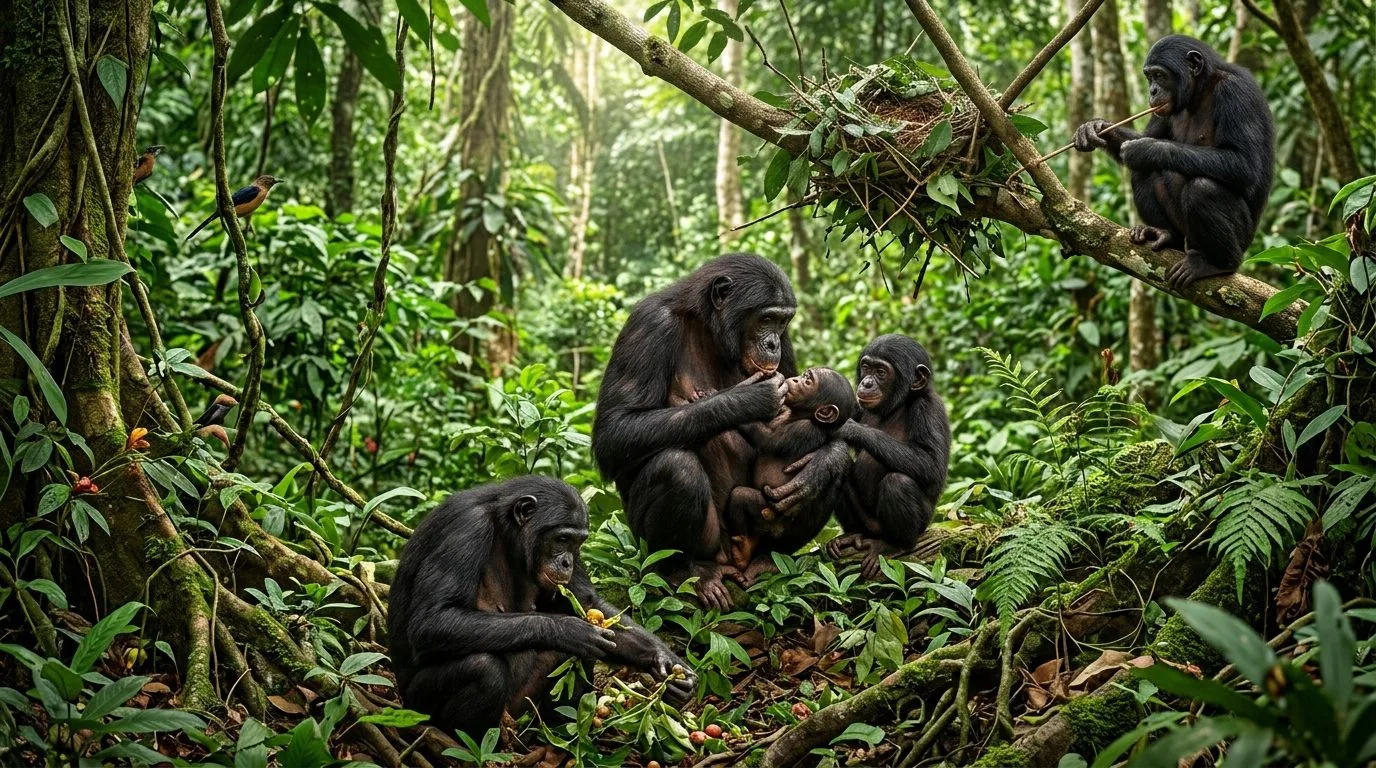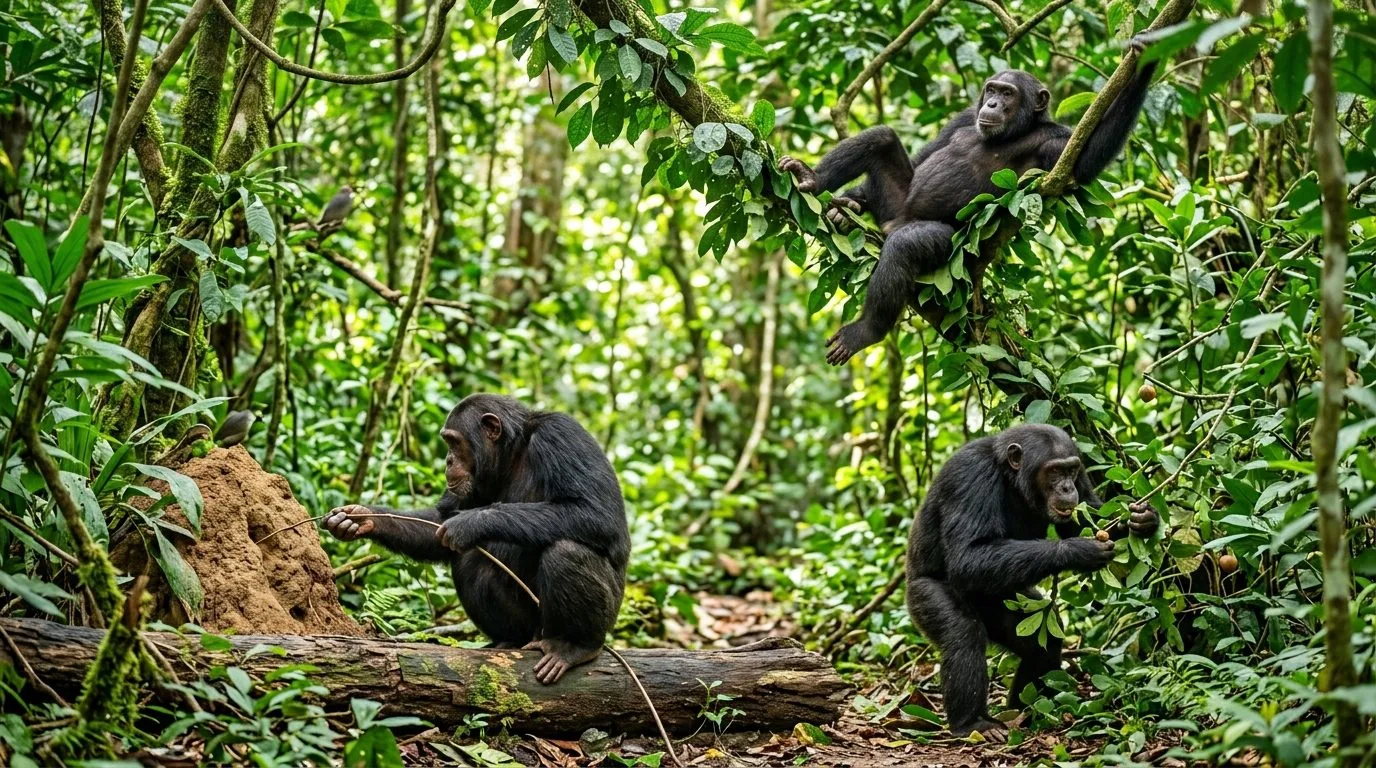
Chimpanzees vs bonobos: what is the difference? Chimpanzees (Pan troglodytes) and bonobos (Pan paniscus) are two distinct species of great ape and our closest living evolutionary relatives. They share many features—high intelligence, strong mother–offspring relationships, flexible social communities and fruit-rich diets—but differ in their geographic ranges, body proportions, social alliances, patterns of conflict and the types of tools commonly observed in the wild.
The most familiar comparison says that chimpanzees are aggressive while bonobos are peaceful. That stereotype is scientifically misleading. A 2026 study of 22 zoo-housed groups found no clear overall difference in aggression rates between the two species, although the sex of the animals directing and receiving aggression differed. Studies of wild communities also report variation, and bonobos have sometimes been involved in severe violence. The useful question is not which species is “good” or “bad”, but how and why their social systems differ.
This article compares the apes using field observations, controlled studies and conservation evidence. It explains where the data are strong, where findings depend on the population studied, and why neither species should be treated as a simple model of human behaviour. Relevant sources include the chimpanzee and bonobo species factsheets from the Wisconsin National Primate Research Center, alongside the latest comparative research.
Chimpanzees vs bonobos: side-by-side comparison chart
| Feature | Chimpanzees | Bonobos |
|---|---|---|
| Scientific name | Pan troglodytes | Pan paniscus |
| Wild range | Several countries across West, Central and East Africa | Only the Democratic Republic of the Congo, mainly south of the Congo River |
| Body proportions | Often more robust, with relatively shorter legs | Often more slender with proportionally longer legs; substantial overlap |
| Social organisation | Multi-male, multi-female fission–fusion communities | Multi-male, multi-female fission–fusion communities |
| Influential alliances | Male alliances often influential; females also form important bonds | Female coalitions often influential; individual ranks vary |
| Aggression | Documented male coercion and sometimes lethal intergroup aggression | Aggression also occurs; patterns and targets differ, with rare lethal outcomes documented |
| Outside-group interactions | Territorial hostility well documented, though context varies | Some communities show tolerance and cooperation with neighbours |
| Wild tool use | Diverse and often used for feeding, such as termite fishing and nut cracking | Documented but generally less frequent; many cases involve non-feeding contexts |
| Diet | Mostly fruit and plants; insects and variable hunting or meat-eating | Mostly fruit and plants; insects and occasional vertebrate foods |
| Reproduction | Usually one infant; years of maternal dependence | Usually one infant; years of maternal dependence |
| Conservation status | Endangered as a species; western subspecies Critically Endangered | Endangered |
These are population-level tendencies, not traits guaranteed in every individual. As the 2023 comparative study of co-feeding tolerance found, different groups within each species can show more variation than the simple two-species stereotype predicts.
1. Are chimpanzees and bonobos the same species?
No. Both belong to the genus Pan and family Hominidae, along with humans and other great apes, but they are separate species. The common chimpanzee is Pan troglodytes; the bonobo is Pan paniscus. The older name “pygmy chimpanzee” for the bonobo is often avoided because it incorrectly suggests that bonobos are merely small versions of chimpanzees.
The two species share an evolutionary ancestor and relatively similar genomes. The bonobo genome study published in Nature investigated their genetic relationships and geographical history. Genetic resemblance is not evidence that one living species evolved from the other, nor should it be taken to mean the species behave identically.
Humans share older common ancestors with both bonobos and chimpanzees. Scientists cannot confidently reconstruct the social life of those ancestors merely by choosing modern chimpanzees as the “aggressive ancestor” or modern bonobos as the “peaceful ancestor”. Traits could have changed along either lineage. For a foundation in animal taxonomy, see SuperEducational's animal-classification guide .
2. Where do chimpanzees and bonobos live?
Geography is one of the clearest differences. Wild chimpanzees occupy a fragmented range across western, central and eastern Africa, from forest and woodland mosaics to some savanna landscapes. They are divided into four commonly recognised subspecies: western, central, eastern and Nigeria–Cameroon chimpanzees. Different subspecies face different conservation pressures.
Wild bonobos, by contrast, occur only in the Democratic Republic of the Congo, largely in the forested region south of the Congo River. The Congo and associated river systems have helped limit movement between the ranges, and geography may have contributed to the species' evolutionary separation. For distribution context see the WWF bonobo guide and the Wisconsin chimpanzee factsheet .
It is inaccurate to imagine that the Congo River alone explains every biological difference between them. Food distribution, habitat change, historical isolation, social learning and evolutionary processes may all matter. Scientists continue to test how these factors interact.
3. Can you tell a bonobo from a chimpanzee by its appearance?
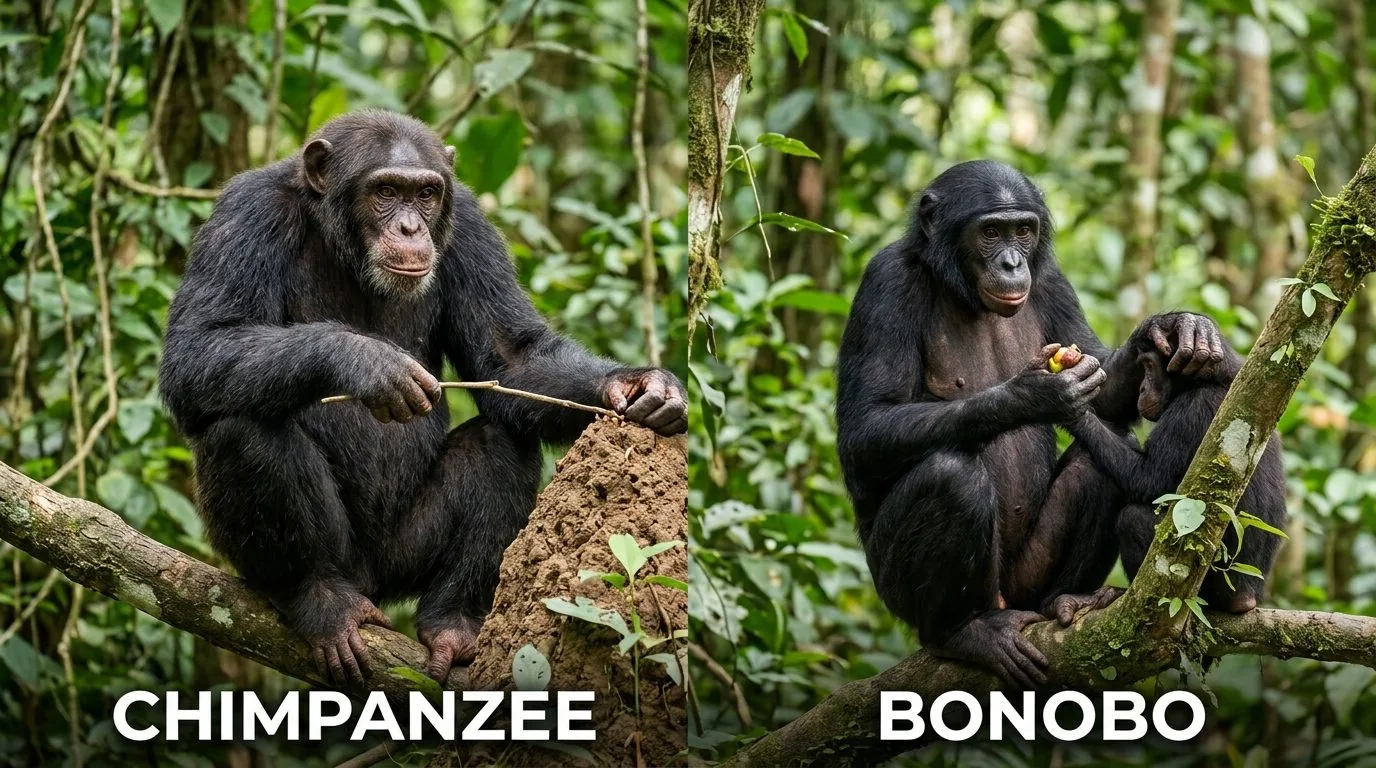
They are closely related and can look similar in photographs, but several tendencies help distinguish them.
Bonobos often have a more slender build, proportionally longer legs, a relatively small head and dark facial skin from an early age. Chimpanzees are often more robust, with relatively greater muscular development in some body regions and facial features that can change with age. A bonobo's head hair may form a distinctive parting, although hairstyles are not reliable biological identification criteria.
A comparative anatomical study found differences in the distribution of body mass and some proportions, while also showing that many apparently large differences become smaller after body size is accounted for. There is extensive overlap in height, body mass and posture. Being smaller or having longer legs alone is not proof that an ape is a bonobo.
Age, sex, condition and camera angle also influence appearances. A confident identification should consider several features, the animal's verified origin and the judgement of experienced specialists.
4. How are their social groups organised?
Both species live in multi-male, multi-female communities with fission–fusion dynamics. This means members of a larger community frequently divide into smaller travelling or feeding parties and later come together again. Group membership, party size and time spent together can change with food, relationships, mating opportunities and risk.
In both species, males often remain in their natal community, while females more commonly transfer between communities as they mature. Yet the political and social consequences of these shared patterns are not identical.
Chimpanzees: male alliances often shape power
In many well-studied chimpanzee communities, males form coalitions that influence competition, dominance rank, territory defence and access to partners. Individual males can cooperate closely with others while also competing for status. Females form substantial relationships too, and their influence should not be ignored. Neither every chimpanzee male nor every group behaves in the same way.
Bonobos: female alliances can limit male power
Bonobo females, including females that are not close relatives, can form strong alliances. These coalitions may affect access to food, reduce male coercion and give females high social influence despite males often being physically larger. A 2025 study in Communications Biology found that female bonobos directed 85% of observed coalitionary actions against males, and female power tended to be stronger where female coalitions were more frequent.
The phrase “bonobo matriarchy” can be a shorthand, but it should not suggest that every female outranks every male or that every bonobo community has exactly the same hierarchy. Social relationships differ among groups and over time.
5. Which species is more aggressive? What 2024–2026 research says
There is no simple scientific answer that chimpanzees are always more aggressive. The answer depends on which acts count as aggression, which individuals are involved and whether researchers are observing wild groups or animals in human care.
2024 field study: who directs aggression matters
A 2024 Current Biology comparison analysed 14 community-years of observation from three bonobo communities at Kokolopori in the DRC and two chimpanzee communities at Gombe in Tanzania. It reported higher rates of aggression by male bonobos against other males in the sampled populations, while male chimpanzees directed more aggression toward females. Female-to-male aggression was more common among bonobos. This challenged the notion that male bonobos are necessarily milder in all interactions.
2026 multi-zoo study: no overall difference in rates
A March 2026 study in Science Advances compared 22 groups—13 bonobo and nine chimpanzee groups—housed at 16 European locations. After adjusting for group size and sex ratio, the researchers did not detect a clear species-level difference in overall aggression or contact aggression. Instead, female-to-male aggression was more characteristic of bonobo groups, and male-to-female aggression was more characteristic of chimpanzee groups.
These results are informative, but zoo group dynamics cannot automatically be generalised to every wild community. Housing, food availability, group composition and human management differ from natural environments. The findings also revealed strong group-to-group variation.
Does violent conflict ever occur among bonobos?
Yes. A 2025 report in Current Biology documented a severe female coalitionary attack on a male bonobo. A 2026 Scientific Reports paper described an intergroup encounter in which an infant bonobo was taken and later died, showing that encounters can have lethal outcomes. A rare observation is important evidence that an outcome is possible, but it does not establish that the event is common or equivalent in frequency to documented chimpanzee intergroup killing.
The most defensible conclusion is that the form, target, severity and social context of aggression differ. Comparing only total aggressive acts, or only the most extreme events, misses this complexity.
6. Do bonobos cooperate more with neighbouring communities?
Some wild bonobo communities show a striking capacity for tolerance and cooperative interactions across community boundaries. A 2023 study in Science documented patterns of grooming, food sharing and coalition formation between members of different bonobo groups. Individuals who cooperated within their groups could also form cooperative relationships with outsiders.
Chimpanzee communities often show strong territoriality, and lethal intergroup attacks have been documented. However, chimpanzees are not incapable of cooperation: they form close alliances within groups, sometimes work together during hunts and engage in a wide range of affiliative behaviour.
Neither species should be labelled universally welcoming or hostile. Observations of tolerant bonobo encounters coexist with evidence of bonobo intergroup aggression. Research on co-feeding tolerance in 16 managed groups also found that some chimpanzee groups were more tolerant than some bonobo groups, highlighting the importance of comparing communities, not stereotypes.
7. How do their diets compare?
Both bonobos and chimpanzees are omnivorous great apes with diets dominated by fruit and other plant matter. They consume different leaves, shoots, seeds, pith and other vegetation depending on the local forest and season. Both can also eat insects and occasional vertebrate prey.
Chimpanzee hunting—particularly of certain monkey species—has been extensively studied at research sites such as Gombe, Taï and Ngogo. Hunting practices, success and meat sharing vary among chimpanzee communities. Bonobos also consume animal foods, including small vertebrates in some field observations; they are not strict vegetarians.
Thus, “chimpanzees eat meat; bonobos eat plants” is incorrect. A more useful comparison asks what proportion of their diet comes from each source in a particular community and season. Changes in fruit availability or habitat can affect foraging time, social grouping and ecological roles. Both species may disperse seeds as they move through forests.
8. Which species uses more tools?
Wild chimpanzees are among the best-documented nonhuman tool users. Depending on location, they use plant stems to fish for termites, hammers and anvils to crack nuts, and other objects to obtain food or water. Different groups preserve distinctive tool traditions.
Wild bonobo tool use is documented but is generally less frequent and less often directed toward extracting food. Many reports involve comfort, play, communication or self-directed behaviour. A 2024 case study recorded a bonobo using a tool to scoop water in the wild, illustrating why it would be wrong to claim that bonobos cannot use tools.
Importantly, tool frequency is not the same as intellectual capacity. A 2026 iScience study reported bonobos in a semi-naturalistic managed setting innovating and socially transmitting solutions to an extractive-foraging task. Researchers must distinguish a species' ability to solve a problem from the ecological and social reasons why a particular solution appears in the wild.
9. Are chimpanzees smarter than bonobos?
There is no scientifically defensible single IQ ranking that declares one species universally smarter. Both show memory, complex social learning, communication, behavioural flexibility and problem-solving. One group may perform better in a particular task because of experience, motivation or the relevance of the challenge to its usual environment.
Chimpanzees are celebrated for complex wild tool traditions. Bonobos have attracted research interest for aspects of social tolerance, communication and cross-group cooperation. But intelligence is not a contest with one score. The two species present different opportunities for studying cognition, and the available test sample may be biased by the number of animals and communities researchers can access.
A good comparison asks precisely what researchers measured: for example, tool manufacture, recall of a location, willingness to share food or interpretation of another individual's gesture. The result should then be reported for the studied group and task rather than transformed into a permanent universal ranking.
10. Do they communicate and form relationships differently?
Both species use calls, facial expressions, gestures, touch, posture and body movement in social life. Chimpanzees communicate with pant-hoots, other calls and gestures; bonobos also have complex vocal and gestural repertoires. Both groom companions, play and maintain long-term bonds.
Bonobo social behaviour often receives attention for adult play and non-reproductive sexual contact, which can be involved in relationships and some tension-management situations. But bonobo relationships cannot be explained by sexuality alone, and chimpanzees also use diverse affiliative and reconciliation behaviours. Neither communication system is simply equivalent to human spoken language.
In both species, mothers play an important role as their offspring develop. Infants depend on years of care, proximity and opportunities to observe adult behaviour. Because social learning shapes how individuals use their environment, losing experienced adults can have effects that extend beyond a simple reduction in population size.
11. Are chimpanzees or bonobos more endangered?
Both species are classified as Endangered. However, their risks are not identical. Bonobos have a smaller, geographically restricted distribution in the DRC, while chimpanzees occupy a wider but heavily fragmented range across several African countries. At the subspecies level, western chimpanzees are Critically Endangered.
| Conservation challenge | Chimpanzees | Bonobos |
|---|---|---|
| Habitat loss | Forest clearing, agricultural expansion, logging and fragmentation across several countries | Forest conversion, infrastructure and fragmentation within the DRC |
| Hunting and trafficking | Direct killing, snares and illegal capture of young | Hunting, snares and illegal live-animal trade |
| Disease | Infections within communities and potential transmission involving people | Similar disease risks, compounded by limited monitoring in some forests |
| Conservation response | Regional action plans, habitat corridors, protected areas and community partnerships | DRC forest protection, anti-poaching work, community-led projects and monitoring |
Both reproduce slowly, so local population losses may take many years to reverse. Conservation planning must respect local communities, support habitat protection and limit risky human–ape contact. See WWF's chimpanzee profile and bonobo profile . Whole-range population estimates should include a survey date, geographic coverage and uncertainty rather than be presented as timeless exact totals.
12. What do these apes tell us about human evolution?
Chimpanzees and bonobos are both close living relatives of humans, but neither species is a direct model of the human ancestor. Shared traits may reflect ancient characteristics; differences may arise from changes along either evolutionary branch. Researchers therefore compare several species, fossils, genetics and ecological histories to investigate human origins.
It is especially tempting to use chimpanzee conflict to argue that human violence is inevitable—or bonobo cooperation to argue that humans are naturally peaceful. Both conclusions are unsupported shortcuts. Human social behaviour has its own cultural, economic, ecological and historical complexity. The bonobo genome research cautions against reconstructing ancestral social behaviour from modern comparisons alone.
The deeper contribution of studying both species is a better understanding of how social alliances, cooperation, conflict, learning and ecology interact in closely related great apes.
Research comparison: four findings students should interpret carefully
| Study | What was investigated | Key limit |
|---|---|---|
| 2024 Current Biology | Male aggression in five wild communities across the two species | These communities do not represent every wild group |
| 2025 Communications Biology | Female coalitions and female social power in bonobos | Alliance patterns and rank vary among communities |
| 2026 Science Advances | Aggression across 22 zoo groups | Zoo conditions differ from the wild; group variation was substantial |
| 2026 Scientific Reports | A rare lethal outcome during a bonobo intergroup encounter | A case study establishes possibility, not how often it happens |
These results do not contradict one another merely because they measure different things. Overall aggression, aggressive targets, coalitionary violence and lethal outcomes are distinct outcomes. A cautious scientist asks which behaviour was measured, who was observed and what comparison is justified.
Common myths: chimpanzees vs bonobos
| Myth | More accurate explanation |
|---|---|
| “Bonobos are just smaller chimpanzees.” | They are a distinct species with overlapping body sizes. |
| “Bonobos never become violent.” | False; serious aggression and rare lethal outcomes have been documented. |
| “Chimpanzees never cooperate.” | False; they form alliances, groom, share some foods and may cooperate during hunts. |
| “All bonobo females rule over all males.” | Female alliances are influential, but rank and power vary by group. |
| “Bonobos cannot use tools.” | Wild and managed tool use has been recorded; frequency and functions differ. |
| “Bonobos never eat animals.” | They are omnivores and sometimes consume animal foods. |
| “One species is smarter than the other.” | No single cognitive ranking is justified across every task. |
| “Humans evolved from modern chimpanzees.” | Humans share common ancestors with both species. |
Frequently asked questions
What is the biggest difference between chimpanzees and bonobos?
Geography is unambiguous: wild bonobos are restricted to the DRC south of the Congo River, whereas chimpanzees live across several African countries. Social differences often include more prominent male alliances in chimpanzees and more prominent female coalitions in bonobos, but there is variation.
Are bonobos more peaceful than chimpanzees?
Not in every sense. Some bonobo groups show relatively tolerant intergroup relations, but aggression occurs in both species. A 2026 comparison of zoo-housed groups found no clear difference in overall aggression rates, while the sex-related targets of aggression differed. This does not establish identical violence patterns in the wild.
Can bonobos and chimpanzees be distinguished by their faces?
Bonobos generally have dark faces from an early age, often finer hair and relatively slender proportions; chimpanzee features vary with age and individual. Appearance alone, especially a single photograph, can be misleading.
Do bonobos and chimpanzees eat the same food?
Their diets overlap: both eat fruit, other plants and some animal foods. Local vegetation, season, ecology and learned feeding practices influence what particular communities eat.
Which species is better at using tools?
Chimpanzees display a larger and more frequently observed repertoire of wild food-gathering tools. Bonobos can nevertheless innovate and learn tool-use solutions, including in managed research settings. Tool frequency is not equivalent to overall intelligence.
Do bonobos have female leaders?
Female alliances often give bonobo females substantial influence, including in interactions with males. Leadership and dominance differ across groups, and it would be misleading to say every bonobo community is controlled by one female.
Are chimpanzees and bonobos both endangered?
Yes. Both are Endangered at the species level. The western chimpanzee subspecies is Critically Endangered. Their limited reproduction and the continuing pressures of habitat loss, hunting, disease and trafficking make conservation urgent.
Are chimpanzees and bonobos the closest living relatives of humans?
Yes. Both belong to the genus Pan and are our closest living relatives, reflecting shared evolutionary ancestry. Neither is an ancestor of humans alive today.
Conclusion: related great apes, different social histories
Chimpanzees and bonobos share close evolutionary ancestry, rich social lives, intelligence and forest-dependent diets. Their most reliable differences include their ranges, some body proportions, the relative importance of male and female coalitions, and patterns of cooperation and tool use in studied populations.
The research also demands humility. “Aggressive chimpanzee versus peaceful bonobo” is not a scientifically adequate summary: conflict has different forms and targets, and findings vary with communities and research methods. Studying both species on their own terms reveals more than choosing one as the ideal model for people—and protecting both means preserving their habitats, relationships and opportunities to learn.
References and further reading
- Wisconsin National Primate Research Center — Chimpanzee Factsheet
- Wisconsin National Primate Research Center — Bonobo Factsheet
- Nature — The Bonobo Genome Compared with the Chimpanzee and Human Genomes
- Journal of Anatomy — Segmental Morphometrics of Bonobos and Chimpanzees
- Current Biology (2024) — Differences in Expression of Male Aggression
- Communications Biology (2025) — Drivers of Female Power in Bonobos
- Science Advances (2026) — Chimpanzees Are Not More Aggressive Than Bonobos but Target Sexes Differently
- Scientific Reports (2026) — A Lethal Incident During an Intergroup Encounter in Bonobos
- Science (2023) — Cooperation Across Social Borders in Bonobos
- iScience (2023) — Group-Specific Expressions of Co-feeding Tolerance
- Primates (2024) — Water Scooping: Tool Use by a Wild Bonobo
- iScience (2026) — Bonobos Innovate, Plan and Transmit Tool Use
- WWF — Chimpanzee
- WWF — Bonobo