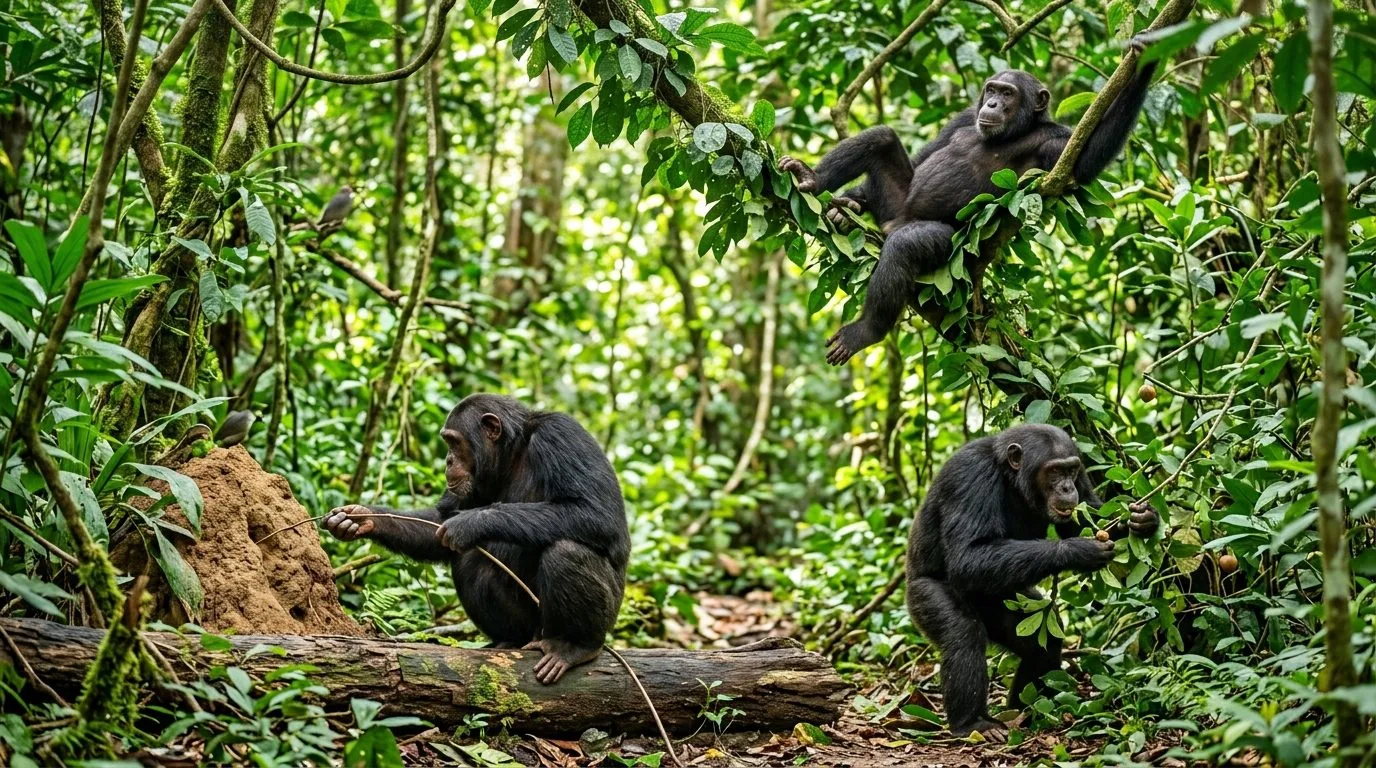
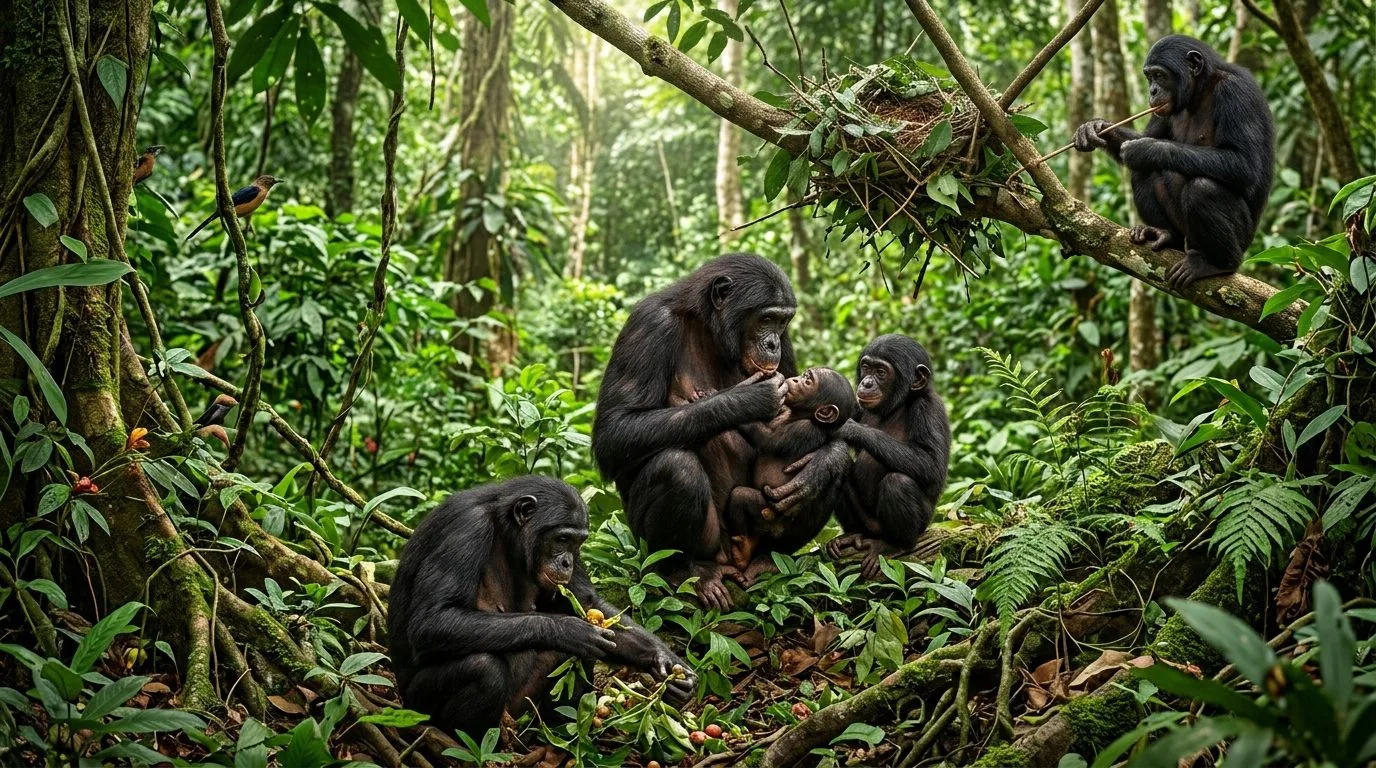
Bonobos are intelligent, highly social great apes that live in the tropical forests of the Democratic Republic of the Congo (DRC). Known scientifically as Pan paniscus, they are close relatives of chimpanzees and humans. Bonobos eat mainly fruit and other plant foods, form flexible communities, communicate with calls and gestures, and build relationships that can extend beyond their own social groups. They are often described as unusually peaceful, but research shows a more complex picture involving cooperation, female alliances, competition and occasional serious aggression.
Where do bonobos live, what do they eat, and how intelligent are they? Their wild range lies south of the Congo River in the DRC; their diet is largely fruit supplemented by leaves, shoots, seeds, insects and occasional animal foods; and their cognitive abilities include social learning, planning and problem-solving. Scientists have also documented tool use, although it is much less frequently observed in wild bonobos than in wild chimpanzees. Bonobos are currently classified as Endangered, and protecting their remaining habitat is central to their survival.
This guide draws on the Wisconsin National Primate Research Center's bonobo account , the World Wildlife Fund , the San Diego Zoo Wildlife Alliance and peer-reviewed studies through 2026. It explains both what researchers have established and what remains uncertain.
Bonobo facts at a glance
| Feature | What the evidence shows |
|---|---|
| Scientific name | Pan paniscus |
| Classification | Mammal; primate; great ape (family Hominidae) |
| Native country | Democratic Republic of the Congo only |
| Habitat | Lowland tropical forests, swamp forests and some forest–savanna mosaics |
| Diet | Omnivorous, predominantly fruits and other plant foods |
| Social structure | Fission–fusion communities; influential female alliances |
| Intelligence | Social learning, memory, cooperation, problem-solving and some tool use |
| Gestation | Approximately eight months; usually one infant |
| Lifespan | Several decades, depending on individual and setting |
| Conservation status | Endangered |
Bonobos are not a uniform population. Research findings vary across wild communities, managed groups and different ecological conditions. Some famous bonobo traits have been studied mainly at a few sites, so broad statements about every individual require caution.
1. What is a bonobo? Is it the same as a chimpanzee?
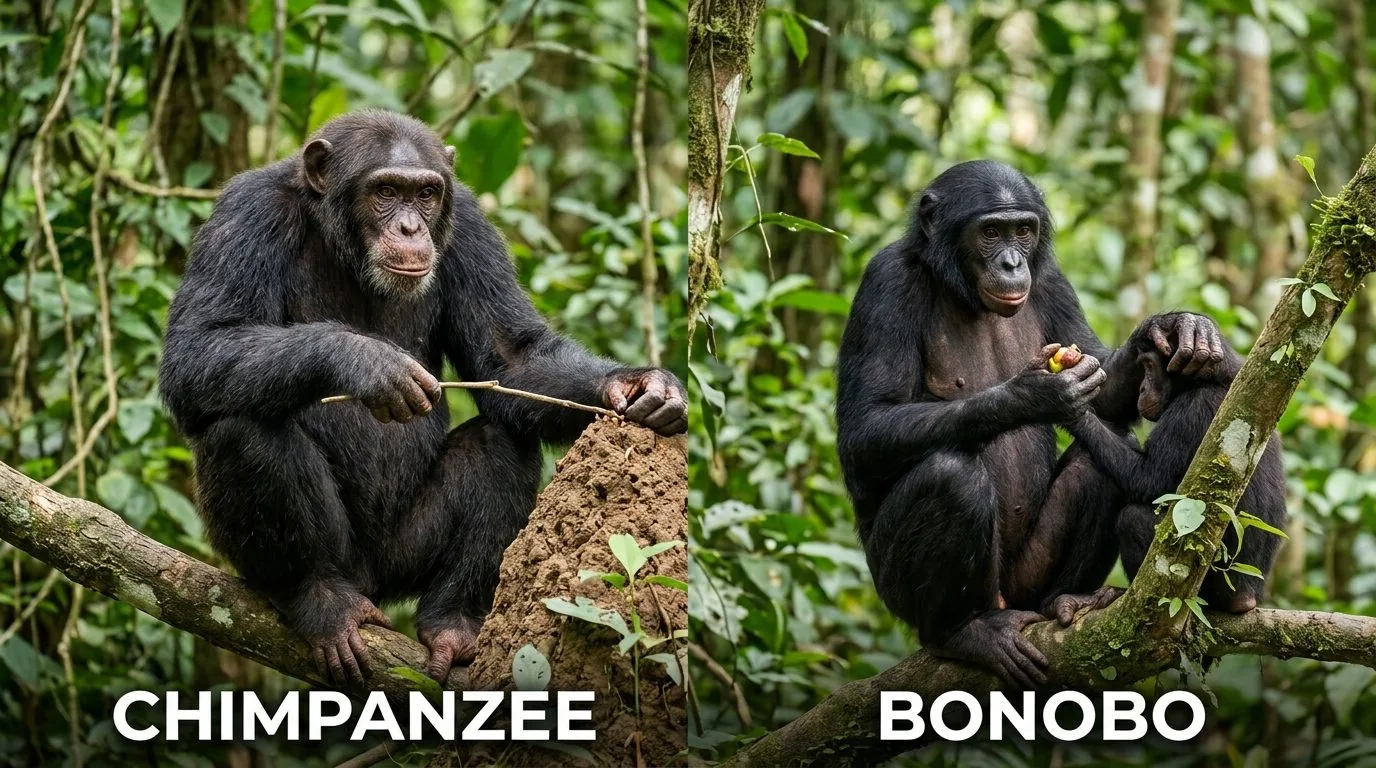
Bonobos and common chimpanzees belong to the same genus, Pan, but they are different species: Pan paniscus and Pan troglodytes. Bonobos were once widely called “pygmy chimpanzees”. That name is misleading because the two species have overlapping adult body sizes. Bonobos often have a more slender build, relatively long legs, black faces from infancy and a characteristic appearance to the hair on the head, but individual variation is considerable.
Like chimpanzees, bonobos are apes rather than monkeys. They do not have external tails, and they can climb, move through trees, knuckle-walk on the ground and sometimes stand or walk briefly on two legs. Their hands and feet help them grasp branches and handle food.
Bonobos, chimpanzees and humans share deep evolutionary relationships. Humans did not evolve from living bonobos or chimpanzees; the lineages descend from earlier common ancestors. Genetic similarity cannot be reduced to a simple percentage without stating which portions of the genome and which kinds of difference are being compared. For a primer on animal groups, see SuperEducational's guide to vertebrates, invertebrates and animal classification .
The University of Wisconsin primate factsheet details bonobo anatomy and taxonomy, while the San Diego Zoo provides an accessible introduction to the species.
2. Where do bonobos live? Habitat and geographic range
Wild bonobos occur only in the Democratic Republic of the Congo, principally in the central Congo Basin south of the Congo River. Rivers help define much of their geographical range, including the Congo River to the north and the Kasai river system towards the south. This limited distribution is a major difference from common chimpanzees, which live across several countries in western, central and eastern Africa.
Bonobos occupy tropical lowland forest, including mature and regenerating forests, swampy areas and mosaics of forest with more open vegetation. Some populations use drier forest–savanna habitats. They depend on fruiting trees, other edible plants, reliable water sources and suitable places to build sleeping nests. A habitat may look green on a map yet be unsuitable if hunting pressure is high or essential food trees have disappeared.
Important research and conservation landscapes include Salonga National Park, the Kokolopori Bonobo Reserve, Lomako–Yokokala and Wamba. Research at one site cannot automatically represent the species everywhere. In some places communities have relatively tolerant relationships with neighbours; elsewhere encounters can be tense. The WWF bonobo profile and a long-term Salonga density study explain why mapping and monitoring bonobos is difficult.
There is no reliable, timeless number for the entire wild population. Estimates vary because remote forests are hard to survey, methods differ and some areas are inadequately sampled. Readers should be cautious of statistics that give a precise global total without a survey date, study area and uncertainty range.
3. What do bonobos eat? Fruit, vegetation and animal foods
Bonobos are omnivores, although much of their food is plant-based. In many studied communities, fruit supplies the largest share of their diet. They also feed on leaves, stems, shoots, flowers, seeds, pith and terrestrial herbaceous vegetation. The exact menu varies with season and habitat. Bonobos can also consume insects, honey, earthworms and occasional small vertebrates.
It is therefore inaccurate to say that bonobos eat only fruit or that they are strictly vegetarian. However, animal foods generally make up a much smaller proportion of observed diets than fruit and other vegetation. A field study of feeding patterns at Kokolopori describes a fruit-dominated diet that also includes multiple plant and animal foods; San Diego Zoo's research-based feeding summary provides additional context.
| Food type | Examples | Importance |
|---|---|---|
| Fruit | Fleshy fruits from forest trees and climbing plants | Major food category in many groups |
| Other vegetation | Leaves, stems, shoots, flowers, pith, aquatic or ground vegetation | Seasonally important; broadens available resources |
| Seeds and other plant parts | Seeds, roots or underground plant material where available | Variable by habitat and season |
| Invertebrates | Insects, larvae and earthworms | Occasional animal nutrients |
| Other animal foods | Some small mammals and other opportunistically obtained foods | Usually a smaller and variable dietary component |
Bonobos may travel through the forest to locate seasonal fruit crops and sometimes gather in feeding parties. Their foraging decisions depend on competition, social relationships, food abundance and risk. Since they swallow and later deposit many seeds, bonobos can contribute to seed dispersal and forest regeneration. This ecological role makes their loss important to other forest organisms, not only to great-ape conservation.
4. How do bonobos behave in social groups?
Bonobo communities have a fission–fusion structure. A larger community includes adults and young that share social relationships and a broad home range, but individuals often split into smaller parties for travel and feeding. These parties can change composition over the day. One bonobo might feed in a small group, spend time with a close companion and later join a larger gathering.
Grooming, play, vocal exchanges and close physical contact help individuals maintain relationships. Young bonobos learn social expectations over many years. Adults may cooperate in particular situations, but also compete for food, partners or rank. Their communities are neither permanent assemblies in which everyone stays together nor conflict-free families.
Female alliances and social power
Female bonobos are often especially influential in their communities. Even though females commonly transfer away from their natal groups as they mature, unrelated adult females can build strong bonds and form coalitions. These alliances can help females defend access to food and resist male aggression. Some adult males also benefit socially from their mother's position and support.
A 2025 study in Communications Biology, “Drivers of female power in bonobos” , analysed how female coalitions relate to social rank. It reported that females targeted males in a large majority of observed coalitions and that groups with more frequent female coalitions tended to show stronger female dominance. The finding helps explain why physical size alone does not determine power.
Calling every bonobo group simply “matriarchal” can obscure variation. The structure is better understood by asking which females have influence, how alliances operate and how relationships change across groups. Some females rank above males in important interactions, but not every female outranks every male under every circumstance.
How do bonobos reduce tension?
Bonobos use grooming, play, physical contact and a range of sociosexual behaviours during social interactions. In some contexts, non-reproductive sexual contact is associated with bonding or tension reduction. This is one reason popular accounts emphasise bonobo sexuality, but it is not an adequate explanation for everything they do.
Researchers must consider context, relationship history and individual differences. Bonobos do not resolve every disagreement through sexual contact; they also avoid rivals, negotiate access to resources, seek allies and sometimes fight. Treating one unusual behaviour as the essence of a species can mislead readers about its wider biology.
5. Are bonobos really peaceful? What recent science reveals
Bonobos are frequently contrasted with supposedly aggressive chimpanzees. There are genuine differences in some patterns of intergroup tolerance and female–male relationships, but the slogan “bonobos are peaceful and chimpanzees are violent” is too simple. Bonobos can threaten, chase, bite and injure one another, and some conflict can be severe.
A 2025 report in Current Biology described a violent coalitionary attack by female bonobos against an adult male. Another study published in March 2026 documented a rare intergroup encounter associated with an infant's death, underscoring the possibility of lethal outcomes without implying that such incidents are typical. The researchers distinguished the observations from sweeping claims about all bonobo communities.
A comparative study of feeding tolerance also found meaningful differences between groups within each species, challenging a simple bonobo-versus-chimpanzee dichotomy. The accurate lesson is that bonobos show impressive cooperation alongside real competition and aggression. Both are part of their social behaviour.
6. Can bonobos cooperate with outsiders?
One of the most striking findings in bonobo research is that some wild communities can interact, groom and even cooperate with individuals from other communities. Most animals do not routinely cooperate with unrelated out-group members, so the evolutionary implications are important.
In a 2023 study published in Science , researchers observed patterns of grooming, food sharing and coalition formation across bonobo social groups. The results suggested that relationships and cooperation can extend beyond immediate group boundaries, particularly among individuals with cooperative tendencies. Such encounters are not guaranteed to be friendly, however, and different communities can behave differently.
These observations invite comparisons with human cooperation beyond families or local groups. They do not establish that bonobos have human political institutions, moral rules or language. Evolutionary comparisons work best when researchers specify precisely which behaviour they observed.
7. How intelligent are bonobos?
Bonobos demonstrate a variety of cognitive skills, including social learning, flexible problem-solving, memory and responding to other individuals' behaviour. They can learn how objects work, adjust their actions after experience, and use social cues while interacting with others. Scientists study these capacities in the wild and in managed settings.
It would be misleading to give bonobos one human-style IQ score or to rank the entire species above or below chimpanzees. Performance changes with the task, familiarity, motivation, rearing history and opportunities to practise. A study of cognition in a zoo or sanctuary does not automatically tell us how an unhabituated wild individual would perform.
Do bonobos use tools?
Yes, though tool use is much less frequently documented in wild bonobos than in wild chimpanzees, especially for extracting food. Researchers have recorded bonobos using materials for personal care, communication and other purposes. A 2024 case report from LuiKotale described a wild bonobo using a tool to scoop water. That does not make such behaviour universal or common across every site.
Bonobos in managed settings can show sophisticated tool abilities. A September 2026 study in iScience investigated bonobos in a semi-naturalistic captive population solving an extractive-food problem. The researchers found evidence of innovation, planning and social transmission of tool use. These findings reinforce the distinction between cognitive capacity and the frequency with which an animal uses a skill under particular ecological conditions.
Tool differences between bonobos and chimpanzees may reflect opportunities, social learning, ecological demands and individual circumstances; there is no justification for concluding that bonobos are simply unintelligent because wild tool use is rarer.
Do bonobos have culture?
In behavioural biology, culture can describe patterns maintained or spread through social learning rather than explained entirely by genes or immediately available resources. Researchers have identified group differences in social practices and object use. However, demonstrating cultural transmission is harder than noticing that groups behave differently: alternative explanations involving habitat, age structure and individual learning must also be considered.
The question is especially interesting for bonobos because social bonds shape who spends time together and who might observe another individual's actions. Studies of managed bonobos and long-term wild observations are helping scientists understand the conditions under which behaviours spread between individuals.
8. How do bonobos communicate?
Bonobos communicate through vocalisations, gestures, facial expressions, posture, touch and movement. Calls can help maintain contact, signal excitement or accompany social interactions. Gestures may initiate play, request attention or help coordinate behaviour.
Researchers investigate whether bonobos combine signals in meaningful ways and how listeners respond to the context. For example, the importance of a call may depend on the identity of the caller, the situation and earlier interactions. These systems are complex, but they should not be presented as identical to human spoken language or its grammar.
Bonobos' social intelligence also involves interpreting relationships: who is familiar, who is an ally and which individuals may respond to a request. Their communication reveals a sophisticated social world without requiring the claim that they think exactly like humans.
9. How do bonobo mothers raise their babies?
Bonobo reproduction is relatively slow. Gestation lasts about eight months, and mothers generally give birth to one infant. Newborns depend heavily on their mothers, who carry, nurse and protect them. Young bonobos stay closely associated with their mothers for years while learning food choices, movement skills and social behaviour.
Females often leave the natal community as they approach adulthood, while males more often remain and maintain lasting connections with their mothers. A mother's social position can influence her adult son's opportunities, making mother–son relationships important long after infancy.
The San Diego Zoo Wildlife Alliance's reproduction factsheet reports gestation of approximately 231–244 days in its general summary and notes variation among observations. As with chimpanzees, several years can pass between surviving births. Slow reproduction makes recovery from poaching, disease and other mortality particularly difficult.
10. How long do bonobos live?
Bonobos can live for several decades. Older primate reference summaries often report values around 40 years, while individual lifespans vary. A figure describing lifespan in human care should not be mistaken for wild life expectancy at birth, which is affected by infant mortality, disease, injury, food availability and other hazards.
For comparison across animal groups, SuperEducational's published article on the biology of longevity explains why maximum recorded ages and average survival are different measures. The responsible answer is not a single guaranteed age but a description of the conditions under which the number was measured.
11. Bonobos vs chimpanzees: key differences
These species have much in common, but a few well-supported contrasts can help readers understand their ecology. Neither species should be reduced to one stereotype.
| Feature | Bonobos (Pan paniscus) | Common chimpanzees (Pan troglodytes) |
|---|---|---|
| Wild range | DRC, south of Congo River | Multiple countries in western, central and eastern Africa |
| Build | Often somewhat more slender | Often more robust, with considerable overlap |
| Social relationships | Strong female alliances frequently prominent | Male alliances often prominent; females also form important relationships |
| Interactions with neighbouring groups | Some documented tolerance and cross-group cooperation; aggression still occurs | Different patterns including territorial conflict; variation among populations |
| Wild tool use | Reported, but less frequent and less often food-extraction-focused | More diverse and well-documented food-gathering techniques |
| Diet | Mostly fruit and vegetation, with some animal food | Mostly fruit and vegetation, with some animal food and variable hunting |
| Conservation | Endangered | Endangered at species level; subspecies differ |
A comparison is informative only when it acknowledges the quality and scope of the studies. Researchers have often worked with a limited number of habituated communities or managed groups, and these may not represent all bonobos or all chimpanzees. The comparative feeding-tolerance study is a reminder that variation within species can complicate species-wide generalisations.
12. Why are bonobos endangered?
The bonobo is classified as Endangered. Its limited geographical range makes the species particularly vulnerable to landscape-scale pressures. Its major threats include habitat loss and fragmentation, hunting, illegal wildlife trade, disease and insecurity that makes protection difficult.
| Threat | How it affects bonobos |
|---|---|
| Forest clearance and fragmentation | Agriculture, logging, settlements and infrastructure reduce or divide habitat and food resources |
| Hunting and bushmeat trade | Adults are killed directly or injured in snares set for wildlife |
| Illegal live-animal trade | Infants may be captured or sold; adult family members may be harmed during capture |
| Disease | Infections can threaten small populations, including illnesses that may spread through human contact |
| Insecurity and weak protection | Conflict and limited resources can interrupt patrols, research and conservation programmes |
| Slow reproduction | Long periods between births make population recovery difficult |
WWF identifies poaching, habitat loss and the effects of conflict as major concerns. Protected forests such as Salonga are important, but conservation also depends on conditions outside protected areas and on the involvement of people who live near bonobo habitats. See WWF's species and conservation overview .
Because reliable whole-range surveys are difficult, confident-sounding global population numbers should be handled carefully. The most informative figures give the area surveyed, survey period, detection methods and uncertainty. A long-term Salonga study specifically warns that survey methodology can influence density and distribution estimates.
13. How are bonobos being protected?
Conservation combines forest protection, anti-poaching efforts, population monitoring, community partnerships, habitat management and animal welfare. Patrolling helps reduce illegal hunting in some protected areas, while field surveys provide information about where bonobos occur. Community-supported initiatives are important because protection must be compatible with local livelihoods, cultural relationships and governance.
Wildlife sanctuaries may care for bonobos confiscated from illegal trade. Such programmes require trained staff, appropriate disease control and long-term resources; rescue does not automatically mean that every animal can safely return to the wild.
Responsible research and tourism must also minimise risks to great apes. Physical contact, feeding and unregulated wildlife selfies can spread disease or encourage habituation under unsafe conditions. WWF's 2026 report on tracking bonobos in the wild describes conservation monitoring and carefully planned tourism work in the DRC.
Readers can support transparent conservation organisations, avoid attractions that exploit primates, reject illegal wildlife products and promote verified information rather than sensational stereotypes. Bonobo conservation is fundamentally linked to the rights, knowledge and participation of local communities.
Common myths about bonobos, corrected
| Claim | What the evidence supports |
|---|---|
| “Bonobos are pygmy chimpanzees.” | They are a distinct species and not necessarily much smaller than chimpanzees. |
| “Bonobos live throughout Africa.” | Wild bonobos are native only to the DRC. |
| “Bonobos never fight.” | False; cooperation coexists with aggression, sometimes severe. |
| “Bonobo society is controlled by the single strongest female.” | Female alliances, relationships and context help shape power; structures vary. |
| “Bonobos are vegetarian.” | They eat mostly plants but can also eat invertebrates and other animal foods. |
| “Bonobos cannot use tools.” | False; tool use has been observed, including recent controlled and semi-naturalistic studies. |
| “Humans evolved directly from modern bonobos.” | False; modern humans and bonobos share ancestral lineages. |
| “Captive bonobos are safe pets.” | False; they are powerful, endangered wild apes with complex welfare needs. |
Frequently asked questions about bonobos
What is special about bonobos?
Bonobos combine strong social bonds, female coalitions, cooperation across some community boundaries and sophisticated cognition. They are also geographically restricted to the DRC, making their forest habitat especially important to conservation.
Are bonobos smarter than chimpanzees?
No overall ranking is supported. The two species have overlapping cognitive abilities but may perform differently on particular tasks and in different contexts. Bonobos can solve problems and use tools; wild chimpanzees generally show more frequent and diverse food-extraction tool use.
Are bonobos peaceful?
They are known for some forms of social tolerance and cooperation, but they also show aggression. Recent observations demonstrate why calling them universally peaceful is inaccurate.
What do bonobos eat in the wild?
Mostly ripe fruit and other plants, supplemented by leaves, shoots, seeds, insects, honey and occasional small animals. Food varies with habitat and season.
Where can bonobos be found?
They live in parts of the Democratic Republic of the Congo, principally south of the Congo River, including protected and unprotected forest landscapes.
Are bonobos endangered?
Yes. The species is classified as Endangered and faces threats from hunting, illegal trade, forest loss, disease and instability.
Do bonobos have a matriarchy?
Adult females often have high social influence, particularly through alliances. But the word “matriarchy” can oversimplify differences between communities and individual relationships.
Do bonobos make tools?
Yes. Wild examples are relatively uncommon, but researchers have documented them, and a 2026 study found planning and socially transmitted tool use in a semi-naturalistic managed group.
How are bonobos different from monkeys?
Bonobos are great apes, not monkeys. They have no external tail and are evolutionarily close relatives of chimpanzees and humans.
Conclusion: what bonobos reveal about life and cooperation
Bonobos are remarkable because of the interplay between ecology, intelligence and society. They inhabit a limited part of the Congo Basin, rely heavily on forest plants, raise offspring over many years and form changing social groups in which alliances and learning matter. Their documented cooperation, including some relationships across community boundaries, offers scientists valuable comparisons with other great apes.
But the most accurate picture is not the comforting myth of a species that never fights. Bonobos can be cooperative and competitive, tolerant and aggressive, skilful and still limited by their environment. As conservation threats continue, studying and protecting their varied behaviours—and the forests and communities that sustain them—remains urgent.
References and further reading
- Wisconsin National Primate Research Center — Bonobo Species Factsheet
- World Wildlife Fund — Bonobo
- San Diego Zoo Wildlife Alliance — Bonobo
- San Diego Zoo Wildlife Alliance — Bonobo Reproduction and Development
- Bonobo feeding patterns and forest characterisation at Kokolopori
- Communications Biology (2025) — Drivers of Female Power in Bonobos
- Science (2023) — Cooperation Across Social Borders in Bonobos
- Current Biology (2025) — Coalitionary Intra-group Aggression by Wild Female Bonobos
- Scientific Reports (2026) — A Lethal Incident During an Intergroup Encounter in Bonobos
- Group-specific Expressions of Co-feeding Tolerance in Bonobos and Chimpanzees
- Primates (2024) — Water Scooping: Tool Use by a Wild Bonobo at LuiKotale
- iScience (2026) — Bonobos Innovate, Plan, and Transmit Tool Use
- International Journal of Primatology — Bonobo Density and Distribution in Salonga
- WWF (2026) — Tracking Bonobos in the Wild