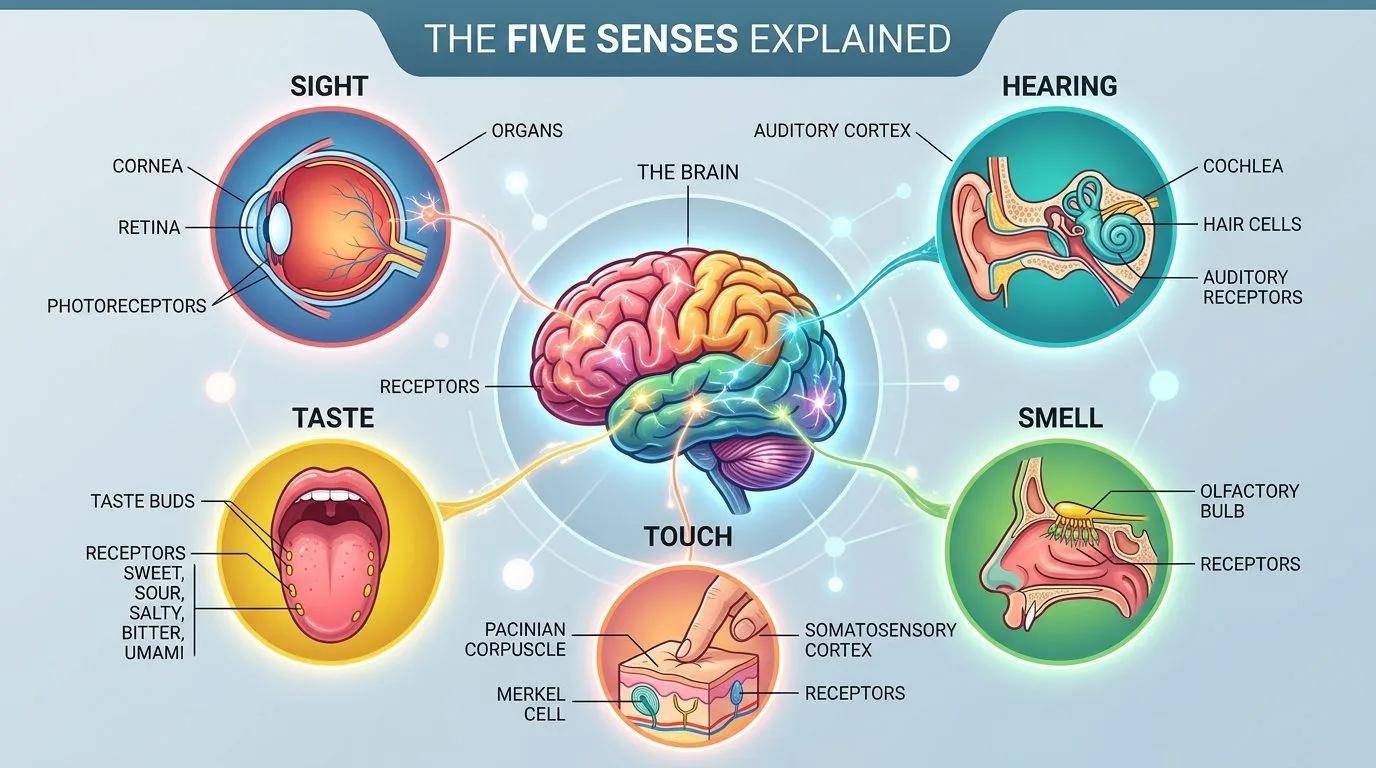
The five senses explained: sight, hearing, smell, taste and touch help us detect changes in the world. Each relies on specialised sensory receptors that respond to light, vibration, dissolved or airborne chemicals, or physical changes in the body. Those receptors convert a stimulus into signals that travel through nerves and neural circuits. The brain processes this information, combines it with experience and other senses, and produces what we consciously see, hear, smell, taste or feel.
Our eyes do not literally contain pictures, and our ears do not contain sounds that the brain simply plays back. They detect physical signals. The nervous system turns those signals into perception—the meaningful experience of a face, a voice, a familiar aroma, a sweet drink or a gentle touch. A simple example is eating an orange: sight reveals its colour, touch its texture, smell contributes aroma, taste detects sweetness and acidity, and the brain combines the information into flavour.
Scientists recognise more than five sensory systems: balance, body position, temperature, pain-related detection and awareness of internal bodily conditions also matter. This guide explains the traditional five while showing where the familiar school model needs refinement. The anatomy and mechanisms are checked against the US National Eye Institute , NIH National Institute on Deafness and Other Communication Disorders (NIDCD) and OpenStax Anatomy and Physiology .
The five senses and their organs: comparison table
| Sense | Main organ or tissue | Receptors | Stimulus | Main pathway to brain |
|---|---|---|---|---|
| Sight (vision) | Eyes, especially the retina | Rods and cones (photoreceptors) | Visible light | Retinal circuits → optic nerve → visual pathways and cortex |
| Hearing (audition) | Ears, especially the cochlea | Inner-ear hair cells | Sound-induced mechanical movement | Auditory nerve → brainstem and thalamic pathways → auditory cortex |
| Smell (olfaction) | Olfactory epithelium high in the nose | Olfactory sensory neurons | Airborne odorant molecules | Olfactory bulb → olfactory cortical regions |
| Taste (gustation) | Taste buds, mainly in mouth and throat | Specialised taste receptor cells | Chemicals dissolved in saliva | Taste nerves → brainstem → thalamus → gustatory cortex |
| Touch (somatosensation) | Skin and sensory tissues throughout the body | Mechanoreceptors; related receptors detect temperature and potential injury | Pressure, stretch, vibration, heat, cold and potentially damaging stimuli | Peripheral nerves → spinal cord/brainstem → thalamus → somatosensory regions |
These are simplified pathways: many brain regions participate, and not every signal follows exactly the same route. Smell is particularly unusual because its first route to primary olfactory cortex does not require the thalamic relay characteristic of several other senses. Neuroscience research on sensory processing explains the distinct circuits.
How do sensory receptors send messages to the brain?
The process of turning a stimulus into a change in a sensory cell is called sensory transduction. Light-sensitive proteins in retinal photoreceptors, mechanically responsive channels in inner-ear hair cells, chemical receptors in the nose and mouth, and sensory nerve endings in the skin respond to different physical or chemical inputs.
Transduction changes the electrical state of a receptor cell or sensory neuron. Some receptor cells release neurotransmitters onto nearby neurons; neurons farther along the pathway can generate rapid electrical impulses called action potentials. These travel through nerves and interconnected brain networks. Importantly, not every receptor itself fires action potentials: for example, retinal rods and cones communicate largely through graded electrical changes and synaptic signalling, while retinal ganglion cells send impulses through the optic nerve.
The brain compares incoming patterns with context, memory, attention and other inputs. Consequently, sensation refers to detecting a stimulus, while perception refers to interpreting it. Two people may detect a stimulus but interpret it differently, especially in an ambiguous situation. The OpenStax sensory-perception chapter introduces the distinction.
1. Sight: how do the eyes and brain produce vision?
Vision begins when light reflected or emitted by objects enters the cornea, passes through the pupil and is focused by the cornea and lens onto the retina at the back of the eye. The coloured iris adjusts pupil size, changing how much light can enter. The retina is nervous tissue containing several layers of interconnected cells.
Rods are especially sensitive in dim conditions and support low-light vision, though they do not provide detailed colour information. Cones support colour discrimination and high-acuity vision in brighter light. They are concentrated in the central retina, especially the fovea. A common misconception is that rods see only black-and-white pictures like a camera filter; in reality, perception results from how multiple retinal and brain circuits respond to light.
Photoreceptors transform light into changes in their electrical activity. Retinal circuits process contrast and other features; ganglion-cell axons form the optic nerve. Most conscious visual processing then involves pathways through the thalamus to the visual cortex in the occipital lobe, alongside other brain regions. Vision depends on neural interpretation as well as the optics of the eyeball. The National Eye Institute traces this process step by step.
Why does the brain sometimes misinterpret what we see?
Context, contrast, perspective and expectations influence visual perception. For example, the Moon can appear much larger near the horizon than when high in the sky even though its angular size changes little. This is a perceptual effect rather than the Moon suddenly growing. SuperEducational's published guide, Why the Moon Looks Bigger on the Horizon , is a useful example of how perception differs from simple measurement.
Light also helps regulate the body clock through specialised retinal pathways, not just the rods-and-cones system used for detailed vision. See Evening Light Can Push Your Sleep Later for that related biological role.
2. Hearing: how do the ears turn vibrations into sound?
Sound starts as pressure waves travelling through a medium such as air. The visible outer ear helps collect sound, and waves travel through the ear canal to vibrate the eardrum. Three tiny middle-ear bones—the malleus, incus and stapes—transfer the vibration toward the fluid-filled inner ear.
Inside the spiral-shaped cochlea, vibration creates travelling waves that move the basilar membrane. Specialised hair cells bear microscopic projections called stereocilia. Their mechanical deflection changes ion flow and electrical activity. This influences the firing of auditory nerve fibres, which carry information through the brainstem and other pathways to the auditory cortex in the temporal lobe.
The cochlea is organised by frequency: different positions respond most strongly to different pitches. That arrangement helps the brain distinguish a low hum from a high whistle. Perception of speech, music and sound location also depends on timing, prior experience and information arriving from both ears. The NIDCD hearing guide explains the six major steps from air vibration to auditory perception.
Are hearing and balance the same sense?
No, although both rely on specialised structures in the inner ear. Hearing uses the cochlea to process sound. The nearby vestibular system detects changes in head movement and orientation, providing essential information for balance and stabilising vision. It works with sight and position signals from muscles and joints. This is one reason the “five senses” label is incomplete.
Excessively loud sound can damage the delicate hearing system. For an evidence-based explanation of noise exposure, see SuperEducational's published How Loud Is Too Loud? Safe Listening Times Explained .
3. Smell: how does the nose recognise thousands of odours?
Smell, or olfaction, begins when volatile molecules reach a small patch of olfactory epithelium high inside the nasal cavity. Here, olfactory sensory neurons have proteins that respond to chemical features of odour molecules. Different odorants activate combinations of receptor types, allowing the brain to distinguish an enormous variety of smells without needing one separate receptor for every smell.
Signals travel along these neurons to the olfactory bulb, then to several brain regions involved in odour perception, memory and emotion. Unlike the familiar initial visual and auditory routes, the main early smell route reaches olfactory cortex without first passing through a thalamic relay. Later olfactory processing can nevertheless involve the thalamus. The NIDCD's smell guide explains receptors, the bulb and the connection between smell and flavour.
Odours enter through the nostrils when we sniff, but also through the back of the mouth and throat as we chew food. This second route, called retronasal olfaction, explains why food can seem bland when nasal congestion blocks aroma molecules from reaching receptors. Familiar smells may also trigger vivid memories because olfactory networks connect with brain systems involved in emotion and memory.
Smelling something is not the same as proving it is safe or dangerous. Some harmful gases are difficult to smell, while some strong odours pose little risk at ordinary levels. Never intentionally sniff unknown chemicals as a science activity.
4. Taste: how does the tongue detect flavour?
Taste, or gustation, depends on specialised taste receptor cells arranged in taste buds. Many taste buds are located in the small structures called papillae on the tongue, but taste cells also occur in parts of the palate and throat. When food compounds dissolve in saliva, they stimulate receptor cells, which communicate with nerve pathways to the brain.
Scientists commonly recognise five basic taste qualities: sweet, sour, salty, bitter and umami (savoury, associated with substances such as glutamate). The signal passes through branches of the facial, glossopharyngeal and vagus nerves to the brainstem, and onward through thalamic pathways to gustatory processing regions including the insula and frontal operculum.
The old school “tongue map”—which assigns sweet to the tongue tip, bitter to the back, and other flavours to isolated zones—is a myth. Different regions of the tongue can detect the major tastes, even though sensitivity may vary somewhat from place to place. Both the NIDCD and a published review of the tongue-map myth explain why the cartoon is misleading.
Is spicy food a sixth taste?
Not in the usual five-basic-tastes classification. The heat from chilli peppers results largely from capsaicin activating sensitive nerve endings, including TRPV1-related pathways, involved in detecting heat and potentially damaging stimuli. Minty coolness involves other chemesthetic pathways. These sensations combine with taste and aroma to shape the experience of flavour, but they are not equivalent to sweet, sour or umami.
Similarly, a food's texture, temperature and smell help the brain decide what it is eating. A person may detect sweetness with a blocked nose yet find it difficult to distinguish the characteristic flavour of apple from pear. The NIDCD taste factsheet describes this multisensory integration.
5. Touch: what receptors help us feel pressure, texture, heat and pain?
Touch is often represented by the skin, but the larger scientific system is somatosensation: detection of touch, vibration, body movement, temperature and potentially damaging stimuli across the skin and deeper tissues. There is no single “touch receptor” that handles everything. Different receptors are specialised for different kinds of physical changes.
| Receptor | Common sensory role | Example |
|---|---|---|
| Merkel cell–neurite complexes | Sustained pressure, edges and fine texture | Reading raised dots by touch |
| Meissner corpuscles | Light moving touch and low-frequency vibration | Feeling an object slip against the fingertips |
| Pacinian corpuscles | Rapid vibration and deep mechanical changes | Detecting vibration through a handheld object |
| Ruffini endings | Skin stretch; functions depend on tissue and context | Detecting stretching as the hand changes shape |
| Hair-follicle receptors | Movement of hairs | Noticing a light brush against the forearm |
| Free nerve endings and related fibres | Temperature and potentially damaging stimuli; some touch-related signalling | Feeling cold or a potentially harmful sharp contact |
Somatosensory nerve fibres carry signals through peripheral nerves to the spinal cord or brainstem, and then through pathways involving the thalamus to regions such as the primary somatosensory cortex in the parietal lobe. Different receptor and fibre types do not all use identical routes. The OpenStax receptor table and the NCBI sensory-receptor overview explain these distinctions.
Is pain simply another kind of touch?
Pain is not a pressure signal at a higher volume. Nociceptors detect potentially tissue-damaging mechanical, thermal or chemical conditions, while pain is a conscious experience shaped by many brain processes and other factors. Likewise, thermoreceptors contribute to sensing warmth and cold. A single contact can activate several systems at once: an ice cube can feel cold, hard, wet and eventually uncomfortable.
Touch sensitivity also varies by body region. Fingertips and lips can resolve fine detail because of receptor distribution and neural processing, whereas the back may be less precise. This is why reading Braille depends on detailed tactile discrimination rather than simply strong pressure.
How does the brain combine the five senses?
Most everyday experiences are multisensory. When someone speaks, your brain links movements of their lips with the sound of their voice. When you hold a cup of tea, vision, touch, proprioception and temperature signals help you decide how to grasp it. Perception depends on signals from more than one source, and attention changes which information becomes prominent.
The brain does not have a single tiny “five-senses control room”. Sensory information is processed in partly specialised networks—visual, auditory, olfactory, gustatory and somatosensory—and distributed circuits combine information with memory, emotion and decision-making. The thalamus is a key relay for many sensory pathways, but the earlier olfactory route differs. The brain's networks are more complex than one organ sending a message to one isolated lobe.
Researchers are still learning how cell types and circuits contribute to perception. SuperEducational's published guide to mapping millions of brain cells explains why new single-cell atlases are useful for understanding complex neural systems.
Perception can also produce illusions. A visual illusion does not mean the eyes failed; it may show how brain circuits use context and previous experience to interpret incomplete or ambiguous information. Sensory science therefore studies stimulus detection and interpretation together.
Do humans have only five senses?
No. Sight, hearing, smell, taste and touch are the traditional five, but modern biology identifies additional sensory functions.
- Balance (vestibular sense): structures in the inner ear detect rotation, head movement and orientation. The brain combines this information with vision and body-position signals.
- Proprioception: receptors in muscles, tendons and joints contribute to knowing where limbs are, even with the eyes closed.
- Temperature: thermosensitive nerve endings help detect warming or cooling.
- Nociception: neural detection of potentially damaging conditions; it contributes to, but is not identical to, the conscious experience of pain.
- Interoception: sensing internal bodily states, which can include signals relevant to fullness, breathing, heartbeat and other physiological conditions.
The exact number of “senses” depends on how broadly or narrowly scientists divide these functions. A biology textbook overview includes equilibrium as a special sense, and NIDCD's balance guide confirms that vision, the vestibular system and muscles all contribute to balance.
Safe five-senses classroom activities
These short demonstrations illustrate perception without requiring dangerous substances, very loud noise, food tasting by students with allergies or blindfolded walking.
| Activity | Method | Concept to discuss |
|---|---|---|
| Visual attention | Look at a familiar picture for ten seconds, turn it over, and list remembered details. | Seeing and attending are not the same. |
| Sound direction | While seated, ask a partner to make a gentle sound from a safe location to the left or right. | Two ears and brain comparisons help locate sound. |
| Smell and memory | Discuss familiar, safe household aromas from labelled containers, without sniffing unknown substances. | Smell can be associated with memory and context. |
| Taste versus flavour | Compare written descriptions of the same sweet or sour food with different aromas; optional tasting only with consent and allergy checks. | Flavour includes taste, smell and other sensations. |
| Touch and texture | With eyes open or closed while seated, feel clean smooth and textured objects and describe them. | Mechanoreceptors detect texture, pressure and movement. |
| Body position | While seated, close eyes briefly and touch one fingertip with the opposite index finger. | Proprioception works even without looking at the hands. |
Discussion prompts: Which activity required more than one sense? What stimulus did the receptor detect? Which part of the experience depended on interpretation or memory? How could you make the observation fairer? Teachers should adapt activities for learners with disabilities and avoid assuming every participant has the same sensory abilities.
Common misconceptions about the five senses
| Myth | Science-based correction |
|---|---|
| “Humans have exactly five senses.” | The traditional five are a useful teaching group, but balance and body-position senses also exist. |
| “The eyes do all the work of seeing.” | Retinal circuits and brain processing are essential to vision. |
| “The brain simply hears sound already stored in the ear.” | Cochlear hair cells transduce vibration into signals the brain interprets. |
| “Each odour has just one unique receptor.” | Odour perception typically involves combinations of olfactory receptor responses. |
| “The tongue has separate zones for sweet, salty, sour and bitter.” | All major taste qualities can be detected across different taste-sensitive regions. |
| “Spicy is one of the five basic tastes.” | Chilli heat is mainly a chemesthetic/nociceptive sensation. |
| “Skin has only one kind of receptor.” | Different nerve endings respond to touch, vibration, temperature and harmful conditions. |
Frequently asked questions about the five senses
What are the five senses and their organs?
The traditional senses are sight (eyes), hearing (ears), smell (nose), taste (taste buds in the mouth and throat) and touch (skin and deeper body tissues). Specialised receptors detect different kinds of stimuli and communicate with the nervous system.
What are sensory receptors?
Sensory receptors are cells or specialised nerve endings that respond to particular physical or chemical stimuli. They start the process of converting light, movement, chemicals or tissue changes into neural signals.
Which part of the brain controls the five senses?
There is no single centre that does everything. Visual, auditory, olfactory, gustatory and somatosensory processing involve different cortical and subcortical networks; several also use the thalamus as a key relay.
Why is the brain important for sight, sound and touch?
Sensory organs detect inputs, but the brain interprets the signals, connects them with memories and context and supports conscious perception and appropriate responses.
Does the tongue have four taste areas?
No. The old tongue map is inaccurate. The five established basic taste qualities are sweet, sour, salty, bitter and umami, and taste-sensitive regions can respond to all of them.
Why does food taste bland when you have a blocked nose?
Much of flavour depends on smell, including odours reaching the nasal cavity from the mouth while eating. Nasal blockage reduces this input even when taste receptors can still detect sweetness or saltiness.
Is balance a sixth sense?
It is often described that way informally. The vestibular system in the inner ear provides information about head movement and orientation, working alongside vision and proprioception.
Can one sense compensate for another?
The brain can adapt to changes in sensory input, and people may develop effective strategies using available senses and assistive tools. However, the degree of adaptation varies, and one sense does not literally become a replacement organ for another.
Conclusion: the five senses are a partnership between receptors and brain
Understanding the five senses explained means following a common pattern: a specialised receptor detects a stimulus, the nervous system carries and transforms signals, and the brain produces perception. Eyes detect light, ears detect vibration, the nose detects airborne molecules, taste buds detect dissolved chemicals, and skin and body receptors detect mechanical and other changes. Every stage is important.
The traditional five senses are an excellent starting point, but the full picture includes balance, body position, internal signals and multisensory integration. From recognising a voice to enjoying a favourite meal, our experience of the world is created through an ongoing partnership among the organs, receptors, nerves and brain.
References and further reading
- National Eye Institute — How the Eyes Work .
- NIDCD — How Do We Hear? .
- NIDCD — Smell Disorders and How Smell Works .
- NIDCD — Taste Disorders and Taste/Flavour .
- NIDCD — Balance Disorders and the Vestibular System .
- OpenStax — Anatomy and Physiology: Sensory Perception .
- OpenStax Biology 2e — Sensory Processes .
- NCBI Bookshelf — Physiology, Sensory Receptors .
- Spence (2022) — The Tongue Map and the Spatial Modulation of Taste Perception .
- Encoding Taste: From Receptors to Perception — Scientific Review .
- Webvision / NCBI Bookshelf — How the Retina Works .