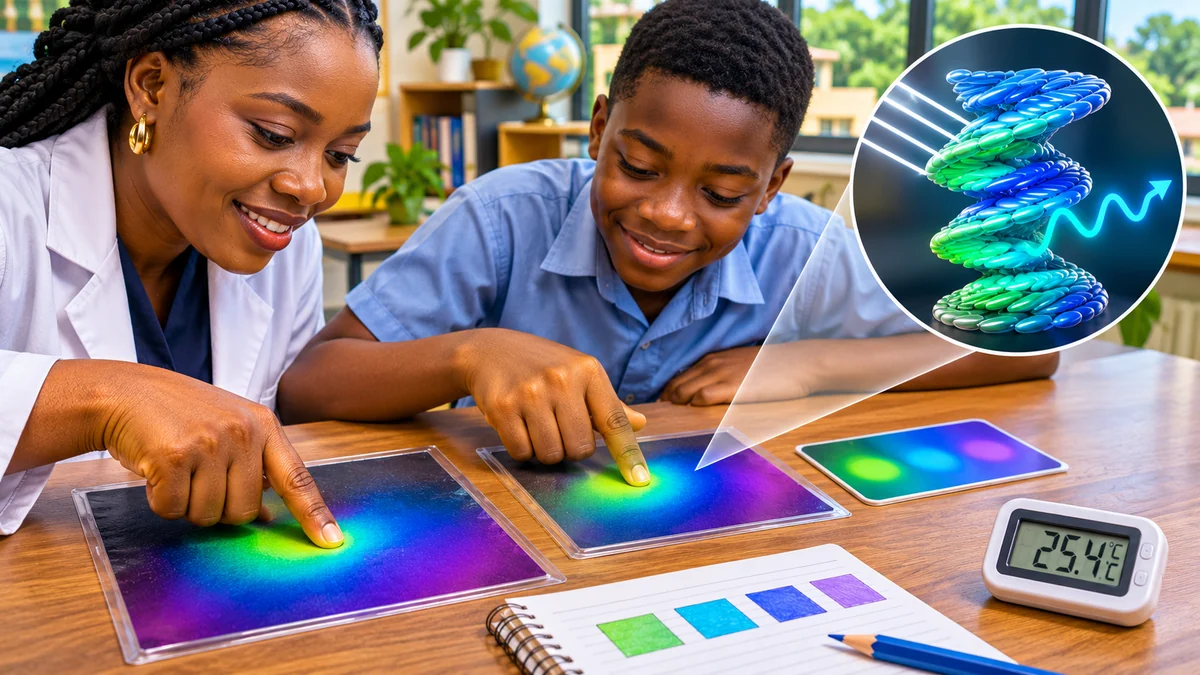
Thermochromic colour change is the ability of a material to change its appearance when its temperature changes. With a sealed, commercially prepared liquid-crystal sheet, students can often make a colourful handprint simply by resting warm fingers on its surface. The changing colours make heat transfer and the behaviour of light visible—without flames, exposed chemicals or boiling water.
This classroom demonstration uses ready-made, intact, touch-responsive thermochromic film, not homemade reactive mixtures. The aim is to investigate the question: How does changing the temperature of a material change the colour we see? Students will compare a warmed area with an untouched control, repeat the test and record observations. A second, optional comparison uses a pre-sealed leuco-dye thermochromic item to explore a different mechanism.
The Harvard Natural Sciences Lecture Demonstrations describes chiral nematic liquid-crystal sheets with different temperature-response intervals, including a 25–30°C formulation that can be activated by touch. The Royal Society of Chemistry's outreach activity also uses prepared thermochromic products as a teaching introduction to temperature-driven changes in materials. This guide adopts a deliberately lower-risk approach: human-hand warmth, dry sheets, sensible supervision and a repeatable observation procedure.
Lesson at a glance: thermochromic colour change
| Lesson detail | Classroom recommendation |
|---|---|
| Topic | Heat transfer, temperature, optical properties and thermochromic materials |
| Suggested age range | Approximately 10 years and above; adapt language and supervision to your class |
| Group size | Pairs or groups of three |
| Teaching time | 35–45 minutes, including discussion and reflection |
| Core material | Intact pre-sealed thermochromic liquid-crystal sheet with a touch-responsive range |
| Heat source | Ordinary hand warmth only |
| Main investigation | Compare the colour of a touched area with an untouched area under the same conditions |
| Expected learning | Students explain that temperature changes material properties and that different systems produce colour differently |
Key safety boundary: The class does not make thermochromic chemicals, heat liquids, use hairdryers or heat guns, open capsules, or dismantle colour-changing jewellery. Choose a finished product whose instructions permit normal skin contact.
What materials do you need?
- One or more sealed, touch-responsive chiral nematic liquid-crystal sheets, ideally labelled with a temperature range appropriate for your room; Harvard documents 25–30°C sheets that respond to touch.
- One ordinary non-thermochromic sheet or card of a similar colour to act as a control.
- Clean, dry paper, a notebook or printed observation table.
- A pencil, timer or clock, and optional room thermometer.
- A level, dry work surface with stable lighting.
- Optional: a teacher-approved, pre-sealed thermochromic dye patch or commercial colour-changing card, labelled with its activation temperature and safe handling instructions.
Do not buy loose mystery powders, uncured colour-changing ink or reagent mixtures for this beginner activity. The preparation and safety requirements for synthesising thermochromic systems are quite different from safely observing a finished demonstration film. Check product age recommendations, surface integrity and supplied handling information before the lesson.
In naturally warm classrooms, a 25–30°C sheet might already be within or above its active range before anybody touches it. Do a teacher trial first. If needed, select a manufacturer-approved sheet with a different active range suitable for your normal room conditions. An unsuitable temperature range is a product-selection problem, not a reason to use dangerously hot or cold equipment.
Safety checklist before students begin
- Inspect every sheet. Do not use products with torn seals, leaking contents, exposed coatings or damaged edges.
- Follow the manufacturer's instructions. Only use finished materials labelled as suitable for ordinary handling and the intended age group.
- Use ordinary body warmth. Touch the dry surface gently; do not introduce kettles, boiling water, open flames, hairdryers, heat guns, ice burns or very cold objects.
- Keep the film dry. Do not immerse or wet it unless the manufacturer explicitly approves that use.
- Respect individual needs. Participation does not require skin contact: a teacher can demonstrate a handprint and let students observe or record.
- Stop if there is a concern. If the product is damaged or a student experiences irritation, stop using it and follow the school's normal safety procedure.
- Store materials after the lesson. Protect films from excessive heat, strong sunlight, abrasion and access by younger children who might put small items in their mouths.
The Royal Society of Chemistry warns educators to check the temperatures of hot and cold demonstration items and avoid prolonged direct contact. Our beginner procedure removes those external heat sources altogether. As with any classroom activity, teachers should complete the school's local risk assessment.
Step-by-step thermochromic classroom demonstration
Step 1: Establish a baseline
Place the sealed film on a dry table. Leave it untouched for two or three minutes so that it can approach the surrounding room conditions. Ask students to describe the current colour without guessing the temperature or emotional meaning. Note the room temperature if a thermometer is available.
Record whether the film looks dark, green, blue, mixed or otherwise. There is no one compulsory starting colour: the result depends on the film's particular formulation and its temperature.
Step 2: Make a prediction
Ask: What do you predict will happen to the area under a warm finger? Students should write down a testable statement such as, “The touched part will change appearance more than the untouched part.” This is a prediction about the observable effect, rather than a guess at the exact colour.
Step 3: Touch only one part of the sheet
One student places a clean, dry fingertip gently on the middle of the sheet for about 10 seconds. Keep the second half of the same sheet untouched if practical, or use a similar untouched film nearby as a comparison. The pressure should be light; the goal is to transfer some heat, not crush the material.
Step 4: Watch what happens
Lift the finger and observe the area immediately, then after approximately 10, 20 and 40 seconds. Describe colour or brightness changes in words rather than forcing every appearance into a fixed colour category. Some products may show a multicolour outline or a temporary imprint; others may show a more modest shift.
Step 5: Allow the film to recover
Leave the film untouched on the same dry surface for another minute or until it appears to approach its original state. Reversible products may change back as their temperature returns towards the surroundings. Note that the time taken is not a universal constant: film thickness, table surface and ambient conditions all affect cooling.
Step 6: Compare with a control
Repeat the touch on a plain paper card. Unlike the special thermochromic sheet, the ordinary card should not show the same designed temperature-responsive colour effect. This supports the idea that the observed reaction depends on the material, not just the movement of a finger or the act of looking.
Step 7: Repeat and discuss
Run at least two more trials under approximately similar conditions. Rotate observers or use the same participant for a fairer comparison. Note both similarities and differences: careful science records what actually happened rather than assuming every trial must look identical.
Ready-to-copy observation table
Use this blank table for each group. Write the room temperature only if it has actually been measured. A room thermometer is not a direct measurement of the film surface or the fingertip.
| Trial | Room conditions | Before touch | Immediately after touch | After 20 seconds | After recovery |
|---|---|---|---|---|---|
| 1 | ______ | ______ | ______ | ______ | ______ |
| 2 | ______ | ______ | ______ | ______ | ______ |
| 3 | ______ | ______ | ______ | ______ | ______ |
Illustrative example—not real classroom measurements: A group might record a mostly dark starting sheet, a green-blue patch after touching, a fading patch after 20 seconds and a return towards the original dark appearance after recovery. Another formulation could show different colours or remain bright throughout. Do not present the illustrative colours as a universal result.
A stronger science report includes the date, type or active range of the sheet, light conditions, duration of contact and any trial that did not work as predicted.
What is the independent variable, dependent variable and control?
Students can improve the activity by stating the experimental design explicitly:
| Research element | In this lesson |
|---|---|
| Independent variable | Contact condition: touched by a finger versus untouched, or length of contact in a repeated investigation |
| Dependent variable | Observed change in colour, brightness or pattern of the thermochromic surface |
| Control condition | An untouched region of the same film under similar ambient conditions |
| Additional comparison | Ordinary non-thermochromic card handled similarly |
| Constants to try to hold steady | Lighting, viewing angle, sheet type, work surface, room conditions and observation times |
| Limitations | Skin warmth varies; colour observations are subjective; surface temperature may not be measured directly |
A useful hypothesis is: “If a sealed temperature-sensitive film is touched by a hand, then its appearance will change in the touched area compared with the control, provided the film is within its active temperature range.”
This is more scientifically useful than the claim that the ring or film can “read emotions.” Temperature is the testable factor.
The science: how liquid crystals produce shifting colour
Many classroom thermochromic sheets use chiral nematic liquid crystals, also called cholesteric liquid crystals. A liquid crystal is an unusual phase of matter in which molecules can have liquid-like mobility while maintaining some ordered orientation.
In chiral nematic materials, the preferred molecular direction rotates from layer to layer, forming a helical pattern. The distance for one full turn of that molecular orientation is the helical pitch. As temperature changes, the pitch can change, altering the wavelength band of incoming visible light that is strongly reflected.
Harvard's liquid-crystal sheets demonstration explains this mechanism as selective reflection. It also identifies ready-made sheets with different active temperature ranges, including 20–25°C, 25–30°C and higher ranges. The actual colours observed are dependent on the formulation and the viewing and lighting conditions.
The material does not need a battery to make the colour. Under ordinary illumination, its structure selects which wavelengths are reflected towards the observer. That is why a handprint can appear as a shifting range of colours against a dark backing. It is not heat being converted into glowing rainbow light like an LED.
As a simple comparison, blue visible light has a shorter wavelength than red visible light. If a change in the helix causes the strongly reflected wavelength band to move towards the blue region, the sheet may look bluer. The precise ordering cannot be assumed for every brand, composition or temperature interval.
Why the active temperature range matters more than the colour chart
A thermochromic sheet is manufactured to show an optical response over a particular range. A sheet designed to respond near 25–30°C may produce a clear handprint in a cooler room. But in a warm classroom it might start in an advanced colour state or beyond its useful range, leaving little visible response to an additional touch.
Similarly, a film designed for much hotter surfaces may not react to an ordinary finger at all. That does not disprove thermochromism; it indicates that the applied temperature change was not suitable for the material.
Before the class: Test one sample using the planned gentle finger touch. If it does not work, verify that the film has a suitable labelled active range, is intact, is illuminated well and has had time to reach room conditions. Do not force a reaction using a heat gun, kettle, flame or freezing temperatures.
How is a leuco-dye patch different?
Not all thermochromic materials are liquid crystals. Another common family uses leuco dyes, often mixed with a colour developer and a temperature-responsive medium. As temperature changes, molecular interactions can alter which wavelengths the mixture absorbs, causing the material to appear coloured, pale or colourless.
The Royal Society of Chemistry's 2024 research on leuco-dye temperature sensors investigates such chemical interactions, while a 2026 peer-reviewed materials review summarises liquid-crystal and dye-based thermochromism, including the use of encapsulated pigments in fabrics and coatings.
| Aspect | Liquid-crystal sheet | Commercial leuco-dye patch |
|---|---|---|
| Primary optical mechanism | Temperature changes the organised structure and selectively reflected wavelengths | Temperature changes molecular interactions and light absorption |
| Typical appearance | May display several shifting colours within an active interval | Often changes between two designed appearances or colour and colourless |
| Educational value | Connects heat, molecular order and structural colour | Connects heat, molecular interactions and absorption |
| Beginner handling | Use sealed, touch-approved sheets | Use finished, sealed, age-appropriate commercial products |
For an optional extension, display a finished leuco-dye patch alongside the liquid-crystal sheet. Compare their colours at room temperature and after gentle hand contact only if their specifications support that test. Some patches change at a different temperature and will not respond to fingers. Do not open capsules or mix dye powders, colour developers or solvents in this lesson.
What does reversible colour change mean?
A reversible thermochromic material is designed to change its appearance when heated or cooled and return when conditions reverse. The cycle can be repeated within its operating limits. An irreversible indicator, by contrast, may permanently mark that a temperature threshold was reached.
The 2026 review of reversible thermochromic materials describes several material families and challenges involving stability, durability and colour sensitivity. There can also be hysteresis: for some formulations, the appearance during warming may differ from the appearance during cooling at the same measured temperature. A research study of thermochromic printing inks documents this behaviour.
In a classroom, this means students should not expect the film to recover at exactly the same speed or to reproduce an identical colour path every time. Warming and cooling rates, surface contact and the material's thermal history can matter.
Common problems and how to troubleshoot them safely
| Observation | Possible explanation | Safe adjustment |
|---|---|---|
| No colour change after touching | Film's active range unsuitable; not enough temperature difference; damaged film | Check specifications and try a suitable undamaged touch-responsive sample |
| Film is already brightly coloured | Room conditions place it within its active range | Observe touched versus untouched regions and let it equilibrate |
| Film remains dark | Outside the visible response range, insufficient lighting, wrong backing or damage | Check supplier guidance and lighting without applying extreme temperatures |
| Different groups see different colours | Skin warmth, viewing angle, lighting or formulation differences | Keep sheet type, lighting and observation method more consistent |
| Patch changes once but fails to recover | Irreversible product, material damage or incomplete recovery time | Check product type; do not repeat with aggressive heating |
| Results look different in photos | Phone white balance, reflection and camera exposure | Keep the camera and lighting settings consistent; use written observations |
Why is this not the same as a mood ring?
Both can use temperature-responsive materials, but this lesson deliberately investigates **heat transfer and visible optical change** under controlled conditions. A mood ring is jewellery marketed with emotion-based colour legends. Those legends cannot reliably diagnose happiness, stress or any other emotional state.
Finger temperature itself responds to environmental conditions and physiological regulation, making a particular colour an unreliable measurement of mood. Instead of assigning meanings such as “blue means relaxed”, students should describe colour and record the conditions under which it appeared.
The classroom activity also offers better controls: the film can be placed on a stable surface, timed, compared with an untouched region and repeated. This makes it a stronger science exercise than simply reading a mood-ring colour chart.
Reflection, absorption and emission: three different ideas
Students often assume that a bright-looking colour must come from a substance producing its own light. That is not usually what happens here.
- Reflection: A liquid-crystal film can preferentially reflect particular wavelengths from the light shining on it.
- Absorption: A coloured dye absorbs some wavelengths more strongly than others; temperature-sensitive chemical changes can alter this process.
- Emission: A glowing material produces light through a physical process. Ordinary thermochromic sheets do not need to glow to show colour.
For a useful contrast in science teaching, see SuperEducational's verified article about why auroras glow green, red and purple . Auroral light is emitted by excited atmospheric gases, whereas the classic classroom liquid-crystal sheet changes the wavelengths of incoming light it selectively reflects.
Teacher discussion questions and model answers
- What caused the visible change? The touched region exchanged heat with the finger, changing the optical properties of the thermochromic material.
- Why was the untouched area useful? It served as a comparison so the class could identify which change followed contact.
- Why might a warmer room affect the result? The film may already be in or beyond its active temperature interval.
- Why cannot the sheet tell us someone's feelings? Temperature is influenced by many variables and is not a unique measurement of emotion.
- Would a different thermochromic product always give the same colours? No. Formulations and optical mechanisms differ.
- Did the material necessarily undergo a chemical reaction? Not necessarily. Some colour changes arise from temperature-dependent physical organisation, while some dye systems involve changing molecular interactions.
- What would make our results more reliable? Repeating trials, holding viewing conditions steady, documenting material specifications and recording rather than guessing.
Assessment: can students explain the result?
By the end of the lesson, students should be able to state what thermochromism means, identify the independent and dependent variables, explain why an untouched control matters, and distinguish liquid-crystal reflection from leuco-dye absorption at an introductory level.
An exit-ticket question can ask: “A sealed liquid-crystal sheet does not change colour when touched in a very warm classroom. Give two scientifically reasonable explanations and one safe next step.” Suitable responses include an unsuitable active range, an already-warm film or possible product damage; the safe next step is to check the labelled response range and use an intact, appropriate sheet—not stronger heating.
Where thermochromic materials are used outside classrooms
The same broad idea appears in temperature-indicator products, novelty mugs, responsive inks, textile designs and specialised optical materials. Some indicators are engineered for specific thresholds; others show a general visual response. The 2026 materials review covers uses in smart textiles and notes limitations including colour stability and wash durability.
It is important not to treat every colour-changing product as a certified thermometer, food-safety indicator or medical device. Reliable safety decisions require validated products and the correct method of measurement. This classroom film is an educational demonstration, not a substitute for a calibrated clinical or laboratory thermometer.
Frequently asked questions
What is the safest way to demonstrate thermochromic colour change?
Use a finished, intact, touch-approved liquid-crystal sheet selected for the room's temperature range. Have students observe gentle hand contact and compare it with an untouched area. Avoid heat guns, boiling water, open chemicals and damaged materials.
Which liquid-crystal temperature range works for handprints?
Harvard documents a 25–30°C sheet that responds to touch. However, a warm room may make this range unsuitable. Check the actual product specification and complete a teacher trial rather than assuming one range works everywhere.
Do students need hot water?
No. For a touch-responsive sheet, ordinary hand warmth can be sufficient. This activity is intentionally designed without heating liquids.
Will every thermochromic material show rainbow colours?
No. Some cholesteric liquid-crystal films can show changing spectral colours, while many leuco-dye products shift between coloured and colourless states. The appearance depends on the chemistry or optical structure and the product design.
Is thermochromic colour change a chemical reaction?
Not always. Liquid-crystal examples often involve changes in the physical organisation of molecules and the light they reflect; dye systems can involve temperature-dependent molecular interactions. The term thermochromic describes the effect, not a single chemical mechanism.
Can a classroom thermochromic sheet accurately measure body temperature?
Not without appropriate calibration, a known active range and measurement controls. A handprint film is a qualitative demonstration and should not be used for medical assessment.
Why do colours change back after my hand moves?
An intact reversible film returns towards its ambient temperature, and its optical response changes with it. How quickly it recovers depends on its formulation and heat exchange with the surroundings.
What if the experiment does not work?
Check whether the sheet is intact, labelled as touch-responsive and suited to the classroom's temperature. Observe it under consistent lighting, allow it to equilibrate and try a properly specified replacement if necessary. Do not use hazardous heating or cooling to force a visible result.
Conclusion: a small experiment with a big science lesson
Thermochromic colour change turns an invisible change in temperature into something students can observe. By using a pre-sealed liquid-crystal sheet, a controlled comparison and written observations, learners can investigate heat transfer, reversible material behaviour and the interaction of light with molecular structure.
Most importantly, the demonstration teaches scientific method as well as science content: make a prediction, change one condition, keep a control, repeat the test and explain what the evidence actually supports. No boiling water, flames or exposed pigments are needed to make the lesson memorable.
Research and safety guidance checked 16 November 2026. Select materials using manufacturer instructions and local classroom risk-assessment requirements. Product responses depend on formulation, active temperature range and environmental conditions.