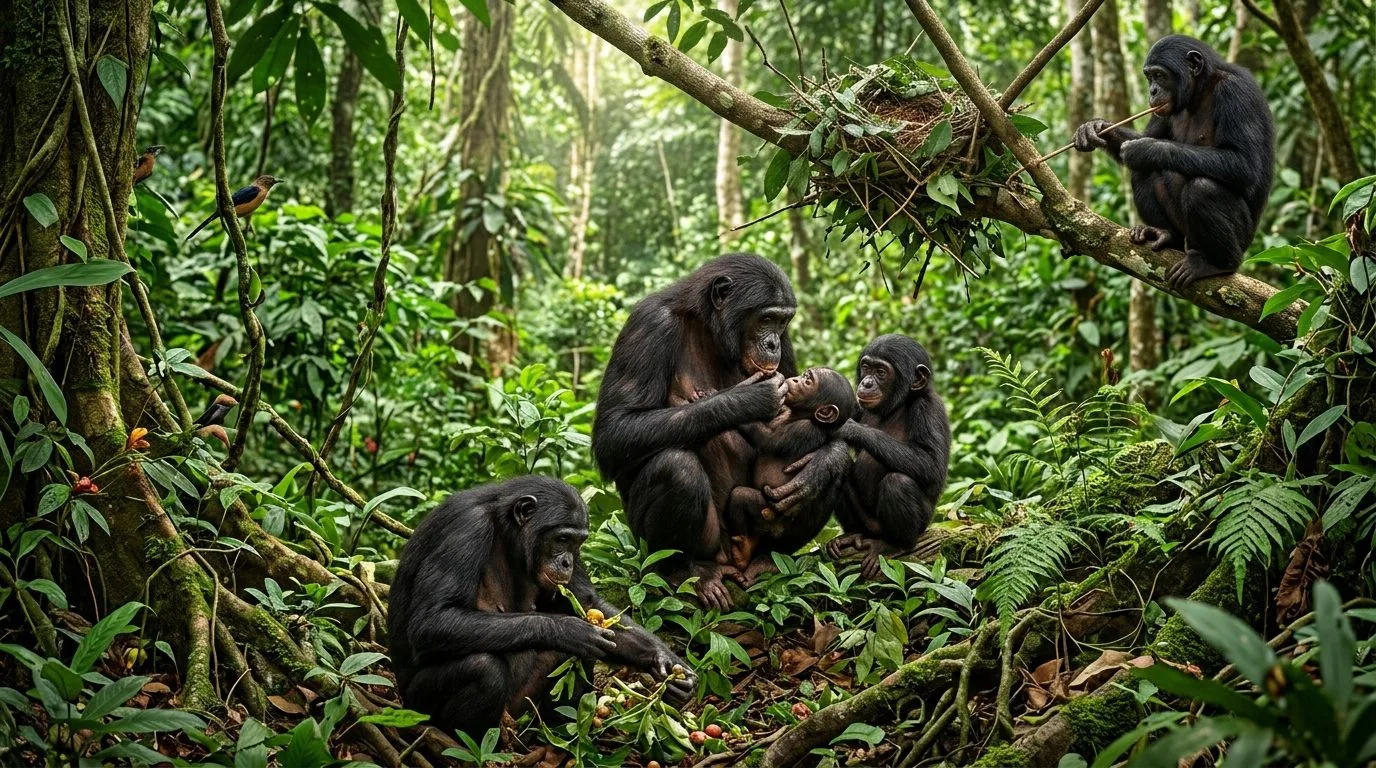
Chimpanzees are highly social great apes native to equatorial Africa. They live in forests and woodland–savanna mosaics, eat a varied diet dominated by fruit, and use tools to obtain foods that would otherwise be difficult to reach. They form long-lasting relationships, communicate through calls and gestures, and learn behaviours from other chimpanzees. Their intelligence is impressive—but it is their combination of social learning, ecological adaptability and complex group life that makes them especially important to biology.
The common chimpanzee, Pan troglodytes, is one of humanity's closest living relatives, alongside the bonobo, Pan paniscus. That does not mean modern humans descended from living chimpanzees: both lineages developed from an earlier shared ancestor. Chimpanzees are also Endangered, threatened by habitat loss, hunting, disease and illegal wildlife trade. This guide explores their behaviour, habitat, diet, intelligence, family life and conservation, using scientific studies and specialist conservation sources.
Research from the Wisconsin National Primate Research Center , the Jane Goodall Institute and the IUCN Great Ape Specialist Group helps separate well-documented findings from popular myths about these animals.
Chimpanzee facts at a glance
| Feature | Evidence-based information |
|---|---|
| Scientific name | Pan troglodytes |
| Animal group | Mammal; primate; great ape (family Hominidae) |
| Native range | Parts of western, central and eastern Africa |
| Habitats | Tropical forest, forest edge, woodland and some savanna mosaics |
| Diet | Omnivorous, mainly fruit; also leaves, seeds, insects and occasional meat |
| Social system | Communities with flexible smaller subgroups (fission–fusion organisation) |
| Distinctive abilities | Toolmaking, problem-solving, social learning and complex communication |
| Young | Usually one infant following a gestation of roughly eight months |
| Lifespan | Often several decades; variable across wild and managed populations |
| Species conservation status | Endangered; some subspecies are at higher risk |
These are broad species-level descriptions, not measurements that apply to every individual or community. Habitat, sex, age, food availability and regional traditions matter.
What is a chimpanzee, and how is it related to humans?
Chimpanzees belong to the genus Pan, along with bonobos. They are apes, not monkeys: unlike most monkeys, apes do not have external tails. Chimpanzees have long arms, grasping hands and feet, dark body hair and faces that change with age. They move both in trees and on the ground, commonly travelling terrestrially by knuckle-walking while also climbing and suspending themselves among branches.
Humans, chimpanzees and bonobos share an evolutionary history. The Smithsonian Human Origins Program explains that modern humans did not evolve from any ape alive today; chimpanzees and humans instead share a common ancestral population. Popular claims that humans and chimpanzees are “98% identical” simplify a complicated genomic comparison: estimates depend on which DNA regions and kinds of changes are counted. Genetic closeness does not mean identical biology or intelligence.
For a beginner-friendly explanation of mammal and primate classification, SuperEducational's guide to animal classification places chimpanzees within the larger vertebrate family tree.
Where do chimpanzees live?
Wild chimpanzees live only in Africa, across a broad but increasingly fragmented belt from West Africa through Central Africa to parts of East Africa. Contrary to the idea that every chimpanzee lives in dense rainforest, populations occupy a variety of habitats: evergreen and semi-deciduous tropical forests, gallery forests, forest edges, woodlands and some comparatively dry savanna landscapes.
Forested habitats provide fruiting trees, sleeping and resting sites, and other food resources. In more open woodland–savanna environments, chimpanzees may travel farther to find scattered food and water and alter their daily activities to cope with heat. The habitats of different populations are not interchangeable, and suitable habitat depends on more than the presence of trees alone.
Research sites such as Gombe in Tanzania, Taï National Park in Côte d'Ivoire, Budongo in Uganda and the Goualougo Triangle in the Republic of the Congo have revealed different aspects of chimpanzee ecology. Findings from one community cannot automatically be generalised to every chimpanzee across the continent. See the University of Wisconsin species account .
Four commonly recognised chimpanzee subspecies
Conservation authorities commonly recognise four subspecies of Pan troglodytes. Taxonomic boundaries may be studied or refined, but these names are widely used in regional conservation planning.
| Subspecies | Broad region | Conservation note |
|---|---|---|
| Western chimpanzee, P. t. verus | West Africa | Listed as Critically Endangered by IUCN |
| Nigeria–Cameroon chimpanzee, P. t. ellioti | Nigeria and Cameroon | Endangered; forest fragmentation is a concern |
| Central chimpanzee, P. t. troglodytes | Central African forest region | Endangered; threatened by habitat loss, hunting and disease |
| Eastern chimpanzee, P. t. schweinfurthii | Parts of East and Central Africa | Endangered; affected by fragmented landscapes and other pressures |
The IUCN Great Ape Specialist Group lists the four subspecies and distinguishes the Critically Endangered western subspecies from the Endangered species as a whole. For readers in Nigeria, the Nigeria–Cameroon chimpanzee is particularly relevant: its conservation depends on forest protection and coordinated action across national borders. See the IUCN regional programme .
What do chimpanzees eat?
Chimpanzees are omnivores, but in many communities their diet is dominated by ripe fruit. They also eat leaves, buds, seeds, flowers, bark, stems, pith and other plant materials. Insects such as termites and ants provide additional food, and chimpanzees sometimes consume honey, eggs and meat.
Meat-eating is a smaller and highly variable component of the diet, not the default daily menu of every chimpanzee. Some communities hunt other mammals, including monkeys such as red colobus, while others obtain animal food less often. Food availability and cultural traditions can affect both dietary choices and the techniques used to obtain them. The Wisconsin National Primate Research Center documents the diet's range.
| Food category | Examples | How it fits the diet |
|---|---|---|
| Fruit | Wild figs and other seasonal fruits | Major source of food for many populations |
| Other plant matter | Leaves, seeds, shoots, flowers and pith | Supplemental and seasonally important |
| Invertebrates | Termites and ants | Sometimes collected with specialised tools |
| Animal foods | Small mammals, eggs or other prey | Variable and typically less common than fruit |
| Other foods and resources | Honey, tree-hole water and occasional soil | Different uses depend on ecology and local practice |
Why chimpanzees matter to forests
By travelling between fruiting trees and passing or dropping seeds, chimpanzees can contribute to seed dispersal. Their feeding behaviour is part of wider forest food webs involving plants, insects and other mammals. The ecological effect of a particular chimpanzee population depends on what plants it eats and where seeds are deposited, so it is more accurate to describe a potential and documented ecological role than to assume every swallowed seed survives and grows.
How do chimpanzees behave in groups?
Chimpanzees have a distinctive fission–fusion social system. A larger, relatively stable community contains individuals who know one another and share a home range, but daily travel and feeding often occur in much smaller temporary parties. Individuals join and separate as food availability, social relationships and other circumstances change.
This system differs from an image of one permanent, tightly packed troop moving together at all times. One chimpanzee may feed with several companions in the morning, travel alone for a period, and join a different party later. Group membership and size can vary considerably among research sites. The Wisconsin's species account describe this social flexibility.
Grooming, friendship and cooperation
Chimpanzees spend considerable time grooming: picking through one another's hair and skin to remove debris or parasites. Grooming also strengthens social relationships. Individuals may cooperate during travel, feeding, coalition building or disputes, while preferred companions can remain important over many years.
Relationships are not always equal or peaceful. Chimpanzee communities have dominance hierarchies and experience competition, conflict and reconciliation. Some males form alliances that affect status, and social behaviour is shaped by age, sex, personality and changing group circumstances. Describing chimpanzees only as gentle friends—or only as aggressive animals—misses their full behavioural range.
Do chimpanzees fight?
Yes. Aggression occurs within and between communities, and some interactions can be severe or fatal. Researchers have documented territorial patrols and attacks on members of neighbouring groups. This does not mean violence is inevitable in every encounter, or that every community is equally aggressive. Social bonds, grooming, play, maternal care and cooperation are also central to chimpanzee life. The Jane Goodall Institute's Gombe research summary describes both cooperation and intergroup aggression.
How intelligent are chimpanzees?
Chimpanzees demonstrate sophisticated problem-solving, memory, planning and social learning. They can select objects for particular purposes, remember where valuable foods occur, monitor companions' behaviour and learn complex skills over many years. Because intelligence contains different abilities, reducing it to a single “chimp IQ” or human equivalent is misleading.
Researchers examine cognition through careful observations and experiments. They ask what an individual knows, what it can learn, and how context changes performance. Laboratory test results can be influenced by familiarity with the task and environment, so no single puzzle provides a complete ranking of animal intelligence.
Tool use: termite fishing and nut cracking
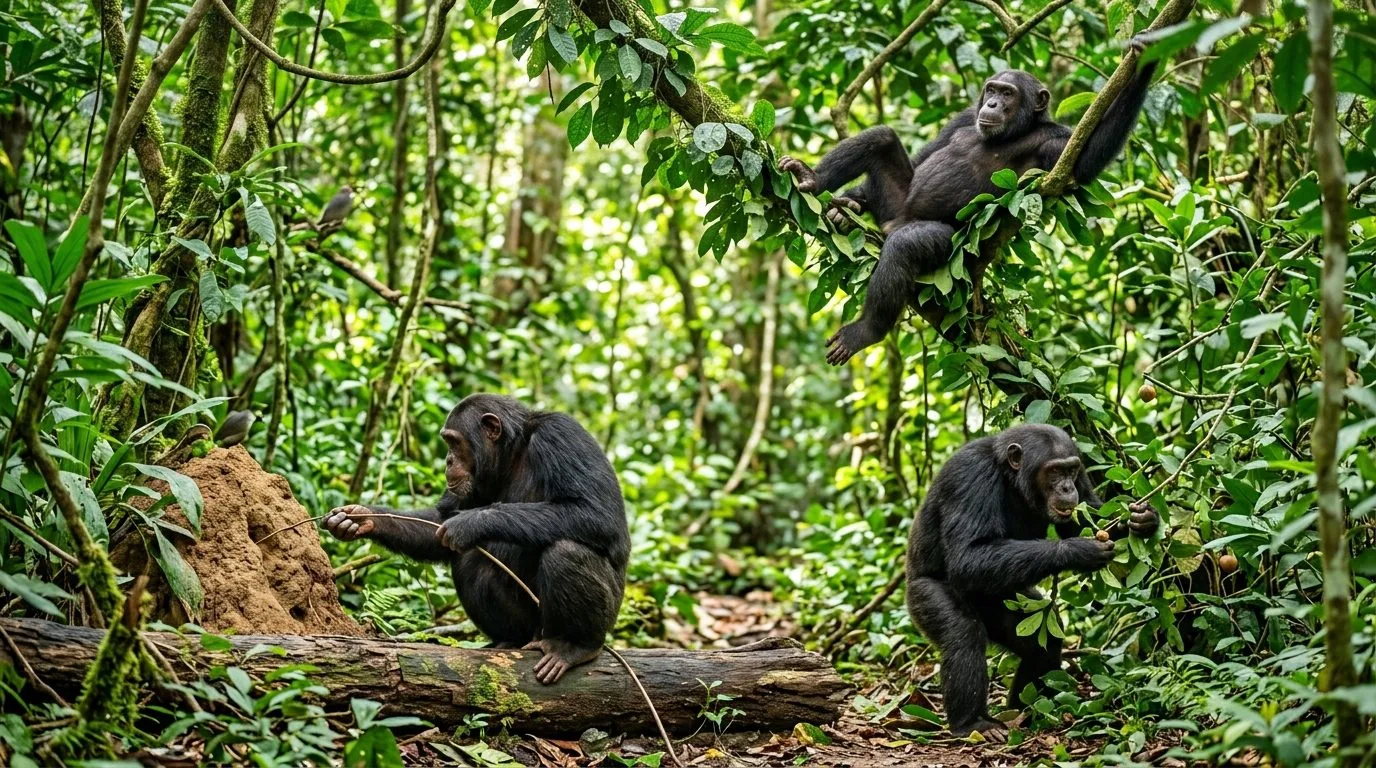
At Gombe in 1960, Jane Goodall observed chimpanzees using and modifying plant stems to extract termites, helping overturn the once-common assumption that toolmaking was uniquely human. The Jane Goodall Institute explains the importance of these observations.
In different regions, chimpanzees also use stones or wooden hammers to crack nuts, leaves as sponges to collect water, and tool combinations to access insects or honey. These techniques are not all found in every community. Tool choice, preparation and efficiency often require practice, and youngsters can learn by observing others. A study in Scientific Reports describes adults transferring termite-fishing probes to younger individuals in the Goualougo Triangle, consistent with a particular operational definition of teaching.
A 2024 study in Nature Human Behaviour further examined enduring individual variation in wild chimpanzee tool-use efficiency. These studies show that a behaviour's success may depend on both the animal's skill and its local environment.
Do chimpanzees have culture?
In animal-behaviour research, culture can refer to behaviours that spread or persist through social learning rather than solely through genes or immediate environmental necessity. Different chimpanzee populations have distinct tool preferences, grooming customs and foraging techniques. Such patterns offer evidence for cultural variation, although proving the role of social transmission in any particular behaviour requires careful analysis.
For example, some West African chimpanzee communities crack nuts with stones or wood, while others use different tools or techniques. Research in the Taï forest has examined how technical traditions persist even as individuals move between communities. The IUCN Great Ape Specialist Group treats cultural diversity as a conservation consideration, not merely an interesting curiosity.
This does not mean chimpanzee culture is identical to human language, technology or cumulative knowledge. Researchers debate how frequently innovations are built upon across generations and which learning processes support particular traditions.
How do chimpanzees communicate?
Chimpanzees communicate through a combination of vocalisations, facial expressions, gestures, body posture and physical contact. A loud “pant-hoot” can be heard over considerable distances; softer grunts and calls occur during close-range interactions. Gestures may help request grooming, initiate play or coordinate social behaviour.
Communication varies with context. Some chimpanzees drum on tree roots, and researchers have investigated whether timing and patterns help listeners identify individuals or track group movements. A 2024 review of gesture exchanges describes rapid turn-taking between chimpanzees, a feature that invites comparison with human conversation.
However, these discoveries do not prove that chimpanzees use human-style grammar or possess the same language capacities as people. They show rich, intentional and flexible communication whose mechanisms remain an active subject of research.
How do chimpanzee mothers raise their young?
Chimpanzee reproduction is slow compared with that of many smaller mammals. After a pregnancy of roughly eight months, a mother usually gives birth to one infant. Newborns depend heavily on her for warmth, transport and feeding. As infants grow, they begin to explore and play while retaining a close relationship with their mother.
Weaning and independence happen gradually; juveniles may learn foraging routes, social expectations and tool-using skills across several years. In many populations, females have years between surviving births, meaning that replacing individuals lost to hunting or disease is difficult. The Wisconsin factsheet describes reproduction and development, while field research on tool transfer illustrates how adults can support learning.
Chimpanzee mothers do not all behave identically. Their age, health, experience and social circumstances influence caregiving. Youngsters also learn from siblings and other members of the community, not exclusively from their mothers.
What is a chimpanzee's lifespan?
Chimpanzees can live for several decades, but lifespan statistics depend on whether researchers measure life expectancy at birth, survival among adults, age of the oldest individuals, or longevity under managed care. Wild individuals face disease, injury, food shortages and other hazards. Some chimpanzees in human care survive into their fifties or beyond; that does not make such ages typical for every population.
Older reference summaries often suggest wild adult lifespans on the order of 40 years or more for individuals that survive early hazards. The exact population average varies substantially, and short figures quoted without age or habitat context can be misleading. For a broader perspective on why lifespans differ across animals, read SuperEducational's biology of animal longevity guide.
Chimpanzees vs bonobos: are they the same animal?
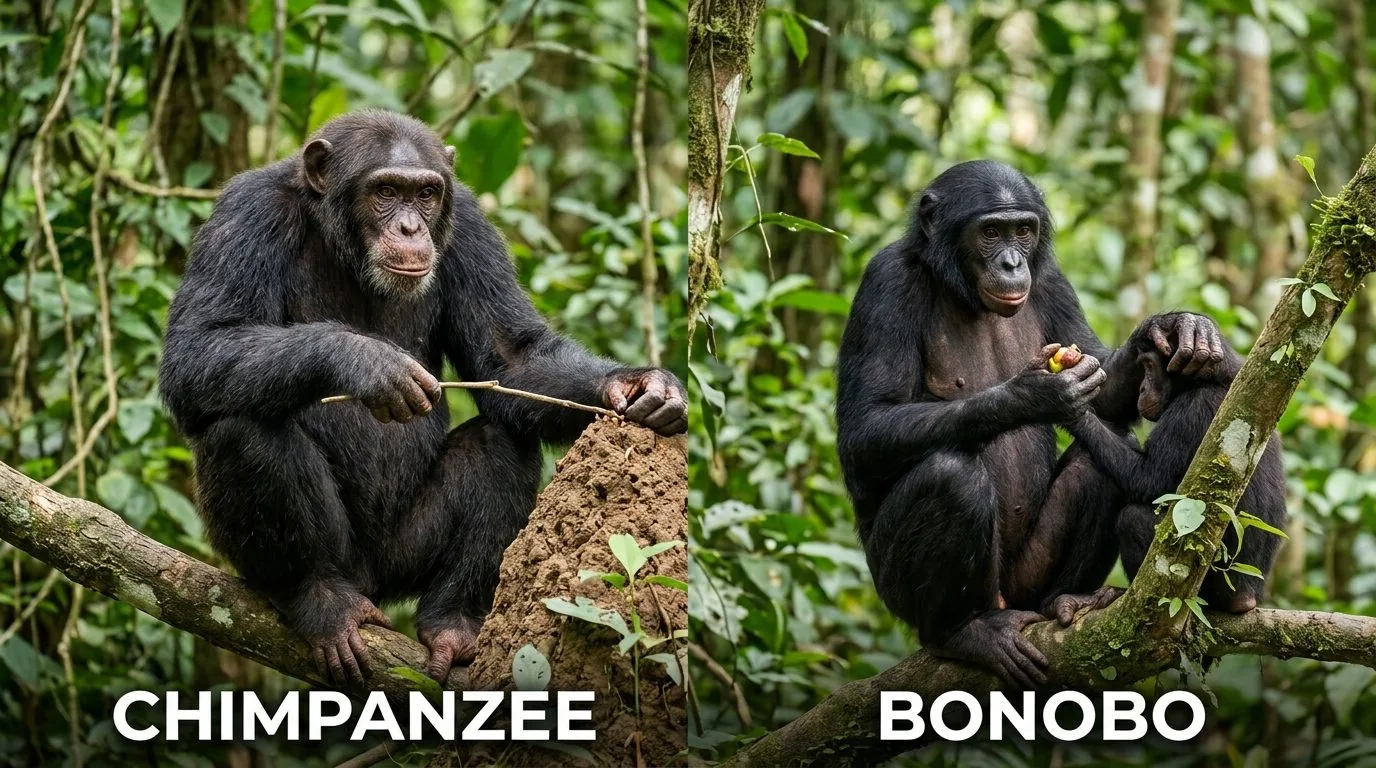
No. Common chimpanzees (Pan troglodytes) and bonobos (Pan paniscus) are different species within the same genus. Both are great apes and close relatives of humans. Bonobos are native to forests south of the Congo River in the Democratic Republic of the Congo, while common chimpanzees live in other parts of western and equatorial Africa.
Researchers have documented important differences in social structures, patterns of aggression, cooperation and sexual behaviour, but stereotypes such as “chimpanzees always fight, bonobos never do” are inaccurate. Individuals and groups vary, and their ecological and social settings also differ. The WWF bonobo profile provides a useful species comparison.
Are chimpanzees dangerous to people?
Chimpanzees are powerful wild animals and can cause serious injuries, particularly when frightened, provoked or habituated to inappropriate human contact. Their occasional friendly or playful behaviour should never be mistaken for domestication. Wild chimpanzees are not suitable pets, and physical interaction creates risks for people and for the apes.
Humans can also transmit infections to chimpanzees. Responsible research and wildlife tourism use local rules to maintain distance, avoid feeding, limit contact and minimise disease transmission. These precautions help protect an already threatened species. The WWF guidance on primates as pets explains welfare and trafficking concerns.
Why are chimpanzees endangered?
The common chimpanzee is listed as Endangered; populations have declined across parts of their range, with especially serious pressure in some regions. The western subspecies is considered Critically Endangered. Conservation assessments require attention to the exact species or subspecies and the date of the assessment rather than treating one label as appropriate for every local group.
| Threat | How it affects chimpanzees |
|---|---|
| Habitat loss and fragmentation | Farming, logging, roads and other development shrink or divide suitable habitat |
| Hunting and illegal trade | Adults may be killed; young animals may be captured or traded, sometimes after family members are harmed |
| Disease | Infections can spread within populations and sometimes between humans and apes |
| Human–wildlife conflict | Competition over food, crop damage and contact around settlements can increase risk |
| Slow reproduction | Females generally reproduce only after several years, slowing recovery from population losses |
See the World Wildlife Fund's chimpanzee profile , the IUCN western chimpanzee assessment overview and the Nigeria–Cameroon conservation programme .
No single global population figure is used here because estimates change with surveys, geographical coverage and methods. A population count should always be accompanied by the study area and date rather than presented as a timeless universal fact.
What conservation actions can help?
Chimpanzee protection combines several approaches. Habitat conservation protects key forests and movement corridors. Community-led programmes seek practical benefits and participation from people living near ape habitats. Anti-poaching and wildlife-law enforcement address direct threats, while monitoring and health precautions help identify disease and population changes.
Conservationists also study local cultural traditions. Protecting habitat without preserving the social networks and experienced tool users who transmit distinctive skills may still lead to behavioural losses. There is no single intervention that works everywhere: strategies need to consider local ecology, governance and community needs. The IUCN chimpanzee-cultures programme addresses the relationship between cultural diversity and conservation.
For general readers, useful actions include supporting transparent conservation initiatives, avoiding wildlife attractions that encourage handling or performances, refusing illegal primate products, and learning from credible science rather than sensational captive-animal videos.
Myths and facts about chimpanzees
| Common claim | Better-supported explanation |
|---|---|
| “Chimpanzees are monkeys.” | False: chimpanzees are great apes. |
| “Humans evolved from today's chimpanzees.” | False: humans and chimpanzees share an earlier common ancestor. |
| “Chimpanzees only eat bananas.” | False: diets are varied, mostly fruit, with many other plant and animal foods. |
| “Every chimpanzee makes the same tools.” | False: tool traditions and foraging techniques differ across populations. |
| “Chimpanzee societies are always peaceful.” | False: they include cooperation, strong bonds, rivalry and sometimes serious aggression. |
| “All chimpanzees live in rainforest.” | False: some live in woodland and savanna mosaics as well as forests. |
| “An intelligent chimpanzee makes a suitable pet.” | False: chimpanzees remain powerful wild animals with complex welfare and conservation needs. |
Frequently asked questions about chimpanzees
Are chimpanzees intelligent?
Yes. They show advanced social learning, memory, flexible tool use, problem-solving and communication. Their abilities vary with individuals, tasks and environments, so no single “IQ” captures chimpanzee intelligence.
Where are chimpanzees found in Nigeria?
The Nigeria–Cameroon chimpanzee (Pan troglodytes ellioti) occurs in parts of Nigeria and neighbouring Cameroon. Its range is patchy and conservation is important because of habitat fragmentation and other pressures.
Do chimpanzees eat meat?
Yes, sometimes. Although fruit and other plant foods dominate much of the diet, chimpanzees may hunt or eat insects and other animals, including monkeys in certain communities.
Do chimpanzees use tools?
Yes. Well-documented examples include extracting termites with plant stems, cracking nuts with stones or wood and using leaves as water-collecting sponges. The techniques vary by location and learning history.
How do chimpanzees sleep?
They commonly build temporary sleeping nests from branches and vegetation, often in trees, and generally make new nests rather than using the exact same structure indefinitely. Nesting choices vary with habitat and safety conditions.
How many babies does a chimpanzee have?
A female usually gives birth to one infant at a time and may have several years between births. That slow reproductive schedule contributes to population vulnerability.
Are chimpanzees endangered?
Yes. The species is classified as Endangered, and the western chimpanzee subspecies is Critically Endangered. Local conservation status and population trends vary across their range.
What is the difference between a chimpanzee and a bonobo?
They are distinct species of the genus Pan with overlapping but different biological and social traits and different natural distributions. Neither is simply a miniature version of the other.
Conclusion: why chimpanzees are remarkable and worth protecting
Chimpanzees combine complex social relationships with diverse diets, adaptable habitat use and sophisticated intelligence. Their toolmaking and cultural traditions show how behaviours can be learned and maintained within communities; their communication reveals rich social lives; and their ecological roles help connect animals with the forests they inhabit.
Yet their survival is not secure. Habitat destruction, hunting, wildlife trafficking and disease continue to threaten chimpanzees, with some subspecies facing especially severe risks. Understanding these great apes accurately—from their behaviour and diet to their distinct populations—is an important foundation for effective conservation and a better understanding of our shared evolutionary history.
References and further reading
- Wisconsin National Primate Research Center — Chimpanzee Species Factsheet
- Jane Goodall Institute — Gombe Stream Research Center
- IUCN Great Ape Specialist Group — Chimpanzee Cultures
- IUCN Great Ape Specialist Group — Nigeria–Cameroon Chimpanzee
- IUCN Great Ape Specialist Group — Western Chimpanzees
- World Wildlife Fund — Chimpanzee
- Smithsonian Human Origins Program — Frequently Asked Questions
- Scientific Reports — Tool Transfers Are a Form of Teaching Among Chimpanzees
- Nature Human Behaviour (2024) — Reliable Long-Term Individual Variation in Wild Chimpanzee Technological Efficiency
- Primate Archaeology Reveals Cultural Transmission in Wild Chimpanzees
- Smithsonian Magazine (2024) — Chimpanzees Take Turns in Fast-Paced Conversations
- World Wildlife Fund — Bonobo