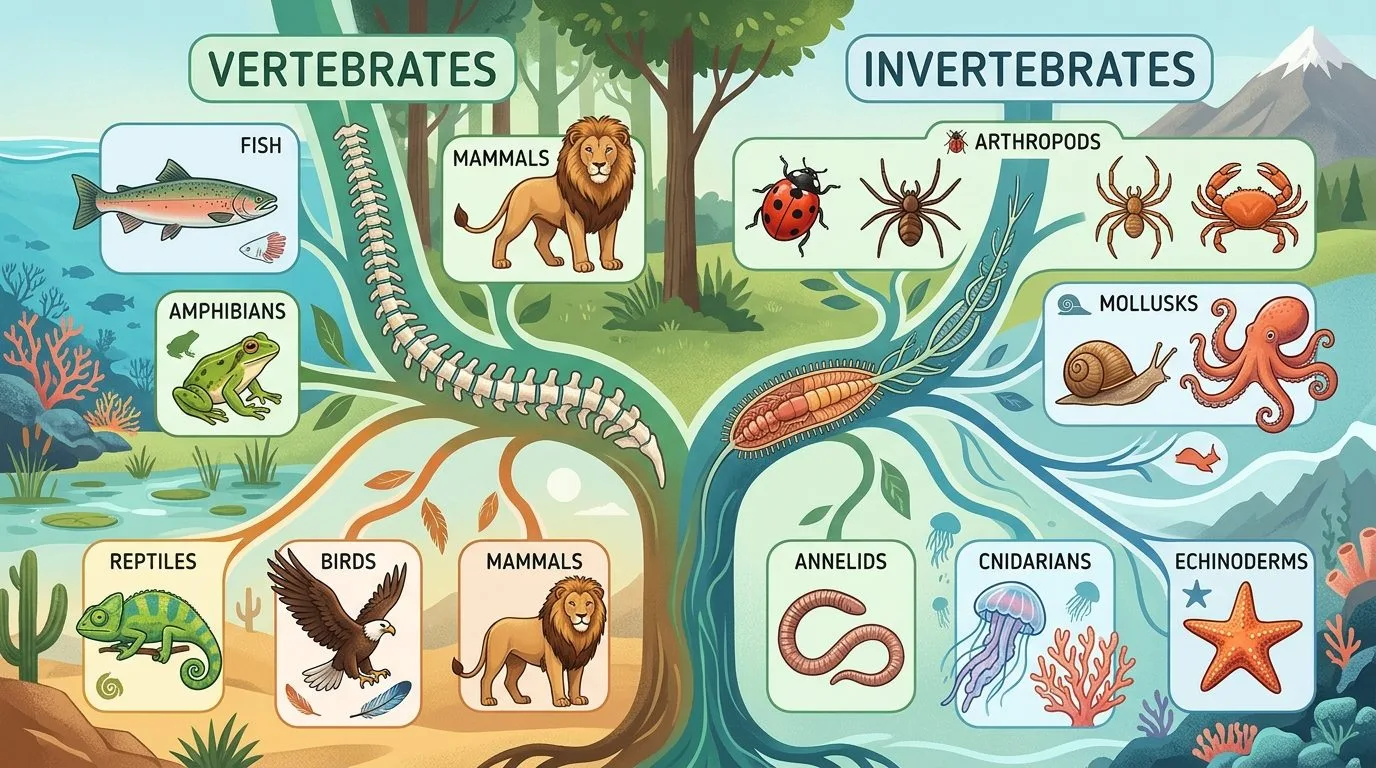
Animal classification is the process of organising animals into groups based on shared characteristics and evolutionary relationships. One of the easiest starting points is to distinguish vertebrates, such as birds, mammals and most familiar fishes, from invertebrates, such as insects, snails, jellyfish and sea stars. But this simple division is only the beginning: the animal kingdom contains many branches, and modern biologists use anatomy, development, fossils and DNA to understand how they are related.
Consider three creatures: a whale, an octopus and a sea star. All live in water; only the whale is a mammal with a vertebral column. An octopus is a mollusc, and a sea star is an echinoderm. An animal's habitat or appearance alone can be misleading, which is why animal classification asks deeper questions about body structures and shared ancestry.
This guide explains the five familiar school-level vertebrate groups, the main invertebrate phyla, the order of scientific classification, and common exceptions. It includes comparison tables, examples and a classroom-friendly identification key and quiz. The science is grounded in OpenStax's taxonomy chapter , its animal-evolution guide , and other authoritative references.
What makes an organism an animal?
Animals belong to the biological kingdom Animalia. In general, they are multicellular, have cells containing nuclei (eukaryotic cells), and obtain energy by consuming organic material rather than making their own food through photosynthesis. Animal cells lack the rigid cell walls typical of plants and fungi. Many animals move during at least one stage of life, although adult sponges and many corals remain attached in one place.
Animal bodies show enormous variety. Some have specialised organs and complex nervous systems; others, such as sponges, have comparatively simple organisations. A coral may resemble a plant, but coral polyps are animals. A jellyfish is also an animal, although it lacks bones, a heart like ours and a backbone. OpenStax Biology 2e explains the shared cellular and developmental features of the kingdom.
The eight basic levels of animal classification
Scientists use taxonomy to name and organise organisms. The familiar hierarchy moves from broad groups towards more specific ones:
- Domain: A broad division of cellular life; animals belong to Eukarya.
- Kingdom: Animals belong to Animalia.
- Phylum: A major animal branch, such as Chordata or Arthropoda.
- Class: A smaller group within a phylum, such as Mammalia.
- Order: A more specific grouping, such as Carnivora.
- Family: Closely related genera; lions belong to Felidae.
- Genus: A set of closely related species; for lions, Panthera.
- Species: The most specific standard rank in this sequence; the lion is Panthera leo.
The Integrated Taxonomic Information System's verified record for the lion supports this example. Scientists write the genus with a capital letter and the species epithet with a lower-case letter, usually italicising both: Panthera leo. Real taxonomy also includes extra ranks and unranked evolutionary clades; the eight-level sequence is a learning framework, not the complete modern tree of life.
Vertebrates versus invertebrates: what's the difference?
For introductory biology, a vertebrate is an animal belonging to the vertebrate lineage, typically with a backbone or vertebral column and a skull. Invertebrates are animals outside that lineage. The difference is useful, but there are subtleties: jawless hagfishes, for example, belong to the skull-bearing vertebrate evolutionary lineage despite lacking a typical series of vertebrae. And some invertebrates possess sophisticated internal or external skeletons.
| Feature | Vertebrates | Invertebrates |
|---|---|---|
| Main identification | Belong to the vertebrate lineage; most have a vertebral column | Outside the vertebrate lineage; no vertebral column |
| Skeleton | Usually an internal framework of bone or cartilage | May have a shell, exoskeleton, internal skeletal plates, spicules or no rigid skeleton |
| Examples | Lion, bat, penguin, crocodile, frog, shark | Butterfly, crab, earthworm, octopus, coral, sea star |
| Diversity | A smaller share of described animal species | The overwhelming majority of described animal species |
| Taxonomic status | A recognisable evolutionary lineage | A descriptive category containing many different lineages, not one equivalent evolutionary clade |
OpenStax estimates that roughly 97% of animal species are invertebrates, a useful approximate educational figure rather than an exact, unchanging worldwide census. Most animal diversity is in insects and other invertebrate lineages, not the large mammals and birds we tend to notice first. See OpenStax's introduction to invertebrates .
The five familiar groups of vertebrates
Many school lessons introduce five everyday groups: fishes, amphibians, reptiles, birds and mammals. This remains a helpful way to compare bodies and life cycles. However, these are not five equivalent, completely independent evolutionary branches. Birds evolved within the reptile lineage, while the traditional category “fish” excludes land vertebrates descended from ancient fish ancestors. These distinctions are explained later.
1. Fishes: vertebrates adapted mainly to water
Most fishes breathe using gills and swim using fins. Many have scales, but not all fish are covered in obvious scales, and not all fish have bony skeletons. Cartilaginous fishes include sharks, rays and skates; most familiar bony fishes include tilapia, salmon and tuna. Ancient jawless lineages include lampreys, with hagfishes presenting a special anatomical classification case.
Fish also differ greatly in reproduction, anatomy and habitat. Some live in the open ocean, others in rivers or deep water. The OpenStax fish chapter distinguishes the major lineages and explains that bony and cartilaginous skeletons are adaptations, not evidence that one group is “less advanced”.
When examining bony fish, scientists sometimes use tiny mineral structures called otoliths to estimate age and study environmental history. SuperEducational's guide to fish ear stones and ocean history explores that scientific technique.
2. Amphibians: frogs, salamanders and caecilians
Amphibians include frogs and toads, salamanders and newts, and limbless caecilians. Many begin life as aquatic larvae before undergoing metamorphosis into adults, although life cycles vary. Their skin is often moist and plays an important role in water balance and, in many species, gas exchange.
Amphibians are generally ectothermic: much of their body temperature depends on external conditions. Not every amphibian lives equally in water and on land, and not every species follows the familiar tadpole-to-frog sequence. The OpenStax amphibian overview covers their diverse body plans and life histories.
3. Reptiles: lizards, snakes, turtles and crocodilians
In the familiar classroom grouping, non-bird reptiles include snakes, lizards, turtles, tortoises, crocodiles and alligators. Their skin is typically protected by keratinised scales or related coverings that help limit water loss. Most are ectothermic, and their reproductive adaptations are not tied to water in the same way as those of many amphibians.
Not all reptiles lay eggs: some snakes and lizards give birth to live young. Snakes lack visible limbs but belong to the lineage of four-limbed vertebrates, called tetrapods. Modern evolutionary classification also places birds within the reptile ancestry, because birds evolved from theropod dinosaurs. For school comparison tables, “reptiles” often means non-bird reptiles. OpenStax explains that qualification .
4. Birds: feathered descendants of dinosaurs
Birds have feathers, beaks, two legs and forelimbs modified as wings. They lay eggs and are endothermic, generating much of their own body heat. Not every bird flies: ostriches, penguins and some other birds are flightless, yet they remain birds because of their shared ancestry and anatomical features.
Birds evolved from feathered theropod dinosaurs, so they are not separate from dinosaurs in an evolutionary sense: they are the surviving dinosaur lineage. The OpenStax bird chapter describes that history and adaptations for flight, while noting that living bird relationships continue to be refined by genetic research.
5. Mammals: animals that produce milk
Mammals are defined in part by mammary glands that produce milk and by hair, although hair may be sparse or difficult to see in species such as whales. Most mammals give birth to live young. Important exceptions include the monotremes—the platypus and echidnas—which lay eggs but are unequivocally mammals because they possess mammalian features and nourish their young with milk.
Mammals also include marsupials, such as kangaroos, and placental mammals, such as humans, lions, elephants and dolphins. Bats are mammals despite flying; whales and dolphins are mammals despite living in water. These examples show why skin covering, reproduction and evolutionary relationships are stronger clues than habitat alone. See OpenStax's mammal classification .
Quick comparison: the five vertebrate groups
| Group | Useful identifying feature | Examples | Important exception |
|---|---|---|---|
| Fishes | Primarily aquatic; gills and fins in most familiar species | Tilapia, shark, tuna | Not all have a bony skeleton or obvious scales |
| Amphibians | Often moist skin and a water-linked early life stage | Frog, salamander, caecilian | Not all undergo a free-swimming tadpole phase |
| Non-bird reptiles | Keratin-rich skin covering and amniote ancestry | Lizard, snake, turtle | Some give birth to live young |
| Birds | Feathers and beaks | Pigeon, eagle, penguin | Some cannot fly; birds belong within the reptile lineage |
| Mammals | Milk-producing glands and hair | Lion, bat, whale, platypus | Monotremes lay eggs; whales are aquatic mammals |
The major groups of invertebrates
Invertebrates are extraordinarily diverse. The main groups below are often discussed at the phylum level—a more fundamental scientific rank than a loose label such as “insect” or “worm”. They are not the only animal phyla, but they provide a useful introduction to different body plans.
Arthropods — jointed legs and external skeletons
Phylum Arthropoda includes insects, spiders, scorpions, crabs, lobsters, centipedes and millipedes. Arthropods have jointed appendages and a protective external skeleton (exoskeleton), often made largely of chitin. They periodically moult their outer covering as they grow.
Insects generally have six legs as adults, while spiders are arachnids with eight. Both are arthropods, but spiders are not insects. Crabs and shrimp belong to crustacean lineages. According to OpenStax's arthropod overview , arthropods comprise by far the largest number of described species among animal phyla.
Molluscs — soft bodies with very different forms
Phylum Mollusca includes snails, slugs, clams, mussels, oysters, squid and octopuses. Many have a muscular foot, a mantle and a soft body; shells occur in many, but not all, lineages. Octopuses and squids are cephalopods, a molluscan group with specialised arms and well-developed nervous systems.
A snail and an octopus look unlike one another, but their underlying anatomy and evolutionary history place them in the same phylum. The OpenStax mollusc and annelid guide describes the diverse modifications of the molluscan body plan.
Annelids — segmented worms
Phylum Annelida includes earthworms, leeches and many marine bristle worms. The name refers to the repeated segments that make up much of their bodies. Earthworms help mix and aerate soil, while marine annelids occupy many ecological roles.
However, “worm” is not a single scientific phylum. A flatworm and a roundworm are not annelids, even though all three can look elongated. Classification looks beyond a broadly similar body shape.
Cnidarians — stinging cells in jellyfish and corals
Phylum Cnidaria includes jellyfish, sea anemones, hydroids and corals. Their defining feature is the cnidocyte, a specialised cell that can contain a stinging structure called a nematocyst. Some species have a swimming, bell-shaped medusa stage; others are attached polyps or form colonies.
A coral reef is built largely by living animals and their skeletons—not by marine plants. Understanding that distinction helps explain coral ecology and the effects of warming waters. SuperEducational's article on coral bleaching and coral stress explores why bleaching does not necessarily mean every coral is already dead. See also OpenStax's Cnidaria chapter .
Sponges — simple animals that filter water
Phylum Porifera includes sea sponges. They attach to surfaces and draw water through pores, collecting food particles and oxygen. Sponges lack the complex organs found in vertebrates and do not have the same kind of organised tissues as most animals, yet they are unmistakably part of Animalia.
Because a sponge may appear motionless and plant-like, it is a classic example of why movement alone cannot define an animal. OpenStax's Porifera chapter explains their specialised filtering cells.
Echinoderms — sea stars, urchins and sea cucumbers
Phylum Echinodermata consists of marine animals including sea stars, brittle stars, sea urchins, sand dollars and sea cucumbers. Many adults show five-part body organisation and operate a distinctive water vascular system, often using tube feet to move, feed or attach.
Echinoderms possess internal skeletal plates called ossicles. But they have no vertebral column, so they are invertebrates. Interestingly, evolutionary evidence places echinoderms and chordates within the broader group Deuterostomia, making their relationship more informative than a simple “has bones versus no bones” rule. OpenStax explains the connection .
Flatworms and roundworms — two different phyla
Platyhelminthes are flatworms, including free-living planarians and parasitic tapeworms. Nematoda are roundworms with elongated, generally unsegmented bodies, including many free-living soil species and parasites. They differ from segmented annelids in body structure and development.
These examples highlight why common descriptive names such as “worm” are convenient but scientifically incomplete. Students should compare body plan, symmetry, segmentation and reliable reference descriptions before assigning a phylum.
At-a-glance table: common invertebrate phyla
| Phylum | Typical characteristic | Examples |
|---|---|---|
| Arthropoda | Jointed appendages, exoskeleton, moulting | Butterfly, spider, crab |
| Mollusca | Soft body; mantle and modified muscular foot | Snail, clam, octopus |
| Annelida | Segmented body | Earthworm, leech |
| Cnidaria | Specialised stinging cells | Jellyfish, coral, anemone |
| Porifera | Water-filtering body with pores | Sea sponge |
| Echinodermata | Water vascular system and skeletal ossicles | Sea star, sea urchin |
| Platyhelminthes | Usually flattened, unsegmented body | Planarian, tapeworm |
| Nematoda | Rounded, unsegmented worm-like body | Free-living roundworm |
Why vertebrates and invertebrates are not two equal branches of the family tree
The vertebrate–invertebrate distinction is practical, but invertebrates do not form one exclusive evolutionary clade comparable to vertebrates. They include sponges, insects, molluscs, echinoderms and even some members of the chordate phylum. Tunicates and lancelets are examples of invertebrate chordates: animals that share important chordate developmental features but are not vertebrates.
Similarly, familiar groups can be nested inside broader ancestry. Birds are surviving theropod dinosaurs within the reptile evolutionary lineage; tetrapods descended from lobe-finned fish ancestors. Thus, when a strict evolutionary family tree is required, “reptiles excluding birds” and “fish excluding land vertebrates” are not complete clades representing all descendants of their common ancestors.
Modern classification uses phylogenetics: evidence from DNA, anatomy, embryonic development and fossils to reconstruct relationships. A phylogenetic tree is a testable hypothesis that can change with new evidence. OpenStax's animal phylogeny discussion explains why some deep branches, including relationships among early animal groups, remain active research questions.
How to classify an unfamiliar animal: five questions
- Is it an animal? Does it fit the cellular and nutritional features of Animalia, rather than simply looking like a plant?
- Does it belong to the vertebrate lineage? Look for evidence of a skull and vertebral column while remembering special cases such as hagfishes.
- Which body-plan features stand out? Feathers, hair, jointed legs, segmented bodies, shells, stinging cells and water vascular systems can provide clues.
- How does it develop? Eggs, larvae, metamorphosis and other developmental features can help distinguish groups, but exceptions matter.
- What do reliable references and genetics show? Confirm the identification with taxonomic databases and current evolutionary evidence.
Do not rely only on whether the animal swims, flies or lives on land. A whale is not a fish, a bat is not a bird, and an octopus is not a vertebrate even though it has a complex brain.
Classroom activity: use a simple animal identification key
A dichotomous key offers two choices at each step, gradually narrowing an identification. The following small key is deliberately designed for six example animals only: cat, pigeon, frog, butterfly, spider and snail. It is not a complete identification guide for every animal on Earth.
- Backbone lineage? Yes: go to step 2. No: go to step 5.
- Hair and milk-producing mammal features? Yes: cat. No: go to step 3.
- Feathers? Yes: pigeon. No: go to step 4.
- Moist-skinned amphibian among our six examples? Yes: frog. If not, check the original list and observations.
- Jointed legs and arthropod exoskeleton? Yes: go to step 6. No: snail.
- Six legs as an adult? Yes: butterfly. Eight legs? Spider.
Safety and accessibility: Use photographs, drawings or approved models rather than catching wild animals. Children should not handle unknown insects, spiders, amphibians or marine organisms. Ask learners to explain the identifying clue and note which examples would not fit the key.
For a more advanced class, have pupils expand their key to include a crab, sea star and fish, checking their decisions against established taxonomic ranks and phylogenetic methods .
Animal classification practice quiz: ten questions
- Which kingdom contains animals? A. Plantae B. Animalia C. Fungi
- Which is an invertebrate? A. Frog B. Octopus C. Pigeon
- Which feature identifies an adult insect rather than a spider? A. Six legs B. Eight legs C. A backbone
- Which animal is a mammal? A. Penguin B. Dolphin C. Shark
- Which group includes corals and jellyfish? A. Cnidaria B. Annelida C. Chordata
- Which statement is correct? A. All mammals give birth to live young B. Some mammals lay eggs C. All mammals live on land
- Which phylum contains earthworms? A. Annelida B. Mollusca C. Echinodermata
- Why is a sea star an invertebrate? A. It lives in water B. It has no vertebral column C. It has no internal structures
- In evolutionary classification, birds are descended from which animals? A. Dinosaurs B. Modern bats C. Jellyfish
- Why is “invertebrates” a convenient but incomplete evolutionary grouping? A. It includes several unrelated animal lineages defined mainly by absence of vertebrae B. It contains no marine species C. Every invertebrate has six legs
Answer key with explanations
- B — Animalia. Animals are multicellular eukaryotes in the kingdom Animalia.
- B — Octopus. Octopuses are cephalopod molluscs, not vertebrates.
- A — Six legs. Adult insects have three pairs of legs; spiders usually have four pairs.
- B — Dolphin. Dolphins are aquatic mammals that breathe air and nurse their young.
- A — Cnidaria. Corals and jellyfish belong to a phylum with characteristic cnidocytes.
- B — Some mammals lay eggs. The platypus and echidnas are monotremes.
- A — Annelida. Earthworms are segmented annelid worms.
- B — No vertebral column. Sea stars have an internal skeleton of ossicles, but are not vertebrates.
- A — Dinosaurs. Modern birds belong to the theropod dinosaur lineage.
- A — Multiple lineages. Invertebrates are united by being outside Vertebrata, not by membership in one exclusive clade.
Why does animal classification matter?
Biologists use classification to identify species, compare organisms, study evolution and plan conservation. Knowing that corals are colonial cnidarian animals, for example, changes how scientists describe their growth and response to environmental stress. Knowing the differences between fish and mammals helps researchers understand breathing, reproduction and anatomy. Shared scientific names also help people in different countries discuss the same species.
Classification is not just memorisation. It teaches children to notice evidence, test categories and change an explanation when a counterexample appears. A rule that “all animals move” fails for many adult sponges, while “all mammals give birth to live young” fails for monotremes. Better science builds definitions that acknowledge those exceptions.
Frequently asked questions about animal classification
What are the two main animal groups taught in school?
Vertebrates and invertebrates. Vertebrates are the lineage that typically has a backbone; invertebrates include all animals outside that lineage. It is a useful beginner distinction, but not a complete evolutionary classification.
What are the five main vertebrate groups?
Fishes, amphibians, non-bird reptiles, birds and mammals are the five familiar school-level categories. Modern evolutionary biology also recognises that birds belong within reptile ancestry and that tetrapods evolved from fish ancestors.
Which group has the most animal species?
Invertebrates as a broad category account for the overwhelming majority of described animal species. Arthropods, particularly insects, account for a large share of this diversity. Exact totals change as species are described and taxonomies are revised.
Is a spider an insect?
No. Spiders are arachnids with eight legs; insects generally have six legs. Both belong to the arthropod phylum.
Are sharks vertebrates even though their skeletons are cartilage?
Yes. Sharks are cartilaginous fishes within the vertebrate lineage. Vertebrates do not all require a skeleton made mainly of bone.
Are whales fish or mammals?
Whales are mammals. They breathe air, nurse their young with milk and share mammalian evolutionary ancestry, despite living in the ocean.
Is a jellyfish a fish?
No. Jellyfish are cnidarian invertebrates. The common name is historical and does not describe membership in the fish lineages.
Why do scientists change animal classifications?
New fossil discoveries, improved anatomical comparisons and DNA evidence can reveal evolutionary relationships that earlier classification did not capture. Taxonomy is updated as that evidence develops.
Conclusion: classification is a map of animal diversity
Animal classification helps us understand how lions, frogs, birds, sharks, insects, snails, sea stars and corals fit into the enormous diversity of life. The introductory vertebrate–invertebrate division makes the subject approachable, while phyla, scientific names and evolutionary family trees reveal more precise relationships.
The best way to learn is to compare real examples, ask which traits truly define a group and remember important exceptions. As researchers gather new genetic, anatomical and fossil evidence, the animal family tree becomes more informative—and our understanding of biodiversity becomes more accurate.
Editorial and taxonomy check: 16 November 2026. School-level labels are identified where they simplify evolutionary relationships. This article is an educational overview, not a complete list of all animal phyla or species.