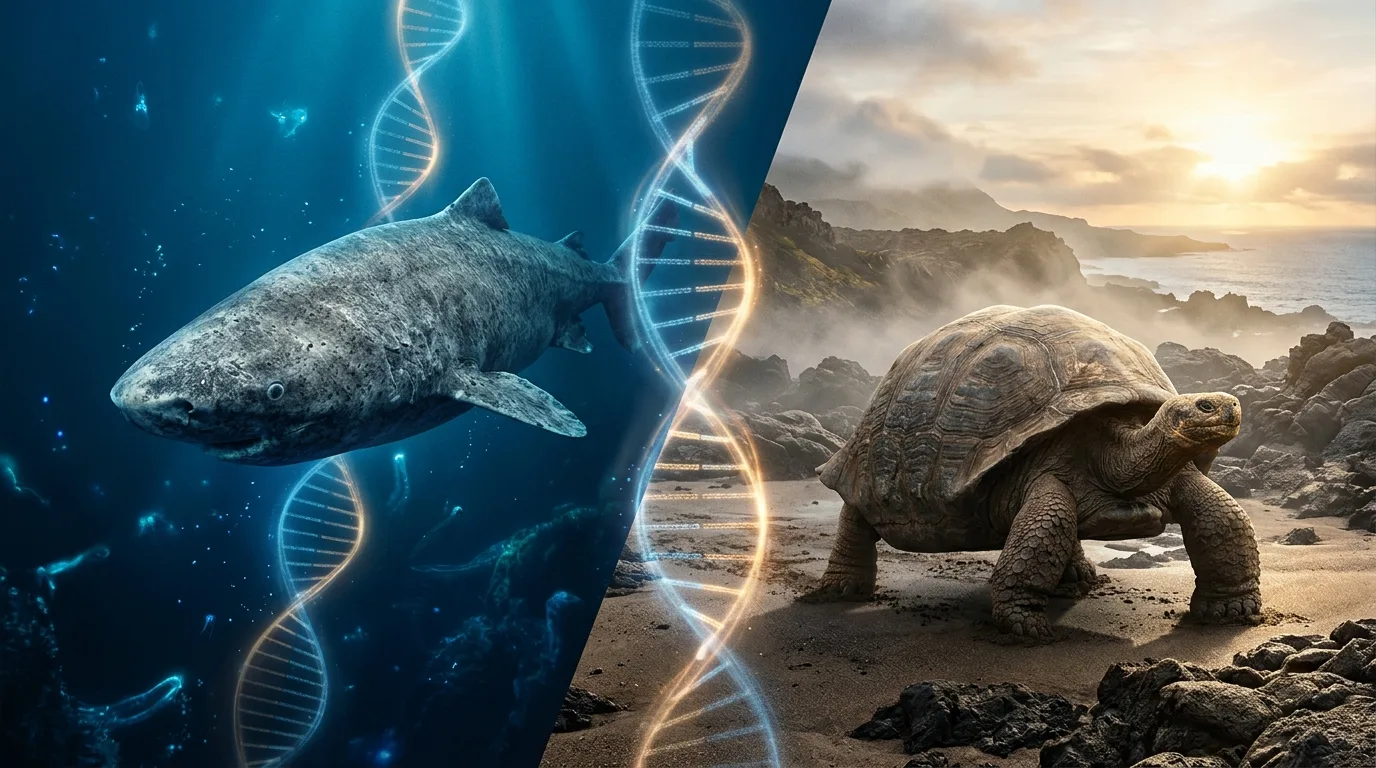
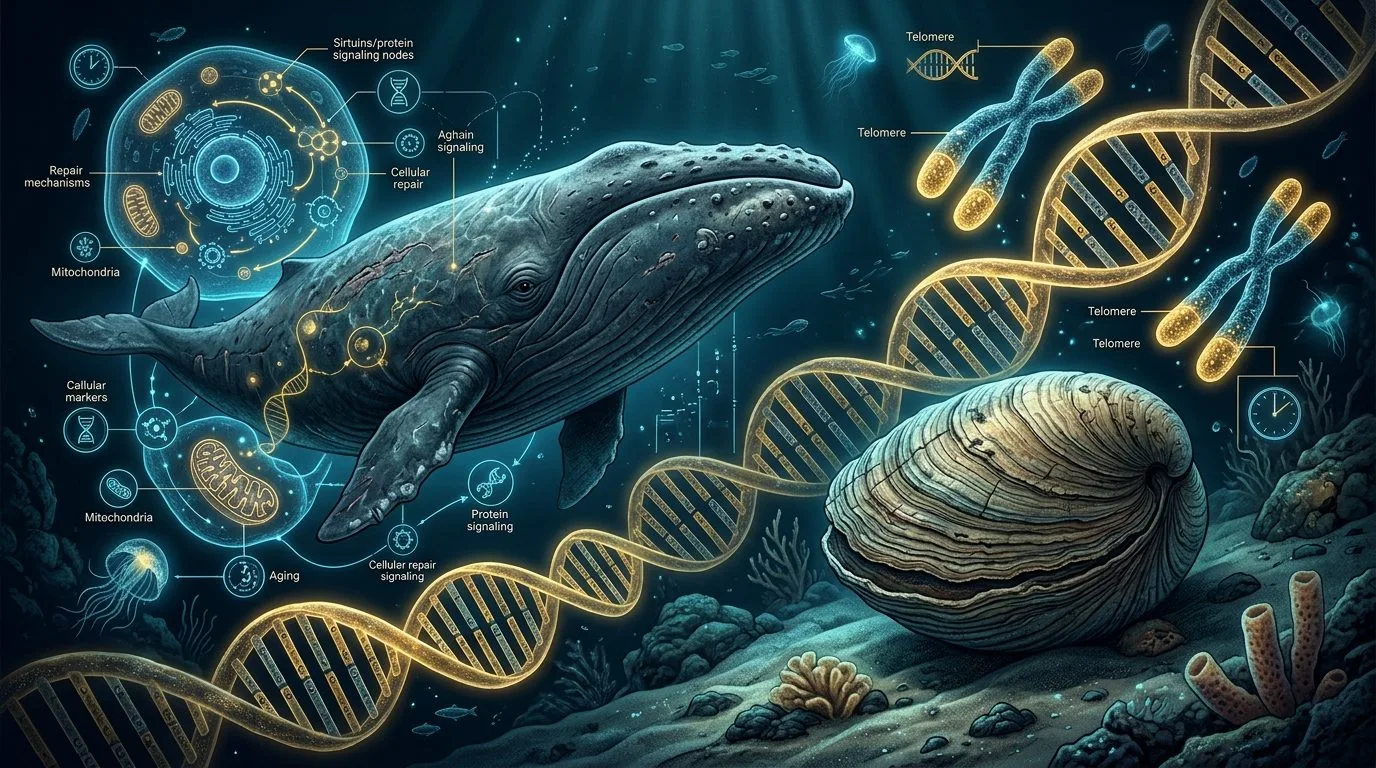
Some animals live for centuries because they have evolved ways to limit, repair or tolerate biological damage—and because their life histories and environments make long survival possible. There is no single longevity gene or universal formula. A bowhead whale can exceed 200 years, an ocean quahog clam reached a recorded 507 years, and Greenland sharks may survive for several centuries. Yet each belongs to a different branch of the animal family tree and appears to use a different combination of biological strategies.
Why do some species remain alive and functional for far longer than others? Researchers study DNA repair, cancer resistance, protein maintenance, metabolism, reproduction, protective body structures and the evolution of ageing. Recent discoveries include a 2025 study of unusually effective DNA repair in bowhead whales , a 2026 Greenland shark genome study and an October 2026 analysis of Jonathan, an approximately 194-year-old tortoise .
This article focuses on the biology behind the longest-living animals, rather than simply ranking their ages. It distinguishes established experimental findings from promising hypotheses, explains why unusually slow ageing does not mean immortality and shows what animal research may—and may not—teach us about human health.
What actually causes animals to age?
Ageing is not one event. Over time, cells and tissues may accumulate damage to DNA, proteins and other structures; systems that maintain normal function may become less effective; and the likelihood of certain diseases or death may rise. Scientists distinguish lifespan (how long an individual lives) from senescence (the deterioration or rising risk of death associated with age).
Animals also die from external hazards, including predators, starvation, storms, disease and human activity. A turtle killed by a vehicle at 30 years has not necessarily reached its biological limit. Conversely, an animal that survives to an extraordinary age may have benefited from both unusual biology and unusually favourable circumstances.
A 2025 review in Nature Aging describes comparative biology as a way to distinguish mechanisms shared across species from adaptations that are unique to individual evolutionary lineages. In that framework, there are several promising explanations for extreme animal longevity, but none has yet solved every aspect of ageing.
How do exceptionally long-lived animals compare?
| Animal | Longevity evidence | Biological question it helps researchers investigate |
|---|---|---|
| Bowhead whale | Can exceed 200 years | How very large mammals maintain DNA integrity and control cancer risk |
| Ocean quahog clam | Documented individual aged 507 years | Oxidative stress resistance, protein stability and low-energy survival |
| Greenland shark | Central age estimate 392 ± 120 years in a 2016 study | DNA maintenance, genome architecture and slow life-history strategies |
| Giant tortoises | Jonathan estimated at about 194 years in 2026 | Epigenetic stability, disease resistance and delayed functional decline |
| Naked mole-rat | More than 37 years in a small rodent | Cancer resistance and relatively slow age-related deterioration |
These numbers are maximum records or estimates, not average lifespans. The Greenland shark estimate is particularly uncertain; Canada's 2025 assessment notes the absence of an independent technique that can validate its eye-lens dating. The value of comparing these animals lies less in declaring one winner than in identifying how nature achieves long survival in several different ways.
1. DNA repair: keeping the biological instructions readable
DNA carries information needed for cells to function. Everyday metabolism, environmental exposure and normal cell division can damage it. Cells possess repair systems that identify many kinds of damage, but these systems are not perfect. A lifetime of unrepaired or incorrectly repaired mutations can interfere with tissue function and raise the risk of cancer.
One of the most striking recent examples comes from bowhead whales, which may live for more than 200 years despite having enormously more cells than humans. In a 2025 Nature study, researchers investigated DNA double-strand break repair in bowhead whale cells. They reported greater efficiency and fidelity of certain repair processes and identified CIRBP, a cold-inducible RNA-binding protein, as a contributor to protection against DNA damage.
The research was especially interesting because bowhead cells were not simply resistant to every laboratory method of cancerous transformation. Some tests found they could be transformed with fewer oncogenic changes than human fibroblasts. The results instead point towards preventing mutations from accumulating in the first place—a potentially different solution to cancer avoidance. Read the original bowhead whale study .
Related experiments found that CIRBP could improve repair in human cells and extend survival in experimental fruit flies, but these are laboratory observations. They do not establish that increasing CIRBP in humans would safely prevent ageing, extend human lifespan or treat cancer.
2. Cancer resistance: why bigger bodies need special protection
A large animal has many more cells in which harmful mutations could occur, and a long-lived animal has more time for such changes to accumulate. Yet a whale is not simply thousands of times more likely to develop cancer than a mouse. This mismatch between a simple cell-count expectation and observed patterns across species is called Peto's paradox.
Different animals may have evolved different ways to reduce their risks. In elephants, researchers identified an expanded family of TP53-related genes associated with a heightened response to DNA damage. TP53 is involved in mechanisms that can stop the cell cycle or help eliminate seriously damaged cells. The relevant 2016 eLife research describes around 20 TP53-related copies in elephant genomes and how they influence cellular responses.
Bowhead whales appear to illustrate a partly different strategy focused on high-fidelity DNA repair. These findings show why scientists should not expect every long-lived animal to use the same anticancer mechanism. Neither elephant nor whale biology gives a straightforward prescription for humans, and cancer can still occur in long-lived species.
3. Protein maintenance and oxidative damage: lessons from a 507-year-old clam
The ocean quahog, Arctica islandica, is famous for one specimen dated to 507 years using its shell's annual growth increments. Its survival also makes it a useful laboratory model for how living tissues handle years of chemical stress.
Normal cellular activity can produce reactive oxygen species (ROS). These molecules have useful signalling roles, but in excess they can damage proteins, lipids and other cellular structures. Cells normally balance ROS production with antioxidant defences and repair or removal mechanisms. Ageing scientists call this balance redox homeostasis.
Comparative experiments found that the ocean quahog displayed lower production of some reactive oxygen species and less accumulated oxidative damage in certain tissues than a shorter-lived clam species. The study of oxidative stress in Arctica islandica supports a relationship between cellular damage resistance and extreme lifespan. It does not prove that antioxidants alone create a five-century life.
Other research investigated the clam's heart and systems that identify and dispose of damaged proteins. Some molecular indicators remained surprisingly stable across ages in sampled animals. These systems are part of proteostasis: the continual process of making, folding, maintaining and removing proteins so cells keep functioning. See the research on cardiac protein maintenance in old ocean quahogs .
Quahogs can also adjust metabolism during periods of low oxygen, including when buried. Such physiological flexibility may help them endure environmental stress, although researchers are still testing how directly that ability contributes to longevity.
4. Slow metabolism: an advantage, not a universal rule
Many famously long-lived animals live in cold or low-energy environments. Greenland sharks move slowly in deep Arctic waters; ocean quahogs spend much of their lives buried in sediment; and some deep-sea invertebrates grow at extraordinarily slow rates. These life histories invite the hypothesis that lower energy demand can reduce some sources of cellular wear.
That is plausible for certain species, but it is not a universal biological law that a lower metabolic rate always leads to a longer life. Birds and bats can have high energy demands and still live unusually long relative to similarly sized mammals. Genetics, ecological risk, repair systems, body size and reproduction can affect the relationship.
In ocean quahogs, experiments on burrowing and metabolic depression show physiological adjustments to low-oxygen conditions. In Greenland sharks, slow metabolism is an observed part of an unusual deep-sea lifestyle. The evidence does not support telling people that lowering their heart rate, body temperature or oxygen intake will reproduce such longevity.
5. Greenland sharks: what a new genome reveals—and what remains unknown
In 2016, researchers used radiocarbon analysis of eye-lens nuclei to estimate the ages of 28 female Greenland sharks. The largest shark received a central estimate of 392 ± 120 years, and the study suggested sexual maturity might occur around 156 ± 22 years. Those figures describe probability-based estimates, not precisely recorded birthdays. See the original Science paper .
A 2026 PNAS genome study added molecular clues. Researchers assembled the shark's approximately 5.9-billion-base-pair genome and identified possible longevity-related features associated with DNA repair, cancer resistance and genome organisation. Some changes in a protein called histone H1.0 were predicted to affect how tightly DNA is packaged into chromatin.
Chromatin helps organise and protect the genome. A stable system for packaging DNA could be relevant to cellular maintenance, but the authors were describing hypotheses from genetic analysis, not demonstrating that a particular shark gene caused an individual animal to live for 400 years. The study also raised possible connections involving ferroptosis, an iron-dependent form of regulated cell death, that require further investigation.
Another 2026 Nature Communications study of Greenland shark vision found a functioning visual system adapted to dim light and evidence of DNA repair-associated activity in retinal tissue. This challenges the idea that all shark tissues simply deteriorate with age. But preserving vision in some examined specimens is not proof that every Greenland shark avoids ageing or that vision remains perfect for centuries.
6. Giant tortoises: slow ageing may be a life-history adaptation
Many tortoises and turtles have protective shells, slow reproductive strategies and long adult lives. Researchers suspect that these traits can alter the evolutionary pressures that shape ageing. A durable shell may reduce predation on adults, making it more worthwhile, in evolutionary terms, to maintain the body over many years.
In a study of 52 turtle and tortoise species in zoos and aquariums, approximately 75% showed slow or negligible senescence within the studied conditions, and ageing rates in about 80% were lower than in modern humans. These percentages describe the study's analysed species and survival patterns, not a guarantee that every turtle does not age. See the 2022 Science research on turtle senescence .
A complementary NIH summary of wild reptile and amphibian research reported that protective features such as shells, spines and other defensive traits are associated with slower ageing patterns in some lineages. Importantly, reptiles and amphibians also include short-lived species. Being cold-blooded does not automatically explain a long lifespan.
7. Jonathan at 194: DNA methylation and the ageing epigenome
The giant tortoise Jonathan, living on St Helena, has an estimated birth year of 1832 and an approximate age of 194 years in 2026. His age is supported by historical evidence, but his exact hatching date is unknown.
An October 2026 Science Advances study sequenced his genome and investigated his epigenome—chemical marks and other regulatory features that affect how genes are used without changing the underlying DNA sequence. The researchers studied DNA methylation and the variability or entropy of those patterns, comparing Jonathan with a small set of other tortoises.
They reported comparatively stable methylation patterns in some regulatory regions linked to mitochondrial energy production and RNA metabolism. Such stability could be relevant to keeping cells working late in life. The work also identified genetic variants associated with pathways that scientists investigate in ageing biology.
However, the comparison centred on one exceptionally old tortoise, with a limited number of other animals and substantial differences in life history and environment. The data do not show whether his unusual epigenetic patterns caused his survival or are consequences of reaching a very old age. Jonathan's nutrition, husbandry, access to veterinary care and sheer chance also matter.
8. Evolution: why would natural selection favour a long life?
To understand extreme longevity, scientists also ask what happens in the wild. Natural selection can favour biological traits that improve the chance of surviving and reproducing. If predators or hazards kill most adults young, there may be less evolutionary advantage to maintaining an exceptionally durable body decades after typical reproduction.
But when adult survival is relatively high, animals may benefit from growing slowly, reproducing over many seasons and investing in maintenance. Protective shells, large body size, protected burrows, social colonies or environments with fewer predators can change the balance of risk. Evolutionary biologists refer to these differences as life-history strategies.
Research across wild reptiles and amphibians in Science (2022) found varied ageing rates and relationships with protective traits, temperature regulation and pace of life. Such broad comparisons are useful precisely because they challenge easy rules like “cold-blooded animals live longer” or “large animals live longer.”
There are trade-offs. A shark that matures at more than a century may be well suited to a relatively stable long-term environment, but it can recover very slowly when fishing removes breeding adults. A biological strategy that worked over evolutionary time may be vulnerable to rapid environmental changes.
9. The naked mole-rat: why small animals can also age slowly
Long life is not limited to enormous whales or century-old reptiles. The naked mole-rat, a small burrowing rodent native to East Africa, has a maximum recorded lifespan exceeding 37 years—extraordinary for such a small mammal.
A 2023 review in Annual Review of Animal Biosciences discusses the species' comparatively delayed age-related decline, cancer resistance, tolerance of low-oxygen underground environments and unusual social organisation. Some studies found little increase in mortality with age over the available observation period, but this is not proof that any naked mole-rat is biologically indestructible.
Naked mole-rats are a powerful reminder that extreme longevity is about survival relative to the species' size and evolutionary expectations—not just whether an animal reaches a dramatic three-digit age.
10. Why an ancient animal is not always a single ancient individual
Coral colonies and some sponges can persist over very long periods. For instance, a black coral colony was dated to about 4,265 years, and some giant glass sponge skeletal structures have modelled ages reaching thousands of years. Those examples are scientifically impressive, but they are not interchangeable with the documented age of an individual clam.
A coral colony contains many polyps, and a long-lived shared skeleton or genotype can outlast particular polyps. A giant sponge spicule age may depend on models and environmental assumptions. For biological comparisons, scientists separate individual age, colony age, clonal lineage age and estimated skeletal age.
This difference matters for mechanisms: maintaining an intact individual animal for centuries may demand different solutions from replacing modules of a colony over millennia. The NOAA explanation of coral longevity describes several such distinctions.
How can researchers test a longevity hypothesis?
There are several levels of scientific evidence. Observing a gene variant in a long-lived species provides a correlation. Measuring its effect in cells offers stronger functional evidence. Changing the gene experimentally in a model organism and observing effects on damage or lifespan can support a causal role in that model. None of these automatically proves the same intervention will work safely in people.
| Research approach | What it can reveal | What it cannot establish alone |
|---|---|---|
| Longevity records and age dating | How long a particular animal may have lived | The molecular reason for longevity |
| Comparative genome sequencing | Gene variants, gene families and potential pathways | Whether the discovered features actually caused a long life |
| DNA methylation or protein studies | Patterns of gene regulation and cellular activity | Whether the patterns are cause, consequence or coincidence |
| Cell culture experiments | Responses to DNA damage, stress or cancer-related changes | Whole-animal lifespan or the safety of human treatment |
| Long-term animal follow-up | Age-specific survival, reproduction and health changes | The complete lifespan of every member of a species |
One way to understand the challenge is to compare the act of measuring age with the act of explaining ageing. Researchers can count growth increments in shells or certain fish structures; SuperEducational's published article How Do Fish Ear Stones Record Age, Migration and Ocean History? explains why otoliths are useful. Such measurements tell us an age, not necessarily why the animal survived that long.
Does negligible senescence mean an animal is immortal?
No. Negligible senescence is a demographic or physiological description suggesting little measurable worsening with age across the period studied. It does not mean an animal can never die, never experience disease or remain exactly the same forever. Even a species whose death risk changes little with age still faces external hazards.
Some creatures, such as the hydrozoan Turritopsis dohrnii, can reverse parts of their life cycle in special conditions. That is another fascinating form of biological plasticity, but it is different from simply living an exceptionally long adult life. The vocabulary matters: rejuvenation, slow ageing and long survival are not synonyms.
Can animal longevity discoveries extend human life?
Studying extremely long-lived animals may identify pathways that protect cells and tissues. Researchers are interested in DNA repair, chromatin stability, protein clearance, mitochondrial health and immune regulation. These discoveries can guide fundamental experiments and may eventually inform medical research.
But a claim that a whale gene, tortoise supplement, cold exposure technique or antioxidant regimen can extend human lifespan by decades would go far beyond the current evidence. Cells grown in a laboratory are not whole humans, and a genetic adaptation evolved in one species may create unexpected costs if transplanted into another.
The responsible conclusion from the 2025 comparative-biology review is that species-specific adaptations can reveal useful scientific principles while requiring careful validation before any translation to human health.
Why extreme longevity also creates conservation risks
Animals capable of living a very long time often grow or reproduce slowly. A Greenland shark that may require more than a century to reach maturity cannot quickly compensate for adults lost through fishing. Slow-growing deep-sea animals are easily damaged by bottom-contact equipment, while warming waters and habitat degradation can threaten ocean quahogs and other long-lived species.
Survival over centuries does not make a species resilient to sudden human pressure. Individual animals can endure natural conditions for generations, yet populations may decline rapidly if habitat and breeding adults are removed faster than they can be replaced. Conservation decisions must consider longevity alongside fertility, age at maturity, juvenile survival and environmental change.
Classroom exercise: one longevity record, three possible explanations
Choose one species—the bowhead whale, ocean quahog, Greenland shark, giant tortoise or naked mole-rat. Draw three columns labelled evidence, hypothesis and unknown. Place one finding in each column: for example, a whale's measured DNA repair is evidence; the claim that repair helps extend the animal's life is a supported but still developing hypothesis; and its exact contribution to maximum lifespan remains unknown.
Ask students to explain whether the result came from direct age measurement, genomic comparison or a laboratory experiment. This exercise teaches why scientific uncertainty is a strength when it helps distinguish what was observed from what is inferred. No wildlife handling is needed.
Frequently asked questions
Why do some animals live for hundreds of years?
They may combine cellular maintenance, effective DNA repair, disease resistance, slow growth, protective structures and life-history strategies that favour long adult survival. The balance differs among species, and no single mechanism explains all cases.
Do Greenland sharks really live for 400 years?
Research supports extraordinary longevity, but the best-known age of 392 ± 120 years is an estimate from radiocarbon analysis of eye lenses, not a documented birth date. Scientists are still evaluating the underlying assumptions.
How do bowhead whales resist cancer?
A 2025 study found evidence of unusually effective DNA repair, involving CIRBP and enhanced repair fidelity in laboratory experiments. It is an important clue, not a complete or proven explanation for every whale's lifespan.
Is a slow metabolism enough to make an animal live longer?
No. It may contribute to the life history of some species, but genetics, cellular maintenance, predators, reproduction and environment also matter. High-metabolism animals such as some birds and bats can be long-lived for their size.
What does negligible senescence mean?
It describes unusually little age-related deterioration or increase in mortality across the period observed. It does not mean that animals cannot die or that they never experience illness.
Why is Jonathan the tortoise so old?
Researchers found unusual genetic and epigenetic patterns linked to cell maintenance and energy functions. However, Jonathan's age cannot be attributed to any one proven gene, and his environment and care may also contribute.
Can humans copy the longevity of long-lived animals?
Not with any established method. Comparative biology helps scientists investigate potentially useful pathways, but the findings are not evidence for untested anti-ageing supplements, genetic treatments or lifestyle claims.
Does being cold-blooded automatically make animals long-lived?
No. Research on reptiles and amphibians finds highly varied ageing rates. Some turtles age slowly, but temperature regulation alone does not determine lifespan.
Conclusion: longevity is an evolutionary toolkit, not a single secret
The biology of the longest-living animals shows that evolution has produced multiple ways to preserve function over time. Bowhead whales offer clues to unusually accurate DNA repair; ocean quahogs show cellular resilience to oxidative damage; Greenland sharks provide new genomic hypotheses; and tortoises illustrate how life history and the epigenome may relate to very slow ageing.
None of these animals provides a ready-made cure for ageing. Together, however, they give researchers new ways to ask how cells avoid damage, how bodies control disease and why natural selection sometimes rewards extremely long survival. The scientific challenge is to move from intriguing comparisons to carefully tested explanations—and to protect these remarkable animals long enough to learn from them.
Research checked on 16 November 2026. Longevity figures and mechanisms are qualified by the evidence available. This educational article is not a source of medical or anti-ageing treatment advice.