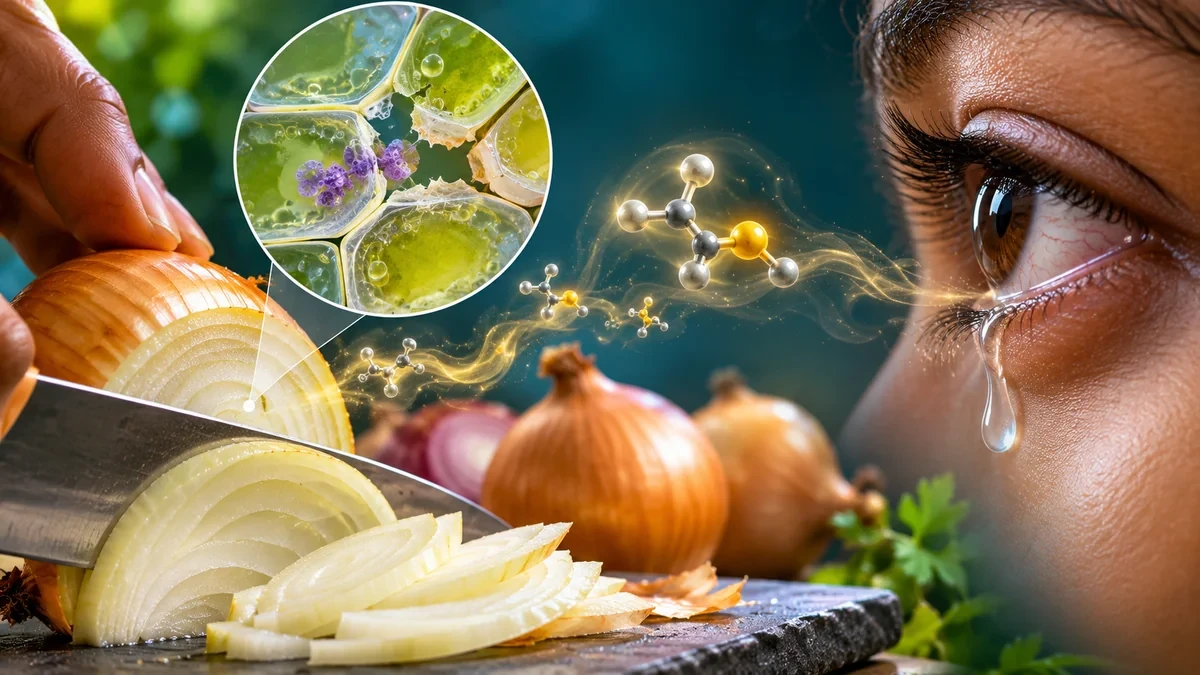
Why do onions make you cry? Cutting an onion breaks open its cells and allows naturally occurring sulfur-containing compounds to react with enzymes. The reactions form a volatile eye irritant called syn-propanethial-S-oxide (also called the onion lachrymatory factor). When it reaches the moist surface of your eyes, sensory nerves respond and your tear glands produce extra tears to help wash the irritant away. These are reflex tears, not tears caused by emotion.
The key chemistry involves two enzymes: alliinase, which helps create a reactive intermediate, and lachrymatory-factor synthase (LFS), which converts that intermediate into the tear-triggering molecule. That second enzyme was identified as essential to the process in a landmark 2002 Nature paper. Research published in 2017 clarified its molecular structure; a separate 2025 study explained how knife sharpness and cutting speed influence droplets ejected from an onion. Together, these findings make a familiar kitchen nuisance a fascinating example of plant biology, organic chemistry, physics and human physiology.
This guide separates what scientists know from popular kitchen myths and explains how to reduce irritation without turning onion preparation into a risky experiment.
The short explanation: five steps from onion to tears
- The onion is cut. A knife damages many plant cells and disrupts the separation between chemical precursors and enzymes.
- Alliinase starts the reaction. It acts on particular sulfur-containing molecules and produces reactive sulfenic-acid intermediates.
- Lachrymatory-factor synthase takes over. This enzyme converts a specific intermediate into (Z)-propanethial S-oxide, commonly called syn-propanethial-S-oxide.
- The irritant reaches the eyes. This volatile compound travels through the air; onion cutting can also eject fine liquid droplets.
- Reflex tears protect the eyes. Irritation activates sensory pathways and increases tear production, helping dilute and clear the substance.
That mechanism is described by the National Capital Poison Center and investigated in the original 2002 Nature study .
What is inside an onion before you cut it?
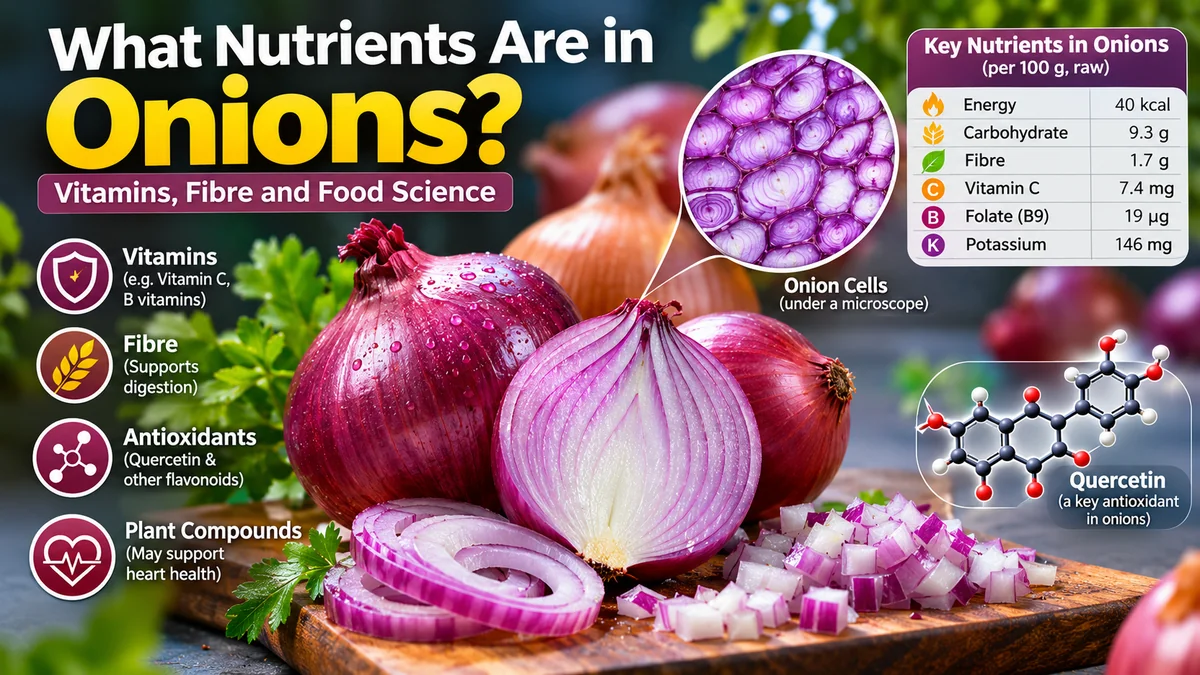
An onion is not a container full of pre-made tear gas. Instead, its tissues hold precursors that can generate an irritant after cell damage. A major precursor of the onion tear reaction is S-(1-propenyl)-L-cysteine sulfoxide, often called isoalliin. It is one of several sulfur-containing molecules found in members of the Allium group, which includes onions, garlic, leeks and related plants.
Cells organise their contents into compartments, so reactive substances are not constantly mixed together. Injury disrupts that arrangement. A blade, animal bite or crushing force can bring enzymes into contact with molecules that had been kept apart. This helps explain why an intact onion smells relatively mild while a freshly chopped one can become pungent in seconds.
The chemistry is part of a broader set of responses associated with damaged Allium tissue. Some of the compounds formed are thought to contribute to defence against organisms that feed on or infect plants. That biological interpretation is plausible, but the immediate reason your eyes water is the chemical reaction that follows tissue damage—not a conscious action by the onion.
The chemistry explained: alliinase, sulfenic acid and LFS
Stage 1: damaged cells activate the alliinase pathway
Alliinase is an enzyme that acts on certain sulfur-containing amino-acid derivatives. In onions, this process generates 1-propenesulfenic acid, a reactive intermediate. Other substances formed from related reactions help explain the characteristic smell and taste of a freshly cut onion.
It is a mistake to jump straight from “sulfur” to “sulfuric acid.” Sulfur appears in many different organic compounds, and their properties depend on molecular structure. The volatile molecule involved here is a specific sulfur-containing organic compound, not a puff of elemental sulfur.
Stage 2: lachrymatory-factor synthase produces the irritant
For years, researchers thought the irritating compound formed largely through a spontaneous rearrangement after the action of alliinase. Work by Imai and colleagues, published in Nature in 2002, demonstrated the crucial role of another enzyme: lachrymatory-factor synthase, abbreviated LFS.
LFS catalyses the conversion of the sulfenic-acid intermediate into (Z)-propanethial S-oxide, the onion's lachrymatory factor. An especially useful 2017 study determined the enzyme's crystal structure and proposed how its active site assists this rearrangement. The research appears in Enzyme That Makes You Cry—Crystal Structure of Lachrymatory Factor Synthase from Allium cepa .
“Lachrymatory” simply means causing tears. You may encounter the chemical written as syn-propanethial-S-oxide, (Z)-propanethial S-oxide or, in some sources, with a closely related spelling of its name. These describe the same principal onion tear factor in this context.
Stage 3: the volatile product disperses
Once produced, the irritant can leave the damaged tissue and move through the surrounding air. How much reaches your face depends on several things: how vigorously you cut, how much onion tissue is damaged, your distance from the board and the airflow around the preparation area.
You do not have to touch your eye with onion juice to start tearing. Airborne exposure is enough. However, transferring onion residue directly to your face with your fingers can increase discomfort, so it is sensible to avoid touching or rubbing your eyes while preparing onions.
What happens when onion vapour reaches your eyes?
The front surface of the eye is protected by a thin tear film. When the onion's lachrymatory factor comes into contact with this surface, it can irritate sensitive nerve endings. Signals then trigger protective responses, including additional tear production by the lacrimal glands. Blinking helps spread the tears and move the irritant away.
These are known as reflex tears. Other examples include watering caused by smoke, dust and some strong fumes. Reflex tears are different from the tears associated with sadness or strong emotion, although the liquid is produced through overlapping anatomical structures. The American Academy of Ophthalmology's explanation of tears distinguishes these functions.
The eyes can feel hot, sting or temporarily become watery and red. For most people, ordinary onion exposure is short-lived once they move away and the irritant disperses. Persistent pain, marked redness, sensitivity to light or changes in vision should not simply be blamed on onion fumes; seek professional assessment if symptoms do not settle.
Does cutting onions create sulfuric acid in your eyes?
A frequently repeated explanation claims that onion vapour turns into sulfuric acid when it meets tears. That is an oversimplified—and potentially misleading—way to describe the established chemistry. The well-characterised tear factor is propanethial S-oxide, a reactive organic molecule whose direct irritating effect is enough to explain the reflex response.
The scientific literature on LFS identifies the precursor, enzymes and volatile product. It does not require imagining that drops of concentrated sulfuric acid are being created on the eye. Some older educational accounts discuss acid formation, but the most reliable explanation for general readers is the specific lachrymatory-factor pathway and the eye's sensory reaction. See the 2017 molecular-structure research and the National Capital Poison Center's review .
The distinction matters because scientific explanations should identify what has actually been measured and demonstrated, not turn a simple chemical name into an alarming health claim.
Why do some onions make you cry more than others?
Not every onion releases the same amount of tear-inducing compounds under the same conditions. Variety, soil conditions, plant chemistry, maturity and handling can influence pungency. In particular, sulfur availability during growth can affect the compounds present in an onion. It is therefore possible for two bulbs that look similar to differ in how strongly they irritate your eyes.
Colour does not provide a perfect prediction. Red, yellow and white onions are convenient shopping descriptions, not a chemical ranking of tear production. Sweet or low-pungency onion cultivars can be noticeably milder, but flavour intensity and tearing do not always track one another exactly.
The Poison Center's discussion of onion pungency notes several factors that contribute to flavour variation, including sulfur availability during cultivation. Individual sensitivity, room ventilation and chopping style add more variation to the experience.
What a 2025 scientific study discovered about onion droplets
The chemistry of the tear factor has been studied for decades. But another question remained: what actually happens to liquid inside the onion when a knife breaks its tissues?
A study titled Droplet outbursts from onion cutting , published in the journal Proceedings of the National Academy of Sciences in October 2025, used high-speed imaging and controlled cutting experiments to investigate how liquid droplets leave an onion.
The researchers observed a rapid initial spray, followed by slower breakup of liquid into droplets. Under their experimental conditions, blunter and faster blades generated more energetic droplet ejection. They connected this behaviour to the way a blunt blade compresses onion tissue before it ruptures.
This helps explain why a sharp knife used with controlled movements is a sensible kitchen recommendation. However, the experiments primarily measured mechanical droplet production. They were not a clinical trial measuring precisely how much each chopping technique makes human eyes water. The chemical vapour and ejected liquid droplets are related aspects of the same kitchen experience, but they should not be treated as identical measurements.
One intriguing finding concerned chilled onions. In one experimental comparison, refrigerated onion samples ejected a larger volume of droplets, even though droplet velocities did not differ significantly from room-temperature samples. The study's authors said more research was needed to clarify the effect. That is a good reason not to promise that putting an onion in the fridge will always stop tears.
How to cut an onion without crying: practical methods and their evidence
There is no guaranteed tear-free trick for every onion and every kitchen. The best approach is to reduce tissue crushing, minimise airborne exposure and protect the eyes where necessary.
| Method | Why it may help | Strength of evidence or caution |
|---|---|---|
| Use a sharp knife | Cleaner cuts reduce compression and ejected droplets | Supported by controlled 2025 cutting-mechanics research |
| Cut steadily rather than forcefully | Faster cutting increased droplet ejection in the research setup | Reasonable practical inference; prioritise knife safety |
| Wear well-fitting protective goggles | Creates a physical barrier between airborne irritants and eyes | Mechanistically sound; less convenient for everyday use |
| Use effective ventilation | May carry airborne irritant away from your face | Depends on airflow direction and room setup |
| Leave the root end until last | May reduce early disturbance of a pungent region | Recommended by onion-industry guidance; not guaranteed |
| Chill before cutting | Sometimes said to slow reactions or volatility | Mixed/limited evidence; 2025 study saw more droplets from chilled samples |
| Cut under water | Water can limit airborne dispersal | Do not risk knife control or hand safety to attempt it |
A safe, efficient chopping routine
- Place a stable cutting board on a non-slip surface and select a sharp, clean knife appropriate for the onion.
- Trim the stem end, remove the papery outer layers and keep the root end intact while making most of your cuts.
- Cut the onion in half, position each half flat-side-down and keep fingertips tucked away from the blade.
- Slice using controlled, deliberate movements rather than crushing or striking the onion.
- Keep your face away from the board, use a properly directed extractor or nearby ventilation, and avoid touching your eyes.
- Transfer chopped pieces into the pot or a covered container as appropriate, wash your hands and clean the board.
The National Onion Association recommends retaining the root until the end and also suggests a brief period of chilling. Treat the second suggestion as an optional household technique rather than a research-proven guarantee, given the newer droplet study.
Which common onion-tear tricks do not have reliable support?
Holding bread in your mouth, chewing gum or breathing only through your mouth: these suggestions are popular but do not reliably prevent an airborne irritant from contacting your eyes. Breathing differently does not seal the surface of the eye.
Lighting matches or burning candles: there is no good reason to add an open flame near a cutting board to manage an irritant when safer, more direct methods are available. Avoid creating a fire risk.
Cutting in a bowl of water: water may reduce airborne dispersal but submerged knife work can obstruct the view and make cutting less controlled. For routine preparation, a stable board and sharp knife are the safer choice.
Freezing onions until very hard: this may make them awkward to cut and is not supported here as a dependable tear-prevention strategy. Do not sacrifice good knife control to test a kitchen hack.
If a method works for you, it may still be useful—but personal experience should not be presented as proof of a universal chemical solution.
Why do cooked onions usually stop making you cry?
Cooking changes onion chemistry in two important ways. First, heat can reduce the activity of enzymes involved in creating the lachrymatory factor. Second, volatile substances are driven off or transformed during cooking. That is why simmered onions usually do not release the same irritating burst as freshly chopped raw onions.
Heating also softens tissues and changes the balance between pungent sulfur aromas, sweetness and browning flavours. A gently cooked onion may taste much sweeter than its raw counterpart without requiring sugar to be added. Those flavour changes result from more than one chemical process; there is no single “sweet onion molecule” responsible for every cooked-onion flavour.
There is a useful connection to other food-science topics: enzymes and microbes can create flavour in fermented foods , while heat changes the activity of enzymes and the chemistry of ingredients during cooking. These are different mechanisms, but both demonstrate why food preparation changes what we smell and taste.
Why does garlic not usually make you cry in the same way?
Garlic and onion are related plants with sulfur-containing precursors, but they produce different characteristic compounds when damaged. Garlic is particularly associated with allicin and related compounds formed after crushing. The onion tear response depends on its particular precursor chemistry and the LFS pathway that produces propanethial S-oxide.
Garlic can still have a strong smell and cause irritation for some people, especially with direct contact, but it does not typically release the same onion-specific tear factor in ordinary kitchen preparation. Related plants can therefore share general chemical families without having identical effects.
Are onion tears harmful, and what should you do if your eyes sting?
In everyday cooking, onion fumes usually cause temporary irritation. If your eyes water, put down the knife, move away from the cutting area and allow fresh air to circulate. Do not rub your eyes with hands that may carry onion residue. Washing your hands before touching your face is a sensible precaution.
If onion juice or another substance has entered the eye, gently rinse with clean water or sterile saline rather than applying improvised household remedies. Seek prompt medical advice if there is significant or persistent pain, marked redness, blurred vision, ongoing irritation or concern about an injury. Eye pain during cooking should never be assumed to have only one cause. See the American Academy of Ophthalmology's kitchen eye-safety guidance .
A classroom-friendly way to explore onion chemistry
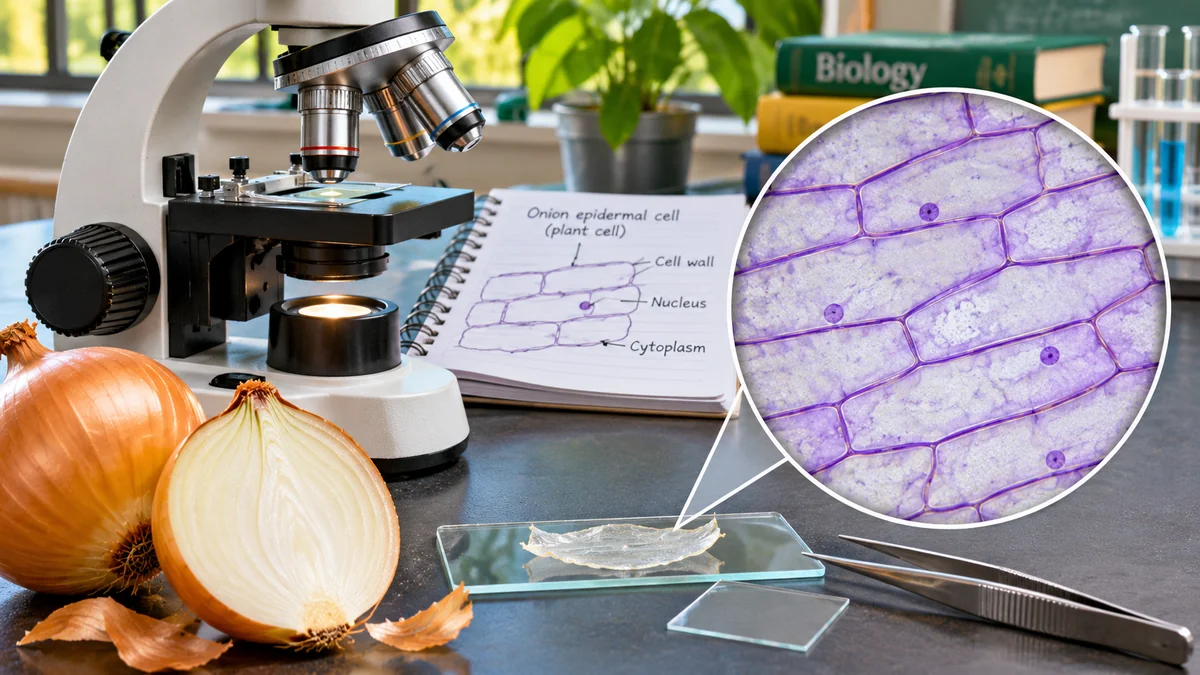
Students can learn the reaction without deliberately exposing anyone's eyes to irritants. An instructor can use photographs or microscopy images of onion cells, draw the pathway from precursor to enzyme to tear factor and invite learners to predict what happens when cells are damaged.
For an observation activity, compare the smell of a covered whole onion and a separately prepared chopped onion without putting faces close to either container. An adult should handle all knives. Students can then compare the evidence for different chopping methods using published research rather than testing irritation on themselves.
Ask three questions: What is the biological trigger? Which enzyme produces the tear factor? What did the 2025 study actually measure? The answers distinguish a chemical reaction, a biological reflex and a physical measurement.
Frequently asked questions
What chemical in onions makes you cry?
The main onion tear factor is syn-propanethial-S-oxide, also written (Z)-propanethial S-oxide. It is produced by enzyme-catalysed reactions after onion tissue is damaged.
Why don't onions make you cry before they are cut?
Intact cells help keep precursors and enzymes apart. Cutting disrupts that organisation and initiates the reactions that produce the irritant.
Does a sharper knife really make a difference?
A controlled 2025 study found that blunter blades caused more forceful liquid-droplet ejection. This supports using a sharp knife, although the study did not directly measure human tear volume.
Does chilling an onion stop tears?
Not reliably. Some cooking advice recommends brief chilling, but newer research found more liquid-droplet ejection in chilled onion samples under one test setup. The net effect on people's eyes still needs better direct testing.
Do red onions make you cry more than white onions?
There is no universal colour-based ranking. Cultivar, sulfur chemistry, storage and cutting technique can matter. Colour by itself is an unreliable measure of the tear factor.
Are the tears a sign of an onion allergy?
Usually not. Onion-induced watery eyes during chopping are generally a reflex response to an irritant. Allergic reactions are a different medical process; seek professional evaluation for persistent or unusual symptoms.
Why do onion fumes make some people cry more than others?
People may differ in how much irritant reaches them and how sensitive their eyes are. Air movement, distance from the board, onion variety and cutting habits also change exposure.
Conclusion: why onions make you cry
Onions make you cry because damage to their cells starts a two-enzyme chemical pathway that produces a volatile eye irritant. Alliinase creates a reactive sulfur-containing intermediate, lachrymatory-factor synthase converts it into propanethial S-oxide, and the eye responds with protective reflex tears.
Science also offers practical advice: use a sharp knife, cut with control, direct airflow away from your eyes and use a protective barrier when needed. Household tricks such as chilling are less certain than they may sound. Understanding the chemistry lets you keep the flavour—and reduce some of the tears—without relying on myths.
References and further reading
- Imai S. et al. (2002). An onion enzyme that makes the eyes water. Nature 419, 685.
- Silvaroli J.A. et al. (2017). Enzyme That Makes You Cry—Crystal Structure of Lachrymatory Factor Synthase from Allium cepa.
- Wu Z. et al. (2025). Droplet outbursts from onion cutting. Proceedings of the National Academy of Sciences.
- National Capital Poison Center. Why do onions make you cry?
- National Onion Association. Frequently asked questions: reducing onion tears.
- American Academy of Ophthalmology. Facts about tears.
- American Academy of Ophthalmology. Kitchen eye safety tips.