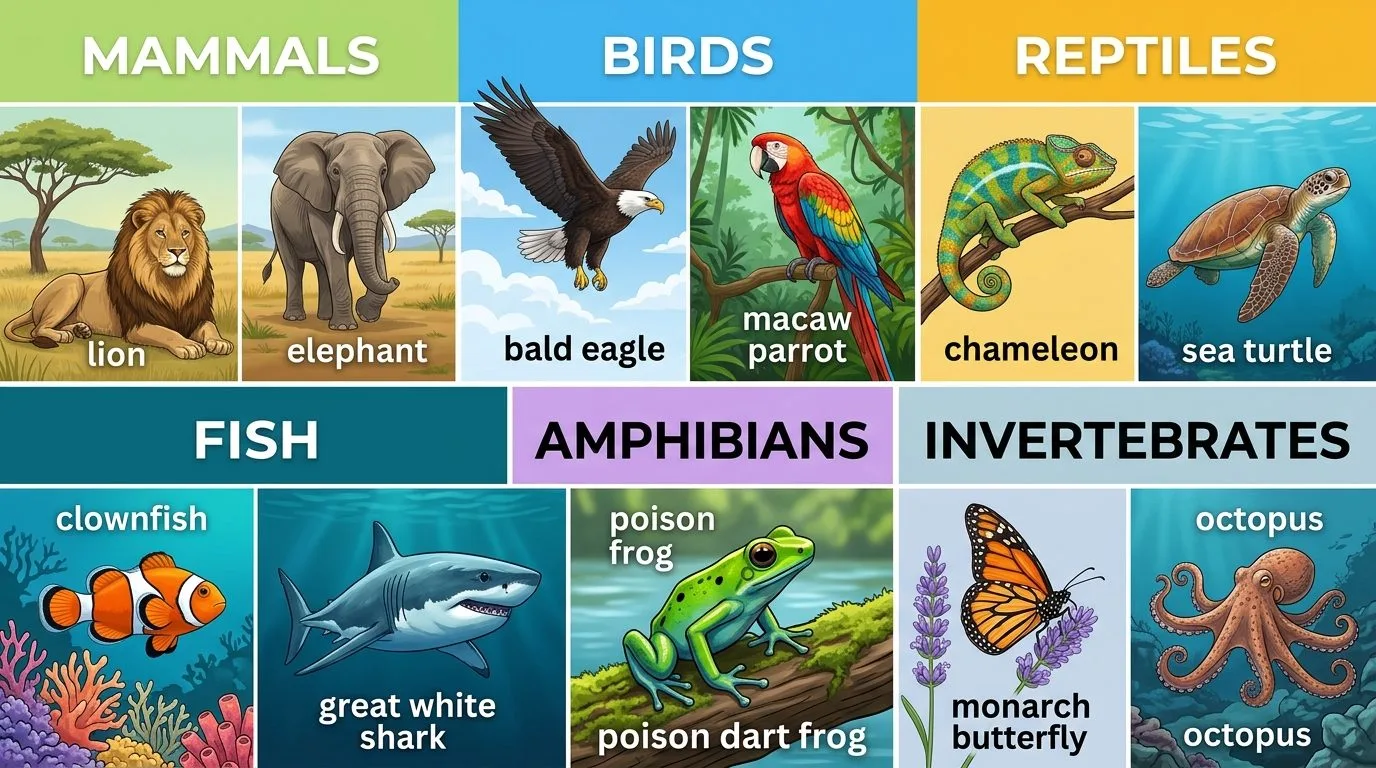
An animal classification chart helps students organise mammals, birds, reptiles, amphibians, fish and major invertebrate groups by their anatomy, reproduction and evolutionary relationships. A whale and a shark both swim in the ocean, but the whale is a mammal and the shark is a fish. A spider and an ant both have jointed legs, but they belong to different arthropod groups. The best classification chart therefore pairs familiar examples with the specific traits that matter.
This animal classification chart is designed as a practical reference for learners, teachers and curious readers. It contains a five-group vertebrate comparison, an eight-phylum invertebrate chart, the taxonomic hierarchy from domain to species, a step-by-step identification guide and a classroom sorting worksheet with explained answers. The tables are intentionally written in copyable text so they can be adapted into handouts or study notes.
For a deeper explanation of the science, see OpenStax Biology 2e on animal phylogeny and the Natural History Museum's guide to taxonomy . The familiar school-level groupings are useful, but scientific family trees include important exceptions that we will identify throughout.
Animal classification chart: mammals, birds, reptiles, amphibians and fish
The chart below compares the five familiar school-level vertebrate groups. They are convenient teaching labels, not five equally ranked branches in strict evolutionary taxonomy. Birds evolved within the reptile lineage, and “fish” is a broad everyday label covering different vertebrate branches.
| Group | Common features | Breathing | Reproduction | Body temperature | Examples |
|---|---|---|---|---|---|
| Mammals | Hair or fur at some life stage; mammary glands | Lungs | Usually live young; monotremes lay eggs | Mostly regulate heat internally (endothermic) | Lion, bat, whale, platypus |
| Birds | Feathers, beak and wings, whether or not they fly | Lungs, specialised air sacs | Lay eggs | Endothermic | Eagle, penguin, ostrich, chicken |
| Reptiles (non-bird) | Dry, keratin-rich scales or related covering | Lungs | Many lay eggs; some bear live young | Mostly ectothermic | Snake, lizard, turtle, crocodile |
| Amphibians | Often moist, permeable skin; metamorphosis common | Larvae often gills; adults lungs/skin (varies) | Often eggs in water or moist sites; exceptions | Ectothermic | Frog, toad, salamander, caecilian |
| Fishes (familiar grouping) | Fins and aquatic adaptations; scales in many | Gills in most | Eggs or live young, varying by species | Usually ectothermic; exceptions | Salmon, tilapia, shark, ray |
How to read the chart: Look for the combination of characteristics rather than one simple rule. A bat flies but has hair and mammary glands, so it is a mammal. A penguin cannot fly but has feathers and bird ancestry, so it is a bird. A shark has a skeleton largely made of cartilage, yet it remains a vertebrate fish. Reproduction and breathing patterns can vary across species.
What about temperature? “Warm-blooded” and “cold-blooded” are common classroom shortcuts. Biologists more precisely distinguish endothermy (heat generated largely through internal metabolism) and ectothermy (reliance on environmental heat sources), with variations and exceptions. These traits alone do not identify an animal's evolutionary lineage.
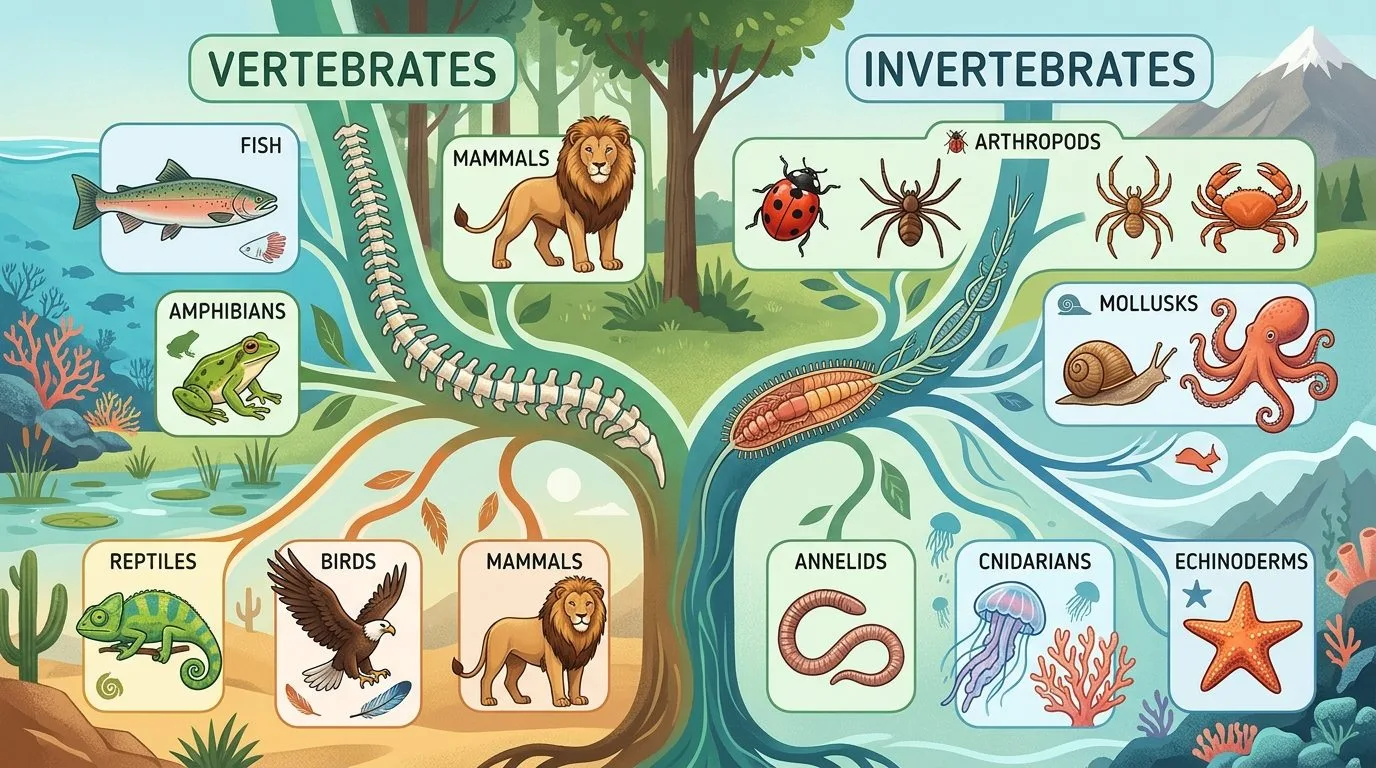
Animal kingdom chart: vertebrates and invertebrates
Animals belong to the kingdom Animalia. An introductory sorting chart often divides them into vertebrates, generally animals in the backbone-bearing lineage, and invertebrates, animals outside that lineage. This is a practical teaching division rather than two equivalent evolutionary clades.
| Starting group | Useful subdivision | Examples | Key note |
|---|---|---|---|
| Animalia → vertebrates | Fishes | Shark, tilapia, salmon | Traditional everyday grouping, not one exclusive evolutionary clade |
| Animalia → vertebrates | Amphibians | Frog, salamander | Often moist skin and specialised development |
| Animalia → vertebrates | Non-bird reptiles | Snake, crocodile, turtle | Birds belong within reptile ancestry |
| Animalia → vertebrates | Birds | Ostrich, pigeon, eagle | Feathers identify living birds |
| Animalia → vertebrates | Mammals | Elephant, whale, bat | Mammary glands produce milk |
| Animalia → invertebrates | Arthropods | Ant, spider, crab | Jointed appendages and exoskeleton |
| Animalia → invertebrates | Molluscs | Snail, clam, octopus | Soft body with a mantle |
| Animalia → invertebrates | Other invertebrate phyla | Earthworm, jellyfish, sea star, sponge | Many distinct evolutionary lineages |
The distinction does not mean every vertebrate has bones and every invertebrate has an external skeleton. Sea stars have internal skeletal plates but no backbone. Insects and crabs have exoskeletons, while earthworms use muscles and fluid pressure for support. Some members of Chordata, such as sea squirts and lancelets, are invertebrates despite sharing fundamental chordate developmental features. OpenStax's chordate chapter covers these complexities.
Five vertebrate groups explained with the most important examples
Mammals: milk-producing animals
The defining feature to remember is mammary glands, which produce milk for young. Mammals also possess hair or fur during at least some life stage, although this can be sparse in whales and dolphins. Most give birth to live young, but the platypus and echidnas are monotremes, mammals that lay eggs. Mammals can walk, swim, climb, burrow or fly: lions, bats and whales belong in the same broad group despite very different habitats. Read OpenStax on Mammalia .
Birds: feathers, not necessarily flight
Feathers are the most helpful everyday clue for living birds. Birds have beaks, lay eggs and possess respiratory adaptations that support active lifestyles. Penguins, ostriches and kiwis demonstrate that flight is not required to belong to the bird lineage. Birds are surviving descendants of theropod dinosaurs and belong within reptile ancestry in evolutionary classification. The bird chapter in OpenStax describes the fossil and anatomical evidence for that connection.
Reptiles: snakes, lizards, turtles and crocodilians
Traditional school reptile charts usually mean non-bird reptiles. Many have dry, keratinised scales or related coverings, breathe with lungs and regulate body temperature largely using their surroundings. Reptiles are not uniformly egg-laying; some snake and lizard species produce live young. A snake is a vertebrate even though it lacks visible legs: its ancestors belonged to the tetrapod lineage. Modern phylogenetic discussions include birds within the broader reptile group, an important distinction from the usual classroom chart.
Amphibians: more diverse than the typical tadpole picture
Frogs, toads, salamanders, newts and caecilians are amphibians. Many have moisture-sensitive skin, and some experience metamorphosis from aquatic larvae to a differently shaped adult. But not every amphibian has a free-swimming tadpole stage; some develop directly, and life cycles vary widely. Their skin often plays a role in gas exchange as well as water balance. Compare the anatomy in OpenStax's amphibian chapter .
Fish: an everyday group with several evolutionary branches
Fishes generally use gills to obtain oxygen from water and have fins adapted to swimming. Cartilaginous fishes include sharks and rays; many other familiar fishes have largely bony skeletons. Some fishes lay eggs, others give birth to live young, and not every species has the same scales or temperature regulation. A dolphin is not a fish: it is an air-breathing mammal.
Biologists distinguish jawless fish lineages, cartilaginous fishes and bony fishes, and recognise that land vertebrates descended from ancient fish ancestors. Fish classification is therefore more complicated than an exclusive single “fish class”. To see a real research tool used with many bony fishes, read SuperEducational's published article How Do Fish Ear Stones Record Age, Migration and Ocean History? .
Invertebrate classification chart: insects, molluscs, corals, worms and more
Invertebrates comprise the great majority of described animal species. The educational estimate that nearly 97% of animal species are invertebrates appears in the OpenStax introduction , although exact species counts change as research advances. Unlike vertebrates, “invertebrates” is not one exclusive evolutionary branch. The following chart gives eight useful animal phyla and examples.
| Phylum | Identifying feature | Examples | Watch for |
|---|---|---|---|
| Arthropoda | Jointed legs and an exoskeleton; moulting | Butterfly, ant, spider, crab | A spider has eight legs; an adult insect has six |
| Mollusca | Soft body and mantle; muscular foot often modified | Snail, clam, squid, octopus | A shell is common in some molluscs, not universal |
| Annelida | Body made of repeated segments | Earthworm, leech, marine bristle worm | Not all animals called worms are annelids |
| Cnidaria | Specialised stinging cells called cnidocytes | Jellyfish, coral, sea anemone | Coral polyps are animals, not plants |
| Porifera | Filter water through a porous body | Sea sponge | An adult sponge usually stays attached |
| Echinodermata | Water vascular system and internal skeletal ossicles | Sea star, sea urchin, sea cucumber | Their internal skeleton does not make them vertebrates |
| Platyhelminthes | Mostly flattened, unsegmented worms | Planarian, tapeworm | Some are free-living; others parasitic |
| Nematoda | Elongated, unsegmented roundworm body | Soil roundworm, pinworm | Roundworms are not segmented earthworms |
One especially common error is calling a spider an insect. Both belong to Arthropoda, but spiders are arachnids that typically have eight legs; adult insects have six. Another is calling coral a plant: the living coral polyp is a cnidarian animal, often forming colonies. In fact, SuperEducational's published vertebrates versus invertebrates comparison provides additional everyday examples and a longer identification quiz.
For the underlying anatomy and phylogenetic evidence, consult the chapters on arthropods , molluscs and annelids , cnidarians and echinoderms .
Scientific taxonomy chart: domain, kingdom, phylum, class and more
Everyday names such as “bird” or “worm” help describe organisms, but a scientific name and taxonomic hierarchy make identification more precise. The familiar levels, from broadest to narrowest, are domain → kingdom → phylum → class → order → family → genus → species. OpenStax's taxonomy chapter describes this naming hierarchy, while the Natural History Museum explains why grouping organisms increasingly relies on evolutionary relationships.
| Taxonomic rank | Lion example | Meaning |
|---|---|---|
| Domain | Eukarya | Organisms with eukaryotic cells |
| Kingdom | Animalia | All animals |
| Phylum | Chordata | Chordate evolutionary branch |
| Class | Mammalia | Mammals |
| Order | Carnivora | Group including cats, dogs and relatives |
| Family | Felidae | Cat family |
| Genus | Panthera | Big-cat genus including lions |
| Species | Panthera leo | Lion |
Scientific names use binomial nomenclature: the genus starts with a capital letter, the species epithet is lower-case and both are usually italicised. Extra ranks such as subfamily or subspecies can also be useful. Modern systematics additionally recognises unranked clades, which capture ancestral relationships more precisely than a rigid eight-rank ladder.
How to read the charts without memorising every animal
- Start with a reliable identification. A common name can be misleading: “jellyfish” is a cnidarian, not a fish, and “starfish” is better called a sea star.
- Ask about the vertebrate lineage. Does the animal belong to a recognised fish, amphibian, reptile, bird or mammal lineage? Check exceptional chordates rather than relying solely on visible backbones.
- Look at defining features. Hair and milk suggest mammals, feathers birds, jointed appendages arthropods, and cnidocytes cnidarians.
- Do not classify by habitat alone. Whales, sharks and jellyfish all live in water but belong to very different groups; bats and birds both fly but are unrelated at that level.
- Confirm the group with a scientific source. Taxonomic reference materials and DNA-based studies can clarify difficult cases.
Classroom charts simplify nature, so any strong rule should be tested against exceptions. The “five groups” are school-level comparisons; some taxonomists use more detailed ranks and evolutionary subdivisions. The most useful learning question is not “Which group is better?” but “Which evidence places this animal here?”
Common animal classification mistakes: corrected examples
| Mistake | More accurate explanation |
|---|---|
| All aquatic animals are fish | Whales and dolphins are mammals; jellyfish are cnidarian invertebrates |
| All flying animals are birds | Bats are mammals; butterflies are insects |
| Every mammal gives birth to live young | The platypus and echidnas lay eggs |
| Every bird can fly | Ostriches and penguins are flightless birds |
| Every invertebrate has a hard shell | Earthworms and jellyfish do not have that kind of protective shell |
| Spiders are insects | Spiders are arachnids within Arthropoda |
| Sea stars lack internal skeletons | Echinoderms have internal skeletal ossicles |
| Reptiles and birds have no common ancestry | Birds evolved within the broader reptile lineage |
| Every animal called a worm is an annelid | Flatworms and roundworms belong to other phyla |
Classroom worksheet: classify 20 animals using the chart
This worksheet can be copied into a notebook or printed as text. It needs no animal handling, wildlife collection or specialised equipment. Ask students to fill the blank cells with the best school-level group or invertebrate phylum and one defining clue.
| No. | Animal | Classification | Identifying clue |
|---|---|---|---|
| 1 | Dolphin | ________ | ________ |
| 2 | Eagle | ________ | ________ |
| 3 | Crocodile | ________ | ________ |
| 4 | Frog | ________ | ________ |
| 5 | Tuna | ________ | ________ |
| 6 | Platypus | ________ | ________ |
| 7 | Penguin | ________ | ________ |
| 8 | Snake | ________ | ________ |
| 9 | Salamander | ________ | ________ |
| 10 | Shark | ________ | ________ |
| 11 | Butterfly | ________ | ________ |
| 12 | Spider | ________ | ________ |
| 13 | Crab | ________ | ________ |
| 14 | Octopus | ________ | ________ |
| 15 | Snail | ________ | ________ |
| 16 | Earthworm | ________ | ________ |
| 17 | Jellyfish | ________ | ________ |
| 18 | Coral | ________ | ________ |
| 19 | Sea sponge | ________ | ________ |
| 20 | Sea star | ________ | ________ |
Worksheet answer key
- Dolphin — mammal: breathes air, nurses young with milk.
- Eagle — bird: feathers.
- Crocodile — non-bird reptile: reptile ancestry and keratin-rich skin covering.
- Frog — amphibian: amphibian development and skin physiology.
- Tuna — fish: vertebrate with gills and fins.
- Platypus — mammal: milk production despite laying eggs.
- Penguin — bird: feathers despite flightlessness.
- Snake — non-bird reptile: vertebrate reptile lineage despite lack of legs.
- Salamander — amphibian: characteristic amphibian anatomy and development.
- Shark — fish: cartilaginous vertebrate with gills.
- Butterfly — Arthropoda (insect): three pairs of adult legs.
- Spider — Arthropoda (arachnid): typically four pairs of legs.
- Crab — Arthropoda (crustacean): jointed appendages and exoskeleton.
- Octopus — Mollusca: cephalopod body plan and mantle.
- Snail — Mollusca: mantle and muscular foot.
- Earthworm — Annelida: segmented body.
- Jellyfish — Cnidaria: cnidocytes and medusa body plan.
- Coral — Cnidaria: animal polyps with specialised stinging cells.
- Sea sponge — Porifera: pores and filter-feeding body organisation.
- Sea star — Echinodermata: water vascular system and skeletal ossicles.
Extension: Ask learners to choose two similarly shaped animals from different groups—for example, a whale and a shark—and explain why their shared environment does not make them close relatives. Older pupils can design a simple two-choice identification key for six animals selected from the worksheet.
Frequently asked questions about animal classification charts
What are the five main animal groups?
The five familiar vertebrate groups taught in many schools are mammals, birds, non-bird reptiles, amphibians and fishes. This does not describe all animals: most animal species belong to invertebrate phyla, and evolutionary taxonomy includes additional groupings.
Where do insects appear in an animal classification chart?
Insects are invertebrates in the phylum Arthropoda. Adult insects have six legs; spiders, which also belong to Arthropoda, are arachnids with eight legs.
Are mammals, birds, reptiles, amphibians and fish five biological classes?
They are five familiar teaching groups, but not five equally ranked natural clades. Mammalia and Aves are classes; the term “fish” covers several lineages, and birds fall within reptilian ancestry. Detailed modern taxonomy depends on the phylogenetic question.
Is a whale a fish or a mammal?
A whale is a mammal. It breathes air with lungs and produces milk for its young. Its ocean habitat does not change its ancestry.
Is a frog a reptile?
No. Frogs are amphibians. They differ from non-bird reptiles in skin, development and evolutionary history.
Why is a shark classified as a vertebrate?
Sharks belong to the cartilaginous fish lineage of vertebrates. The skeleton's main material is cartilage rather than bone, but the shark still belongs to the vertebrate branch.
Are coral and jellyfish animals?
Yes. Both are cnidarians and invertebrates, although coral colonies may resemble plants and jellyfish names can be misleading.
Can teachers use the animal classification worksheet?
Yes. The tables, prompts and 20-item exercise in this article are written as original educational content and can be adapted for classroom or home learning. Keep the explanatory caveats alongside any simplified chart.
Conclusion: use charts as a starting point for scientific thinking
A useful animal classification chart does more than place pictures under headings. It identifies the traits that matter, explains how groups are related and makes room for exceptions. Mammals, birds, reptiles, amphibians and fishes provide a memorable way to start with vertebrates; arthropods, molluscs, annelids, cnidarians, sponges and echinoderms reveal the much larger variety of invertebrate life.
Use the tables as an at-a-glance reference, test yourself with the worksheet and confirm unfamiliar species through reliable scientific sources. As new anatomical and genetic evidence becomes available, classification can be refined—because the goal is to understand the real diversity and shared history of animals, not simply memorise a list.
Editorial note: Taxonomic and educational sources checked 17 November 2026. School-level categories and the approximate share of invertebrate species are explicitly described as simplifications or estimates. This original chart and worksheet are for general education, not a complete taxonomic catalogue.