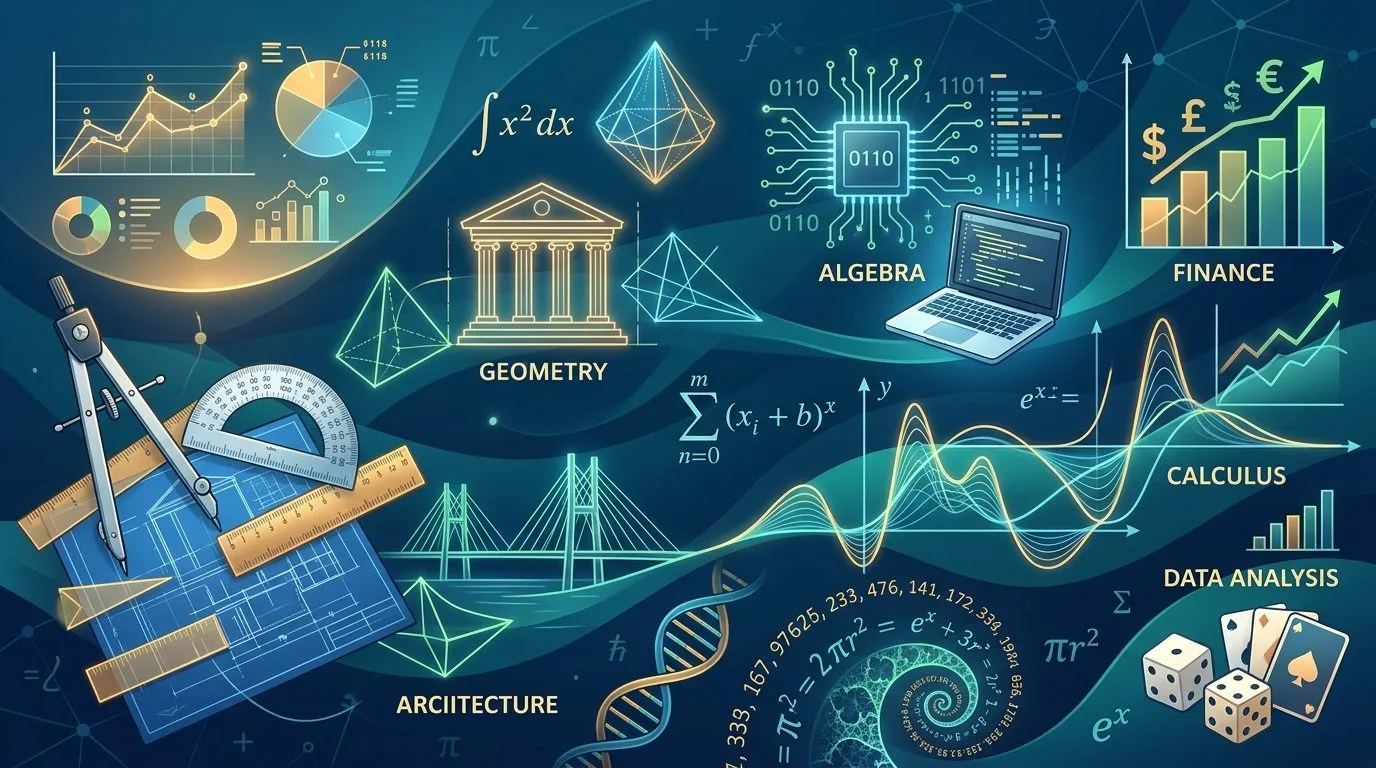
Mathematics is the study of numbers, quantities, patterns, shapes, structures and relationships using precise reasoning and evidence-based methods of proof. It helps us describe everything from the price of groceries and the area of a room to the behaviour of moving objects and the uncertainty in a scientific result. Yet mathematics is more than calculation: it also asks why a rule works, what can be inferred from assumptions, and how a complex situation can be represented in a simpler, testable way.
If you have wondered what is mathematics, what are its main branches, and how can you study it?, this guide brings the answers together. It introduces arithmetic, algebra, geometry, calculus, probability, statistics and other fields; demonstrates practical examples; explains pure and applied mathematics; and maps sensible study routes for school learners, adult beginners and aspiring university students.
The OECD's mathematics framework emphasises reasoning and using mathematics to formulate, solve and interpret real-world problems. The Mathematics Subject Classification (MSC2020) , maintained by Mathematical Reviews and zbMATH, shows how much broader the research field is than any single school syllabus. Mathematics is useful both when applied immediately and when explored for its own internal ideas.
What is mathematics in simple words?
Mathematics is a way of thinking clearly about quantities, relationships and patterns. Counting items is mathematics. So is asking how a shape changes when it is enlarged, how a pattern continues, whether an argument is logically valid, or which decision makes the best use of limited resources.
It uses symbols, definitions, diagrams, equations and proofs to communicate ideas precisely. A result such as 3 × 4 = 12 can describe three packets with four items each; a formula such as A = length × width can calculate a rectangular floor's area. At more advanced levels, mathematics investigates abstract objects that do not always have an obvious everyday interpretation.
Mathematics and numeracy are related but not identical. Numeracy often refers to the ability to understand and use mathematical information in everyday settings. Mathematics is the wider discipline, including abstract theory and proof. The European School Education Platform makes a similar distinction between abstract mathematical study and practical numerical literacy.
What are the main branches of mathematics?
There is no single, universally fixed list of “main branches”. School subjects, university departments and professional researchers organise them in different ways, and many fields overlap. The following chart gives a useful beginner-friendly picture without pretending that all areas are independent.
| Branch | What it studies | Simple example or use |
|---|---|---|
| Arithmetic | Numbers and operations | Calculating change after a purchase |
| Algebra | Symbols, equations, functions and relationships | Finding an unknown price |
| Geometry | Shapes, distance, angles and spatial properties | Measuring a room's floor area |
| Trigonometry | Angles and relationships among sides of triangles | Estimating a building's height |
| Calculus and analysis | Change, limits, rates, accumulation and functions | Studying speed or the growth of a quantity |
| Probability | Randomness and uncertain outcomes | Estimating a chance of rain in a model |
| Statistics | Collecting, describing and analysing data | Comparing survey results |
| Number theory | Integers, primes and divisibility | Understanding properties used in cryptography |
| Discrete mathematics | Countable structures, networks and algorithms | Planning paths in a delivery network |
| Logic and foundations | Valid reasoning, sets and mathematical structures | Testing whether a conclusion follows from premises |
| Linear algebra | Vectors, matrices and linear transformations | Representing graphics or data transformations |
| Topology | Properties preserved under continuous deformation | Investigating connections and spaces |
| Optimisation and numerical methods | Finding best solutions and approximating difficult calculations | Scheduling routes or solving equations with computers |
The American Mathematical Society's subject classification guidance and MSC2020 organise research into many more detailed categories. The table above is an introduction, not an official ranking of mathematical importance.
1. Arithmetic: the foundation of everyday calculation
Arithmetic covers addition, subtraction, multiplication and division, together with fractions, decimals, percentages, ratios and operations on numbers. It is often the first mathematics people learn, and it supports nearly everything that follows.
Everyday example: A shop offers a 15% discount on an item priced at ₦8,000. Multiply 8,000 by 0.15 to find a discount of ₦1,200, then subtract it: ₦8,000 − ₦1,200 = ₦6,800. Before paying, you can check whether the final price is reasonable.
To develop these skills, begin with whole numbers and place value, then progress to fractions, decimals, ratios and percent. OpenStax Prealgebra 2e provides a free, structured starting point.
2. Algebra: using symbols to express relationships
Algebra represents unknown values using symbols, commonly letters such as x. It studies equations, expressions, functions and patterns that apply to many cases rather than just one calculation.
Worked example: Three notebooks cost ₦2,400 altogether. If each notebook has the same price, write 3x = 2,400. Divide both sides by three to obtain x = ₦800. The equation expresses the relationship before solving it.
In later algebra, functions describe how inputs affect outputs. For example, C(n) = 500n + 2,000 could represent a delivery service charging ₦2,000 plus ₦500 for each additional item, if that is the stated pricing rule. Algebra is essential for physics, economics, software development and further mathematical study. Explore OpenStax's introduction to functions .
3. Geometry and trigonometry: understanding shapes and space
Geometry investigates lengths, angles, shapes, areas, volumes and spatial relationships. It is used in design, construction, mapping and visualisation. Trigonometry focuses on relationships involving angles and sides, especially in triangles, and also studies repeating patterns through functions such as sine and cosine.
Worked example: A rectangular room measures 4 metres by 3 metres. Its area is 4 × 3 = 12 square metres. A flooring estimate must also consider cutting, waste, package sizes and installation details, which the simple area calculation does not capture.
A surveyor may use an angle and a known distance to estimate an otherwise hard-to-measure height. The geometry and trigonometry are useful because the measurement problem can be represented with diagrams rather than guesswork.
4. Calculus: how quantities change and accumulate
Calculus studies change and accumulation. Differential calculus concerns rates of change, often expressed using derivatives. Integral calculus concerns accumulation and quantities such as area under a curve. Their connection is one of the central ideas in mathematical analysis.
Consider a car's position changing over time. A derivative describes instantaneous speed under a mathematical model; an integral of speed over time can give distance travelled when the assumptions fit. Calculus also supports modelling population change, electricity, motion and many engineering problems.
It is usually easier to study calculus after algebra, functions, graphs and trigonometry. MIT OpenCourseWare's Single Variable Calculus is a free self-study course covering differentiation and integration; its syllabus lists high-school algebra and trigonometry as prerequisites .
5. Probability and statistics: making sense of uncertainty and data
Probability investigates the likelihood of outcomes in a specified model. Statistics examines how to collect and interpret data, estimate unknown quantities, test hypotheses and understand uncertainty. They are closely connected but answer different questions.
Probability example: A bag contains two blue counters and three yellow counters. If each counter is equally likely to be selected and only one is drawn, the probability of blue is 2 ÷ 5 = 0.4, or 40%.
Statistics example: Five students study for 2, 4, 6, 8 and 10 hours in a week. The mean is (2 + 4 + 6 + 8 + 10) ÷ 5 = 6 hours. But an average alone may hide differences among individuals, and a small sample does not automatically represent an entire school.
Statistics is used in medicine, public health, business, sports and scientific research. Data quality matters: biased samples or misleading charts can produce unreliable conclusions even when the arithmetic is correct. OpenStax Introductory Statistics 2e describes how probability, data and statistical inference relate.
6. Number theory, discrete mathematics and mathematical logic
Number theory studies integers and properties such as prime numbers and divisibility. These ideas appear in some cryptographic systems, although real security also depends on sound implementation and more than mathematics alone.
Discrete mathematics studies countable structures, including graphs, networks, combinatorics and many algorithms. A road system can be modelled as a network of junctions and connections; algorithms can then help plan routes, subject to the model and constraints.
Mathematical logic examines statements, implications, proof and reasoning. For example, if every square is a rectangle and a particular figure is a square, it follows that the figure is a rectangle. The reverse statement does not necessarily hold. Logic matters in mathematics, computing, philosophy and clear argumentation.
Set theory, the study of collections of objects, is another foundation. OpenStax Contemporary Mathematics introduces sets, and the logic chapter introduces statements and reasoning.
7. Linear algebra, topology and applied mathematical methods
Linear algebra studies vectors, matrices and transformations. It supports computer graphics, machine learning, scientific computing and systems of equations. A matrix can organise many values so they can be manipulated systematically, instead of addressing each number independently.
Topology investigates properties of spaces and shapes that remain unchanged under continuous deformation, such as connectivity. Its introductory examples may feel abstract, but topological methods are important in modern geometry and some scientific data analysis.
Optimisation asks how to find the best feasible solution under stated constraints—for instance, allocating limited delivery vehicles while respecting capacities and schedules. Numerical analysis develops reliable computational approximations when exact formulas are unavailable or impractical. These fields overlap with operations research, engineering and computing.
For advanced self-study pathways, MIT OpenCourseWare's Scholar Courses lists linear algebra, calculus and probability-related materials. The right sequence depends on your mathematical background, not just the field you eventually want to pursue.
Pure mathematics versus applied mathematics
In pure mathematics, a researcher may study a structure or theorem mainly to understand its properties and prove new results, even without an immediate application. In applied mathematics, the emphasis is often on mathematical models or methods for problems in science, finance, computing or engineering.
The boundary is not rigid. Number theory, once studied largely for its internal beauty, now contributes to cryptography. Abstract algebra supports modern codes; probability develops both as theory and as a tool for making decisions. A new application may emerge decades after a mathematical idea was first studied.
The MSC2020 research classification reflects the many connections between theoretical and application-oriented disciplines. Neither category is more valuable by definition: rigorous reasoning and useful modelling inform one another.
Everyday uses of mathematics: six realistic situations
| Situation | Mathematical ideas | What they help you do |
|---|---|---|
| Shopping and budgeting | Arithmetic, percentages, ratios | Compare prices, calculate discounts and balance spending |
| Cooking and home projects | Fractions, measurement, geometry | Scale a recipe or estimate material quantities |
| Transport and travel | Rates, distance, time, optimisation | Estimate journey time or compare routes |
| Health and science | Statistics, probability, modelling | Understand measurements, studies and uncertainty |
| Computers and digital services | Logic, discrete maths, algebra, linear algebra | Design algorithms, analyse data and render graphics |
| Business decisions | Algebra, statistics, financial mathematics | Forecast costs, examine trends and test assumptions |
Budget example: Suppose monthly income is ₦120,000, and planned spending is ₦45,000 on housing, ₦25,000 on food, ₦12,000 on transport and ₦8,000 on utilities. The planned spending totals ₦90,000, leaving ₦30,000 before any other costs, savings or emergencies. Arithmetic reveals the amount; good judgement is still needed to decide whether the plan is realistic.
Journey example: A vehicle travels 90 kilometres in 1.5 hours. Its average speed is 90 ÷ 1.5 = 60 kilometres per hour. That does not mean it travelled at exactly 60 km/h every moment. The distinction between an average and changing instantaneous speed illustrates the connection between arithmetic, statistics and calculus.
These are illustrative examples, not financial or medical advice. The OECD's mathematical-literacy guidance emphasises interpreting results within the original situation, rather than treating a calculation as the whole solution. For a family-focused practical example, SuperEducational's guide to teaching children financial literacy connects everyday money decisions to learning.
Why learn mathematics if a calculator or AI can solve problems?
Calculators and software can make computation faster, but they cannot replace understanding what a question means, choosing the correct model or checking whether the output makes sense. A calculator may correctly evaluate a formula with incorrect inputs; an AI system may also make mistakes in mathematical reasoning or present unsupported steps with confidence.
Mathematical understanding helps you ask whether a result has the correct units, whether the assumptions are reasonable, whether a graph is misleading and whether the answer addresses the original question. This ability is increasingly useful when people encounter statistics in news coverage, marketing claims and digital tools.
For the wider educational context, SuperEducational's published analysis of reading and maths performance discusses how large-scale assessments should be interpreted; here the focus remains on the underlying skills learners can practise.
How to study mathematics: a practical beginner-to-advanced roadmap
There is no single study path for everyone. A pupil preparing for a school examination and an adult learning statistics for work may begin in different places. The general rule is to build prerequisites in order, check understanding with problems and return to difficult topics rather than rushing.
| Stage | Focus | Practical milestone |
|---|---|---|
| 1. Number fluency | Whole numbers, fractions, decimals, percentages, ratios | Calculate discounts and explain why an answer is reasonable |
| 2. Prealgebra | Negative numbers, expressions, order of operations and equations | Solve one-step and two-step equations |
| 3. Core secondary maths | Algebra, graphs, geometry, introductory statistics and probability | Translate a word problem into an equation or graph |
| 4. Precalculus or applied foundations | Functions, trigonometry, more advanced algebra and modelling | Interpret function behaviour and basic trigonometric relationships |
| 5. Higher-level specialisation | Calculus, linear algebra, discrete mathematics, probability and statistics | Complete a small project using appropriate mathematical methods |
| 6. Advanced or professional study | Proof, analysis, abstract algebra, optimisation, research or applied modelling | Explain assumptions, limitations and the logic behind a solution |
Start with OpenStax Prealgebra if fractions and basic equations need revision. Advance to College Algebra and Introductory Statistics when ready. Khan Academy's mathematics courses provide topic-by-topic exercises, and MIT OpenCourseWare offers more advanced material.
For software engineering or data science: strengthen algebra, functions and logic, then study discrete mathematics, probability, statistics and linear algebra. Calculus is important for many advanced data and engineering topics. For finance or business: prioritise arithmetic, percentages, algebra, statistics, financial mathematics and modelling. For engineering and physics: focus on algebra, trigonometry, calculus, linear algebra and differential equations. These are suggested pathways, not official requirements for a particular university or job.
A weekly maths practice plan that avoids last-minute cramming
A realistic study routine can fit into several short sessions. The US Institute of Education Sciences' learning practice guide recommends spacing learning over time and using low-stakes quizzes to strengthen retention. Exact schedules should be adjusted to age, ability and other commitments.
| Day | Activity | Purpose |
|---|---|---|
| Monday | Learn one concept and work two guided examples | Understand the method |
| Tuesday | Practise five varied questions without reading the solution first | Build recall and problem-solving |
| Wednesday | Review mistakes and explain them aloud or in writing | Identify misunderstandings |
| Thursday | Apply the concept to an everyday example | Connect theory with real situations |
| Friday | Complete a short mixed-topic quiz | Practise retrieval and identify gaps |
| Weekend | Revisit one older topic and plan the next step | Space practice and build confidence |
Keep an error notebook: write the original question, the step where reasoning failed, the correct approach and a fresh similar problem. For examination preparation, SuperEducational's published guide to creating a personalised exam revision plan offers a complementary planning method. Use digital tools for feedback, but check their answers against reliable worked solutions or a teacher.
Five small mathematics problems to check your understanding
- Percentages: A school bag costs ₦10,000 and is discounted by 20%. What is the new price?
- Algebra: Solve 4x + 6 = 22.
- Geometry: What is the area of a rectangle 5 metres long and 2 metres wide?
- Probability: A fair six-sided die is rolled once. What is the probability of getting an even number?
- Statistics: Find the mean of 3, 5, 7 and 9.
Answers and reasoning
- ₦8,000. Twenty percent of ₦10,000 is ₦2,000; subtract the discount.
- x = 4. Subtract 6, giving 4x = 16, then divide by 4.
- 10 square metres. Area is length × width = 5 × 2.
- 1/2 or 50%. The even outcomes are 2, 4 and 6, giving three favourable outcomes out of six equally likely ones.
- 6. Add the four values to get 24, then divide by 4.
If an answer is difficult, ask which prerequisite is missing. A percentage mistake may indicate a gap in fractions or decimal conversion; an algebra mistake may indicate uncertainty about balancing both sides of an equation. Fixing that prerequisite is often more useful than repeating the same question many times.
Frequently asked questions about mathematics
What is mathematics in one sentence?
Mathematics studies numbers, patterns, quantities, structures and relationships through precise reasoning, problem-solving and proof.
What are the five main branches of mathematics?
A simple introductory list might include arithmetic, algebra, geometry, calculus and statistics, but there is no universal official list of exactly five. Probability, number theory, discrete mathematics, logic and many other fields are important too.
Is mathematics only about numbers?
No. It also studies shapes, logical arguments, abstract structures, transformations, networks, change and uncertainty. Some mathematical areas rely more on proofs than numerical calculation.
What is the difference between arithmetic and algebra?
Arithmetic usually works directly with numbers and operations. Algebra uses variables, expressions and equations to represent general relationships and find unknown values.
Is statistics part of mathematics?
Statistics is a mathematical and scientific discipline closely connected with probability. It includes collecting data, drawing inferences and assessing uncertainty, rather than simply calculating averages.
Do I need calculus to learn programming?
Not for every programming task. Basic arithmetic, algebra, logic and discrete mathematics support many programming activities. Calculus becomes more important for selected fields such as physics simulation, optimisation and advanced machine learning.
Can adults learn mathematics from the beginning?
Yes. A structured review of number operations, fractions, percentages and basic algebra is a sensible starting point. Choose materials matched to current skills and practise regularly rather than judging progress solely by speed.
What careers use mathematics?
Mathematical thinking contributes to engineering, actuarial work, finance, statistics, research, economics, software development, data science, architecture and education. Each career requires a different combination of maths and other professional skills.
Conclusion: mathematics is a way to reason, not just a school subject
Understanding what mathematics is begins with numbers but extends to the logical study of patterns, structures, change and uncertainty. Arithmetic helps with everyday decisions; algebra and geometry express relationships; calculus describes change; probability and statistics help assess uncertain information; and advanced branches support science, technology and further discoveries.
The best study path is neither the fastest nor the most complicated. Begin with the skills you can demonstrate, strengthen missing foundations, practise with meaningful problems and work towards the branch that interests you. Mathematics becomes more useful when you can explain why an answer makes sense as well as how to calculate it.
Editorial note: Research checked 17 November 2026. Branch labels are introductory categories rather than an exhaustive or universally ranked taxonomy; examples and study timelines are illustrative, not individualised academic or financial advice.