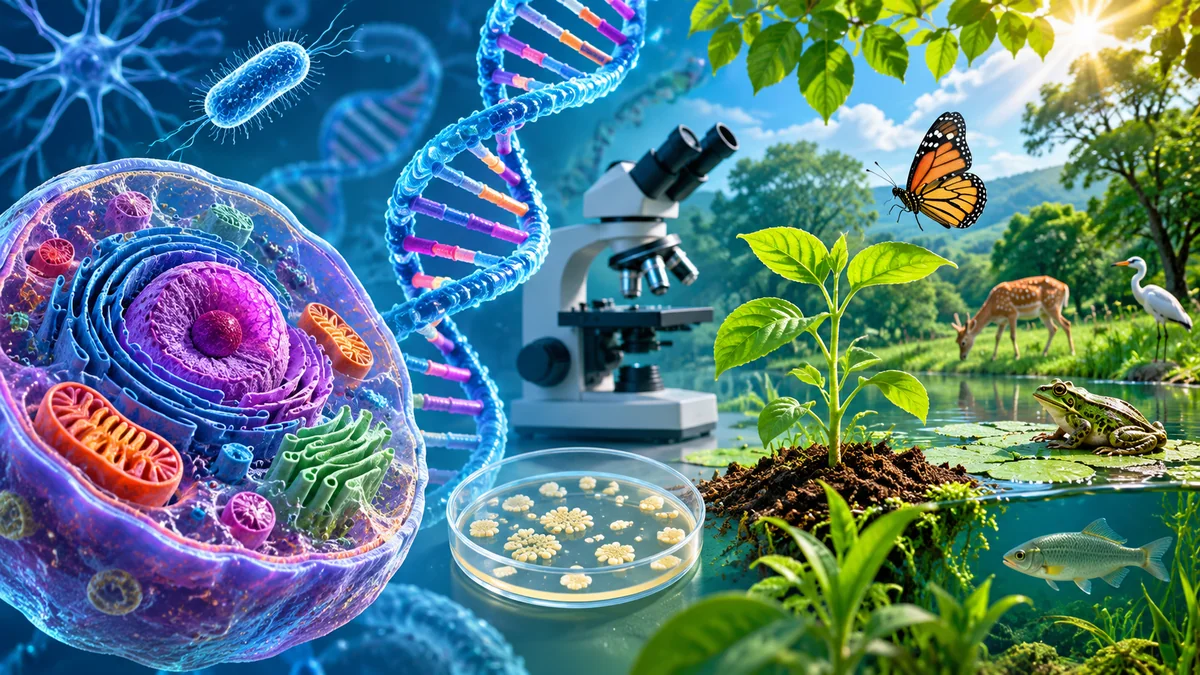
What are the branches of biology? They are specialised fields within the scientific study of life. Cell biology examines cells; genetics investigates inheritance and variation; ecology explores relationships between organisms and their environments. Other important branches include molecular biology, microbiology, botany, zoology, physiology, evolutionary biology and bioinformatics. Each answers a different kind of question, and many work together to solve real-world problems.
Knowing the branches of biology helps students choose what to study and helps everyone understand how scientific discoveries are made. A medical researcher may study genes and cells, while a conservation scientist examines animals, plants and habitats. The names are useful, but the boundaries are not rigid: an ecologist may use DNA sequencing, and a geneticist may study entire ecosystems.
This guide groups the major branches by what they investigate, compares commonly confused fields, and shows how they collaborate. The explanations draw on OpenStax Biology 2e and scientific resources from the US National Institutes of Health and other authoritative organisations.
Quick-reference chart: major branches of biology
There is no universally fixed number of branches of biology. Universities, textbooks and research organisations classify overlapping specialisms differently. The following chart covers important examples, not an official exhaustive ranking.
| Branch | What it studies | Example question |
|---|---|---|
| Cell biology (cytology) | Cell structure, behaviour and function | How does a cell repair damage? |
| Molecular biology | DNA, RNA, proteins and molecular processes | How is a gene expressed? |
| Genetics | Heredity and genetic variation | How is a trait inherited? |
| Genomics | Complete genomes and their interactions | Which DNA variants occur across a genome? |
| Microbiology | Microorganisms and related microscopic life | How do soil bacteria recycle nutrients? |
| Virology | Viruses and their interactions with hosts | How does a virus enter a host cell? |
| Botany | Plants | How do roots respond to drought? |
| Zoology | Animals | How do migrating birds navigate? |
| Anatomy | Organism structure | How are the heart's chambers arranged? |
| Physiology | How living systems function | How does the body regulate temperature? |
| Ecology | Organism–environment interactions | What happens when a predator disappears? |
| Evolutionary biology | Evolution and diversification of life | How does resistance evolve in a population? |
| Taxonomy and systematics | Classification and evolutionary relationships | How are two species related? |
| Developmental biology | Growth and development | How does an embryo form tissues? |
| Biochemistry | Chemical processes in living systems | How do enzymes speed up reactions? |
| Bioinformatics | Computational analysis of biological data | What patterns occur in DNA sequences? |
| Conservation biology | Protection of biodiversity | Which actions help a threatened species recover? |
1. Cell biology: understanding life's basic units
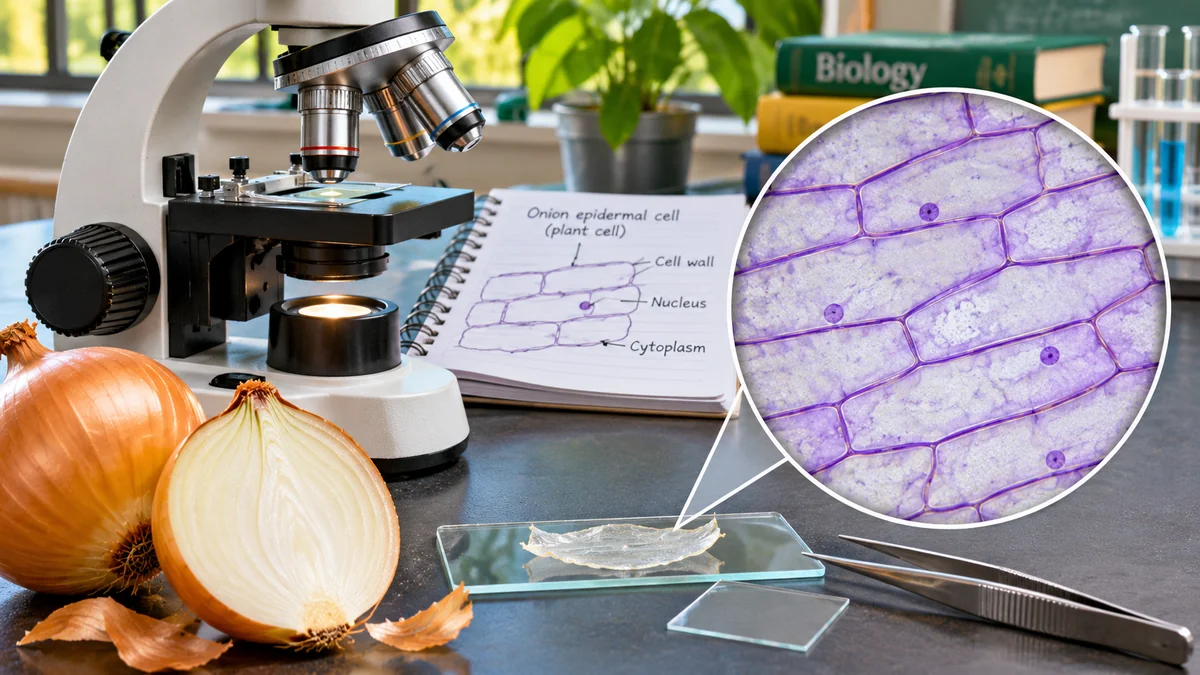
Cell biology studies the structure and functions of cells, the basic units of living organisms. It asks how cells obtain energy, communicate, divide, transport substances and respond to their surroundings. Researchers examine features such as cell membranes, ribosomes, mitochondria and—in eukaryotic cells—the nucleus.
For example, a cell biologist might investigate what happens when a cell receives a signal to divide or why a cell stops functioning normally. Cell research underpins understanding of tissues, immune responses, disease and development. The US National Library of Medicine's cell biology definition covers cell structure, function and processes including differentiation and signalling.
2. Molecular biology: investigating the machinery inside cells
Molecular biology focuses on biological processes at the molecular level, especially those involving DNA, RNA and proteins. It helps explain how information stored in genetic material can influence the molecules that cells produce and how those molecules work together.
For example, researchers may investigate how a cell controls the amount of a particular protein. Techniques can include analysing nucleic acids and proteins. Molecular biology overlaps strongly with genetics, biochemistry and cell biology, but its central focus is the molecular mechanisms of life. The National Library of Medicine describes the field in terms of molecular structure, function and processes of inheritance and protein synthesis.
3. Genetics: inheritance and variation
Genetics studies genes, heredity and variation. It explores why offspring resemble their parents, how genetic variants are passed on, and how genes and environmental factors influence traits. Not every trait is controlled by one gene; many characteristics involve numerous genes and environmental influences.
One practical example is understanding inherited blood disorders. SuperEducational's guide to sickle cell disease and genetics illustrates how biological knowledge of inheritance can help explain a real health condition. For an authoritative introduction, see the National Human Genome Research Institute's genetics glossary .
4. Genomics: looking at the bigger genetic picture
Although genetics and genomics overlap, they are not identical. Genetics often focuses on particular genes and patterns of inheritance; genomics examines the genome more broadly, including interactions among genes and environmental influences. Genomics can investigate many DNA variants at once rather than considering only one gene.
Researchers use genome-scale data to study organisms, compare populations and investigate biological questions related to health, agriculture and evolution. The NHGRI genetics-versus-genomics fact sheet explains this distinction. Importantly, finding a statistical association between a DNA variant and a trait does not automatically prove that the variant causes it.
5. Microbiology: life that often requires a microscope
Microbiology investigates microscopic organisms, including bacteria, archaea, microscopic fungi and many protists. These organisms are important not only in disease but also in nutrient recycling, fermentation, digestion and environmental processes. Microbiologists study how microorganisms grow, interact, survive and affect other organisms.
A microbiologist examining compost might ask which microbial communities break down leaves and how moisture affects their activity. In healthcare, microbiology supports the identification of infectious agents and the study of antimicrobial resistance. It is a broad discipline with specialist areas such as bacteriology and mycology. See OpenStax Microbiology for an introduction to microbial classification.
6. Virology: studying viruses
Virology studies viruses, their structures, replication, evolution and interactions with host cells. Viruses generally require host-cell machinery to reproduce, and scientists debate aspects of how they fit into definitions of life. That makes virology distinct from the study of independently reproducing cellular microorganisms, although it is often taught within microbiology.
Virologists can investigate how viral particles attach to cells, how viruses change over time and how immune systems respond. Their research informs vaccines, diagnostic methods and understanding of viral diseases. OpenStax's overview of biology discusses viruses as a useful example of why definitions of life require care.
7. Botany: the biology of plants
Botany, or plant biology, examines plant structure, growth, reproduction, physiology, diversity and relationships with environments. Botanists may study how leaves capture light, how plant hormones influence growth or why certain plants survive drought better than others.
This branch contributes to agriculture, forestry, environmental restoration and crop research. Imagine a farmer observing that one variety of bean grows better in dry soil: plant physiology can help investigate water use, while plant genetics can examine whether inherited differences contribute to the result. Botany connects naturally with ecology and molecular biology.
8. Zoology: understanding animals
Zoology studies animals, including their anatomy, physiology, behaviour, development, classification and evolutionary history. Its specialisms include entomology (insects), ornithology (birds) and ichthyology (fish). A zoologist might track a migrating bird population or investigate the feeding behaviour of an insect.
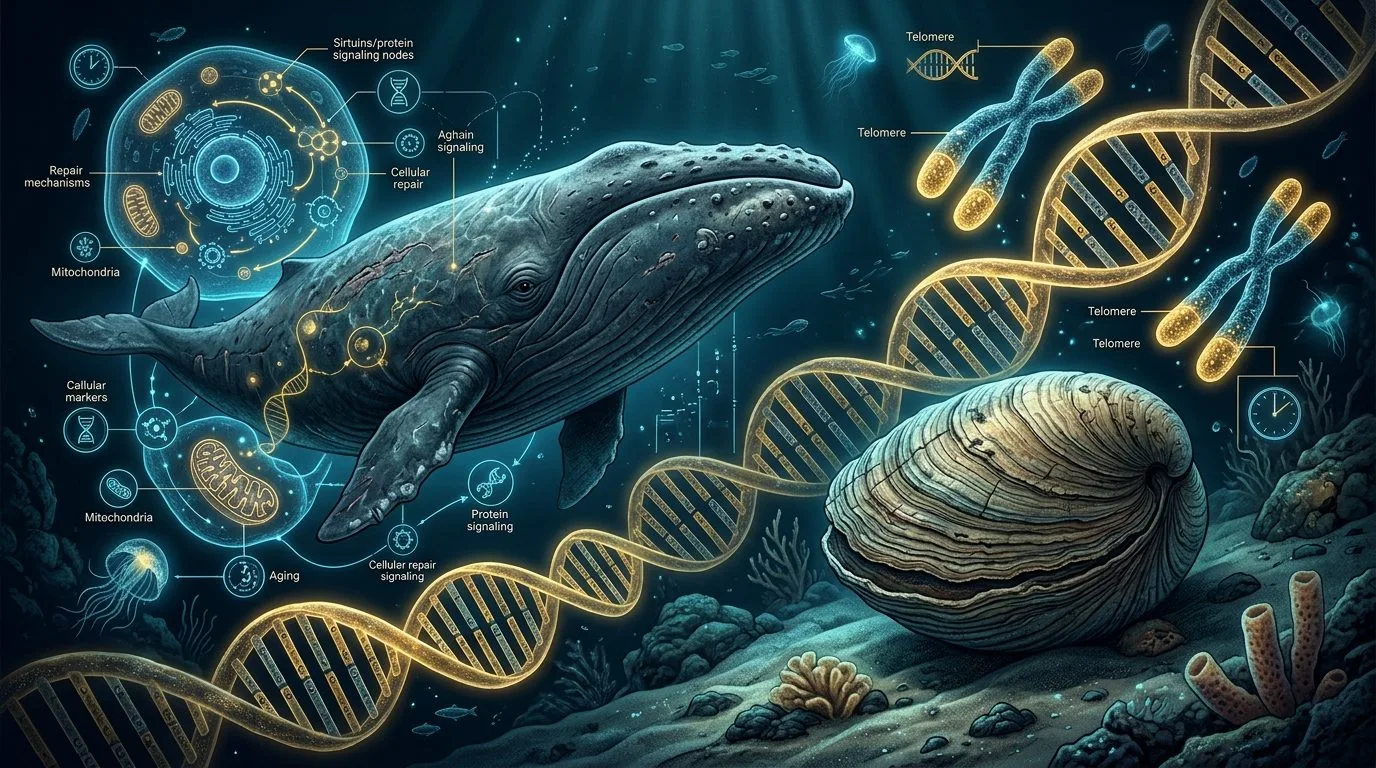
Zoological research has applications in veterinary science, wildlife management and conservation. It also helps explain the striking variety of animal adaptations. For an example of different biological approaches converging on one question, read SuperEducational's explainer on the biology of animal longevity .
9. Anatomy and 10. Physiology: structure versus function
Anatomy investigates how an organism is built: its organs, tissues and spatial arrangement. Physiology investigates how the parts work and how living systems maintain the conditions required for life. They are complementary rather than competing subjects.
Think of the heart. An anatomist may describe its chambers, valves and blood vessels; a physiologist may measure how heart muscle contracts and how blood flow responds to physical activity. The distinction—structure versus function—is explained in OpenStax Anatomy and Physiology 2e . Researchers frequently use both approaches in the same project.
11. Ecology: connections between organisms and environments
Ecology studies how organisms interact with one another and with their physical surroundings. An ecologist might investigate why a fish population declines, how a pollinator and plant depend on each other, or how drought changes a grassland.
Ecological questions can be studied at several levels: an individual organism, a population of one species, a community of interacting species, or an ecosystem that includes living and non-living components. The OpenStax ecology chapter explains these levels. Ecology is crucial for conservation, food systems, land management and understanding environmental change.
12. Evolutionary biology: how populations change across generations
Evolutionary biology investigates changes in inherited characteristics of populations through time and the processes that shape life's diversity. Mechanisms include natural selection, mutation, genetic drift and gene flow. Evolution can be studied through fossils, observations, experiments and comparisons of genetic information.
Consider bacteria exposed to an antibiotic. If resistance-conferring traits are heritable and favour survival under those conditions, resistant variants can become more common. Evolutionary biology helps explain this population-level change, while genetics examines the variants involved and microbiology studies the bacteria. For background, consult OpenStax's evolutionary biology introduction .
13. Taxonomy and systematics: naming and relating organisms
Taxonomy concerns the identification, naming and classification of organisms. Systematics examines biological diversity and the evolutionary relationships among organisms, often using anatomical and molecular evidence. They are closely related but not interchangeable.
For example, scientists comparing two newly discovered frogs might study body features and DNA to assess how the animals fit into an evolutionary tree. Their work helps researchers communicate clearly about species and their relationships. Classifications can be revised as better evidence becomes available; they are not simply unchanging lists to memorise.
14. Developmental biology: how organisms grow and form
Developmental biology investigates the processes that transform a fertilised egg or other early developmental stage into a functioning organism. Researchers examine cell division, differentiation, growth, pattern formation and the regulation of developmental changes.
One question is how cells with largely the same DNA become different cell types, such as muscle cells and nerve cells. The answer involves patterns of gene regulation, chemical signals and interactions among cells. Developmental biology overlaps with genetics, cell biology and physiology, and can also study regeneration and life-cycle changes.
15. Biochemistry: the chemistry of living systems
Biochemistry studies the chemical substances and reactions that sustain life. It includes enzymes, metabolism, proteins, lipids, carbohydrates and nucleic acids. Biochemists ask how organisms extract usable energy from food, how enzymes catalyse reactions and how cells synthesise important molecules.
For instance, a biochemist might measure how temperature changes an enzyme's activity. This does not mean every enzyme works best at the same temperature; each enzyme operates within particular conditions. Biochemistry connects biology with chemistry and is central to biotechnology and much biomedical research.
16. Bioinformatics: turning biological data into knowledge
Bioinformatics uses computers, statistics and databases to organise and analyse biological information. Modern research can generate large DNA, RNA or protein datasets that cannot reasonably be inspected one sequence at a time. Bioinformaticians develop and apply tools to compare sequences, identify patterns and test hypotheses.
For example, a research team may compare sequences from many organisms to investigate their relatedness or detect variants relevant to a research question. The NHGRI bioinformatics glossary describes the computational role of this field. Computational results still require appropriate biological interpretation and, where relevant, experimental verification.
17. Conservation biology and other specialised branches
Conservation biology integrates ecology, evolutionary biology, genetics, population studies and human land-use questions to protect species, habitats and biodiversity. It may involve monitoring a threatened animal population, assessing habitat fragmentation or evaluating a restoration programme.
Other common specialisms include marine biology (life in seas and oceans), neurobiology (nervous systems), immunology (immune systems), parasitology (parasites and hosts), mycology (fungi), palaeontology (ancient life based on fossils) and biotechnology (applying living systems or their components to useful technologies). These disciplines often cross several of the broader branches already described.
How the branches overlap: a river pollution example
Imagine that fish are dying in a river after a change in nearby land use. Different biological specialists would investigate complementary pieces of the problem:
- Ecologists compare fish populations, habitats and food webs at affected and unaffected locations.
- Microbiologists investigate whether changes in microbial communities could affect oxygen levels or other conditions.
- Physiologists examine how exposure or low oxygen affects the fish's organs and body functions.
- Cell biologists and biochemists look for cellular or biochemical responses that could help test specific mechanisms.
- Geneticists and bioinformaticians may analyse genetic variation or sequence data when those methods address the research question.
- Conservation biologists combine evidence with ecological management options and monitor the effects of interventions.
No single branch can answer every question. Researchers would first collect evidence and test competing explanations; the presence of an unusual microorganism or genetic pattern alone would not establish the cause of the fish deaths. This is why biology is both specialised and collaborative.
How to choose a branch of biology to study
Start with the questions you enjoy rather than the longest list of scientific names. If you want to know how cells operate, begin with cell biology and molecular biology. If you are fascinated by inheritance, study genetics before moving into genomics. If you enjoy wildlife, plants and outdoor observations, explore ecology, zoology, botany or conservation biology. If you prefer numbers, programming and datasets, bioinformatics may provide an especially interesting entry point.
Many courses build on shared foundations: scientific methods, cell structure, energy and metabolism, genetics, evolution and ecology. Learn those first, then explore specific techniques such as microscopy, field surveys, laboratory experiments, statistical analysis or sequence comparison. A specialism is a direction for investigation, not a barrier preventing you from learning other fields.
Check your understanding
- A researcher measures the activity of an enzyme as temperature changes. Which branch? Biochemistry.
- A researcher studies why deer numbers change after predators return. Which branch? Ecology.
- A researcher investigates how a DNA variant is passed from parents to children. Which branch? Genetics.
- A researcher asks which organs make up an animal's digestive tract. Which branch? Anatomy.
- A researcher builds software to compare thousands of genome sequences. Which branch? Bioinformatics, working closely with genomics.
Frequently asked questions
What are the three main branches of biology?
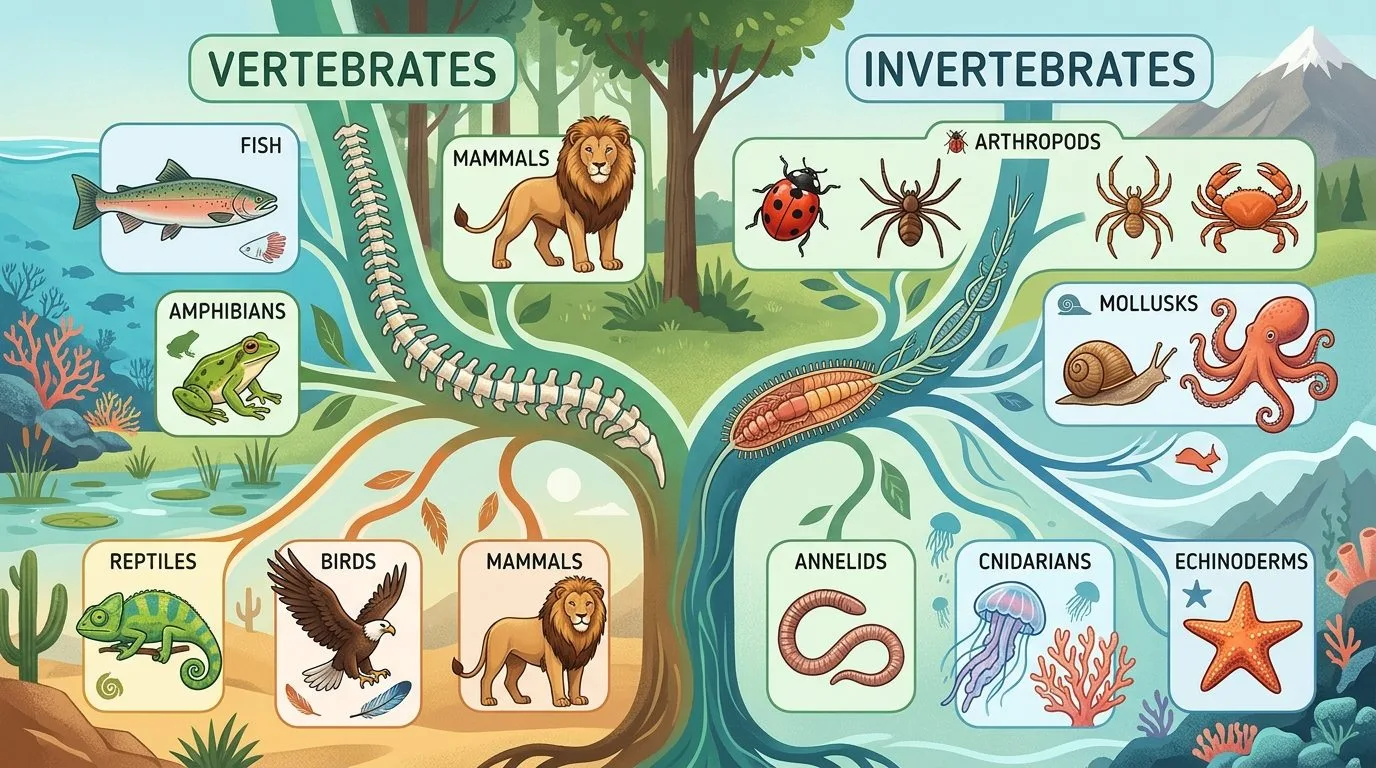
Traditional introductory classifications sometimes highlight botany, zoology and microbiology, but there is no universally agreed three-branch system. Modern biology also includes genetics, cell biology, ecology, molecular biology and many overlapping specialisms. A useful classification depends on whether you group fields by organism, level of organisation or research question.
What is the difference between cell biology and molecular biology?
Cell biology concentrates on cells as functioning units, including their structures and behaviour. Molecular biology concentrates on molecules and molecular processes, particularly DNA, RNA and proteins. One experiment may belong to both disciplines.
Is ecology the same as environmental science?
No. Ecology is a biological discipline focused on organism–environment interactions. Environmental science is broader and draws on biology, chemistry, earth science, physics and social science to investigate environmental conditions and problems.
Is genetics more important than ecology?
Neither is inherently more important. Genetics can explain inheritance and variation, while ecology explains interactions among organisms and their environments. Many important questions—from biodiversity to disease—require knowledge of both.
Conclusion
The branches of biology provide different windows into the same living world. Cell biology and molecular biology explain processes inside cells; genetics and genomics explore hereditary information; botany, zoology and microbiology examine organisms; anatomy and physiology explain structure and function; and ecology and evolutionary biology illuminate broader patterns across populations and environments. The most useful lesson is not to memorise an arbitrary number of branches, but to understand the questions each branch asks—and when collaboration produces a better answer.
References and further reading
- OpenStax, Biology 2e: The Science of Biology .
- US National Library of Medicine, Cell Biology .
- US National Library of Medicine, Molecular Biology .
- National Human Genome Research Institute, Genetics vs. Genomics .
- OpenStax, The Scope of Ecology .
- OpenStax, Overview of Anatomy and Physiology .
- National Human Genome Research Institute, Bioinformatics .