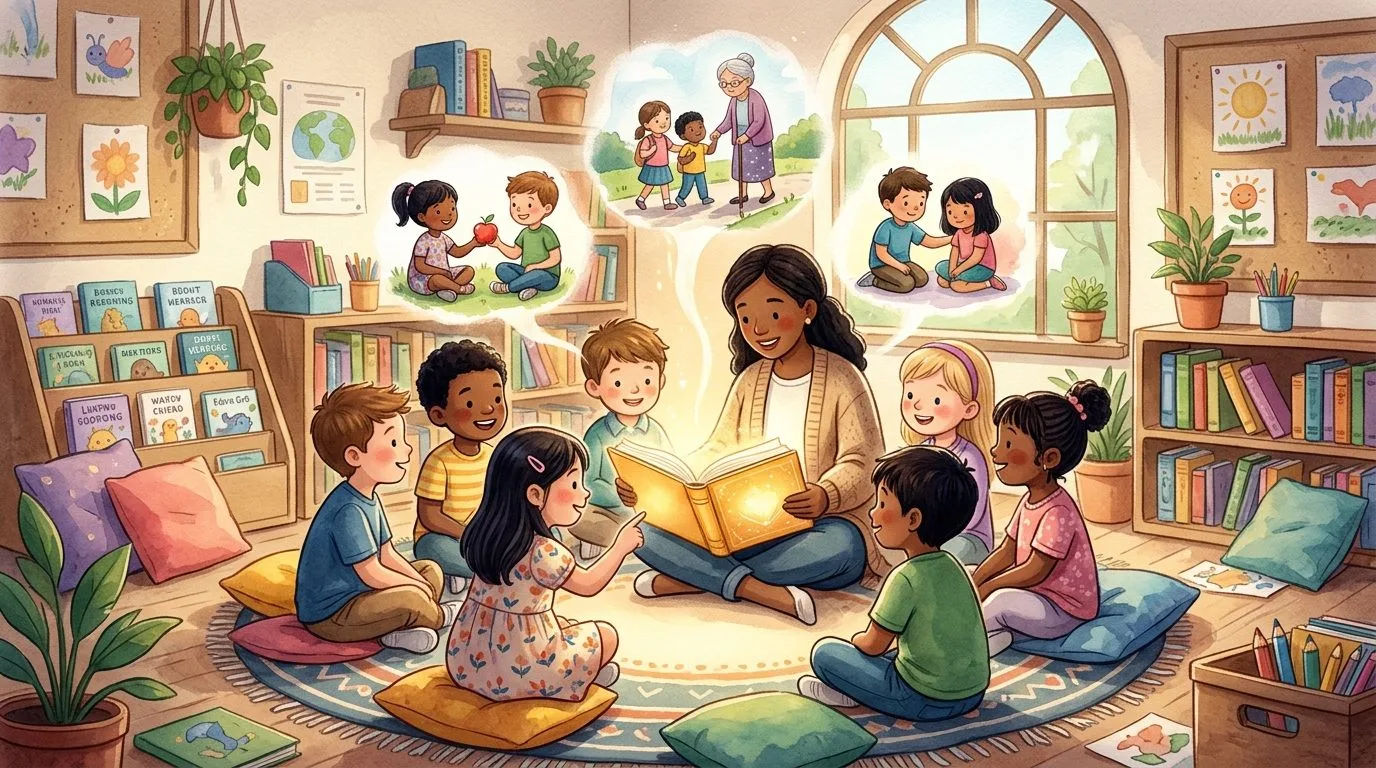
Short moral stories for children can help teach kindness when adults invite children to notice feelings, consider different perspectives and practise thoughtful choices. The aim is not to make every child recite “be nice”. It is to help them recognise that kindness involves listening, respecting boundaries, offering appropriate help and repairing harm when something goes wrong.
Try asking a child why a fictional character acted as they did rather than telling them what to think. Harvard's Making Caring Common recommends using stories to talk about feelings and alternative points of view. Reading Rockets describes dialogic reading, in which an adult and child talk together about the text, as a way to support language and meaning-making.
This guide explains how to teach kindness with short moral stories and reflection questions. It contains five completely original short stories for approximately ages 5–11, age-adaptable questions, safe follow-up activities, a 20-minute lesson format and a week-long practice plan. For readers looking for a wider collection of values, SuperEducational also has eight original moral stories with lessons and activities ; the focus here is specifically on the teaching method and how to turn kind intentions into concrete actions.
What does kindness mean for a child?
Kindness is more than saying please or giving away possessions. A kind response pays attention to another person's situation and considers what would actually be helpful. It can mean welcoming someone, respecting their decision, speaking truthfully with care, sharing when appropriate or asking a trusted adult for assistance. Kindness also includes being fair to yourself: a child is allowed to say no to unsafe or unwanted requests.
CASEL's social and emotional learning framework includes social awareness, relationship skills and responsible decision-making among the abilities that children can practise. In a 2023 study described by UC Berkeley's Greater Good Science Center , fourth- and fifth-grade students gave varied examples of kindness, including compassionate responses and inclusion. These findings do not mean that listening to any single story automatically improves a child's behaviour. They support offering children multiple meaningful opportunities to discuss and practise caring choices.
A five-step method: read, pause, notice, choose and practise
- Read a short story with a genuine dilemma. Select a situation children can recognise, such as a classmate needing help or a friend saying no. Stories need not have flawless heroes.
- Pause before the decision. Ask, “What might happen next?” or “What is this person worried about?” Allow silence for thinking.
- Notice feelings and perspectives. Ask what each character might feel; avoid assuming facial expressions or quiet behaviour always reveal an emotion.
- Compare possible choices. Ask which option is helpful, fair, respectful and safe. More than one answer may be reasonable.
- Practise a real-world action. Role-play asking before helping, listening without interrupting, thanking someone or repairing a mistake.
During reading, keep the interaction flexible. Reading Rockets' PEER approach suggests prompting, responding to and expanding a child's answer, and revisiting the idea. It is a useful guide, not a requirement to quiz a child on every sentence. For younger readers, one or two questions are usually enough; older readers may enjoy discussing competing interpretations and an alternative ending.
Five original short kindness stories with reflection questions
The following stories and characters are original fiction written for SuperEducational. They are not retellings of a traditional fable. Each story includes a choice that can be discussed without labelling a child as “good” or “bad”.
1. The Pencil with Two Names — offering help without making assumptions
Suggested ages: 5–8
At morning drawing time, Nala opened her pencil case and counted three blue pencils. Across the table, Deji was looking under his chair.
“Have you lost something?” Nala asked.
“My pencil,” Deji replied. “I brought it yesterday, and now it's gone.”
Nala was about to push one of her pencils towards him when she noticed the tiny label on his notebook: Deji — drawing competition. The drawing mattered to him, and he looked worried.
“Would you like to borrow my pencil, or should I help you look for yours first?” she asked.
“Can we look first?” Deji said. “My grandmother gave me that pencil.”
They searched the shelf and the floor. Finally, their teacher found it tucked into a folder of drawings. Deji held it like treasure.
“Thank you for helping,” he told Nala.
“I nearly gave you another one without asking,” Nala said.
“I would have been grateful,” Deji replied, “but I really wanted to find this one.”
Later, another pupil's crayon broke. Nala offered one of her spare crayons, and this time the pupil accepted at once.
Nala discovered that the same caring intention could lead to different helpful actions. The important first step was to notice—and ask.
Kindness lesson: Kindness begins with attention; ask what help is wanted instead of deciding for someone else.
Reflection questions
- Why was Deji's missing pencil important to him?
- Was Nala being unkind when she considered lending a different pencil?
- What could Nala say if Deji wanted to search alone?
Activity: In pairs, practise three helpful questions: 'Would you like help?', 'Which kind of help?', and 'Would you prefer to do it yourself?'
2. The Goal That Made Everyone Quiet — speaking fairly after a mistake
Suggested ages: 7–11
Two neighbourhood teams played a small football match after school. The score was tied when Ada caught a bouncing ball against her arm. She had been turning quickly and had not meant to touch it. The ball rolled near her feet, and she kicked it towards the goal.
“Goal!” shouted her friends.
But the other team stopped cheering. “That touched your arm,” said their captain, Somto.
The adult supervising the game had looked away for a moment and asked the players what they had seen.
Ada's face felt warm. She wanted her team to win. Some friends insisted that nothing had happened. Others were unsure.
“It touched my arm,” Ada said. “I don't know what the right decision is. We should ask you to decide.”
The adult thanked her for describing what happened and explained the agreed rules for their friendly game. The goal was not counted.
Ada's team groaned, and Ada felt disappointed. Somto walked over. “Thanks for saying what you saw. I know that was hard.”
After the match, Somto noticed Ada sitting alone. “Want to join our passing practice?” he asked. Ada nodded.
The children did not all agree about every moment of the game. They still learned that fairness means hearing different accounts, being honest about your part and allowing someone to feel disappointed without treating them as a bad person.
Kindness lesson: Kindness and fairness include telling the truth, listening to different perspectives and respecting shared rules.
Reflection questions
- What made Ada's choice difficult?
- How did Somto respond to Ada's disappointment?
- How could teammates disagree without insulting one another?
Activity: Use paper players and a drawn pitch to practise respectful phrases for a disputed decision, without physical tackles or arguing about real pupils.
3. The Note Left on the Bench — noticing without demanding a story
Suggested ages: 6–10
After the art exhibition, Lila saw her friend Emeka sitting alone on a bench. Everyone else was discussing prizes and colourful pictures. Emeka held his drawing in his lap but wasn't joining the conversation.
Lila sat at the other end of the bench. “Would you like company?” she asked.
Emeka shrugged. “Maybe. I don't want to talk about the exhibition.”
Lila had lots of questions. Had he wanted a prize? Had somebody laughed at his drawing? She did not ask them. Instead, she took out her notebook and drew a little bird wearing enormous boots.
Emeka glanced over and smiled.
“That's a very serious bird,” he said.
“It has an important meeting,” Lila replied.
For a few minutes, they drew quietly. Then Emeka spoke. “I worked so hard. I thought my picture would be chosen.”
“That sounds disappointing,” Lila said. She did not tell him to cheer up. “I liked the way you drew the street after rain.”
Emeka looked at his picture again. “Thanks for noticing that.”
When the bell rang, he stood. “Would you walk to class with me?”
“Of course,” Lila said.
She had not solved his disappointment. She had offered space, listened when he was ready, and stayed beside him.
Kindness lesson: Listening and respecting quiet moments can be kinder than insisting someone explain or immediately feel better.
Reflection questions
- Why did Lila avoid asking many questions at once?
- Can a person appreciate company and still want privacy?
- What would you say if Emeka asked to be alone?
Activity: Create a 'listening menu': offer company, a quiet activity, an adult's support or space, and discuss why people may choose differently.
4. The Community Shelf — caring for people beyond your friends
Suggested ages: 7–11
A small shelf stood beside the community centre entrance. Families left clean books and school supplies there for anyone who needed them. A sign said, “Take what helps. Return or share when you can.”
One afternoon, Bayo brought two storybooks he no longer read. He hoped someone would see him put them on the shelf and thank him. But nobody was around.
His younger sister, Ife, noticed his disappointed face. “Do they have to know the books are from you?” she asked.
“I suppose not,” Bayo said. “I just wanted to do something good.”
The next week, they passed the shelf again. One book was gone; a packet of pencils had appeared. Beside it was a note: “Thank you. The pencils helped me finish my homework.”
Bayo smiled. “Maybe somebody needed the storybook too.”
Ife pointed to a different note: “Please leave items clean and usable.” She noticed an old broken ruler on the shelf and asked the centre worker whether it should be recycled rather than offered to another child.
The worker thanked them for checking. Together, they sorted the shelf carefully.
On their way home, Bayo said, “Maybe kindness isn't always about being noticed.”
“And it isn't just giving things away,” Ife added. “It's thinking about whether they really help.”
Kindness lesson: Community kindness considers what is useful, respects people's dignity and does not require public praise.
Reflection questions
- Why did Bayo want someone to notice his books?
- Why was Ife right to ask about the broken ruler?
- What can children do for a community without spending money?
Activity: Plan a supervised class resource-sharing station with clear rules for useful items, consent, privacy and adult oversight.
5. The Pause Before 'Just Joking' — repairing hurtful words
Suggested ages: 7–11
At lunch, Kemi told a joke about how slowly her friend Yusuf tied his shoelaces. Two pupils laughed. Yusuf looked down and quietly moved to another table.
“It was only a joke,” Kemi said, but she noticed he had not laughed.
That afternoon, their teacher asked the class to consider a question: “Can someone intend to be funny and still hurt another person?”
Kemi thought about lunchtime. At home, she sometimes laughed when her brother teased her, but other jokes made her feel small.
The next morning, she found Yusuf near the bookshelves. “I made a joke about you yesterday. You looked hurt. I'm sorry,” she said. “I won't do that again.”
Yusuf nodded but didn't smile. “I was embarrassed.”
“I understand,” Kemi said. “You don't have to say it's fine.”
They chose different reading partners that day. Kemi kept her promise and stopped making the same joke. A few days later, Yusuf asked whether she wanted to join the science club after school.
Kemi was happy, but she knew that forgiveness had not been something she could demand. Her responsibility had been to notice the impact of her words, apologise sincerely and change what she did next.
Kindness lesson: Good intentions do not erase harm; kindness includes acknowledging the impact, apologising without pressure and changing behaviour.
Reflection questions
- Why did 'just joking' not make Yusuf feel better?
- What did Kemi do beyond saying sorry?
- Should Yusuf have been required to forgive right away?
Activity: Use fictional sentence cards to practise an apology: name the action, acknowledge the impact, offer repair and respect the other person's response.
Reflection questions that lead to deeper thinking
Good story questions move beyond “Was the character nice?” to help a child identify a need, consider several viewpoints and suggest an action. Harvard's story-based empathy resource recommends discussing how people may feel differently about the same event, especially during conflict.
| Level | Sample prompt | Why it helps |
|---|---|---|
| Notice | “What happened just before the character became quiet?” | Connects feelings to events without guessing |
| Perspective | “How might the other person explain this moment?” | Encourages consideration of more than one viewpoint |
| Choice | “What are two safe ways to respond?” | Builds flexible problem-solving |
| Boundaries | “How could someone say no and still be respectful?” | Separates kindness from forced agreement |
| Repair | “What action could make this a little better?” | Moves from blame to responsibility |
| Transfer | “Where might we try this in our classroom or home?” | Connects fiction to everyday habits |
A 20-minute kindness story lesson for home or school
- Minutes 0–3 — choose the focus. Introduce one question, such as “What does useful help look like?” Set a ground rule that pupils may disagree respectfully and pass on personal sharing.
- Minutes 3–9 — read aloud. Choose one short story, then pause at the turning point and invite predictions. Let pupils draw or listen quietly if they prefer.
- Minutes 9–14 — reflect. Use two or three questions that move from what happened to alternative choices. Ask who was affected, not which child in the room behaves like the fictional character.
- Minutes 14–18 — practise. Use pairs to rehearse a respectful offer, an apology or a boundary. Avoid role-plays that recreate real bullying or put children on the spot.
- Minutes 18–20 — choose one action. Invite a voluntary, small kindness practice, such as asking before helping or greeting a classmate. End without ranking children's goodness.
Reading Rockets' repeated interactive-read-aloud guidance recommends returning to a story across several sessions, increasing children's predictions, retelling and analytical talk. The 20-minute template is a practical suggested schedule, not a tested dosage that guarantees behaviour change.
Adapt kindness stories for different ages and abilities
Ages 5–7: Use short readings, picture prompts and concrete questions such as “What could they say?” Offer drawing, pointing and simple role-play. Avoid making a child disclose a personal experience to answer.
Ages 8–11: Explore mixed motives and more than one reasonable response. Ask whether a kind act could become intrusive, why fairness sometimes requires different support and what changes after an apology.
Multilingual learners: Explain a few key words such as respect, notice and repair; invite responses in familiar languages where practical. Reading Rockets notes that dialogic reading can be used across ages and learning needs, with prompts adjusted to the reader.
Children who prefer quiet participation: Allow a drawing, written note, partner discussion or pass. Kindness education should not punish shyness or assume everyone displays emotion in the same way.
When discussing unkind behaviour, keep criticism focused on the action rather than describing a child as a bad person. UNICEF's communication guidance recommends active listening, naming feelings and noticing specific helpful actions. These principles can be modelled in the way adults lead the lesson.
Five small kindness activities that cost little or nothing
- Ask-before-helping cards: Partners practise asking what help someone wants and hearing the reply without argument.
- Two-sided feelings map: Draw a story moment and write what two characters might have wanted, feared or misunderstood.
- Respectful words repair: Rewrite an unhelpful sentence into a direct but caring statement; do not require a child to disclose real incidents.
- Quiet kindness log: Record optional acts noticed in a community, including actions with no audience or reward. Avoid naming pupils publicly without consent.
- Alternative ending: Groups invent a new story ending, then explain the benefits, limits and possible unintended consequences of their choice.
How can adults tell whether the lesson is helping?
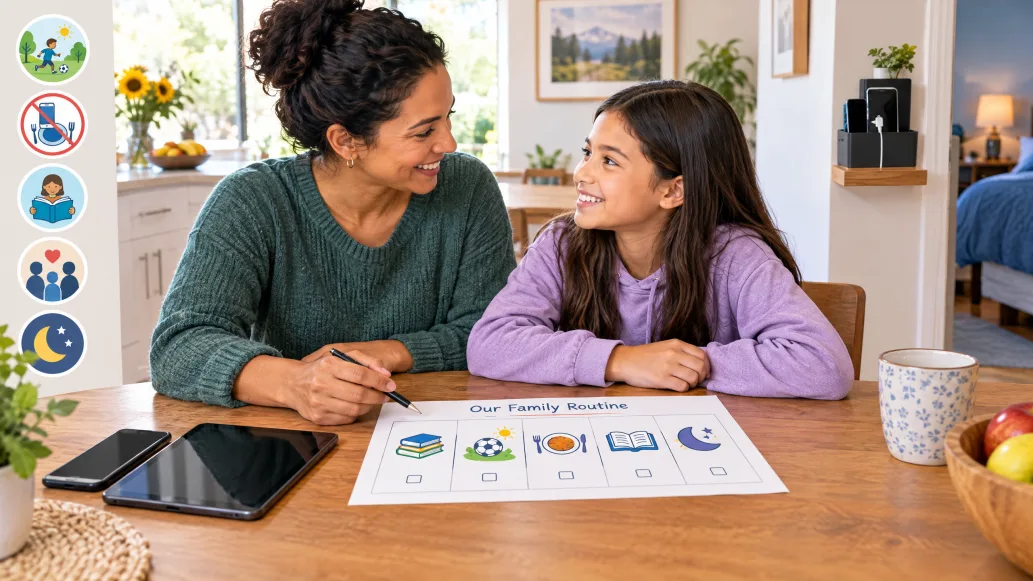
Do not turn kindness into a competitive scoreboard or promise that five stories will transform conduct. Look instead for observable skills over time: Does the child ask before helping? Can they describe how another person may feel? Do they seek adult help when needed, listen to a refusal, or try to repair a hurtful action? A child may understand these ideas in a story and still need guidance during a difficult real event.
The CASEL framework presents social awareness, relationship skills and responsible decision-making as developmental abilities practised across settings. Children learn from consistent adult examples and a caring environment, not only from a weekly story. UNICEF's guidance for ages 6–10 likewise emphasises calm guidance, opportunities to make decisions and learning through doing.
When a serious pattern of exclusion, bullying or distress is involved, a story can support conversation but should not replace safeguarding procedures or support from responsible adults. Children should never be told that being kind means tolerating harm or remaining in an unsafe situation.
To connect this lesson with everyday courtesy, see SuperEducational’s published guide to good manners for children . It offers practical examples that can follow the story discussion, such as listening respectfully and considering how words affect others.
Common mistakes when using moral stories to teach kindness
| Less helpful approach | A better alternative |
|---|---|
| Demanding a memorised moral after every reading | Invite the child to identify competing feelings and choices |
| Making the hero perfect and the other character bad | Show mistakes, repair and growth |
| Telling children they must share every personal item | Teach generous offers together with consent and boundaries |
| Giving rewards for public kindness rankings | Notice specific thoughtful actions without comparing children |
| Forcing a quick apology or forgiveness | Explain impact, support repair and give feelings time |
| Using stories as a substitute for addressing bullying | Apply the school's safeguarding and respectful conduct procedures |
Frequently asked questions
Can moral stories for children really teach kindness?
Stories provide opportunities to discuss perspectives, recognise feelings and rehearse caring decisions. Interactive reading and repeated discussion can support comprehension and social reflection. A story alone does not guarantee that a child will behave differently in every situation.
What are good reflection questions after a kindness story?
Try “What did each character need?”, “Why might they have reacted differently?”, “What other safe response was possible?” and “How could someone repair the situation?” Questions about reasoning often generate richer dialogue than asking only for the moral.
How long should a moral story be for young children?
There is no universal length. Pick a story that fits the child's interest and attention, and leave time for conversation. A short story followed by two thoughtful questions can be more useful than reading several stories quickly.
Is sharing always the kindest choice?
No. Sharing can be generous, but children also have appropriate personal boundaries. Asking before borrowing and accepting a reasonable refusal are both expressions of respect.
How can I teach kindness without shaming a child?
Focus on the choice and its impact, not a negative label for the child. Model a calm tone, invite other options, and support a practical way to repair harm if something went wrong.
What if my child does not want to discuss feelings?
Allow quiet listening, drawing, acting with fictional characters or simply revisiting the story another day. Do not force personal disclosures. A child may engage more readily when the conversation feels safe and optional.
Can teachers use these five stories in school?
Yes. The five stories are original works written for this article. Teachers can adapt the prompts and activities to age, accessibility needs, local safeguarding guidance and the classroom context.
Where can I find more moral stories for children?
Read SuperEducational's companion collection of eight moral stories with lessons and activities for themes including honesty, fairness, inclusion, responsibility and teamwork.
Conclusion: kindness grows through reflection and practice
The most useful moral stories for children do more than describe a kind hero. They help children see what another person might need, consider several safe responses and understand that kindness can include listening, honesty, helpful boundaries and repairing mistakes. A child does not need to offer a perfect answer to benefit from that conversation.
Use one short story, ask a few open questions, practise a real-world response and return to the idea over time. Adults' actions, classroom culture and everyday relationships give those lessons a chance to grow beyond the page.
Editorial note: All five stories are original fiction created for SuperEducational. Educational guidance was checked on 16 November 2026. Age bands are suggestions, and these activities are not a substitute for individual safeguarding or developmental support.