Some of the longest-living animals on Earth can survive for centuries, while certain coral colonies and deep-sea sponges may persist for thousands of years. An ocean quahog clam was dated to 507 years, the age of a large Greenland shark was estimated at 392 years with substantial uncertainty, and a Hawaiian black coral colony has been dated to approximately 4,265 years. Those figures are remarkable—but they do not all mean the same thing.
To understand longest-living animals, scientists first ask what is being aged. Is the record for a single animal, a colony consisting of many individual animals, a fossil-like skeleton accumulated over millennia, or an organism capable of restarting a stage of its life cycle? They also ask how the age was measured. A clam's growth bands can be counted, whereas the age of a Greenland shark is inferred from radiocarbon measurements in its eye lens.
This guide separates these categories, explains how scientists investigate ageing and explores why exceptional longevity does not make an animal immune to disease, fishing, climate change or habitat loss. Findings are based on research from NOAA Fisheries , NOAA Ocean Exploration , peer-reviewed studies and the 2026 Guinness tortoise record .
Which animals live the longest? A scientifically qualified comparison
| Animal | Notable age | What the number actually means |
|---|---|---|
| Giant glass sponge (Monorhaphis chuni) | About 11,000 ± 3,000 years | Model-based age estimate for a sponge's giant siliceous spicule, with major uncertainty |
| Hawaiian black coral (Leiopathes) | About 4,265 years | Radiocarbon-dated skeletal age of a coral colony, not one polyp |
| Ocean quahog clam (Arctica islandica) | 507 years | Age of a dated, non-colonial individual named Ming |
| Greenland shark (Somniosus microcephalus) | 392 ± 120 years | Central age estimate for the largest shark in a 2016 eye-lens study, not an exact birthday |
| Bowhead whale (Balaena mysticetus) | More than 200 years | Extreme mammal lifespan supported by historical objects and age-estimation studies |
| Rougheye rockfish (Sebastes aleutianus) | Reported 205 years | Exceptionally old fish record; some specialists treat the highest estimate as an outlier |
| Red sea urchin (Mesocentrotus franciscanus) | Possibly 200+ years | Estimated from growth research and radiocarbon methods; not every urchin lives that long |
| Jonathan, giant tortoise | Approximately 194 years in 2026 | Estimated age of an identifiable living land animal, based on historical records |
These are not average life expectancies. They are old specimens, record ages or study estimates with different levels of uncertainty. It would be misleading to rank them as though every figure were a birth-certificate-verified age. The Guinness record for the oldest non-colonial animal and the NOAA explanation of coral colony age clarify why those distinctions matter.
1. Ocean quahog: a clam that lived 507 years
The ocean quahog, Arctica islandica, is a slow-growing marine bivalve that lives buried in the seabed of the North Atlantic. One clam collected off Iceland in 2006 became famous as Ming. Bangor University researchers initially assigned it an age of around four centuries; improved analysis of growth increments revised its age to 507 years. Guinness recognises it as the oldest documented non-colonial animal, and Bangor University confirms that 507-year figure.
Clam shells develop layers of calcium carbonate. Under suitable conditions, researchers can identify annual growth increments, compare them across shells and construct long environmental timelines. The same archive helps reveal changes in sea temperature and marine conditions centuries before modern instruments existed.
Scientists did not establish that every ocean quahog can live half a millennium. NOAA Fisheries says animals in the US East Coast fishery can live at least 200 years, itself a very long time. A 2025 genome assembly of A. islandica provides a foundation for studying its survival and maintenance pathways, but a genome sequence alone does not reveal one definitive explanation for Ming's lifespan.
Ming's age was determined after the animal was collected; it is not an example of a 507-year-old clam currently known to be alive. That is an important distinction between a recorded lifespan and a living age record.
2. Greenland shark: a vertebrate that may live for centuries
The Greenland shark inhabits cold waters of the North Atlantic and Arctic. It grows unusually slowly and lacks the easily interpreted hard structures that scientists often use to age bony fishes. A 2016 study published in Science analysed radiocarbon signatures in the nuclei of eye lenses from 28 female sharks. The largest, measuring about five metres, received a central age estimate of 392 years, plus or minus 120 years within the study's reported probability range.
That is not the same as saying scientists know it was born exactly 392 years before capture. The research suggested a lifespan of at least 272 years and an extraordinarily late age of sexual maturity—estimated at 156 ± 22 years. See the original Nielsen and colleagues study .
Canada's 2025 Greenland shark assessment stresses that eye-lens radiocarbon ages have not been independently validated by a workable alternative technique and depend on uncertain assumptions about deep-ocean carbon history. Thus, “a Greenland shark definitely lived 500 years” is stronger than the evidence supports.
Slow growth and very late maturity create a conservation problem: individuals removed from the population may not be replaced for generations. Avoiding unnecessary bycatch and protecting habitat matter especially when an animal's population turns over so slowly.
3. Bowhead whale: the mammal that can pass 200 years
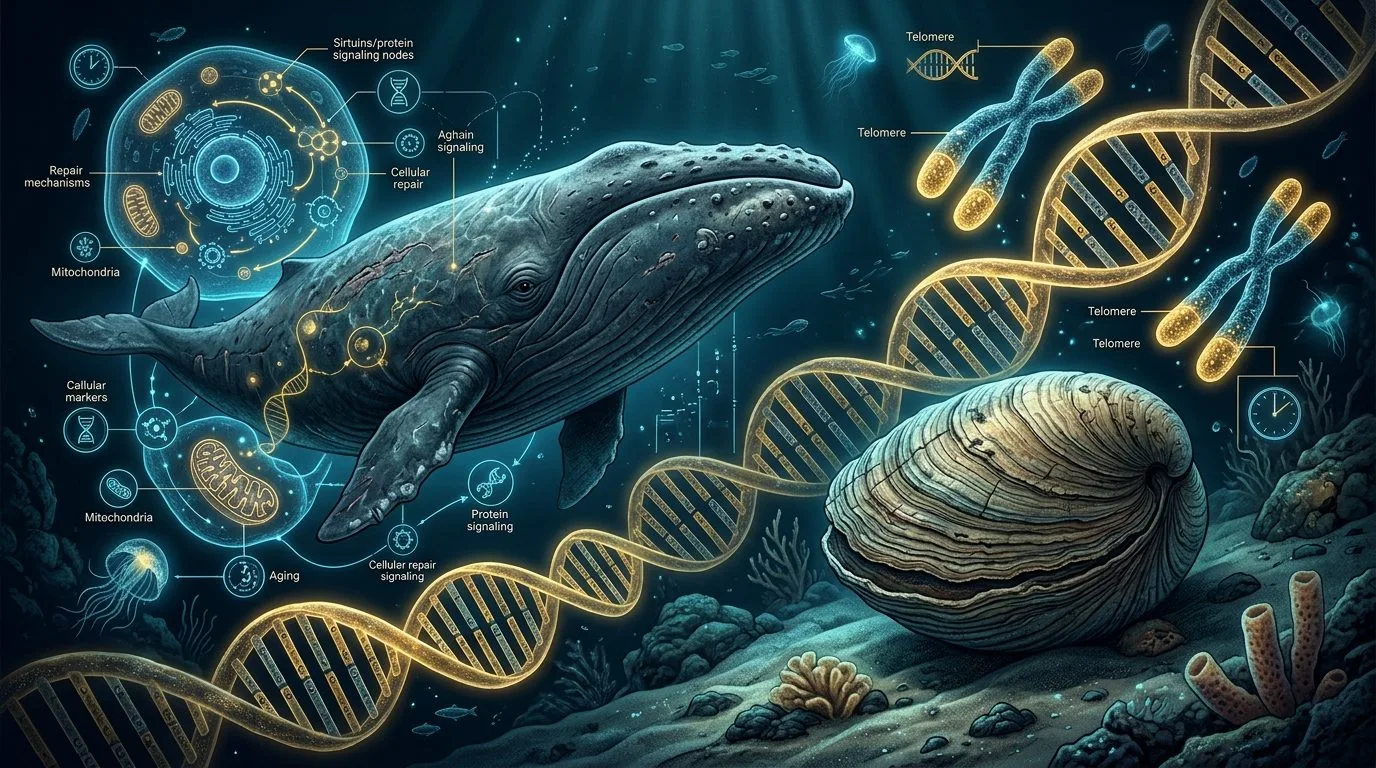
The bowhead whale is an Arctic specialist and the longest-lived marine mammal known. NOAA reports that bowheads may live for more than two centuries. Historical harpoon fragments embedded in some whales provide independent clues that they survived earlier encounters many decades ago; biochemical methods also support exceptional ages.
Its longevity raises a biological puzzle. A whale has a vast number of cells over which harmful mutations could develop during a long lifetime, yet bowheads do not appear to suffer cancer in proportion to that simple expectation. This general size-versus-cancer puzzle is known as Peto's paradox.
A 2025 Nature study examined DNA repair in bowhead cells and found evidence for improved repair processes. It adds to the investigation of cancer resistance, but it does not mean a bowhead possesses a clinically proven mechanism that humans can simply copy. Ageing involves many pathways, and laboratory results are not treatments.
4. Black coral: 4,265 years of a living colony
In the deep sea near Hawaii, scientists identified a black coral in the genus Leiopathes whose accumulated skeleton was approximately 4,265 years old. Its age was estimated using radiocarbon dating. Both NOAA Ocean Exploration and the Smithsonian Ocean describe this remarkable finding.
Why isn't it simply the oldest single animal? A coral colony is formed by many living animal units called polyps. Polyps reproduce, grow, die and are replaced while the colony's shared structure continues. The skeleton's great age therefore does not mean one polyp has survived untouched since ancient times.
NOAA also reports research on shallow-water elkhorn corals in which a shared genotype may persist for more than 5,000 years through fragmentation and regrowth. That measures the persistence of genetic lineage across colonies, not the age of an uninterrupted single body. Comparisons must preserve that distinction.
Deep-sea coral growth layers can also function as natural environmental archives. They record aspects of surrounding water chemistry across the centuries. Yet thousands of years of slow growth can be destroyed rapidly by bottom-contact fishing gear or other physical disturbances.
5. Glass sponges: a claim of roughly 11,000 years—with uncertainty
Sponges are animals, even though they have no typical brain, bones or muscles. Some deep-sea glass sponges construct silica structures that can grow very slowly. A 2012 study of the giant spicule of Monorhaphis chuni estimated an age of around 11,000 ± 3,000 years by comparing chemical signals in the silica with reconstructed ocean temperatures.
That finding, described in the original research on the sponge's palaeoclimate archive , is among the most extraordinary animal longevity estimates. But the date is model-dependent, with an uncertainty of thousands of years. It cannot be treated as an exact continuously observed lifespan or casually compared with annual growth increments in a clam.
A deep-sea sponge that survives for millennia is also extremely vulnerable to sudden damage. Large structures can take generations to replace, and scientists cannot necessarily know the age of an intact living sponge without intrusive sampling.
6. Jonathan: approximately 194 years and still a living land record
Jonathan, a Seychelles or Aldabra-related giant tortoise living on the island of St Helena, is the world's oldest-known living terrestrial animal according to Guinness World Records . His estimated birth year is 1832, making him approximately 194 years old in 2026.
Jonathan's exact hatching date is not documented. The estimate rests partly on evidence that he was already a mature adult when he arrived on St Helena in 1882. Historical photographs and caretaking records give a strong basis for an approximate age, but it is still an estimate rather than an exact date of birth.
In October 2026, researchers published a genomic and epigenetic study in Science Advances . They examined genetic variants and DNA-methylation patterns associated with functions including cellular energy production, DNA maintenance and RNA processing. Researchers identified unusual features in Jonathan compared with younger tortoises, suggesting promising hypotheses about how some ageing-related processes may remain stable for a very long time.
This was a study of one extraordinary tortoise alongside limited comparisons. It cannot prove which particular changes caused his longevity, nor establish a human anti-ageing therapy. Jonathan also receives veterinary care and appropriate feeding, illustrating that an individual animal's circumstances matter alongside biology.
7. Rougheye rockfish and red sea urchins: two overlooked centenarians
The rougheye rockfish is a slow-growing deep-water fish in the North Pacific. A specimen has been reported at about 205 years old. The Washington Department of Fish and Wildlife lists a maximum age of at least 205 years, although a later NOAA technical review notes that the highest reported age is sometimes considered an outlier by contemporary ageing specialists. The species illustrates why an apparent record should be interpreted alongside ageing uncertainty.
The red sea urchin, Mesocentrotus franciscanus (formerly Strongylocentrotus franciscanus in much older literature), can also live for many decades. Oregon State University reports evidence that some may be 200 years or older. Scientists used growth observations and radiocarbon methods to test their age estimates.
In both animals, reproductive success and survival at old ages matter for conservation. Removing the largest fish or urchins can remove individuals that took a century or more to reach their size.
Does the “immortal jellyfish” live forever?
The tiny hydrozoan Turritopsis dohrnii is often called the immortal jellyfish, but that nickname is easily misunderstood. Under certain conditions, the mature jellyfish can reverse its development and return to an earlier polyp stage, instead of following a one-way life cycle. Scientists study cellular reprogramming and related genetic changes involved in this process.
A 2022 comparative genomics study in PNAS identified mechanisms associated with the species' repeated rejuvenation. It described an unusual form of biological immortality, meaning that the animal can avoid some normal limits imposed by development and ageing under suitable conditions—not that individual jellyfish are invulnerable.
They can still be eaten, damaged, infected or killed by unfavourable environmental conditions. Nobody has demonstrated that an individual Turritopsis has lived continuously for thousands of years in the wild. Biological life-cycle reversal is therefore a separate category from the documented age of Ming the clam or the estimated age of a shark.
How do scientists know an animal is hundreds of years old?
Ageing an animal is a measurement problem. Many wild creatures have no birth record, so investigators combine anatomy, chemistry, historical evidence and statistical modelling.
| Ageing method | Example | Important limitation |
|---|---|---|
| Counting annual growth increments | Ocean quahog shells; some fish otoliths | Researchers must verify that the increments correspond to years and are interpretable |
| Radiocarbon analysis | Greenland shark eye lens; coral skeletons | Depends on carbon history, calibration and the sampled tissue |
| Historical records and photographs | Jonathan the giant tortoise | Often yields an age range or minimum, not a precise birthday |
| Growth and environmental models | Glass sponge silica spicule | Uncertainty depends on assumptions about environmental history and growth |
| Genealogical or mutation-based estimates | Fragmenting coral genotypes | Can reflect the age of a shared genetic lineage rather than a single body |
Fish researchers can examine otoliths, tiny mineralised structures inside the inner ear. In many species they accumulate annual rings that record growth and conditions. SuperEducational's published guide, How Do Fish Ear Stones Record Age, Migration and Ocean History? , explains this approach in more detail.
Sometimes two methods can validate each other. In other cases—as with Greenland shark ages—the absence of an independent ageing method is itself a major scientific limitation. A trustworthy article reports that uncertainty rather than presenting a broad estimate as a measured birthday.
Why do some animals age so slowly?
There is no universal single gene or “secret” that makes an animal long-lived. Scientists study interacting influences on cell maintenance, metabolism, reproduction, ecology and the evolution of survival strategies.
DNA repair and cell maintenance
Cells are exposed to DNA damage and other molecular stress throughout life. Systems that recognise and repair damage may help certain long-lived animals preserve normal functioning. Research on bowhead whale DNA repair and the 2026 Jonathan tortoise study offers clues—but different species may use different combinations of pathways.
Energy use and metabolism
Some long-lived marine animals grow slowly in cold, stable environments. Slower growth and reduced energy expenditure may contribute to their life histories, yet it would be wrong to claim that cold temperatures automatically produce a longer lifespan. Species with very different metabolic strategies can be long-lived, and healthy survival depends on many factors.
Delayed reproduction and life-history trade-offs
Greenland sharks are estimated to mature only after well over a century. Bowheads also mature slowly compared with many mammals. Evolution can favour extended growth, survival and reproduction under environments where adult mortality is low. But slow reproduction can make a species especially vulnerable when human activity sharply raises adult mortality.
Proteins, inflammation and cellular stability
Researchers also investigate how animals maintain proteins, manage oxidative stress and regulate immune or inflammatory responses. These processes work together and can change across tissues and ages. An association between a molecular trait and long life is not yet proof that altering the trait will extend lifespan.
Protection from predators and stable habitats
Large body size, shells, protected environments or very deep-water habitat may reduce some sources of mortality. Long-term survival is not purely a cellular achievement; an animal must also avoid predation, disease, storms, fishing gear and habitat destruction over many years.
Does living longer mean ageing more slowly?
Not necessarily. Lifespan is the length of life; the rate of ageing concerns how survival chances and physiological performance change with age. Some animals survive for a very long time despite measurable ageing. Others show weak signs of increasing mortality or declining reproduction across the ages researchers can observe.
A turtle estimated to be 194 years old and a coral colony lasting four millennia have fundamentally different body plans and life cycles. A sponge's estimated age may refer to skeletal growth, while a hydroid jellyfish can reverse developmental stages. These are scientifically interesting differences, not reasons to collapse all longevity records into one universal ranking.
What do the longest-living animals teach us about conservation?
Extreme longevity often comes with slow population recovery. A Greenland shark may need more than a century before reproducing. A deep-sea coral or sponge may take thousands of years to build a structure that heavy fishing equipment could damage quickly. Ocean quahogs and older rockfish represent long accumulations of growth that cannot be replaced in a few seasons.
Protecting very old animals therefore requires managing more than annual catch counts. Researchers and conservation agencies consider bycatch, habitat disturbances, reproductive age, ocean warming and the condition of long-lived adults. For a species with slow reproduction, the loss of mature animals can have effects that persist far beyond a human planning cycle.
Long-lived shells and skeletons also preserve environmental information, making these organisms important for historical climate research. That scientific value strengthens the case for protecting fragile deep-sea habitats and avoiding unnecessary destruction of rare ancient specimens.
Classroom activity: sort the longevity claims
Ask students to create cards for eight examples in this article. On each card, write the animal, the reported age, the method used and one uncertainty. Then sort the cards by individual versus colony/genotype and by direct record versus scientific estimate.
Discussion questions: Would a 4,265-year-old coral colony automatically beat a 507-year-old individual clam in a single-animal record? Why not? Does a 392 ± 120-year estimate mean a Greenland shark was exactly 392 years old? How does the nickname “immortal jellyfish” differ from a documented lifespan?
This activity needs only paper and reputable references. Students should not disturb wildlife or collect protected species to test animal ages.
Frequently asked questions
What is the longest-living animal in the world?
It depends on the category. An ocean quahog reached a documented 507 years as a non-colonial individual. A Hawaiian black coral colony was dated to about 4,265 years, while some glass sponges have still older but highly uncertain model-based age estimates.
What is the oldest-known living land animal in 2026?
Jonathan, a giant tortoise on St Helena, is estimated to be 194 years old in 2026, according to Guinness World Records. His exact birth date is not known.
Can Greenland sharks really live 400 years?
Evidence supports extraordinary longevity. The largest shark in a 2016 radiocarbon study received a central age estimate of 392 years with a reported range of ±120 years. Scientists stress that the method contains substantial uncertainty.
Which mammal lives the longest?
The bowhead whale is the longest-lived known marine mammal, with studies suggesting it can exceed 200 years. Exact maximum ages remain challenging to establish.
Why is the 507-year-old clam famous?
The ocean quahog nicknamed Ming was dated to 507 years using shell-growth increments. It is a record for an identifiable non-colonial animal, not evidence that all clams live that long.
Is the immortal jellyfish actually immortal?
No individual is guaranteed to live forever. Turritopsis dohrnii can reverse its life cycle under some conditions, but it can still die from predators, disease or environmental harm.
Do long-lived animals hold a cure for human ageing?
Research on DNA repair, cell maintenance and metabolism may improve understanding of ageing biology. It has not established a reliable method to reproduce a whale's or tortoise's lifespan in humans.
Do animals in cold water always live longer?
No. Cold environments may be associated with slow growth in some long-lived species, but lifespan also depends on genetics, reproduction, predators, food availability, human threats and many other factors.
Conclusion: the record matters, but the method matters more
The world’s longest-living animals challenge our assumptions about how bodies survive over time. A clam can preserve five centuries in its shell; a shark's eye lens can contain chemical evidence pointing to hundreds of years; whales and tortoises may maintain their bodies across multiple human generations; and colonies of deep-sea animals can persist across millennia.
The most important scientific lesson is to compare like with like. Individual age, colony age, genetic-lineage age, modelled skeleton age and the ability to rejuvenate are different claims. Once that distinction is made, the evidence becomes more fascinating—and more useful for understanding evolution, ageing and conservation.
Research and age records checked 16 November 2026. Ages are estimates unless described as documented age determinations; none of the examples represents the normal lifespan of every member of its species.