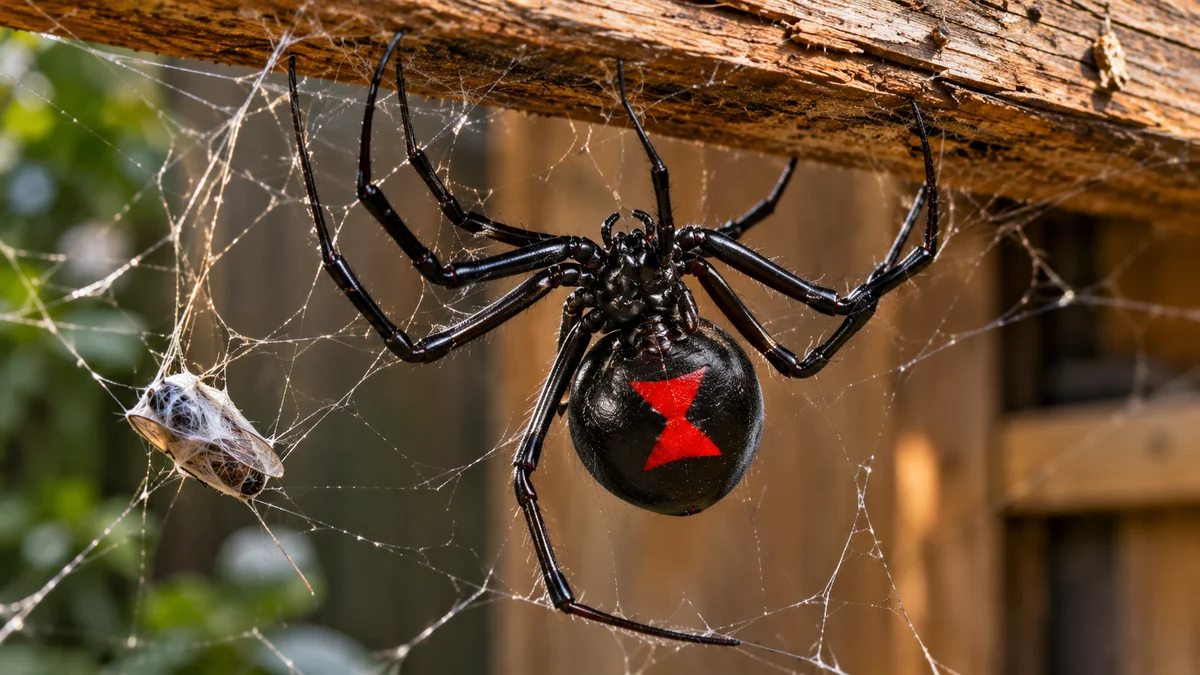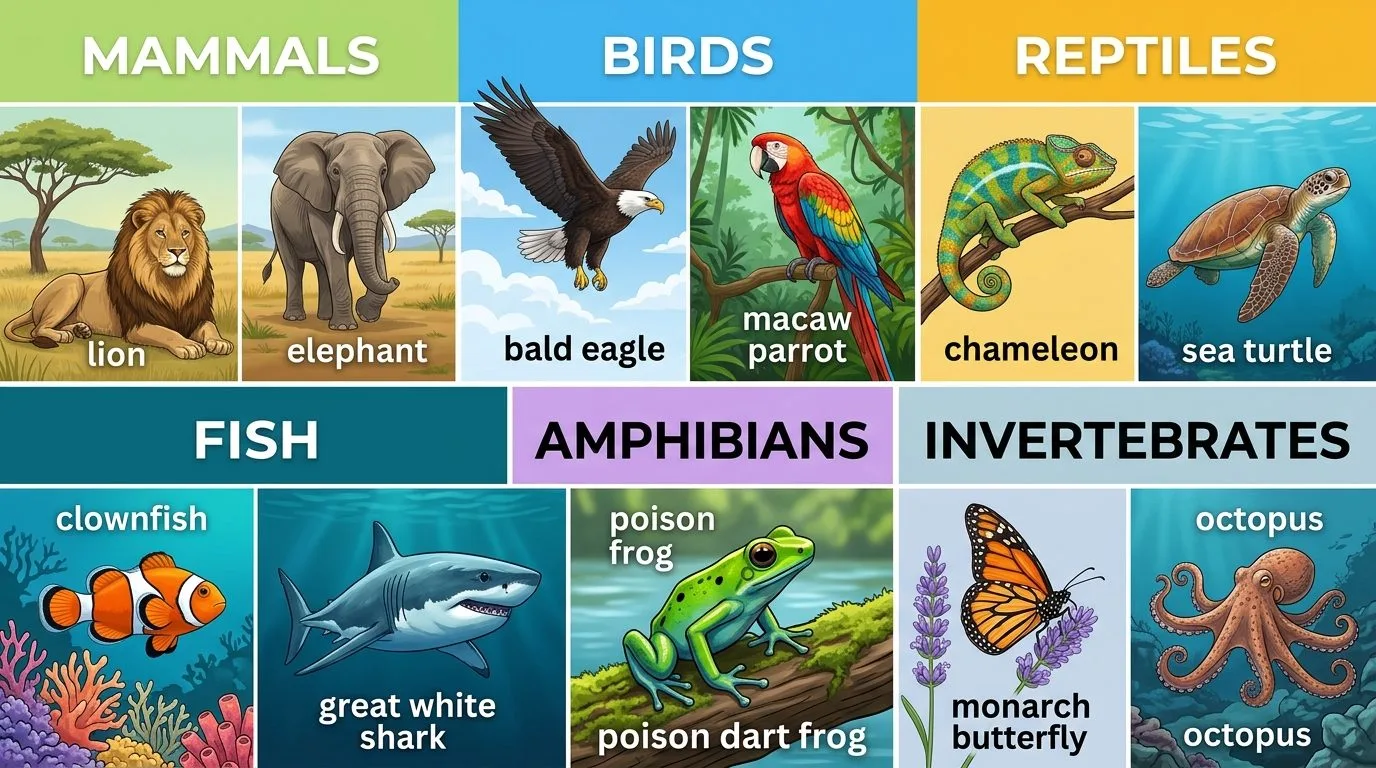
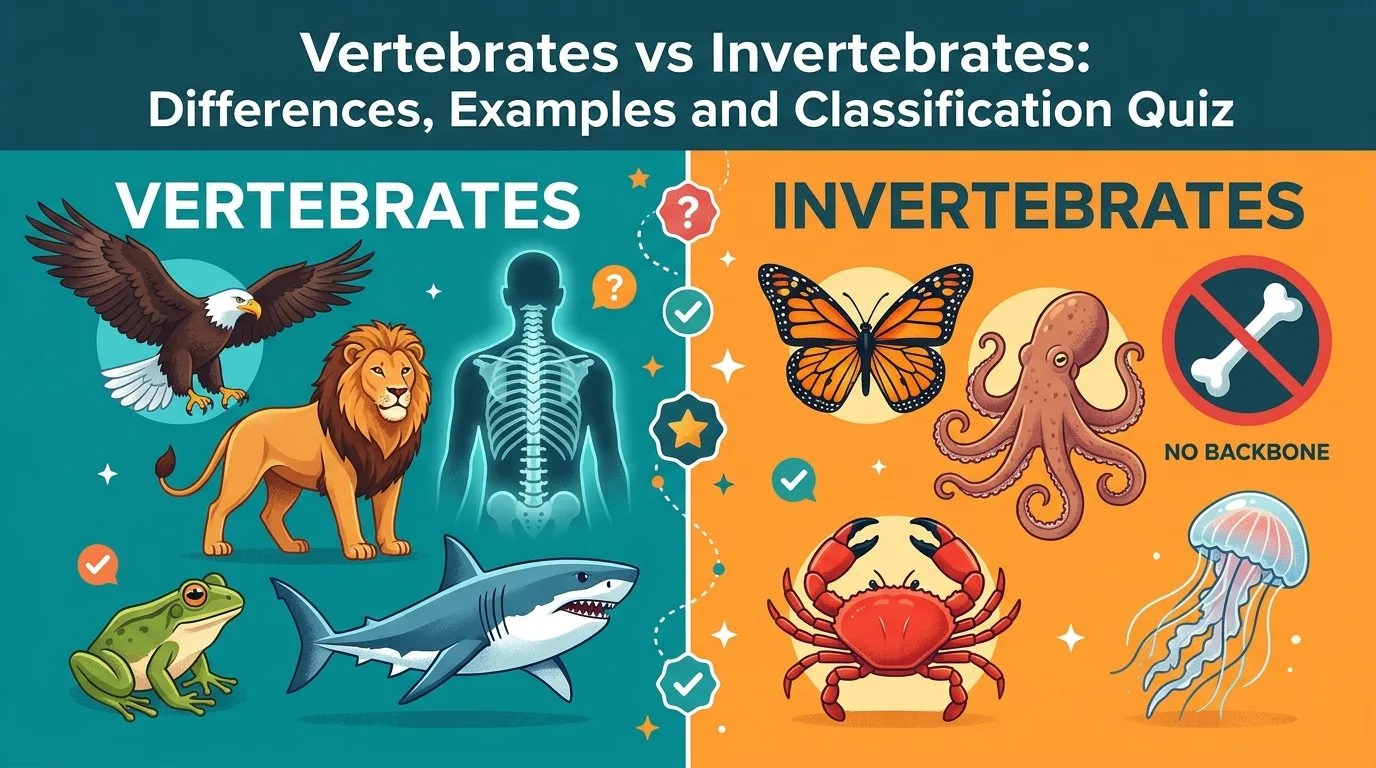
The main difference between vertebrates and invertebrates is evolutionary ancestry and the presence of a backbone: most vertebrates have a vertebral column, while invertebrates are animals outside the vertebrate lineage. A dog, frog, eagle and shark are vertebrates. A butterfly, spider, octopus, earthworm and jellyfish are invertebrates. The distinction sounds straightforward, but a shell is not a backbone, a cartilaginous skeleton still belongs to a vertebrate, and where an animal lives does not settle the question.
This guide to vertebrates vs invertebrates provides clear examples, an accessible comparison chart, the five familiar vertebrate groups, major invertebrate groups and the exceptions that make biology interesting. It also includes a 15-question classification quiz with explained answers and a no-collection classroom activity.
The scientific explanations draw on OpenStax Biology 2e's chapter on chordates and its introduction to invertebrates . This lesson uses the practical school distinction while explaining why vertebrates and invertebrates are not equivalent branches of the evolutionary family tree.
Vertebrates vs invertebrates: quick comparison
| Feature | Vertebrates | Invertebrates |
|---|---|---|
| Basic definition | Animals in the vertebrate evolutionary lineage, usually possessing a backbone | All animals that do not belong to the vertebrate lineage |
| Backbone | Present in most; hagfishes are an unusual exception in some classification treatments | No vertebral column |
| Structural support | Typically an internal skeleton of bone or cartilage | May have an exoskeleton, shell, internal plates, fluid support or no rigid skeleton |
| Brain and nerves | Typically a brain protected by a skull and a spinal cord | Highly variable, from simple nerve networks to complex brains in octopuses |
| Examples | Human, whale, snake, pigeon, frog, tuna, shark | Ant, spider, crab, snail, squid, earthworm, coral, sea star |
| Species diversity | A small fraction of described animal species | The great majority; approximately 97% in OpenStax's introductory estimate |
| Scientific grouping | A nested lineage within Chordata | A convenient category covering multiple distinct evolutionary lineages |
Important: The often-quoted 97% figure is an approximate educational estimate for animal diversity, not a precise and permanent census. Researchers continue to discover species, especially invertebrates. OpenStax uses “nearly 97 percent” to illustrate the scale of invertebrate diversity.
What is a vertebrate?
A vertebrate is an animal within the vertebrate branch of the phylum Chordata. In most vertebrates, a series of vertebrae forms a backbone that supports the body and protects the spinal cord. Vertebrates also belong to a skull-bearing evolutionary lineage, with a specialised central nervous system and internal skeleton.
Not every skeleton is made of bone. Sharks and rays have skeletons largely composed of cartilage. They remain vertebrates because their ancestry and anatomical features place them within the group. Hagfishes are a more complicated case: they have a skull but lack conventional vertebrae. Modern treatments often include them in Vertebrata/Craniata, although textbooks may describe that relationship differently. The OpenStax chordate overview explicitly acknowledges this anatomical exception.
To recognise vertebrates, think about shared body organisation and ancestry, not simply whether the animal looks strong, large or capable of walking.
The five familiar vertebrate groups
| School-level group | Examples | Useful clues and exceptions |
|---|---|---|
| Fishes | Tilapia, salmon, sharks, rays | Usually aquatic, with gills and fins; sharks have cartilaginous skeletons |
| Amphibians | Frogs, salamanders, caecilians | Often moist skin and water-linked development, but life histories vary |
| Non-bird reptiles | Lizards, snakes, turtles, crocodiles | Typically keratin-rich skin coverings; some give birth to live young |
| Birds | Pigeons, eagles, penguins, ostriches | Have feathers; flightlessness does not remove bird status |
| Mammals | Humans, bats, whales, platypuses | Have mammary glands and hair; monotremes lay eggs |
These five are helpful teaching categories, not five perfectly separate evolutionary branches. Birds evolved within the theropod dinosaur lineage and are nested within the broader reptile ancestry. Tetrapods, including humans and birds, descended from ancient lobe-finned fish lineages. OpenStax's bird chapter explains the dinosaur connection, and its mammal chapter confirms that egg-laying monotremes remain mammals.
What is an invertebrate?
An invertebrate is an animal outside the vertebrate lineage. Unlike a vertebrate, it does not possess a vertebral column. This definition covers an enormous variety of body plans, from tiny insects to large squid and octopuses, from microscopic worms to reef-building corals.
Invertebrate does not mean boneless, brainless or simple. Sea stars possess internal skeletal plates, insects have protective outer skeletons, snails and clams can have shells, and octopuses have sophisticated sensory and nervous systems. The key distinction is that none belongs to the vertebrate lineage. The OpenStax echinoderm chapter describes the internal ossicles of sea stars, while the mollusc chapter shows how complex octopus anatomy is.
Six useful invertebrate groups
| Phylum | Examples | Characteristic worth remembering |
|---|---|---|
| Arthropoda | Insects, spiders, crabs, centipedes | Jointed appendages and a chitin-rich exoskeleton |
| Mollusca | Snails, clams, octopuses, squid | Soft-bodied plan with a mantle; shell is not universal |
| Annelida | Earthworms, leeches | Segmented bodies |
| Cnidaria | Jellyfish, corals, sea anemones | Specialised stinging cells called cnidocytes |
| Porifera | Sea sponges | Water-filtering structures and pores |
| Echinodermata | Sea stars, sea urchins, sea cucumbers | Internal skeletal ossicles and a water vascular system |
These are six major examples, not a complete list of invertebrate phyla. Flatworms, roundworms and numerous other lineages also belong in the category. For deeper study, see arthropods , molluscs and annelids , and cnidarians in OpenStax Biology 2e.
Do vertebrates always have an internal skeleton and invertebrates an external one?
No. This is a useful way to introduce some examples, but it becomes inaccurate if taught as a universal rule. Vertebrates generally have an internal skeleton made of bone or cartilage. Invertebrate arthropods, such as insects and crabs, have an external skeleton; however, many other invertebrates lack that kind of outer covering.
A sea star, despite being an invertebrate, has internal ossicles forming an endoskeleton. An earthworm relies substantially on fluid pressure and muscles for support. A jellyfish contains much water and has a very different supportive body structure. A clam's shell is an external protective structure, but not a vertebral column. Invertebrates are better identified through ancestry and body-plan features than through a claim that “all have shells”.
Is a shell the same as a backbone?
A shell protects all or part of an animal. It may be secreted by a mollusc's mantle or form part of another specialised protective structure. A vertebral column is a series of supportive elements within the characteristic vertebrate body plan, associated with the spinal cord. A snail's shell therefore does not make the snail a vertebrate. A turtle has both a vertebral column and a shell integrated with aspects of its skeleton, so it is a vertebrate.
Examples that often confuse learners
| Animal | Correct classification | Why |
|---|---|---|
| Whale | Vertebrate — mammal | Breathes air and feeds young milk; living in water does not make it a fish |
| Bat | Vertebrate — mammal | Hair and milk-producing glands; flying does not make it a bird |
| Shark | Vertebrate — cartilaginous fish | Cartilage rather than bone makes up much of its skeleton |
| Penguin | Vertebrate — bird | Feathers and avian ancestry, despite being unable to fly |
| Platypus | Vertebrate — mammal | Monotreme that lays eggs but produces milk |
| Spider | Invertebrate — arthropod, arachnid | Eight legs; not an insect |
| Octopus | Invertebrate — mollusc, cephalopod | No backbone, despite complex learning and behaviour |
| Jellyfish | Invertebrate — cnidarian | Not a fish despite its common name |
| Sea star | Invertebrate — echinoderm | Has internal skeletal plates but no vertebral column |
| Coral | Invertebrate — cnidarian | Colonies of animal polyps, not marine plants |
| Earthworm | Invertebrate — annelid | Segmented body; no backbone |
| Sea squirt | Invertebrate — chordate, tunicate | Shares chordate developmental traits but lacks vertebrate anatomy |
If students are interested in why marine animals such as fish and corals belong to different branches, SuperEducational's published articles on how fish ear stones record age and what coral bleaching means provide two useful follow-up investigations.
Why are there far more invertebrate species?
Arthropods alone include an enormous diversity of insects, spiders, crustaceans and related animals. Evolutionary history, specialised feeding, life cycles, habitats and reproduction have produced many distinct invertebrate lineages. Some are exceptionally tiny and easily overlooked, while others live deep in oceans or soils that are difficult to survey.
OpenStax describes nearly 97% of animal species as invertebrates in an introductory overview and identifies arthropods as the most species-rich animal phylum. These figures illustrate magnitude, not a promise of exact global completeness. Taxonomists continually revise species counts as new organisms are discovered or existing names are reassessed. Source: OpenStax arthropod classification .
Invertebrates also perform crucial ecological roles. Many pollinate plants, break down dead organic matter, aerate soil or form the foundations of marine food webs. Vertebrates can be predators, grazers, seed dispersers and ecosystem engineers. Neither category is biologically “better” or more advanced; both contain organisms adapted to different ways of living.
A deeper classification point: why the two labels are not equal branches
Vertebrates form a particular evolutionary lineage; invertebrates are a collection of other animal lineages. In evolutionary biology, a clade consists of a common ancestor and all its descendants. Vertebrates can be described as a lineage nested within Chordata. By contrast, grouping every animal that is not a vertebrate into one evolutionary branch would hide the separate origins and relationships of sponges, insects, molluscs and echinoderms.
There is an especially instructive exception: not all chordates are vertebrates. Tunicates (including sea squirts) and lancelets share chordate characteristics such as a notochord during at least part of their development, but lack a vertebral column. Also, hagfishes have skulls but no typical backbone, and their placement has historically been treated differently by taxonomists. See Chordates: anatomy and evolutionary relationships .
These qualifications do not make the beginner vertebrate–invertebrate comparison useless. They demonstrate how scientists move from a simple identification rule towards more rigorous phylogenetic classification.
How to tell whether an animal is a vertebrate: a safe checklist
- Identify the organism: Start with a photograph, trusted species name or illustrated guide, not only a common nickname such as “starfish”.
- Look for its evolutionary group: Is it a mammal, bird, reptile, amphibian or fish lineage, or a known invertebrate phylum?
- Check the body plan: Vertebrates usually have a skull and backbone; arthropods have jointed appendages, while molluscs and cnidarians have other defining traits.
- Test the exceptions: A flying animal is not necessarily a bird, and an aquatic animal is not necessarily a fish.
- Confirm with a reliable source: Use a biology textbook or scientific taxonomic database when the animal is unfamiliar.
Do not handle unknown spiders, marine animals or wildlife just to classify them. Photographs and models provide safer classroom examples, and neither touching a backbone nor collecting an organism is necessary.
Classification activity: sort twelve animal cards
Materials: Paper, pencil, two labelled columns and optional printed pictures. Write these twelve animal names on individual cards: shark, penguin, frog, whale, bat, crocodile, crab, spider, snail, earthworm, octopus and sea star.
Round one: Put each card into the vertebrate or invertebrate column. Ask the group to give one reason for each placement.
Round two: Move the cards into finer groups. Vertebrates can be sorted by their familiar school groups; invertebrates can be sorted into arthropods, molluscs, annelids or echinoderms.
Round three: Have pupils explain why “all swimmers are fish” and “every animal with an external covering is an invertebrate” would lead to mistakes. Challenge them to name one true feature and one useful exception for each group.
Expected sorting: Shark, penguin, frog, whale, bat and crocodile are vertebrates; crab, spider, snail, earthworm, octopus and sea star are invertebrates. This is a learning activity, not a complete scientific identification key.
Vertebrates vs invertebrates classification quiz: 15 questions
Instructions: Choose A, B or C for each question. Try the quiz before reading the answer explanations. Questions begin with examples and progress to more subtle biological differences.
- Which animal is a vertebrate? A. Jellyfish B. Frog C. Earthworm
- Which animal is an invertebrate? A. Tuna B. Eagle C. Octopus
- A shark's skeleton is mostly cartilage. Does that make it an invertebrate? A. Yes B. No C. Only when young
- What distinguishes most vertebrates? A. A vertebral column B. An outer shell C. Six legs
- Which pair are both mammals? A. Bat and whale B. Shark and dolphin C. Penguin and seal
- Which pair are both arthropods? A. Spider and butterfly B. Snail and spider C. Sea star and crab
- Which is not a true insect? A. Ant B. Beetle C. Spider
- Which group does an earthworm belong to? A. Annelida B. Mollusca C. Chordata
- A sea star has an internal skeleton of small plates. Is it a vertebrate? A. Yes, because it has internal support B. No, because it lacks a vertebral column C. Yes, because it lives in the sea
- Why is a penguin classified as a bird? A. It can fly B. It has feathers and bird ancestry C. It lives near water
- Which of these animals produces milk for its young? A. Platypus B. Crocodile C. Squid
- Why is a sea squirt biologically interesting? A. It is a fish B. It is an invertebrate chordate C. It is a bird
- Why is “invertebrates” not one exclusive evolutionary clade? A. It includes several different animal lineages B. It contains only insects C. It contains only marine species
- Which statement about birds is most accurate? A. Birds evolved from theropod dinosaurs B. All birds can fly C. Birds are mammals
- Which is the strongest approach to identifying an unfamiliar animal? A. Guess from its habitat alone B. Check its body traits and verified taxonomy C. Decide only by its size
Quiz answers and explanations
- B — Frog. Frogs are amphibian vertebrates. Jellyfish and earthworms are invertebrates.
- C — Octopus. An octopus is a cephalopod mollusc and lacks a vertebral column.
- B — No. Sharks belong to the cartilaginous fish lineage within vertebrates.
- A — A vertebral column. Most vertebrates possess one; hagfishes are a nuanced evolutionary exception.
- A — Bat and whale. Both are mammals, despite flying or swimming respectively.
- A — Spider and butterfly. Spiders and insects belong to Arthropoda, though spiders are arachnids rather than insects.
- C — Spider. A spider normally has eight legs; adult insects have six.
- A — Annelida. Earthworms belong to the segmented worm phylum.
- B — No, it lacks a vertebral column. Echinoderm ossicles form an internal skeleton, not vertebrae.
- B — Feathers and bird ancestry. Penguins are flightless birds.
- A — Platypus. It is an egg-laying monotreme mammal and produces milk.
- B — An invertebrate chordate. Sea squirts are tunicates and share developmental traits with chordates.
- A — Several lineages. The category groups many different branches outside Vertebrata.
- A — Theropod dinosaur ancestry. Modern birds are descendants of theropod dinosaurs.
- B — Body traits and verified taxonomy. Habitat and size alone produce frequent errors.
Suggested scores: 13–15 correct: strong grasp; 10–12: good progress; 7–9: revisit the comparison chart; 0–6: start again with the sorting cards. These are informal teaching bands, not a formal biology qualification.
Frequently asked questions about vertebrates and invertebrates
What is the main difference between vertebrates and invertebrates?
Vertebrates belong to a particular lineage that usually possesses a backbone; invertebrates do not belong to that lineage. Modern classification considers shared ancestry, not only a single visible body part.
What are five examples of vertebrates?
A lion, frog, pigeon, shark and whale are vertebrates. They represent mammals, amphibians, birds and fishes.
What are five examples of invertebrates?
A butterfly, spider, snail, earthworm and jellyfish are invertebrates. They represent several distinct phyla.
Do all invertebrates have exoskeletons?
No. Arthropods usually have exoskeletons, but jellyfish, earthworms, sponges and many other invertebrates do not. Sea stars possess internal skeletal structures.
Is a snake a vertebrate even without legs?
Yes. Snakes have a backbone and belong to the vertebrate reptile lineage. Leglessness does not determine the distinction.
Is a butterfly a vertebrate?
No. Butterflies are invertebrate insects with six legs as adults and an external skeleton.
Are dolphins and whales vertebrates?
Yes. They are aquatic mammals, breathe air and nurse their young with milk.
Are jellyfish actually fish?
No. Jellyfish are cnidarian invertebrates; the word “fish” in the common name does not describe their taxonomy.
Are vertebrates more advanced than invertebrates?
No. Both include animals with adaptations suited to their environments, and invertebrates include highly complex organisms such as octopuses and social insects. Evolution does not arrange living species on a simple ladder of progress.
What percentage of animals are invertebrates?
OpenStax gives an approximate figure of nearly 97% of animal species. The exact percentage depends on what species have been described and how groups are counted.
Conclusion: look at the family tree, not just the skeleton
Vertebrates vs invertebrates is a powerful first distinction in animal biology. It helps learners recognise that frogs, birds, whales and sharks belong to one evolutionary lineage, while insects, molluscs, worms, corals and echinoderms occupy many others.
But the best classification requires more than asking whether an animal has bones. Cartilage in sharks, internal skeletons in sea stars, egg-laying mammals, flightless birds and invertebrate chordates show why well-supported exceptions matter. Use the chart, practise with the quiz and consult authoritative taxonomic sources when unfamiliar animals challenge your first guess.
Science and source check: 16 November 2026. This is an educational comparison; school-level group labels simplify some evolutionary relationships. Species totals are approximate and subject to revision.