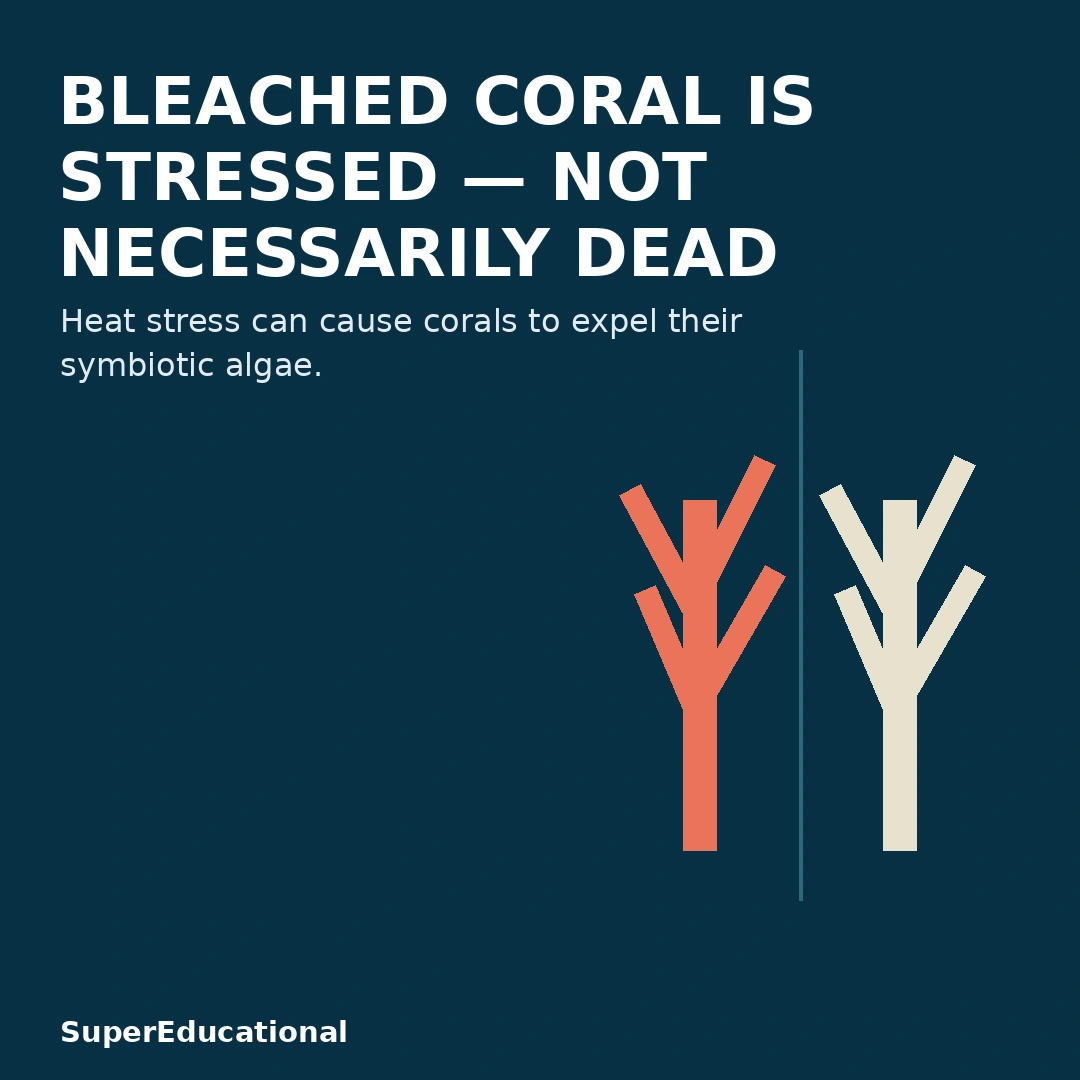
When coral turns ghostly white, the colour change is a visible sign that something is wrong.
Reef-building corals live in partnership with microscopic algae inside their tissues. These algae use photosynthesis to produce energy-rich compounds that help feed the coral, while also giving many corals much of their colour.
When environmental conditions become stressful — especially when ocean temperatures remain unusually high — corals can expel these algae.
Without them, the coral’s pale underlying skeleton becomes visible through its transparent tissue. This is known as coral bleaching.
But a bleached coral is not necessarily dead.
If stressful conditions improve soon enough, some corals can regain their algal partners and recover. However, severe or prolonged bleaching can leave corals without an important source of food for too long.
That makes them weaker, more vulnerable to disease and increasingly likely to die.
Coral bleaching is therefore best understood as a visible stress response, rather than simply a change in colour.
Why It Matters
Bleaching can serve as an important warning sign that coral reefs are under environmental stress. Understanding the difference between bleaching and coral death also helps explain why reducing prolonged stress can give some corals a chance to recover.