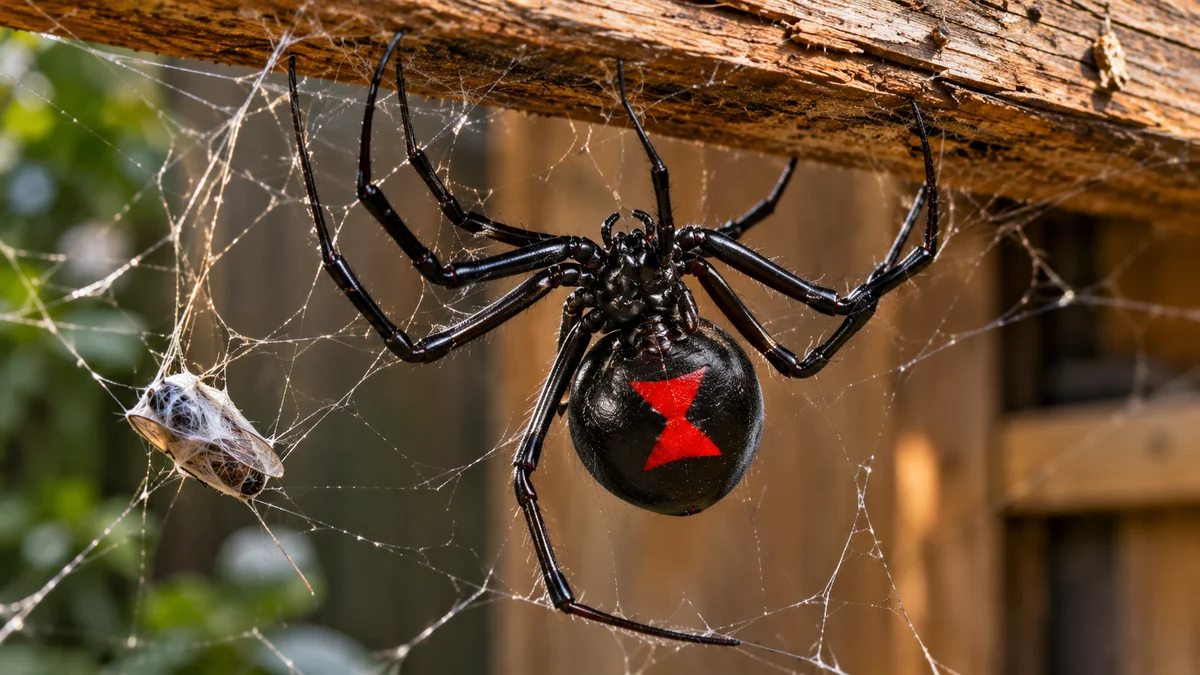
Black widow spider facts begin with one essential distinction: the black widow is not one spider species. The name usually refers to several dark-coloured widow spiders in the genus Latrodectus, particularly the southern, northern and western black widows of North America. An adult female often has a glossy black body, a rounded abdomen and a red or orange hourglass marking underneath that abdomen. Males and immature spiders may look strikingly different. Black widows produce neurotoxic venom, but they are generally reclusive and bite people mainly when trapped, squeezed or disturbed.
These spiders are both predators and prey in their ecosystems. They catch insects in irregular silk webs, raise their young inside protective egg sacs and use venom to immobilise food. Their reputation for being universally deadly—or for every female eating her mate—is much more dramatic than the evidence supports.
This guide explains identification, species, habitat, food, reproduction, venom, bite symptoms and sensible precautions. It draws on university entomology and medical sources, including University of California Integrated Pest Management (UC IPM) , Poison Control and the US Centers for Disease Control and Prevention (CDC) .
Black widow spider facts at a glance
| Feature | Evidence-based description |
|---|---|
| Scientific classification | Genus Latrodectus, family Theridiidae (comb-footed or tangle-web spiders) |
| Animal group | Arachnid; eight legs, not an insect |
| Well-known North American species | L. mactans, L. hesperus and L. variolus |
| Typical adult female | Glossy dark body and bulbous abdomen, often with red/orange marking underneath |
| Adult female body size | Roughly 13 mm in a mature western female; legs make overall span larger |
| Male and immature spiders | Usually smaller or more patterned than mature females |
| Web | Irregular, strong, tangled silk usually near a sheltered retreat |
| Diet | Mostly trapped insects and other small arthropods |
| Behaviour | Often nocturnal and avoids confrontation |
| Main venom concern | Alpha-latrotoxin, which disrupts nerve signalling |
| Human-bite risk | Uncommon but potentially serious; suspected bites merit medical guidance |
The familiar image of a black widow is largely based on mature female North American spiders. Do not use this chart alone to identify an unknown spider in another region. Related African widow or “button” spiders have different markings, while brown widows and false widows can resemble black widows at a glance.
What does a black widow spider look like?
The adult female: dark body and red hourglass
A mature female southern or western black widow is typically shiny black with slender legs and a noticeably rounded abdomen. Her best-known feature is a red or orange hourglass-like pattern on the underside of the abdomen, not necessarily on the back visible when the spider walks. In some specimens the pattern is separated into two triangles, reduced or unusually faint. The University of California notes that even adult western black widows can differ substantially in markings and colour.
A western female's body may reach approximately 13 millimetres (about half an inch), excluding the legs. This is why online measurements can be confusing: “body length” and “leg span” are not interchangeable. A small spider with a big-looking leg span may still be quite small-bodied.
Male black widows
Male black widows are usually considerably smaller than adult females, with more slender bodies and different colour patterns. Brown, cream, red or white markings may remain visible. Males have venom, but their bites are not commonly associated with the severe human envenomation caused by adult females. A black, hourglass-marked adult female is therefore not a reliable template for identifying every member of the genus.
Spiderlings and immature females
Young black widows can be pale, tan or striped rather than uniformly black. As they moult and grow, females of some species gradually develop darker colouration. This means a brownish spider is not automatically harmless—or a brown widow. Identifying juveniles accurately may require specialist help.
See UC IPM's illustrated descriptions and the Clemson University widow-spider guide (2026) for variations in female, male and juvenile appearance.
Which spiders are called black widows?
Latrodectus is a worldwide genus, but common names differ by country. Many sources discussing “the black widow” primarily mean one of three North American species. Their geographical ranges can overlap, and distributions can change over time.
| Species | Common name | Typical distribution or distinction |
|---|---|---|
| Latrodectus mactans | Southern black widow | Especially associated with the southern and eastern United States |
| Latrodectus hesperus | Western black widow | Western North America; mature female generally glossy black |
| Latrodectus variolus | Northern black widow | Eastern and more northerly parts of North America; underside marking often split |
| Latrodectus geometricus | Brown widow | A close relative distributed in many warm regions; often mottled, with distinctive spiky egg sacs |
| Latrodectus indistinctus and relatives | African black button spiders | Southern African widow spiders whose markings do not necessarily resemble the American red underside hourglass |
For readers in Africa, the distinction matters. South Africa's Agricultural Research Council describes several medically important black button spiders with little or no ventral marking, and some have red patterns on the back. An American field-guide illustration should not be used to declare an African spider safe or dangerous.
The genus also contains other widow species. Specific identification depends on locality and multiple features, sometimes requiring an arachnologist.
Black widow versus brown widow versus false widow
Several spiders have round abdomens and messy webs, so appearance alone can be misleading. Three groups are especially easy to confuse:
| Spider | Appearance | Important distinction |
|---|---|---|
| Adult female American black widow | Often glossy black with red/orange underside hourglass | Potentially significant neurotoxic bite |
| Brown widow (L. geometricus) | Usually mottled tan, brown and grey; may have orange underside hourglass | Related widow species; egg sac often has prominent spiky projections |
| False widow (Steatoda spp.) | Often rounded, dark brown or patterned | Different genus; no standard black-widow hourglass and generally less medically significant bites |
Brown widows can produce bites and should still be treated cautiously. False widows are real spiders, not fake animals; the name simply reflects their resemblance to Latrodectus. The UC IPM comparison guide includes examples of immature black widows, brown widows and false widows.
Identification safety: Never pick up or turn over an unknown spider to check its underside. Take a clear photograph from a safe distance if identification is needed.
Where do black widow spiders live?
Black widows tend to prefer sheltered spaces where their webs are less likely to be disturbed and where insects pass nearby. In areas where they occur, familiar locations include woodpiles, stacked building materials, sheds, garages, basement corners, outdoor equipment boxes, unused flowerpots, gaps under structures and piles of debris.
Their webs are often situated near the ground or attached to sheltered retreats, although exact preferences differ by species and habitat. Many are most active at night. A person is more likely to encounter one when moving undisturbed objects or putting a hand into a hidden space than when walking through an open field.
Outside North America, related Latrodectus species occupy different habitats, including some drier landscapes. Distribution maps for one American species do not describe the whole genus worldwide. See the CDC's outdoor-worker guidance and Clemson's habitat recommendations .
How do black widows catch food?
Black widows are predators of small arthropods. Rather than chasing prey across large distances, a female often waits in or near a web with irregular strands and sticky silk. Insects that encounter the web create vibrations that alert the spider. She can move toward the prey, wrap it in silk, inject venom and feed using digestive processes characteristic of spiders.
Their tangled silk is not the symmetrical wheel-shaped web associated with many orb-weavers. Some strands connect a sheltered hiding place to the prey-catching area. The spider can hang upside down; this is one reason the red underside marking is sometimes visible.
By consuming insects, black widows take part in local food webs. That ecological role does not make it sensible to leave one in a frequently used child's play area, but it does explain why avoiding unnecessary contact is usually better than treating every spider as an aggressive threat.
How do black widows reproduce and care for eggs?
A female produces silken egg sacs that protect developing eggs. Depending on the species and conditions, a sac may contain many eggs, and a female may produce several sacs during her life. Young spiders emerge as spiderlings and go through repeated moults before adulthood. Their appearance changes as they grow.
The egg sacs of the familiar American black widow species are generally rounded and relatively smooth. Brown widow egg sacs often have conspicuous pointed or spiky silk projections. Egg sacs should never be opened or handled by students or householders: disturbed spiders may defend their retreat, and attempting to collect a specimen can cause accidental contact.
Spiders do not grow from larvae in a butterfly-style metamorphosis. Spiderlings already have the general body plan of a spider and become larger through moulting. See UC IPM's life-cycle information .
Do female black widows always eat their mates?
No. The name “black widow” reflects a widely publicised behaviour called sexual cannibalism, in which a female eats a male before, during or after mating. But it is not inevitable, and its frequency differs between species and circumstances.
Observations in cramped laboratory containers helped make mate-eating seem universal. In natural habitats, males may be able to withdraw after mating. The Burke Museum's arachnology explanation emphasises that many males survive, especially among the familiar North American species. Related widows in other regions can behave differently.
The scientifically useful lesson is that a dramatic common name should not be mistaken for a rule of animal behaviour. Researchers investigate the conditions in which sexual cannibalism occurs, rather than assuming that every female behaves identically.
How dangerous is black widow venom?
Black widow venom contains substances that act on the nervous system. The best-known medically important component is alpha-latrotoxin (α-latrotoxin), a protein that affects nerve terminals and triggers unusually extensive release of neurotransmitters—chemical messengers used by nerve cells.
That disruption helps explain why a serious widow-spider bite can cause intense pain, muscle cramping, sweating and other symptoms throughout the body. In toxicology, the characteristic syndrome is called latrodectism. Researchers study latrotoxins to better understand nerve signalling and venom mechanisms, but laboratory findings do not make untreated bites safe. See Black Widow Spider Toxicity, NCBI Bookshelf and research on alpha-latrotoxin's structure and action .
For broader context on why venom can be medically dangerous and scientifically useful, SuperEducational has an existing article on how venom kills—and can lead to cures .
Are black widow spiders venomous or poisonous?
Venomous is the appropriate word when discussing a spider that delivers toxins through a bite. “Poisonous” generally refers to substances that cause harm when eaten, absorbed or touched. Everyday speech sometimes mixes the terms, but the scientific distinction makes the mechanism clear.
Can a black widow bite kill a person?
Severe envenomation can be medically serious, particularly for vulnerable patients, but deaths are very rare where medical care is available. The US National Capital Poison Center cites a review of more than 15,000 reported black widow exposures in which no deaths were recorded and around one in ten involved hospital admission. These figures refer to a particular US reporting dataset; they are not a universal bite rate or proof that all exposures are harmless.
Do not confuse the potency of venom in a laboratory test with the probability of death following a real human bite. Effects depend on the species, amount of venom delivered and characteristics of the affected person. Most bites are not fatal, but severe symptoms demand medical care.
What does a black widow bite feel like?
A bite may initially be felt as a pinprick or sharp pain; occasionally it is not immediately noticed. Pain can spread beyond the site and be followed by muscle cramps or stiffness, sometimes involving the back, chest or abdomen. Other possible symptoms include sweating, nausea, vomiting, headache, restlessness and elevated blood pressure.
Symptoms can progress after the initial bite rather than remaining confined to a small spot. Severe abdominal cramps may resemble other urgent medical conditions, so clinicians rely on the history, examination and appropriate assessment rather than simply assuming every episode of abdominal pain is a spider bite.
A black widow bite is not typically identified by a large, expanding necrotic ulcer. Other causes of skin lesions, including infections, are frequently mistaken for spider bites. The 2024 American Heart Association and Red Cross first-aid guidelines distinguish the muscular and systemic syndrome of widow envenomation from the tissue-damaging pattern associated with some recluse bites.
What should you do if a black widow spider bites you?
If you believe a black widow or another medically important widow spider has bitten you, seek prompt medical advice. In the United States, contact Poison Control at 1-800-222-1222 for individual guidance; elsewhere, contact your local poison centre or healthcare service. Severe or spreading symptoms warrant emergency care. Do not delay care to capture the spider.
- Move away from the spider. Avoid further handling or contact.
- Wash the bite site gently with soap and water.
- Apply a cool, cloth-wrapped compress to help with pain and swelling; do not place ice directly on bare skin.
- Keep the affected person calm and monitor symptoms. If possible, note the approximate time and location of the bite.
- Photograph the spider only if it can be done safely. Do not try to capture, crush or pick it up to bring to a clinic.
- Seek medical assessment for a suspected black widow bite, particularly if pain is spreading or worsening, or if the affected person is a child, pregnant, older or medically vulnerable.
Call emergency services immediately for trouble breathing or swallowing, severe widespread cramps, faintness, confusion or other serious symptoms. Never cut or suck the bite, apply a tourniquet, attempt to extract the venom or use unverified home remedies. The CDC , Mayo Clinic and Poison Control provide these core safety principles.
How is a serious bite treated in hospital?
Healthcare teams assess symptoms and may provide pain treatment, monitoring and medications for severe muscle spasms. Clinicians also review tetanus protection and consider other possible causes of the symptoms. In selected severe cases, region-appropriate antivenom may be considered, but use depends on local availability, benefits and potential allergic reactions. Treatment decisions belong to qualified clinicians—not to householders attempting to dose themselves.
Because different widow species exist worldwide, treatment protocols and antivenom products differ by region. Generic internet advice cannot replace local emergency guidance.
How to reduce the chance of meeting black widows at home
Most practical prevention is about avoiding contact rather than trying to eliminate every spider from an outdoor environment.
- Wear gloves and closed shoes when handling stored firewood, old boxes, garden debris or undisturbed equipment.
- Check shoes, boots and gloves that have been stored outside or unused for a long time.
- Keep woodpiles and clutter away from regularly occupied doorways and living spaces where practical.
- Seal gaps around doors, windows and other building openings, and reduce sheltered indoor clutter.
- Do not place bare hands inside unseen cavities, behind outdoor furniture or under stored objects.
- Teach children to observe unknown spiders from a distance and alert an adult rather than touching them.
- If a widow is located where people are likely to touch it, seek suitable local pest-management assistance rather than attempting risky handling.
These precautions follow the preventive guidance of the CDC and Clemson University Cooperative Extension . Insecticides should be used only where legally permitted and according to their approved instructions; habitat management and safe exclusion should come first.
Seven important black widow myths, checked
| Common claim | What the evidence shows |
|---|---|
| Every black widow is a single species | False: multiple species share the name, particularly within Latrodectus |
| Every widow is black with a perfect red hourglass | False: sex, age and geographical species affect colour and markings |
| Black widows aggressively chase people | False: bites are generally defensive, often after the spider is trapped or disturbed |
| Every female eats her mate | False: cannibalism is variable and not inevitable |
| A bite always causes death | False: severe reactions need care, but deaths are rare |
| Two puncture marks prove a black widow bite | False: marks alone cannot reliably confirm the cause |
| All black widows should be handled to confirm an hourglass | Dangerous advice: keep distance and use a photo or qualified identifier |
Black widow spider facts: frequently asked questions
How many legs does a black widow spider have?
Eight, like other spiders. Black widows are arachnids, not six-legged insects.
Are all black widow spiders female?
No. Both sexes exist. Adult females are larger and better known for their glossy black bodies, while males are often smaller and differently coloured.
Is the red hourglass on the top or bottom?
On the underside of the abdomen in the familiar North American adult black widow forms. Other species and developmental stages may have different markings.
Do black widows live in Africa?
Widow spiders occur in Africa, where some are called button spiders. African species do not necessarily share the classic American red underside hourglass, so regional guidance matters.
Are black widows nocturnal?
They are commonly more active at night, particularly around their sheltered webs. Activity depends on conditions and species.
What do black widows eat?
They primarily eat insects and other small arthropods caught in their irregular webs.
Can you identify a spider from a bite mark?
Usually not with confidence. Many skin conditions and insect bites resemble suspected spider bites. Seek medical guidance based on symptoms, especially after a suspected dangerous-spider encounter.
Are black widows beneficial?
They can help control insect populations, but that ecological role does not cancel the need for caution in areas where accidental contact is likely.
Conclusion
The most useful black widow spider facts are also the least sensational. These spiders are diverse members of the Latrodectus genus, and the familiar glossy black female with a red underside hourglass represents only part of that diversity. They generally shelter in secluded places, catch insects in strong tangled webs and avoid unnecessary contact with people.
Their venom is medically important because alpha-latrotoxin disrupts nerve signalling, but severe outcomes are not inevitable and deaths are rare. Learn the identification clues, respect geographical differences and avoid handling unknown spiders. If a bite is suspected, follow appropriate first aid and obtain medical advice rather than relying on myths or fear.
References and further reading
- University of California IPM — Widow Spiders and Their Relatives .
- Clemson University Extension (2026) — Widow Spiders in South Carolina .
- National Capital Poison Center — How Dangerous Is a Black Widow Spider Bite? .
- CDC / NIOSH — Venomous Spiders at Work .
- Mayo Clinic (2026) — Spider Bites: First Aid .
- American Heart Association and American Red Cross — 2024 First Aid Guidelines .
- Burke Museum — Myth: Black Widows Eat Their Mates .
- South African Agricultural Research Council — Neurotoxic Spiders and Button Spiders .
- NCBI Bookshelf — Black Widow Spider Toxicity .
- Structural Basis of Alpha-Latrotoxin Transition to a Cation-Selective Pore (2024) .