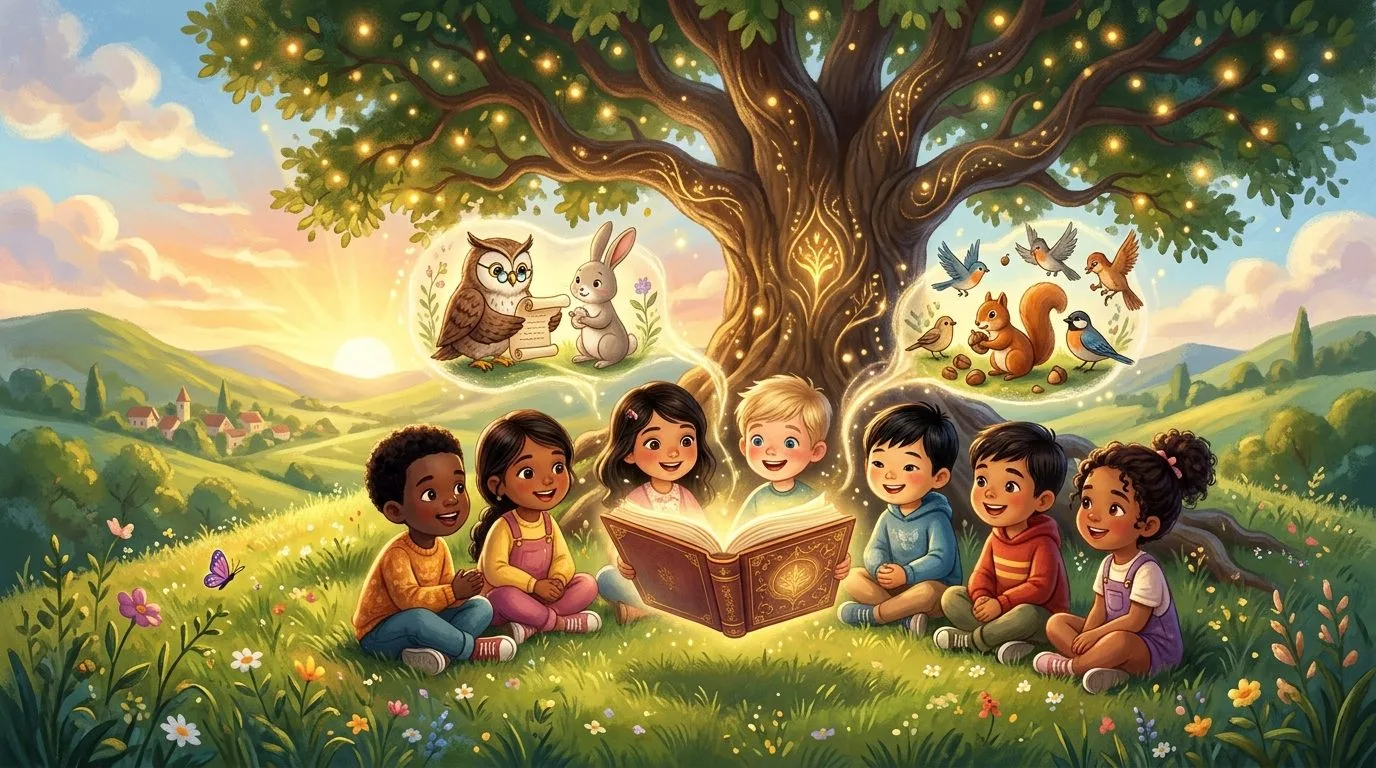
Moral stories for children can make big ideas—honesty, empathy, responsibility, fairness and respect—easier to explore through everyday choices. A child may forget a long lecture about kindness but remember a character who helped a friend while also asking for an adult's assistance. Stories offer a safe space to consider what someone did, why they did it and what they might do differently next time.
This collection contains eight original short stories, each followed by a clear lesson, open-ended discussion questions and a simple activity for home or the classroom. The settings will feel familiar to many children: a reading fair, school library, rainy afternoon, club meeting, garden and group project. The stories avoid punishing characters for ordinary mistakes or teaching that children must ignore their own boundaries to be considered kind.
Educational research supports talking with children about stories rather than only reading to them. Reading Rockets describes dialogic reading as a conversation in which adults ask questions, extend children's ideas and encourage them to revisit a story. Harvard's Making Caring Common recommends stories as opportunities to discuss characters' feelings and perspectives. The CASEL framework identifies relationship skills, social awareness and responsible decision-making among the competencies children can practise.
How to choose a moral story for a child
Choose a story based on the child's interests, listening comfort and developmental needs rather than treating the suggested age bands as strict reading levels. Younger children may enjoy hearing a story read aloud and answering one concrete question; older children can discuss conflicting motivations, alternative endings and whether the response was fair to everyone.
| Story | Suggested ages | Main lesson |
|---|---|---|
| 1. The Blue Thumbprint | 6–10 | Honesty includes taking responsibility and trying to repair harm. |
| 2. The Empty Chair at Story Circle | 5–9 | Inclusion means offering a place without forcing someone to participate in one particular way. |
| 3. One Umbrella, Three Friends | 5–10 | Kindness includes helping others while keeping everyone safe. |
| 4. The Library's Four Special Books | 7–11 | Fairness may require different support so everyone has a real chance to participate. |
| 5. The Kite That Needed Tuesday | 6–10 | Progress comes from practice, reflection and asking for help—not instant perfection. |
| 6. The Garden Watering Chart | 6–11 | Responsibility means following through and repairing a missed commitment. |
| 7. The Quiet 'No, Thank You' | 6–11 | Respecting boundaries is part of friendship; generosity should not be forced. |
| 8. The Paper-Cup Bridge | 7–11 | Teamwork works best when people listen and combine different ideas. |
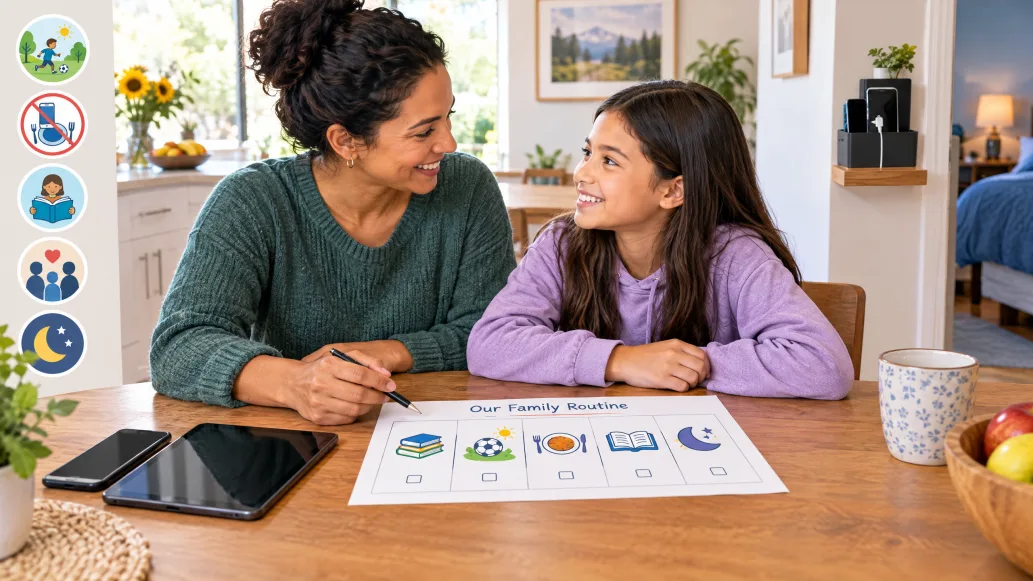
Try this simple routine: read, pause, ask, listen and act. Read the scene without rushing; pause at the difficult choice; ask what the character may be feeling; listen without insisting on a single answer; and try the short activity together. According to UNICEF's 2026 guidance for children aged 6–10 , calm guidance, encouragement and opportunities to make decisions help children develop confidence and social skills.
1. The Blue Thumbprint — a story about honesty
Suggested ages: 6–10
Amara and her classmates spent Friday morning making a colourful poster for the school reading fair. Her friend Tobi drew a bright sun, while Amara painted the blue river below it.
Just before lunch, Amara reached over the poster for her water bottle. Her sleeve brushed the wet paint, leaving a large blue thumb-shaped mark across Tobi's sun.
“Perhaps nobody will notice,” she thought. She moved a drawing of a cloud over the mark, but the cloud looked strange and the paper was still wet.
When Tobi returned, he noticed immediately. “What happened to my sun?” he asked. Amara felt her cheeks grow hot. She wanted to say the paint had spilled by itself. Instead, she told him exactly what had happened.
Tobi frowned. “I worked a long time on that.” Amara listened. She didn't ask him to stop being upset. “I'm sorry,” she said. “Would you like me to help fix it, or would you rather have a little time?”
After a few minutes, they asked their teacher for clean paper. They made a new sun together and glued it carefully over the damaged section. The poster wasn't exactly as they had planned. Tobi still felt disappointed, but he thanked Amara for telling the truth and helping with the repair.
At the fair, a visitor pointed to the new sun. “That part looks especially bright,” she said. Amara and Tobi exchanged a small smile. It reminded them not of a perfect poster, but of a difficult, honest conversation.
Lesson: Honesty includes taking responsibility and trying to repair harm.
Discussion questions
- Why was it hard for Amara to admit what happened?
- Why was Tobi allowed to feel upset even after an apology?
Try this activity: Draw two speech bubbles: one that hides a mistake and another that explains it truthfully while offering help. Discuss which builds trust.
2. The Empty Chair at Story Circle — a story about inclusion
Suggested ages: 5–9
On Monday, the teacher arranged the classroom chairs in a circle. One chair remained empty beside Zara. A new pupil, Kojo, stood quietly near the door, holding a small notebook.
“Sit here!” Zara called. Kojo sat down, but when everyone took turns reading a sentence aloud, his voice became very soft. A few children leaned forward to hear. One child said, “Speak louder!” Kojo looked at his notebook instead.
At break time, Zara found Kojo drawing a beautiful picture of the story's forest. “You remembered all the trees,” she said. Kojo nodded. “I like stories,” he replied. “I just get nervous reading out loud when I don't know people.”
The next day, Zara asked the teacher whether pupils could share a story in different ways. The teacher agreed: some could read, some could act and some could show drawings while a partner spoke.
Kojo chose to display his forest picture. Zara read the line about a bird finding its way home. Kojo pointed to the tiny nest he had drawn in the tallest tree.
By Friday, Kojo was ready to read one sentence himself. He did not have to, and nobody counted how many words he said. The class listened, and the story went on.
After the bell, Zara looked at the circle. The once-empty chair was now just one of many places where a child could belong.
Lesson: Inclusion means offering a place without forcing someone to participate in one particular way.
Discussion questions
- How did Zara learn what Kojo needed instead of guessing?
- What are two ways a class can include someone who feels shy?
Try this activity: Create a ‘many ways to join’ classroom chart: speaking, drawing, pointing, acting, listening and taking a quiet break.
3. One Umbrella, Three Friends — a story about kindness
Suggested ages: 5–10
The rain began just as school ended. Nneka opened her small yellow umbrella and hurried towards the gate. Her friend Bisi was waiting beneath the awning, searching her bag.
“I forgot my umbrella,” Bisi said. Nneka moved closer so Bisi could stand under the yellow canopy. Then their friend Musa arrived, with rain dripping from his hair.
“Can I squeeze in too?” he asked. They tried taking one step together, but the umbrella tipped and water fell down Nneka's sleeve. The path outside the gate was busy with bicycles and puddles.
Nneka wanted to help both friends. She also knew the tiny umbrella could not safely cover three people walking side by side. “We should ask the teacher,” she said.
Inside the entrance, their teacher was organising children who were waiting for their families. She had a spare raincoat and helped Musa call his aunt. Nneka and Bisi stayed under the awning until it was safe to leave.
Later Musa said, “I thought you didn't want me under your umbrella.”
“I did want to help,” Nneka replied. “But we were all getting wet, and the path was slippery.”
Musa smiled. “You helped me find a safer plan.”
On the walk home, Nneka realised that kindness was not always saying yes to the first request. Sometimes it meant noticing a problem, explaining a limit and finding another way to help.
Lesson: Kindness includes helping others while keeping everyone safe.
Discussion questions
- Why might squeezing three people under a tiny umbrella be unsafe?
- What other safe choices could the friends have suggested?
Try this activity: Make a paper ‘helping plan’ with three columns: problem, safe limit and another kind action.
4. The Library's Four Special Books — a story about fairness
Suggested ages: 7–11
Ms Bello brought four illustrated science books to the school library. She told the children they could borrow them for one week. Immediately, four hands shot up.
“One book each,” said Ade. “That's fair.”
His classmate Mariam nodded, but she could not read the small print in one of the books comfortably. “May I choose the one with larger letters?” she asked.
Ade had already picked it up. “But I got here first,” he said.
Ms Bello did not snatch the book away. She asked everyone to stop and think. “Is fairness always giving people the same thing, or can it mean helping people use what they are given?”
The children looked at the books again. Two had tiny print. One had large letters. One had pictures with short captions.
“I can read the tiny one,” Ade said after a moment. “Would you like the larger-print book, Mariam?” Mariam thanked him. Another child suggested making a book-sharing timetable so no one had to miss out completely.
For the rest of the week, the children took turns explaining one interesting fact from their books. Mariam described how a seed grows. Ade shared a drawing of the moon.
The following Monday, Ms Bello asked, “Was our plan equal?”
“Not exactly,” Ade replied. “We didn't all get the same book. But we all got a chance to enjoy reading one.”
Lesson: Fairness may require different support so everyone has a real chance to participate.
Discussion questions
- How is getting the same item different from getting a fair opportunity?
- What if two children need the same book at once—what other solution might work?
Try this activity: Offer imaginary classroom resources to different learners and invite groups to design an accessible, fair sharing system.
5. The Kite That Needed Tuesday — a story about patience
Suggested ages: 6–10
On Saturday, Seyi built a kite with purple paper, two thin sticks and a string. He ran across the field, expecting the kite to climb at once. Instead, it spun twice and fell into the grass.
“I'm terrible at this,” he announced.
His grandfather studied the kite. “What do you think happened?”
“The wind hates purple,” Seyi said, making them both laugh.
They checked the shape. One stick was longer than the other, and the tail was too short. Seyi fixed the tail with an extra strip of paper. They tried again. The kite flew a little higher, then dipped.
On Sunday, there was hardly any breeze. Seyi wanted to run faster and faster, but his grandfather reminded him to stay in the clear field, far from roads, roofs and power lines. They decided to wait for suitable weather and draw a new design instead.
On Tuesday afternoon, the wind was gentle and steady. Seyi held the kite up. He took a few steps, loosened the string and watched the purple shape rise above the field.
It did not stay in the sky forever. After a few minutes, it came down again. But this time Seyi knew what he would check next.
“You didn't suddenly become good at kites,” his grandfather said. “You noticed what needed changing.”
Seyi folded his paper carefully. “I think I like learning this,” he replied.
Lesson: Progress comes from practice, reflection and asking for help—not instant perfection.
Discussion questions
- What did Seyi do differently after the first attempt failed?
- Why was waiting for safe weather part of solving the problem?
Try this activity: Ask children to draw a three-step improvement plan for something they're learning, including one question they can ask for help.
6. The Garden Watering Chart — a story about responsibility
Suggested ages: 6–11
Class Four planted a small garden beside the school wall. Each group promised to water one section during the week, with an adult supervising.
On Wednesday it was Lami's turn. But football practice ran late, and she forgot. When she remembered, she hoped the cloudy sky would bring rain. It didn't.
The next morning, some of the leaves looked droopy. Lami stared at them. “Maybe nobody will know,” she whispered. Then she remembered that the plants depended on the whole group.
She told the teacher and her group. “I missed my day. I'm sorry. Can we check what the plants need and make a better plan?”
Her friend Chidi was frustrated. “We were counting on you.”
“I know,” said Lami.
The teacher helped them check the soil. They watered only what needed water and moved the schedule onto a large classroom chart. Children could tick their turn and ask another group for help before an afternoon activity.
Some leaves recovered quickly; one small plant did not. Lami was sad, but the teacher explained that caring for living things involves paying attention over time. Saying sorry matters; changing a habit matters too.
On the following Wednesday, Lami checked the chart before practice. She asked Chidi to join her, and together they watered the garden.
By the end of the month, new green leaves appeared. Lami felt proud, not because she had never forgotten, but because she had learnt to take her promise seriously.
Lesson: Responsibility means following through and repairing a missed commitment.
Discussion questions
- What was the difference between Lami's apology and her new plan?
- How could a group help members remember duties without shaming them?
Try this activity: Make a simple shared responsibility chart with realistic tasks, reminders, and a way to request help.
7. The Quiet 'No, Thank You' — a story about personal boundaries
Suggested ages: 6–11
Femi brought a small pair of headphones to a supervised music club. He used them because loud sounds sometimes made him uncomfortable.
His friend Ruth loved music and asked to borrow them. Femi held the case close. “No, thank you. I need them for myself today.”
Ruth looked surprised. “Friends share,” she said.
Femi worried that she would stop speaking to him. “I can help you find another way to listen,” he offered.
Ruth felt disappointed. She took a moment and asked the club leader whether there was a spare pair. There wasn't, but the leader invited her to join a small group listening through a classroom speaker at a comfortable volume.
Later Ruth sat beside Femi during snack time. “I didn't like hearing no,” she admitted. “But I think I made you feel bad for answering.”
“It's okay to ask,” Femi said. “And it's okay for me to keep something I need.”
Ruth nodded. The next time she wanted to borrow something, she asked politely and waited for the answer. Sometimes friends said yes. Sometimes they said no. Their friendship did not have to end because they wanted different things.
During the next music club, Ruth drew a sign for the classroom shelf: “Ask first. Listen to the answer. Find another way together.” Femi helped her choose the colours.
Lesson: Respecting boundaries is part of friendship; generosity should not be forced.
Discussion questions
- Why was Femi allowed to say no?
- How can someone respond kindly when a friend cannot share an item?
Try this activity: In pairs, practise respectful requests and responses: ‘May I borrow it?’, ‘Not today’, and ‘Thanks for telling me’.
8. The Paper-Cup Bridge — a story about teamwork
Suggested ages: 7–11
During science week, a teacher challenged four pupils to build a bridge from paper, tape and six paper cups. The bridge had to hold a small toy car between two desks.
Rami wanted a tall bridge. Ijeoma wanted a wide one. Daniel suggested using all the tape at once. Aisha was trying to explain a folded-paper shape, but the others kept talking.
They started building quickly. The bridge looked impressive until the toy car rolled onto it. One side folded, and the car slid gently onto the desk.
“My idea would have worked,” Rami said.
“You never heard my idea,” Aisha replied quietly.
For a moment, nobody spoke. Then Daniel placed the remaining paper in the middle. “Let's try a different plan. Everyone gets a turn.”
They listened one by one. Aisha showed how folding paper into ridges made it stiffer. Ijeoma suggested a wider base. Rami worked out where the cups should stand, and Daniel measured strips of tape so the group would not run out.
The next bridge was smaller than the first. It was also steadier. When the car crossed, all four pupils cheered.
At the end, the teacher asked whose idea had made the bridge strong.
“Aisha's folds,” said Rami.
“And Ijeoma's base,” Aisha said.
“And everyone's listening,” Daniel added.
They took the bridge apart carefully, ready to build something new together another day.
Lesson: Teamwork works best when people listen and combine different ideas.
Discussion questions
- What happened when the group ignored Aisha?
- Why was the second design better even though no one got everything they wanted?
Try this activity: Give groups paper strips and six cups for a supervised bridge-building challenge. Rotate the roles of listener, designer, builder and tester.
How to turn moral stories into meaningful conversations
A story can prompt reflection, but a single reading does not prove a child has learnt a value for life. Adults can model respectful behaviour, revisit the same theme and make space for children to explain their own thinking. Research on repeated interactive read-alouds suggests that asking children to predict events, infer motives and retell stories can support comprehension and analytical talk.
Start with “What do you think?” rather than “What is the correct moral?” If a child says that a character was wrong to apologise, ask why. Perhaps the apology felt rushed, the harm was not yet repaired or somebody's feelings were overlooked. Those observations make for a richer discussion than memorising a slogan.
Adults should also avoid shaming a child for answering differently. UNICEF's positive parenting guidance encourages calm listening, naming feelings and helping children make amends. An adult can correct harmful behaviour while still recognising that frustration, embarrassment and disappointment are normal emotions.
For another practical read on courtesy, SuperEducational's published guide to good manners every child should learn complements these stories with everyday examples of listening, respecting others and being considerate.
Simple weekly story-and-activity plan
| Day | Focus | Five-to-ten-minute follow-up |
|---|---|---|
| Monday | Honesty | Practise explaining a small mistake and choosing a repair |
| Tuesday | Inclusion | Make a ‘many ways to join’ chart |
| Wednesday | Kindness with safety | Invent an alternative way to help someone |
| Thursday | Fairness | Discuss an example where equal is not always equitable |
| Friday | Patience and responsibility | Choose one realistic habit to practise next week |
| Weekend | Boundaries and teamwork | Role-play respectful requests or build a simple paper bridge |
Keep activities optional and adjust for different abilities. Harvard's activities guide for executive-function skills includes age-appropriate games, collaborative storytelling and role-play as ways to practise self-regulation and cooperation. Families can also tell these stories in their home language, encouraging children to express ideas comfortably.
Frequently asked questions about moral stories for children
What are the best moral stories for children?
The most useful stories are age-appropriate, engaging and open to conversation. Children can explore honesty, kindness, responsibility, fairness, inclusion, patience and respect for boundaries through everyday situations rather than dramatic punishments or perfect heroes.
How do you teach a moral lesson without lecturing?
Ask what the character wanted, who was affected and what different choices were possible. Listen to the child's ideas first, then offer a real-world example or small activity. Revisit the lesson through everyday modelling rather than demanding a memorised response.
What age is suitable for these stories?
Many are appropriate for read-aloud sessions from roughly ages five to eleven, but children's language ability, interests and experience vary. Simplify questions for younger learners and add alternative endings or perspective-taking questions for older ones.
Can stories teach empathy?
Stories can provide opportunities to identify feelings and consider another person's perspective. Harvard's Making Caring Common recommends discussing why characters may feel and act as they do. One story alone is not a guarantee of lasting behaviour change.
What if a child gives an unexpected answer?
Ask them to explain their reasoning without embarrassment or ridicule. You can distinguish emotions from harmful actions, consider who else was affected and guide the discussion towards a safer, fairer solution.
Should children always share everything?
No. Children can learn generosity alongside consent, safety and personal boundaries. Sharing should be invited rather than forced, especially where a child needs an item or feels uncomfortable lending it.
Can I use these stories in a classroom?
Yes. They are original educational stories written for this article. Teachers can read them aloud, use the questions for group discussion and adapt the activities to the school's age group and safeguarding procedures.
Conclusion: the conversation is part of the story
Moral stories for children work best as invitations to think, not scripts that every child must repeat. A character's honest admission, kind alternative or respectful boundary can open a conversation about choices and consequences. With thoughtful questions, adult modelling and small activities, children have more opportunities to practise those ideas in real life.
Editorial note: The eight stories and their characters are original fictional works created for SuperEducational. Educational guidance was checked on 16 November 2026. Suggested ages and activities are adaptable, not diagnostic or developmental guarantees.