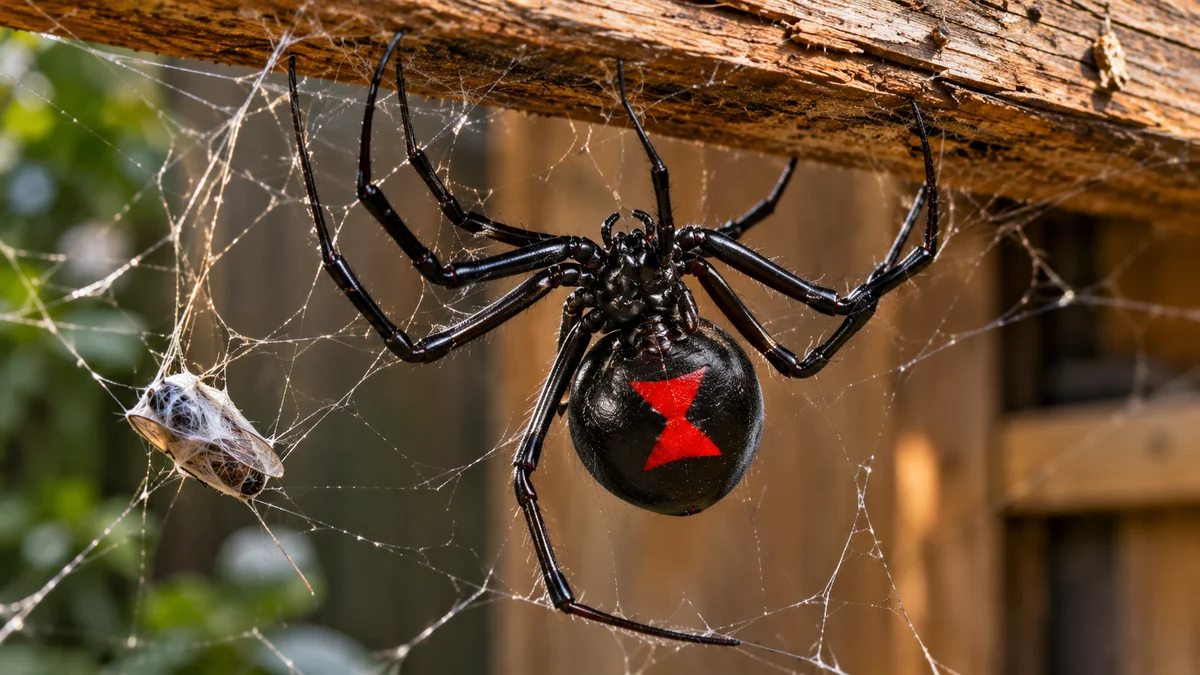
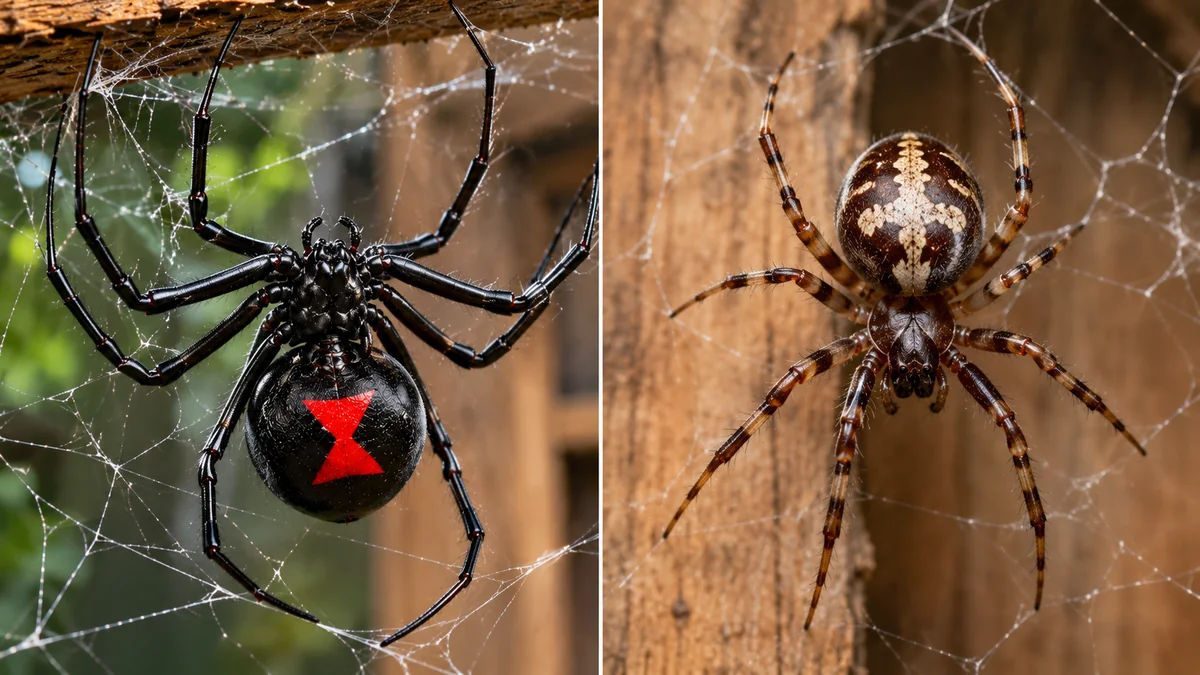
Black widow vs false widow: what is the difference? A true black widow is a spider in the genus Latrodectus; a false widow is usually a spider in the related genus Steatoda. Both belong to the cobweb-spider family Theridiidae, so they can have rounded abdomens, slender legs and messy-looking webs. But many adult female North American black widows are glossy black with a red or orange hourglass on the underside of the abdomen, while common false widows such as the noble false widow (Steatoda nobilis) often have a brown abdomen with pale markings on the back. The false black widow (S. grossa) can be almost uniformly dark brown and lacks the typical red underside hourglass.
There is an important safety qualification: no single colour, marking or body measurement identifies every spider. Young black widows and males look different from mature females, and some adult widows have reduced markings. You should never turn over or handle a spider to look for its hourglass. A clear photograph taken from a safe distance, combined with your location, is a much better starting point.
In this guide, “black widow” primarily refers to the best-known North American species of Latrodectus, while “false widow” refers particularly to Steatoda nobilis and Steatoda grossa. The distinctions are supported by the University of California's Integrated Pest Management programme , the Natural History Museum and the British Arachnological Society .
Black widow vs false widow: quick comparison chart
| Feature | True black widow (Latrodectus) | False widow (Steatoda) |
|---|---|---|
| Scientific group | Genus Latrodectus | Genus Steatoda, with several common-name species |
| Family | Theridiidae | Theridiidae |
| Typical adult female body | Often shiny black with a strongly rounded abdomen | Often glossy brown or dark brown; abdomen rounded or oval |
| Familiar identifying mark | Red/orange underside hourglass in many adult North American females | No typical red underside hourglass; noble false widow often has pale dorsal pattern |
| Pattern variation | Males, juveniles and some adult females may be striped, brown or differently marked | Noble false widow markings may fade; cupboard spider can look almost plain |
| Size | Mature western female around 13 mm in body length | Noble false widow female may reach around 14 mm; sizes overlap |
| Web | Irregular, tangled, sticky cobweb | Also an irregular scaffold or cobweb; not a decisive identifier |
| Typical locations | Sheltered corners, woodpiles and outbuildings where species occur | Walls, sheds, window frames, cupboards, buildings and crevices |
| Bite effects | Can cause medically significant systemic symptoms and muscle cramps | Usually local pain; uncommon complications or more extensive symptoms are possible |
| Behaviour toward people | Generally avoids contact; bites mostly defensive | Generally avoids contact; bites mostly when trapped or disturbed |
The distinction between these two groups is taxonomic and medical, not simply visual. A false widow is not a harmless replica of a black widow; it is a genuine venomous spider, although its bites are ordinarily much less medically significant. Equally, black widow venom does not mean a person who sees one is in immediate danger. Natural History Museum and Poison Control explain these different risk profiles.
1. First check: the red hourglass versus pale back markings
Where is the black widow's red hourglass?
In the familiar mature female southern and western black widow, the characteristic red or orange hourglass sits on the ventral surface—the underside—of the rounded abdomen. It is often visible when the spider hangs upside down in her web. The pattern may be complete, divided into two triangles or reduced. Some specimens lack an obvious red hourglass, so absence of the mark is not proof that a spider is safe. The University of California identification guide describes this variation.
Do not attempt to lift, trap or roll a spider over to inspect its underside. That creates an avoidable bite risk. Look only at whatever features are visible without approaching or disturbing it.
What does the noble false widow's pattern look like?
An adult Steatoda nobilis often has a cream-coloured or pale, irregular pattern on the upper abdomen, sometimes described as a skull-like shape. The exact pattern differs among individuals and can become faint in older females. Legs are frequently brown with some banding. Unlike the typical black widow hourglass, this is a dorsal marking—on the spider's back.
The Natural History Museum's false-widow identification guide shows the range of patterns in British species. It also warns that other common spiders resemble false widows.
What about the false black widow or cupboard spider?
Steatoda grossa is often called the false black widow or cupboard spider. Adult females are commonly chocolate brown or purplish brown with a shiny rounded abdomen, sometimes with little obvious pattern. They do not have the standard red underside hourglass of the American female black widow. However, colour may look nearly black in poor light, making a photograph and regional identification essential. UC IPM explicitly compares this species with the western black widow.
2. Compare body shape, colour and size—but do not rely on size alone
Both genera have the familiar comb-footed spider body plan: a relatively small front body (cephalothorax), slender legs and a rounded or oval abdomen. This is why casual identification can fail. In strong light a mature female black widow may appear jet black, while a noble false widow may look dark chestnut with pale patches. But young Latrodectus spiders can be patterned and much lighter than adults, and an old false widow can appear almost plain.
Measurements also overlap. The University of California gives about 13 mm body length for an adult female western black widow. The British Arachnological Society says female noble false widows may reach about 14 mm. These are body lengths, excluding the long legs, and do not form a simple larger-versus-smaller rule. Sex, age and feeding also change body proportions.
Do not use an informal comparison such as “bigger than a coin” as a diagnostic test; it varies with camera scale and how the legs are spread.
3. Check the web and the spider's hiding place
Black widows and false widows both belong to Theridiidae, the family of tangle-web or cobweb spiders. Neither typically spins the neat circular orb associated with an orb-weaver. Their silk may look like an untidy mesh attached to a crevice, fence, shed or sheltered structure. Some webs have strong sticky strands that catch passing insects.
A female black widow may shelter in a woodpile, outdoor equipment box, garage or similar undisturbed place. A noble false widow often occupies cracks around walls, railings, sheds, window frames or buildings, while S. grossa is frequently found indoors beneath furniture and in cupboards. These tendencies help establish context but cannot identify a species by themselves. A false widow and a black widow might use similar corners in places where both occur.
For this reason, a messy web is best treated as supporting evidence rather than a decisive test. The Montana State University description of Steatoda and British Arachnological Society both describe the web similarities.
4. Location matters: United Kingdom, North America and elsewhere
In the United Kingdom
False widows are established in Britain, with the noble false widow among the most frequently discussed. The Natural History Museum identifies several types that are commonly called false widows in the UK, including S. nobilis, S. grossa and S. bipunctata (the rabbit hutch spider). Many supposed false-widow sightings actually involve other harmless spiders.
True black widows are not established native British house spiders. The British Arachnological Society notes that genuine black widows are not normally found in the UK, although extremely rare accidental introductions occur. An ordinary dark spider in an English garden is therefore far more likely to be a resident species than a North American black widow. This is a probability statement, not a reason to handle an unidentified animal.
In North America
Different Latrodectus species occur in parts of North America. The western, southern and northern black widows are not identical in appearance or distribution. Related Steatoda spiders also occur in North American buildings, so both true and false widows may need to be considered where their ranges overlap. The University of California's regional guide is helpful for western states, while the Penn State Extension false-black-widow page describes S. grossa.
In Africa and other regions
African widow spiders may be called button spiders, and their markings are not always the red underside hourglass familiar from American photos. “False widow” is also a common name covering multiple Steatoda species and other closely related spiders in some regional guides. A UK or US field guide is therefore insufficient to identify an unknown spider in Nigeria, South Africa or another region without local species information.
Where accurate identification is important, obtain a clear photograph and consult a local natural-history service, university entomology department or experienced arachnologist. Avoid crowd-sourced identifications that rely on colour alone.
5. What about males and young spiders?
The famous black widow image largely depicts a mature female. Adult males are usually smaller and can retain brownish, pale or reddish markings. Juvenile black widows can have stripes, spots and lighter colour before developing the familiar adult female appearance. False widows also change as they grow, and the noble false widow's pale pattern can fade with age.
These variations are particularly important when someone is comparing a single photograph with an internet image. A patterned spider is not automatically a false widow; a dark spider is not automatically a true widow. Use the Natural History Museum's species photos and UC IPM's life-stage descriptions together with geography.
6. Do their egg sacs look different?
Some species' egg sacs can provide additional context, but they are not a safe stand-alone identifier. Black widows typically create rounded silken egg sacs near their webs; false widows also enclose eggs in silk, and appearance varies by species. For comparison, the spiky egg sac often featured in spider-identification charts belongs to the brown widow (Latrodectus geometricus), a true widow relative—not to all false widows. Confusing the brown widow with the cupboard spider can lead to incorrect identification.
Do not pick up, open or collect an egg sac from a suspected venomous spider. A female may remain close to it, and disturbance increases the likelihood of accidental contact.
7. Black widow vs false widow venom: are both dangerous?
Both are venomous: they use venom to subdue prey. The clinically important difference is the usual severity of human envenomation, not the simple presence or absence of toxins.
True black widow bites
Black widow venom contains alpha-latrotoxin, a neuroactive protein associated with the release of neurotransmitters from nerve endings. A bite may cause local pain and, in more significant cases, painful muscle cramps, sweating, nausea, back or abdominal pain and other symptoms beyond the bite site. This pattern is called latrodectism. Serious reactions require prompt medical attention; deaths are very uncommon in settings with effective healthcare. See Poison Control and the 2024 American Heart Association and American Red Cross first-aid guidance .
False widow bites
A bite by a noble or cupboard false widow usually causes localised pain, sometimes swelling, redness or discomfort extending a little beyond the bite. The Natural History Museum compares many confirmed symptoms to those following a wasp sting. Severe reactions are much less typical, but allergies, secondary infection or unusual symptoms still warrant appropriate medical attention.
The British Arachnological Society warns that alleged spider bites are frequently reported without anyone seeing or identifying a spider. A painful red patch by itself cannot establish whether a black widow, false widow, insect bite, skin infection or other condition caused it.
| Medical question | True black widow | False widow |
|---|---|---|
| Are bites common? | Uncommon; generally defensive | Uncommon; generally defensive |
| Most important symptoms | Local pain; severe cases may involve widespread cramps and sweating | Usually local pain and sometimes mild swelling |
| Severe systemic effects? | Possible, requiring medical assessment | Unusual, but individual complications are possible |
| Can a bite mark confirm identity? | No | No |
| Should the spider be handled to prove identity? | No | No |
What to do if you think either spider bit you
For a suspected black widow bite, seek prompt medical advice or contact a poison centre. If severe or spreading symptoms develop, seek emergency care. For a suspected false widow bite with mild local symptoms, basic wound care is appropriate, but worsening pain, swelling, fever or other concerning changes should be assessed.
- Move away from the spider without trying to handle it.
- Wash the affected skin gently with soap and water.
- Apply a cool, cloth-wrapped compress for discomfort or swelling; do not put ice directly on bare skin.
- Monitor for spreading pain, severe cramps, dizziness, breathing problems, facial or throat swelling, fever or worsening redness.
- Seek medical assistance promptly for significant symptoms, and immediately for breathing difficulty, collapse or other emergency signs.
- Photograph the spider only if you can do so from a safe distance. Never delay medical help to catch it.
Never cut or suck a bite, use a tourniquet or attempt homemade venom extraction. In the United States, Poison Control can be reached at 1-800-222-1222; outside the US, use the local poison or emergency medical service. The NHS bite-and-sting guidance and Poison Control provide the basis for these recommendations.
This is general educational information, not a diagnosis. Medical evaluation depends on symptoms and the patient's circumstances, not merely on a spider photo or an internet identification.
Are black widows and false widows aggressive?
Neither group is known for pursuing people. Both normally spend much of their time near webs and attempt to avoid unnecessary confrontation. Bites most often occur when a spider is trapped against skin or its retreat is disturbed, such as when a person moves stored objects, puts on unused gloves or reaches into a narrow crevice.
Both also perform useful ecological work by capturing insects and other small arthropods. That does not mean one should be left inside a frequently used child's play area, but it is a reason to favour prevention and careful management rather than panic.
A safe five-point identification checklist
When you discover a dark, round-bodied spider, use this checklist without touching the animal:
- Note your region. Which Latrodectus and Steatoda species occur locally? In Britain, an established false widow is usually much more plausible than an imported true black widow.
- Observe the visible abdomen. Is the spider glossy black, mottled brown or marked with a pale dorsal pattern? Remember that appearance varies with age and species.
- Look for a red underside pattern only if naturally visible. A red hourglass supports an identification of some adult female Latrodectus, but never turn the spider over to check.
- Record the web and habitat. A tangled cobweb supports a theridiid identification but rarely distinguishes the genera on its own.
- Take a clear, safe-distance photo. Share it with a local museum, extension service or arachnology expert. Note the location and approximate body size without touching the spider.
For UK readers, the Natural History Museum's identification service is a useful starting point. In the United States, university extension programmes often provide regional comparison resources.
Other spiders people frequently mistake for widows
Not every spider with a round abdomen belongs to either genus. The missing-sector orb-weaver (Zygiella x-notata) and some lace-webbed spiders (Amaurobius species) are among the British lookalikes discussed by the Natural History Museum. A missing-sector orb-weaver constructs a recognisable circular orb web with a section absent; lace-webbed spiders typically have a less glossy, hairier appearance and distinctive webs.
In North America, immature black widows can also be confused with brown widows or unrelated cobweb spiders. Avoid identification apps or search-image results that claim certainty from one low-resolution photograph. Even trained specialists sometimes need more than a dorsal image.
How to avoid accidental spider bites at home
The most effective precautions are simple habits: check stored gloves and shoes before wearing them, wear gloves when moving timber or garden debris, keep frequently used storage spaces tidy, and avoid reaching blindly under outdoor furniture or into unused boxes. Keep children from handling unidentified spiders. If a suspected medically important spider is in a location with frequent human contact, seek qualified local pest-management advice.
Do not spray household chemicals indiscriminately or attempt to grab a spider with bare hands. In many circumstances, reducing shelter and preventing accidental contact provide a more sensible first response than treating every dark spider as an emergency.
Frequently asked questions
Is a false widow the same as a black widow?
No. A true black widow belongs to Latrodectus; common false widows belong to Steatoda. They are related members of the family Theridiidae but are not the same genus.
Do false widows have a red hourglass?
Typical Steatoda nobilis and S. grossa do not have the familiar red underside hourglass of many adult female American black widows. However, some true widow markings are reduced, so absence alone cannot prove a spider is a false widow.
Is a false widow bite dangerous?
It is usually a limited local reaction, sometimes painful, but serious or worsening symptoms deserve medical assessment. A bite should not be diagnosed from a skin mark alone.
Are there black widows in the United Kingdom?
True black widows are not established British house spiders; rare imports are possible. The spiders most often called false widows are established in parts of Britain.
Are false widows bigger than black widows?
Not reliably. A female noble false widow can be around 14 mm long, while a female western black widow is commonly around 13 mm in body length. Their sizes overlap and variation is considerable.
Can you tell the difference from the web?
Not with confidence. Both groups make irregular, tangled webs. Habitat and web form provide context but are insufficient for reliable species identification.
What is the most reliable way to identify one safely?
Combine a clear photo, geographical location, visible body markings and advice from a local expert. Never handle or turn over a spider to inspect its underside.
Conclusion: the distinction that matters most
In a black widow vs false widow comparison, the first difference is scientific: Latrodectus versus Steatoda. The most familiar visual contrast is the adult female American black widow's red underside hourglass against the pale upper-abdomen pattern of many noble false widows. But body size, web shape and general dark colour overlap, and neither group has one appearance at every age.
Black widow envenomation can produce significant nerve-related symptoms, whereas false widow bites are usually limited to local pain. Neither group typically seeks out people. Observe from a distance, use regional identification resources and obtain medical help based on symptoms rather than rumours. Knowing what to look for is useful; handling a suspected widow to prove an identification is not.
Sources and further reading
- University of California IPM: Widow Spiders and Their Relatives .
- Natural History Museum: Identifying False Widow Spiders .
- Natural History Museum: How Dangerous Are False Widow Spiders? .
- British Arachnological Society: False Widow Spiders .
- Montana State University Extension: Cobweb Weavers (Steatoda) .
- National Capital Poison Center: How Dangerous Is a Black Widow Bite? .
- American Heart Association and American Red Cross: 2024 First Aid Guidelines .
- NHS: Insect Bites and Stings .