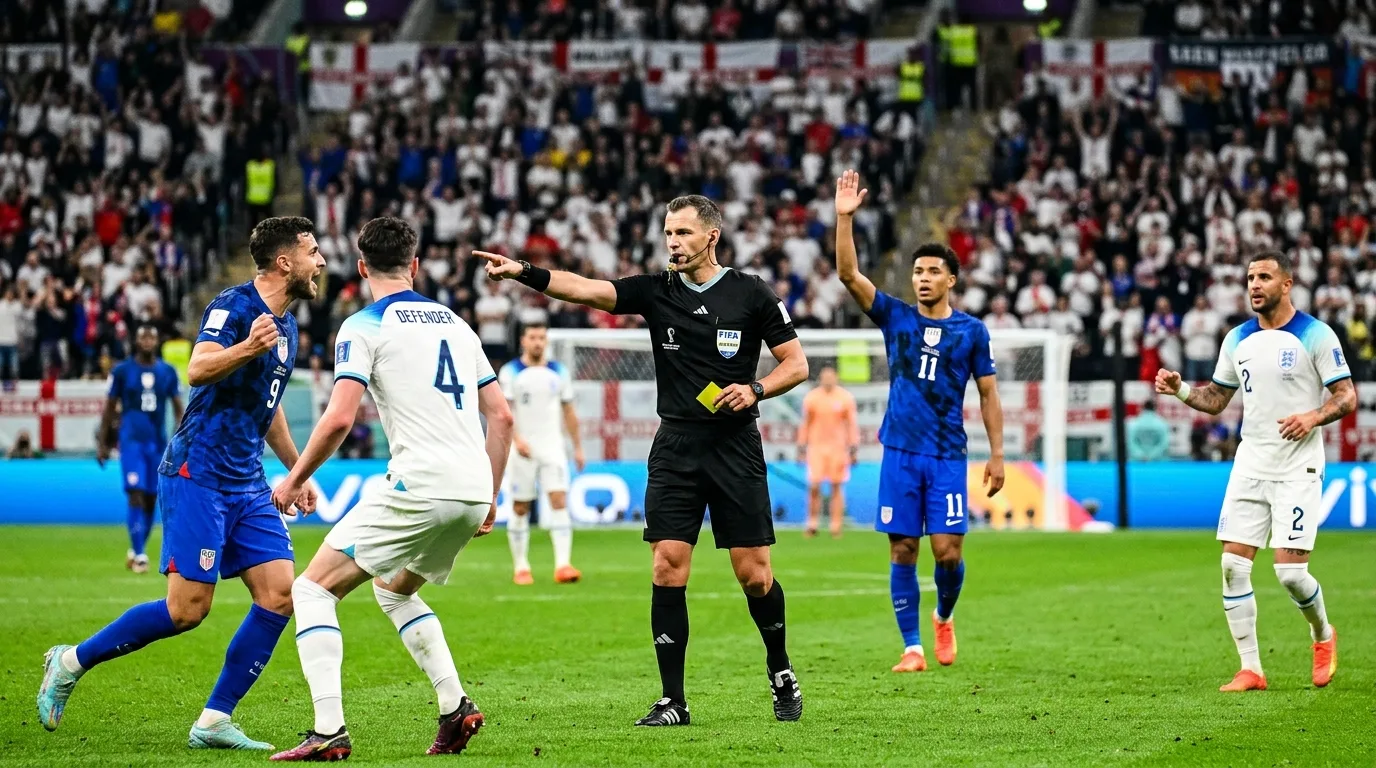
Could you make the correct football refereeing decision when a defender miscontrols a pass, a striker stands offside, or the ball strikes an outstretched arm? This football referee quiz tests realistic situations rather than asking you to memorise the referee's gestures. Each case has one best answer, followed by an explanation and the relevant IFAB Law.
Written for students, football supporters, coaches and aspiring referees, the 26 scenarios are grounded in the 2026/27 IFAB Law 11 (Offside) , Law 12 (Fouls and Misconduct) and related Laws. IFAB is the body responsible for maintaining association football's Laws of the Game. These are educational examples, not assessments of particular matches or certification questions.
How to use the quiz: Answer the questions without viewing the key. Choose A, B or C. Award one point for each correct answer, then read why the decision is correct. Unless stated otherwise, assume the ball is in play, the offence occurs between players on the field, and nothing else changes the decision. The facts are deliberately specific because seemingly small details can change a referee's ruling.
Three rules to understand before you begin
Offside: position and offence are different
A player is not penalised for simply being in an offside position. Under Law 11, involvement in active play—such as touching a ball from a team-mate, challenging an opponent or clearly affecting an opponent's ability to play it—is also required. The position is assessed when the team-mate first plays or touches the ball (with specific guidance for a goalkeeper's throw). Hands and arms are excluded from offside position. The player must have a relevant part of the head, body or feet in the opponents' half and nearer the goal line than both ball and second-last opponent. A player level with the second-last opponent is not offside.
Crucially, a defender's controlled deliberate play may mean an attacker receives the ball without an offside offence, even if the defender misplays it. But a mere deflection, rebound or deliberate save normally does not erase the earlier offside position. IFAB assesses the defender's control, time, ball speed and opportunity to pass, keep or clear the ball; touching the ball alone is not proof of deliberate play. Read the Law 11 examples .
Fouls: contact does not always mean a card
For many physical challenges, careless means insufficient care (a direct free kick but no automatic card), reckless means disregard for an opponent's safety (yellow card), and excessive force in a tackle that endangers safety can mean serious foul play and a red card. Location matters: a direct-free-kick offence by a defender in their own penalty area normally means a penalty. Other sanctions can apply for stopping a promising attack (SPA) or denying an obvious goal-scoring opportunity (DOGSO). See Law 12 .
Handball: not every arm contact is an offence
Under Law 12, punishable handball can involve deliberate movement of the arm towards the ball or an arm position that makes the body unnaturally bigger and is not justified by the player's movement. The arm boundary for this purpose aligns with the bottom of the armpit. A player may also be penalised for scoring directly with the hand/arm or immediately after accidental contact with their own hand/arm. But an accidental touch by a team-mate does not automatically invalidate a subsequent goal. The penalty and card depend on intent, location and the attacking opportunity denied.
Football referee quiz: 26 real-game scenarios
Write your choices in a numbered list. Offside questions are 1–10, fouls and disciplinary decisions are 11–18, and handball scenarios are 19–26.
Offside decisions
Question 1. An attacker is exactly level with the second-last defender when a team-mate releases a forward pass. The attacker runs onto the ball and scores.
A. Offside; indirect free kick
B. Goal allowed, assuming no other offence
C. Retake the pass
Question 2. A striker is standing in their own half, nearer to the opponents' goal than the second-last defender. A team-mate passes forward and the striker runs across halfway to score.
A. Offside because the striker crossed halfway
B. No offside offence
C. Indirect free kick for dangerous play
Question 3. A forward stands beyond the second-last opponent when a team-mate shoots. The shot goes into the net; the forward neither touches the ball nor obstructs the goalkeeper or another opponent.
A. Disallow the goal
B. Award the goal
C. Award a dropped ball
Question 4. A forward is beyond the second-last defender and receives the ball directly from a team-mate's throw-in, then scores.
A. Disallow for offside
B. Award the goal if the throw and subsequent play were otherwise legal
C. Give a goal kick
Question 5. A forward is in an offside position at the moment a team-mate shoots. The ball hits the crossbar, rebounds to the forward and is scored.
A. Offside; indirect free kick
B. Goal counts because the crossbar reset offside
C. Corner kick
Question 6. A long, slow pass travels towards an offside-positioned striker. A defender sees it early, has time to clear and deliberately kicks it, but misdirects the clearance straight to the striker.
A. Automatically offside because the striker was ahead
B. Play on: controlled deliberate play by a defender
C. Dropped ball
Question 7. A fast pass strikes a defender from very close range. The defender has no realistic time or control to coordinate a play; it deflects to an attacker who was offside when the original pass was made.
A. Offside; indirect free kick
B. Goal automatically counts because the defender touched it
C. Penalty kick
Question 8. A shot is heading into goal. The goalkeeper deliberately saves it and the ball rebounds to a forward who was offside when their team-mate shot; the forward scores.
A. Goal allowed: all deliberate touches reset offside
B. Offside; indirect free kick
C. Penalty kick for the attacker
Question 9. An offside-positioned attacker stands directly in front of the goalkeeper and clearly blocks the goalkeeper's line of vision as a team-mate's shot enters the goal.
A. Offside; disallow the goal
B. Goal counts unless the attacker touches the ball
C. Only a warning is possible
Question 10. An offside-positioned attacker chases a through ball but has not challenged an opponent, attempted to play a nearby ball or interfered. A defender carelessly trips the attacker inside the penalty area before any offside offence occurs.
A. Offside always takes priority
B. Penalty kick for the earlier foul
C. Indirect free kick to the defenders for offside position
Fouls and disciplinary decisions
Question 11. A defender misjudges a tackle outside their penalty area and carelessly trips an opponent. The challenge is not reckless, does not deny a goal-scoring opportunity and has no other disciplinary factor.
A. Direct free kick; no automatic card
B. Yellow card and penalty
C. Red card
Question 12. The same tackle is reckless: the defender disregards the danger to an opponent, but does not use excessive force. It occurs outside the penalty area.
A. Indirect free kick only
B. Direct free kick and yellow card
C. Direct free kick and red card in every case
Question 13. A player lunges into a challenge with excessive force that endangers an opponent's safety while attempting to tackle the ball.
A. Yellow card only
B. No offence if they touched the ball first
C. Send off for serious foul play and award the appropriate direct free kick or penalty
Question 14. A defender pulls an attacker's shirt while the ball is in play inside the defender's own penalty area. The facts do not show a promising attack or DOGSO.
A. Penalty kick, no automatic card
B. Indirect free kick and yellow card
C. Goal kick
Question 15. A defender blocks an opponent's running path with contact outside the penalty area, impeding progress. No other serious offence or disciplinary circumstance is involved.
A. Direct free kick
B. Indirect free kick regardless of contact
C. Play on because it was not a kick
Question 16. An attacker raises a boot dangerously near an opponent's head. The opponent withdraws from a playable ball to avoid injury. There is no physical contact.
A. Penalty kick automatically
B. Indirect free kick for dangerous play
C. No offence because nobody was touched
Question 17. A defender tries to play the ball inside their own penalty area, carelessly trips an attacker and denies an obvious goal-scoring opportunity. The referee gives a penalty.
A. Penalty and a yellow card
B. Penalty and a red card automatically
C. Indirect free kick and no card
Question 18. A defender deliberately pulls back an attacker by the shirt inside the defender's penalty area, denying an obvious goal-scoring opportunity. The referee awards a penalty.
A. Penalty and yellow because all DOGSO penalties are yellow
B. Penalty and red card
C. Indirect free kick
Handball scenarios
Question 19. A defender has the arm close to the torso, moving it inward to avoid contact, when a shot from close range strikes it. There is no deliberate movement towards the ball and no unjustified enlargement of the body.
A. Automatic penalty for any arm contact
B. Play on: no handball offence on these facts
C. Indirect free kick to the attacker
Question 20. While blocking a cross inside the defender's penalty area, a player leaves an arm clearly extended away from the body without justification for the movement, and the ball strikes it. The incident does not stop a promising attack or deny a goal.
A. Penalty kick; no automatic card
B. Play on because it was accidental
C. Indirect free kick
Question 21. A defender deliberately reaches an arm towards the ball and handles it inside their own penalty area during an otherwise ordinary challenge. No promising attack or obvious chance is denied.
A. Penalty kick; no mandatory card solely for deliberate handball
B. Automatic red card
C. Only an indirect free kick
Question 22. A defender deliberately punches a shot away from the goal line to stop a certain goal. The ball is in play inside their own penalty area.
A. Penalty and red card
B. Penalty and no card
C. Corner kick
Question 23. A defender's unjustifiably outstretched arm stops a ball going into goal inside the penalty area. The referee judges it a punishable but NON-deliberate handball and awards a penalty.
A. Penalty and red card automatically
B. Penalty and yellow card
C. No offence because the player did not mean it
Question 24. An attacker accidentally brushes the ball with a naturally positioned arm and then immediately scores themself.
A. Award the goal as long as contact was accidental
B. Disallow and give the defenders a direct free kick
C. Only give a dropped ball
Question 25. An attacker accidentally touches the ball with a naturally positioned arm, without deliberation or unnatural enlargement. Their team-mate collects it and scores. There is no other offence.
A. Disallow solely because the scorer's team-mate touched it
B. Award the goal
C. Penalty kick for the defenders
Question 26. A defender deliberately kicks a ball and it unexpectedly ricochets against their naturally positioned arm in the penalty area. There was no deliberate handling and the arm did not make the body unjustifiably bigger.
A. Play on, no handball offence on the stated facts
B. Penalty every time the ball touches a defender's arm
C. Indirect free kick
Answer key: referee decisions and explanations
Compare your decisions with the official Law-based reasoning below. A score is less useful than recognising which facts changed the outcome.
- 1. B — Goal allowed, assuming no other offence. Being level with the second-last opponent is not an offside position. Movement forward after the pass does not retrospectively make the player offside. Law 11.
- 2. B — No offside offence. At the moment of the team-mate's pass, no part of the striker relevant to offside was in the opponents' half. The player was therefore not in an offside position. Law 11.
- 3. B — Award the goal. An offside position alone is not penalised. The forward did not become involved by interfering with play, an opponent, or an applicable rebound/save. Law 11.
- 4. B — Award the goal if the throw and subsequent play were otherwise legal. No offside offence occurs when receiving the ball directly from a throw-in. The same direct-reception exception applies to a goal kick or corner kick. Law 11.
- 5. A — Offside; indirect free kick. A rebound from the goal frame does not reset the offside consideration. Playing that rebound is gaining an advantage from the earlier offside position. Law 11.
- 6. B — Play on: controlled deliberate play by a defender. A defender's deliberate play with a realistic chance to control or clear can remove this offside restriction even if the play is inaccurate. An unsuccessful clearance is not automatically a deflection. Law 11.
- 7. A — Offside; indirect free kick. A quick, uncontrolled deflection is not a deliberate play in the Law 11 sense. An attacker gaining advantage by playing the deflected ball can be offside. Law 11.
- 8. B — Offside; indirect free kick. A deliberate save is an express exception to the deliberate-play reset: it does not make the offside-positioned forward eligible to play the rebound. Law 11.
- 9. A — Offside; disallow the goal. Clearly preventing an opponent from playing or being able to play the ball by obstructing their line of vision counts as interfering with an opponent. Law 11.
- 10. B — Penalty kick for the earlier foul. The foul occurred before an offside offence. IFAB's own Law 11 guidance says the foul is penalised first in these circumstances. Laws 11 and 12.
- 11. A — Direct free kick; no automatic card. A careless trip is a direct-free-kick foul. Being careless, without an additional cautionable reason, does not itself require a yellow card. Law 12.
- 12. B — Direct free kick and yellow card. Recklessness is cautionable. The normal restart for a reckless tripping/tackling offence is a direct free kick where it occurs. Law 12.
- 13. C — Send off for serious foul play and award the appropriate direct free kick or penalty. Winning or touching the ball does not justify a tackle using excessive force that endangers safety. Serious foul play is a sending-off offence. Law 12.
- 14. A — Penalty kick, no automatic card. Holding is a direct-free-kick offence; in the defender's own area it means a penalty. Without a separate disciplinary reason, a card is not automatic. Law 12.
- 15. A — Direct free kick. Impeding an opponent with contact is a direct-free-kick offence; impeding without contact is treated differently and may bring an indirect free kick. Law 12.
- 16. B — Indirect free kick for dangerous play. Playing in a dangerous manner can be penalised without contact when it threatens injury and affects an opponent nearby. Contact may instead change the foul category. Law 12.
- 17. A — Penalty and a yellow card. For DOGSO inside the penalty area, an offence that was an attempt to play or challenge for the ball, with a penalty awarded, normally results in a caution rather than a red card. Law 12.
- 18. B — Penalty and red card. The DOGSO reduction to a yellow card does not apply to holding/pulling with no genuine attempt or possibility to play the ball. A penalty and sending-off follow. Law 12.
- 19. B — Play on: no handball offence on these facts. Not every hand/arm touch is an offence. IFAB gives a similar close-range example with an arm held close to the body as no handball. Law 12.
- 20. A — Penalty kick; no automatic card. An arm that unjustifiably makes the body unnaturally bigger can make the touch punishable even without deliberate movement towards the ball. With no additional SPA/DOGSO circumstances, a card is not automatic. Law 12.
- 21. A — Penalty kick; no mandatory card solely for deliberate handball. Deliberate handling is penalised. A defender's handball in their own area ordinarily means a penalty, but deliberate intent alone does not mandate a yellow or red without a separate sanctionable circumstance. Law 12.
- 22. A — Penalty and red card. Deliberate handball denying a goal or obvious goal-scoring opportunity is a sending-off offence, except for a goalkeeper within their own penalty area. Law 12.
- 23. B — Penalty and yellow card. IFAB specifically distinguishes non-deliberate punishable handball denying a goal where a penalty is awarded: the appropriate disciplinary sanction is a caution, rather than an automatic red. Law 12.
- 24. B — Disallow and give the defenders a direct free kick. Law 12 does not permit a goal scored directly with the attacker's hand/arm or immediately after the scorer's own accidental hand/arm touch, even if the position was otherwise natural. Law 12.
- 25. B — Award the goal. Accidental contact by a team-mate of the scorer does not automatically cancel the goal. IFAB explains that the scorer's own immediately preceding hand/arm touch is a different rule. Law 12.
- 26. A — Play on, no handball offence on the stated facts. IFAB gives a similar example of the ball rebounding from a defender's own deliberate kick onto their arm: without deliberate handball or unnatural enlargement, play continues. Law 12.
How to score your football referee quiz
| Correct answers | Suggested interpretation |
|---|---|
| 23–26 | Strong understanding: refine judgment on deliberate play and card sanctions |
| 18–22 | Good grasp: revisit the scenarios you missed and their IFAB explanations |
| 12–17 | Developing knowledge: review the three rule summaries and replay the quiz |
| 0–11 | Foundation stage: study Laws 11 and 12, then attempt the scenarios again |
These bands are informal learning aids. They are not an official referee certificate, accreditation test or a guarantee about real-match judgment. In real matches, referees also assess positioning, speed, contact, players' actions and evidence from match officials.
Tricky decisions that deserve a second look
Deliberate play versus deflection in offside
The most important distinction is control and opportunity. A defender who anticipates a slow ball, has time to act and tries to clear it may have deliberately played the ball even if the clearance is poor. A defender hit by a fast ball at point-blank range may merely cause a deflection. A save of a ball going into or very close to the goal does not reset offside in the usual way. IFAB published specific guidance on deliberate play and deflection; see Law 11's scenario explanations .
The timing of a foul and an offside offence
Being offside-positioned does not erase the player's right to be protected from an opponent's foul. Where the defender fouls the attacker before the attacker commits an offside offence, the earlier foul is normally penalised. If the attacker is already playing or challenging an opponent for the ball in a way that constitutes offside, that offence may occur first. This is why a freeze-frame of positioning cannot answer every offside-plus-penalty debate.
Penalty kick and disciplinary sanction are separate decisions
A punishable handball inside the defender's penalty area usually results in a penalty; it does not follow that every penalty also requires a card. Reckless challenges can warrant a caution. Serious foul play can require a sending-off. DOGSO decisions require the referee to distinguish attempts to play the ball from holding or pulling, and deliberate handball from non-deliberate handball that still makes the body unnaturally bigger. The right restart does not, by itself, determine the card.
Why the scorer's handball differs from a team-mate's
It is incorrect to say that any accidental attacking handball in the entire build-up to a goal disallows the score. Law 12 has a particular restriction on a goal scored directly with a hand/arm or immediately after the scorer's own contact. Accidental natural-position contact by a different attacker does not, by itself, invalidate a later team-mate's goal. A deliberate or unnaturally bigger arm can still be an offence regardless of who scores.
How teachers and coaches can use these scenarios
For classroom use, split learners into groups of three. One student reads the facts, another makes the ruling and a third explains the relevant Law and sanction. Ask each group to identify three elements: offence or no offence; restart; card or no automatic card. Students can mark a pitch diagram to show where the ball, defenders and attacker were when a pass was made.
For a practical extension, use freeze-frame drawings or slow walking-speed demonstrations. Do not perform reckless or excessive-force tackles to simulate quiz scenarios. Learners can draw arm positions or use paper player markers rather than reproducing unsafe contact.
Frequently asked questions
Can a player be offside without touching the ball?
Yes. An attacker can interfere with an opponent, for example by clearly blocking the goalkeeper's line of vision or challenging for the ball. But merely standing offside without active involvement is not an offence.
Does a defender touching the ball cancel offside?
Not automatically. A controlled, deliberate play may do so, but a quick deflection, rebound or deliberate save does not have the same effect. The referee must apply Law 11 to the specific action.
Is every handball in the penalty area a penalty?
No. The referee first decides whether the contact is a punishable handball. A naturally positioned arm struck accidentally may not be an offence. The location only matters once an offence has been identified.
Can an accidental handball still cancel a goal?
Yes. If the scorer scores directly with their hand/arm or immediately after their own accidental hand/arm touch, the goal is disallowed under Law 12. A different accidental touch by a team-mate does not automatically cancel a later goal.
Is a penalty always accompanied by a yellow card?
No. A penalty and disciplinary action are separate decisions. Some penalties involve no card; others require yellow or red depending on recklessness, excessive force, DOGSO or handball-specific rules.
Which Laws should I study for referee quizzes?
Start with IFAB Law 11 (Offside), Law 12 (Fouls and Misconduct), Law 13 (Free Kicks), Law 14 (Penalty Kicks) and Law 5 (The Referee). Check the current 2026/27 text and applicable competition modifications rather than relying on an old answer sheet.
Conclusion: learn to explain the decision, not just guess it
The best way to improve at a football referee quiz is to ask precisely what happened and when. Was the attacker merely in an offside position or actively involved? Did the defender deliberately play the ball or only deflect it? Was a challenge careless, reckless or excessive? Was handball deliberate, caused by an unjustifiably extended arm or simply accidental contact with a natural arm position?
Answer those questions first, then select the restart and disciplinary sanction. Use the official IFAB links in this guide as the final reference, and practise again with different scenarios rather than memorising one repeated list of answers.
Editorial note: Research checked 16 November 2026 against the IFAB Laws of the Game 2026/27. These hypothetical situations simplify facts to enable one best answer. Competition-specific permitted modifications and real-match judgments may differ; this article is not a substitute for formal referee training.