Mountain snow is more than winter scenery. In many regions it functions as a natural reservoir, storing water during cold months and releasing it gradually as temperatures rise.
When that seasonal store is much smaller than normal, scientists use the term snow drought. The consequences can extend well beyond ski slopes: weaker spring runoff can reduce river flows, reservoir inflows, hydropower generation and water available for farms, ecosystems and communities.
What is a snow drought?
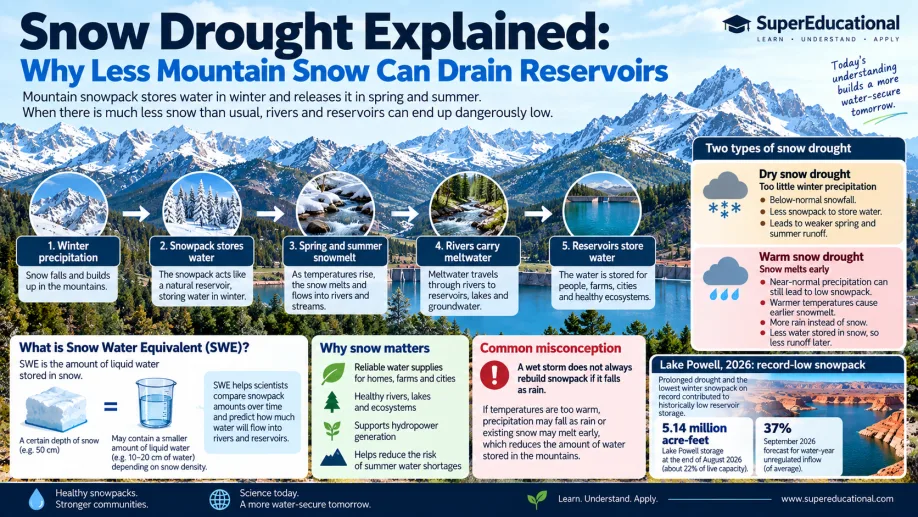
A snow drought is a period when snowpack is abnormally low for the time of year. It can happen because too little precipitation falls during the cold season, because temperatures are warm enough for precipitation to fall as rain instead of snow, or because snow melts unusually early.
Dry snow drought versus warm snow drought
A dry snow drought happens when cold-season precipitation itself is below normal. Less water arrives, so less snow accumulates.
A warm snow drought can occur even when total precipitation is near normal. Warmer conditions may turn snowfall into rain or melt snow earlier than usual, leaving less water stored in the mountains for later release.
What is snow water equivalent?
Snow depth alone does not tell us how much water is stored. Scientists use snow water equivalent (SWE), the amount of liquid water contained in a snowpack if it were completely melted.
Two snowpacks of the same depth can have very different SWE because fresh powder is much less dense than wet, compacted snow.
Why snowpack acts like a reservoir
Snow stores winter precipitation at high elevations. During spring and summer, melting snow feeds streams, rivers, reservoirs and groundwater. This timing is valuable because many regions need large amounts of water after winter precipitation has ended.
If snow melts too early, more water can arrive before it is needed and before reservoirs or ecosystems are prepared to use it. Warm conditions can also increase evaporation and plant water use, further reducing how much runoff eventually reaches reservoirs.
Why one wet storm may not fix a snow drought
A storm can add a lot of precipitation without rebuilding snowpack if temperatures are too warm. Rain may run off quickly instead of remaining stored as snow, and warm conditions can also accelerate melting of existing snow.
This is why scientists track both precipitation and temperature when evaluating snow drought.
Lake Powell in 2026: a useful case study
The Colorado River Basin provides a clear example of why snowpack matters. In 2026, prolonged drought, very low winter snowpack and warm conditions contributed to weak runoff and historically low reservoir storage.
By the end of August 2026, Lake Powell held about 5.14 million acre-feet of water, roughly 22% of live capacity. The September forecast placed water-year unregulated inflow at about 37% of average.
These figures do not mean snow drought was the only cause of low reservoir storage. Long-term drought, high temperatures, evaporation, water use and previous years' conditions also matter. But low snowpack reduced the amount of water available to replenish the reservoir.
What snow drought can affect
- Drinking water: many cities depend on snow-fed rivers and reservoirs.
- Agriculture: irrigation systems often rely on spring and summer snowmelt.
- Hydropower: lower reservoir levels can reduce generation capacity.
- Ecosystems: fish, wetlands and riparian habitats depend on seasonal flows.
- Wildfire risk: earlier snowmelt can contribute to drier landscapes later in the year.
Common misconception
“If the total annual precipitation is normal, there cannot be a snow drought.” Not necessarily. If much of the precipitation falls as rain, or snow melts unusually early, mountain snow storage can still be well below normal.
Key takeaways
- Snow drought means snowpack is unusually low for the time of year.
- Dry snow drought is mainly about too little cold-season precipitation.
- Warm snow drought is mainly about temperatures causing more rain or early snowmelt.
- Snow water equivalent measures how much liquid water is actually stored in the snow.
- Low snowpack can reduce later river and reservoir inflows.
- Lake Powell’s 2026 conditions show how snow drought, heat and long-term drought can combine to stress water supplies.
Frequently asked questions
Is snow drought the same as ordinary drought?
No. They can overlap, but snow drought specifically describes unusually low snowpack. A region can have normal precipitation totals yet still experience a warm snow drought.
Does more snow depth always mean more water?
No. Water content depends on snow density, which is why scientists use snow water equivalent.
Can rain help reservoirs during a snow drought?
Yes, rain can contribute runoff, but it does not provide the same delayed seasonal storage as mountain snowpack.
Authoritative references
- Drought.gov — Snow Drought.
- US Bureau of Reclamation — Colorado River and Lake Powell operational updates, September 2026.
- NASA Earth Observatory — Lake Powell and western snow-drought reporting, September 2026.