
A pulsar can be only about the size of a city, yet in a close binary system it can dominate the behaviour of gas flowing from a companion star thousands of times larger.
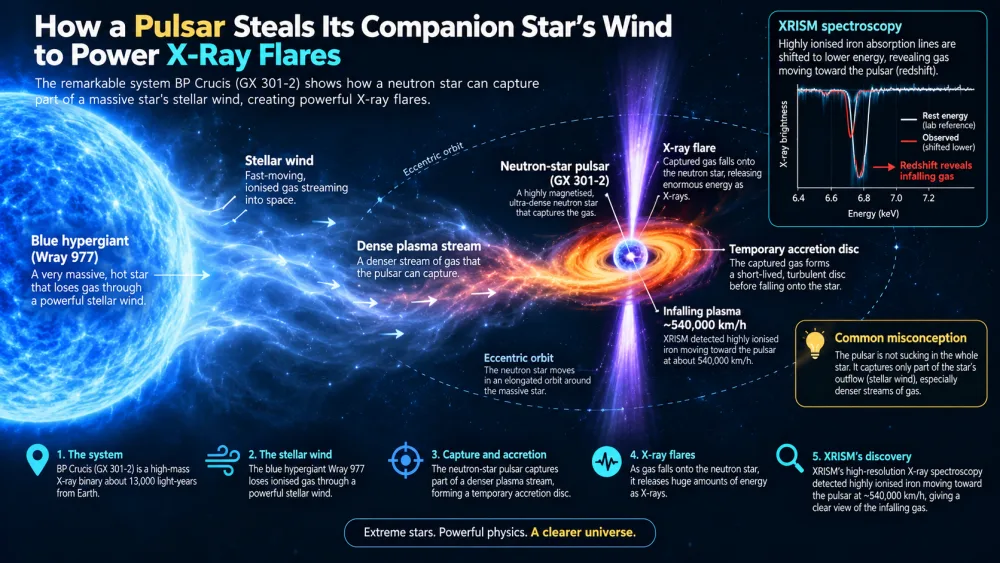
That is the situation in BP Crucis, a high-mass X-ray binary about 13,000 light-years from Earth. The system contains the blue hypergiant Wray 977 and a neutron-star pulsar called GX 301-2. Wray 977 continuously loses gas in a powerful stellar wind. GX 301-2 captures part of that outflow, and the infalling material can release enormous amounts of energy as X-rays.
In September 2026, NASA and JAXA reported results from the XRISM X-ray observatory showing highly ionised iron in plasma moving toward the pulsar at roughly 540,000 kilometres per hour. The measurements provide unusually direct evidence of how the gas is moving through the system.
What is a high-mass X-ray binary?
A high-mass X-ray binary contains a compact object—usually a neutron star or black hole—orbiting a massive companion star.
The massive star can lose material through a stellar wind. If the compact object captures some of that gas, gravity accelerates the material inward. As it falls deeper into the compact object's gravitational field, gravitational potential energy is converted into heat and radiation, often producing X-rays.
The word binary simply means that the two objects are gravitationally bound and orbit a common centre of mass.
What is a neutron-star pulsar?
A neutron star is the extremely dense remnant left behind after certain massive stars explode as supernovae.
Neutron stars pack more mass than the Sun into a sphere only tens of kilometres across. Their magnetic fields can be extraordinarily strong.
A pulsar is a rotating neutron star whose beams of radiation sweep through space. If one of those beams crosses Earth, astronomers observe a regular pulse, much like seeing the flash of a lighthouse every time its beam turns toward you.
GX 301-2 rotates much more slowly than many famous radio pulsars, with a spin period of about 11 minutes.
What is a stellar wind?
A stellar wind is a stream of particles flowing away from a star.
Massive, luminous stars can lose material at very high rates. Radiation from the star interacts with ions in its outer atmosphere and helps drive gas outward into space.
This is different from an explosion. The star is continuously shedding material through its atmosphere.
Wray 977 is a blue hypergiant with a strong, ionised wind. That outflow fills part of the space around the binary.
The pulsar is not “eating” the whole star
It is common to imagine the pulsar pulling material directly off its companion like a cosmic vacuum cleaner. That is misleading.
Wray 977 is already losing material in its stellar wind. GX 301-2 captures only a fraction of that outflow as it moves through the wind and a denser stream of plasma.
The crucial physics is gravitational capture: gas that passes sufficiently close to the neutron star can be deflected, slowed relative to the pulsar and pulled inward.
Why the orbit matters
GX 301-2 follows an eccentric orbit, meaning the orbit is noticeably elongated rather than perfectly circular.
The two objects complete an orbit in about 41.5 days. Because the separation changes during the orbit, the pulsar moves through different densities and geometries of the stellar outflow.
Near particular orbital phases, it encounters a denser stream of plasma. That increases the amount of material available for capture and can trigger stronger X-ray activity.
How does captured gas create X-rays?
When gas is captured by a neutron star, it does not simply fall straight inward in a perfectly smooth line.
The gas carries angular momentum, so some of it can begin circulating around the compact object. Under suitable conditions, that material forms an accretion disc or a more temporary disc-like flow.
As gas moves inward, friction, shocks, magnetic interactions and compression convert orbital and gravitational energy into heat. Near a neutron star, the gravitational field is so intense that a small amount of falling matter can release a very large amount of energy.
Much of that energy emerges as X-rays.
A temporary and turbulent accretion flow
BP Crucis is especially interesting because the accretion structure is not necessarily a stable, long-lived disc like those seen in some other systems.
Changes in the density and direction of the incoming stellar wind can produce a short-lived, turbulent flow that forms, changes and may partly disappear as the pulsar moves through its orbit.
This makes the system an excellent laboratory for studying accretion in a changing environment rather than under idealised steady conditions.
What did XRISM measure?
XRISM is a joint JAXA/NASA X-ray astronomy mission designed for high-resolution spectroscopy.
Spectroscopy separates incoming radiation according to energy, allowing astronomers to detect narrow features associated with specific atoms and ions.
In BP Crucis, XRISM detected absorption lines produced by highly ionised iron. Those lines appeared shifted relative to their expected energies.
The shift revealed that the absorbing plasma was moving toward the neutron star.
How a spectral line measures motion
This works through the Doppler effect.
If material moves away from the observer or deeper into the gravitational environment, the observed energy of a spectral feature can shift toward lower values. If it moves toward the observer, features can shift in the opposite direction.
Astronomers compare the measured position of a line with its known laboratory energy. The size and direction of the shift provide information about the motion of the gas.
In this case, the iron features indicated infalling material travelling at around 540,000 km/h.
Why iron is useful
Iron is common in astrophysical plasmas and produces strong X-ray spectral features when highly ionised.
Because those features occur at well-known energies, they can act as markers that let researchers track the physical state and motion of hot gas.
High-resolution instruments such as XRISM's Resolve spectrometer can separate fine spectral details that older or lower-resolution instruments may blur together.
Why this observation matters
Astronomers have long had models explaining how compact objects capture stellar winds. But models are most valuable when observations can test the actual motion of the gas.
XRISM's measurements provide a more direct view of plasma falling inward in a wind-fed X-ray binary.
That helps researchers test ideas about:
- how stellar winds are structured;
- how much gas a neutron star captures;
- when temporary accretion discs form;
- why X-ray flares occur at specific orbital phases;
- how angular momentum moves through the captured gas.
Why X-ray flares are so powerful
A neutron star's gravity is extremely strong because a stellar mass is packed into a very small radius.
That means infalling matter can lose a large amount of gravitational potential energy over a short distance.
Even if the captured mass is tiny compared with the mass of the companion star, the energy released near the neutron star can be enormous.
This is why compact objects are among the most efficient natural engines for converting infalling matter into radiation.
A useful classroom analogy
Imagine leaves blowing past a small but very deep drain. Most leaves continue with the wind, but those that pass close enough are diverted inward.
The analogy is incomplete because gravity, orbital motion, plasma physics and magnetic fields are far more complex than water flow, but it captures an important idea: the pulsar does not need to capture the whole wind. A small fraction passing through the right region can feed the accretion flow.
Common misconceptions
“The pulsar is sucking in the companion star itself.” No. It captures part of material the companion is already losing in its stellar wind.
“A stellar wind is the same as a solar flare.” No. A stellar wind is a continuing particle outflow. A flare is a separate, transient energy-release event.
“Accretion discs are always permanent.” No. In wind-fed systems, disc-like structures can be temporary and highly variable.
“X-rays come from nuclear fusion on the neutron star.” The dominant source here is gravitational energy released by infalling matter, not ordinary stellar fusion.
“Astronomers directly photograph the gas speed.” The motion is inferred from spectroscopy, particularly shifted absorption lines.
Key takeaways
- BP Crucis contains the blue hypergiant Wray 977 and the neutron-star pulsar GX 301-2.
- Wray 977 loses ionised gas through a strong stellar wind and a denser plasma stream.
- GX 301-2 captures some of that material as it moves through its eccentric orbit.
- Captured gas can form a temporary accretion flow and release intense X-rays as it falls deeper into the neutron star's gravity.
- XRISM detected highly ionised iron absorption features that revealed plasma moving inward at roughly 540,000 km/h.
- The result gives astronomers a clearer observational picture of how wind-fed accretion works in a high-mass X-ray binary.
Frequently asked questions
What is GX 301-2?
GX 301-2 is a neutron-star pulsar in the BP Crucis binary system. It orbits the massive blue hypergiant Wray 977 and emits strong X-rays when it captures material from the companion's wind.
How far away is BP Crucis?
NASA reports that the system is about 13,000 light-years from Earth.
How fast was the infalling gas?
XRISM observations indicated plasma moving toward the pulsar at roughly 540,000 kilometres per hour.
Why does the pulsar flare more strongly at some times than others?
Its eccentric orbit carries it through changing parts of the companion's wind and denser plasma structures, so the amount of gas captured can vary substantially.
What does XRISM add to earlier observations?
XRISM provides very high spectral resolution in X-rays, allowing researchers to measure narrow atomic features and infer the motion and state of the gas with much greater precision.
Authoritative references
- NASA Science — XRISM observations of BP Crucis and GX 301-2, September 2026.
- JAXA — XRISM mission and instrument documentation.
- NASA/JAXA XRISM science materials on high-resolution X-ray spectroscopy.