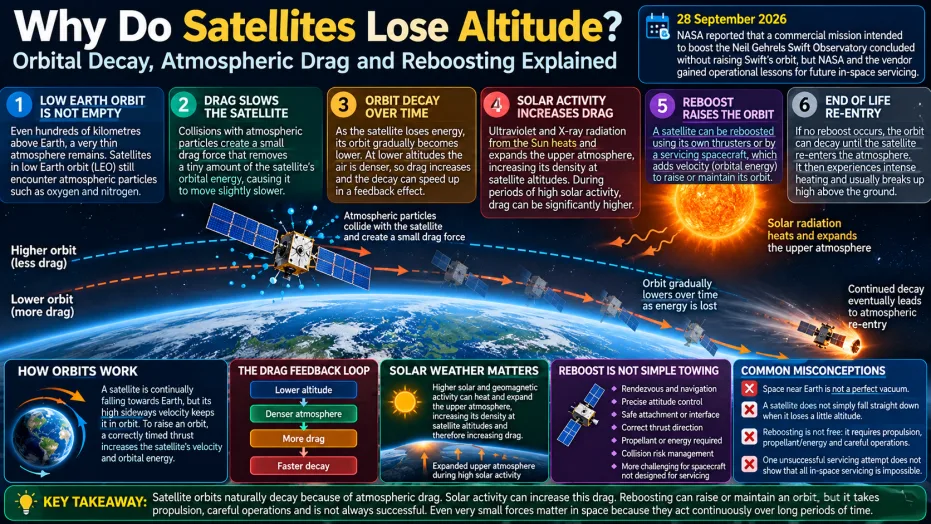
Satellites in low Earth orbit can remain above us for years, yet many gradually lose altitude. The reason is simple in principle but subtle in practice: space close to Earth is not a perfect vacuum.
At altitudes where many satellites operate, a very thin upper atmosphere remains. Individual molecules are sparse, but a satellite travelling at roughly orbital speed collides with enormous numbers of them over time. Each collision produces an almost imperceptible drag force. Over weeks, months and years, that small effect can remove enough orbital energy to lower the spacecraft's orbit.
What keeps a satellite in orbit?
A satellite is continually falling towards Earth under gravity. It does not hit the ground because it also has enough sideways velocity to keep missing Earth as the planet curves away beneath it.
This balance produces an orbit. The satellite's motion can be described by its orbital energy and angular momentum. If drag removes some of that energy, the orbit gradually changes.
Why low Earth orbit is not empty
Earth's atmosphere becomes thinner with altitude, but it does not end at a sharp boundary. Hundreds of kilometres above the surface, atoms and molecules are still present in the thermosphere and exosphere.
A spacecraft moving through those particles experiences atmospheric drag. The drag is tiny compared with what an aircraft experiences near the surface, but satellites move extremely fast and remain exposed continuously.
How drag causes orbital decay
Atmospheric drag acts opposite the satellite's direction of motion. That removes mechanical energy from the orbit.
As energy is lost, the spacecraft's orbit becomes lower. In a lower orbit, atmospheric density is usually greater, so drag tends to increase. This creates a feedback effect:
lower altitude → denser atmosphere → more drag → faster energy loss → still lower altitude.
The process is called orbital decay.
Why doesn't a satellite simply fall straight down?
Because the satellite still has substantial sideways velocity. Losing some orbital energy does not normally turn the motion into a vertical drop. Instead, the orbit changes gradually.
A satellite can spend many revolutions descending through progressively lower orbits before atmospheric drag becomes strong enough to cause rapid re-entry.
How solar activity changes drag
The density of Earth's upper atmosphere is not constant. Solar ultraviolet and X-ray radiation heat the thermosphere. During periods of stronger solar and geomagnetic activity, the upper atmosphere can expand.
That means the atmospheric density at a satellite's altitude can rise, increasing drag even when the spacecraft's orbit has not changed much.
This is why space-weather conditions matter for orbit prediction. Two satellites at the same altitude can experience different drag at different stages of the solar cycle.
What is a reboost?
A reboost is a manoeuvre that adds orbital energy to a spacecraft so that its orbit becomes higher or is prevented from decaying too quickly.
The satellite may use its own thrusters, or another spacecraft may assist. The key is that thrust must be applied at the right time and in the right direction.
Increasing a spacecraft's velocity at an appropriate point in its orbit can raise the opposite side of the orbit. Additional manoeuvres may then circularise the new orbit.
Reboosting is not simply towing a satellite upward
Orbital servicing is more complicated than attaching a rope and pulling. A servicing spacecraft must safely rendezvous with the target, match its orbit and relative motion, control attitude, avoid collisions and apply thrust without destabilising either vehicle.
These challenges become greater when the target spacecraft was never designed to be serviced. Engineers may have to work around delicate structures, uncertain attachment points and limited information about how the spacecraft will respond to external forces.
A 2026 servicing case study
NASA reported in September 2026 that a commercial mission intended to raise the orbit of the Neil Gehrels Swift Observatory concluded without boosting Swift's orbit. Although the reboost itself was not achieved, NASA and the participating company gained operational experience relevant to future in-space servicing missions.
The lesson is important: an unsuccessful attempt does not mean orbital servicing is impossible. It demonstrates how challenging rendezvous, interaction and orbit-change operations can be for spacecraft not originally designed for such work.
Why some satellites need regular reboosts
Large spacecraft in low Earth orbit may need periodic orbital maintenance because drag continually removes energy. The International Space Station, for example, receives regular reboosts to maintain its operational altitude.
Other satellites carry their own propulsion for station-keeping. Some have no practical reboost capability at all and are designed with orbital decay and eventual re-entry as part of their end-of-life plan.
What determines how fast an orbit decays?
Several factors matter:
- Altitude: lower orbits generally encounter denser atmosphere.
- Spacecraft area: a larger cross-sectional area can produce more drag.
- Mass: heavier spacecraft with the same area are generally less affected by drag than lighter ones.
- Shape and attitude: how the spacecraft is oriented changes the effective drag area.
- Atmospheric density: this varies with solar and geomagnetic activity.
- Orbit geometry: eccentricity and inclination can influence the conditions encountered along the orbit.
A useful concept: ballistic coefficient
Engineers often combine spacecraft mass, shape, drag coefficient and effective area into a quantity related to the ballistic coefficient.
A spacecraft with high mass relative to its drag area tends to lose orbital energy more slowly than a lightweight object with a large area. This helps explain why different satellites at similar altitudes can decay at very different rates.
What happens at the end of orbital decay?
As the satellite descends into denser atmosphere, drag rises rapidly. Eventually the spacecraft can no longer sustain an orbital trajectory and begins atmospheric re-entry.
During re-entry, the spacecraft encounters intense aerodynamic heating. Many components melt, fragment or burn up. Larger or more heat-resistant pieces may survive to lower altitudes, which is why responsible end-of-life planning and controlled re-entry are important for some spacecraft.
Common misconceptions
“There is no atmosphere in space.”
Not near Earth. The atmosphere becomes extremely thin but extends far above the conventional boundary of space.
“If a satellite loses altitude, it falls straight down.”
No. It normally remains in orbit while its trajectory gradually becomes lower.
“Reboosting is free.”
No. It requires propulsion, propellant or energy, navigation and careful mission operations.
“Solar storms only affect electronics.”
No. They can also change the density of Earth's upper atmosphere, which can alter drag and orbital predictions.
“One failed servicing mission proves reboosting cannot work.”
No. Reboosting is already a routine operation for some spacecraft. The difficulty depends strongly on whether the target was designed for servicing and on the mission architecture.
Simple analogy: a nearly invisible headwind
Imagine cycling into an extremely weak headwind. For a few seconds, the effect might seem negligible. But if you could travel for months without pedalling harder, even a tiny continuous resistance would gradually reduce your energy.
Atmospheric drag in low Earth orbit is similar in that the force is often very small, but it acts continuously. Small forces can become important over long periods.
Practical application: reading satellite-orbit news
When you see a report that a spacecraft is “losing altitude”, ask:
- What is its current altitude?
- How much propulsion does it have?
- Was it designed for reboosting or servicing?
- What is current solar activity doing to upper-atmosphere density?
- Is the orbit decay expected and controlled, or does it threaten the mission lifetime?
Those questions provide more useful context than altitude alone.
Key takeaways
- Low Earth orbit contains a very thin atmosphere, so satellites experience drag.
- Drag removes orbital energy and can gradually lower a satellite's orbit.
- Lower altitude usually means denser atmosphere and therefore stronger drag.
- Solar activity can heat and expand the upper atmosphere, increasing drag.
- Reboosting adds orbital energy but requires propulsion and precise operations.
- Continued orbital decay eventually leads to atmospheric re-entry.
Frequently asked questions
At what altitude does atmospheric drag matter?
There is no single cutoff. Drag generally becomes more important at lower altitudes, but upper-atmosphere density varies greatly with solar activity and spacecraft properties.
Can every satellite be reboosted?
No. Some satellites carry suitable propulsion, while others do not. External servicing also requires compatible mission design, rendezvous capability and a safe way to interact with the target.
Does a higher orbit always last forever?
No. Higher orbits usually experience less atmospheric drag, but other perturbations and long-term dynamics still affect them. Their lifetimes can nevertheless be vastly longer than those of low-altitude satellites.
Why does solar activity make orbit prediction harder?
Solar and geomagnetic activity change the temperature and density of the upper atmosphere. That changes drag, which introduces uncertainty into predictions of orbital decay.