New Earth-observation satellites do not begin with a spacecraft design. They begin with a scientific question: what do researchers need to measure that existing satellites cannot measure well enough?
ESA’s Earth Explorer programme turns those questions into competitive mission concepts. The process can take years because scientific value, engineering feasibility, risk and programme constraints all have to survive repeated scrutiny.
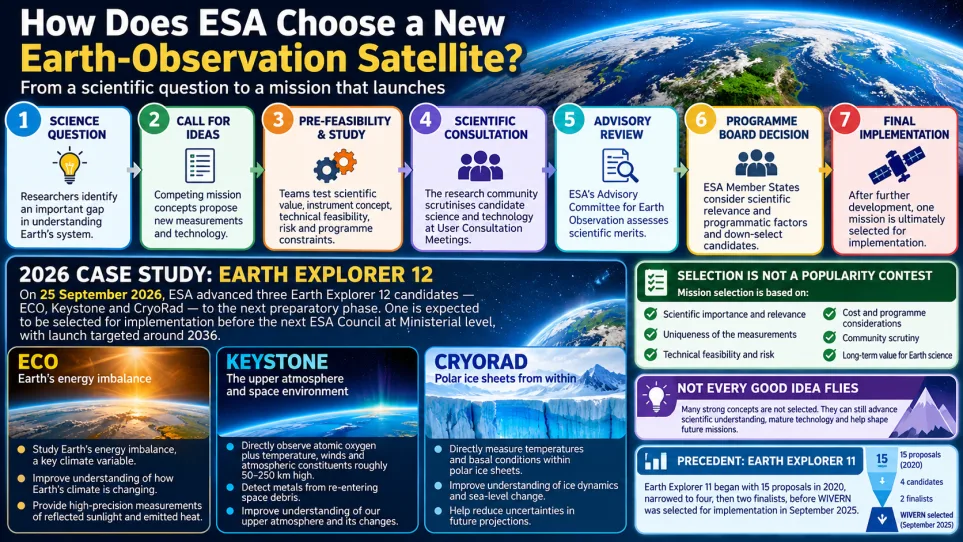
1. Start with a science question
Researchers identify an important gap in understanding Earth’s atmosphere, oceans, ice, land, gravity or climate system. A mission concept must offer observations that are scientifically useful and sufficiently different from what existing satellites already provide.
2. Call for mission ideas
ESA invites scientists and engineers to propose concepts. Teams describe the scientific problem, proposed instruments, observing strategy and expected advances.
3. Study feasibility
Promising concepts enter increasingly detailed studies. Engineers ask whether the instruments can actually be built, whether the satellite can supply enough power and data capacity, whether the orbit works, and whether cost and risk fit programme constraints.
4. Scientific consultation
The wider research community reviews candidate missions through meetings and technical discussion. This matters because a mission may be scientifically interesting but still have weak measurement assumptions, insufficient uniqueness or unrealistic technical requirements.
5. Advisory review
ESA’s Advisory Committee for Earth Observation assesses the scientific merits of candidates. It considers how strongly each concept addresses important research questions and whether the proposed measurements are likely to deliver the promised science.
6. Programme-board decision
Member States then consider the scientific case alongside programmatic factors such as feasibility, risk, maturity and resources. The process is not a public popularity contest; a concept needs both scientific strength and a credible path to implementation.
7. Final implementation
After further development, one mission is eventually selected for implementation. Selection does not mean launch is immediate. Instruments, spacecraft, ground systems, testing and mission operations still have to be built and qualified.
Earth Explorer 12: the 2026 candidates
In September 2026, ESA advanced three candidate concepts—ECO, Keystone and CryoRad—to the next preparatory phase. One is expected ultimately to be selected for implementation, with launch targeted around the mid-2030s.
ECO: Earth’s energy imbalance
ECO would study the difference between energy Earth receives from the Sun and the energy it emits back to space. That imbalance is a central quantity in understanding ongoing climate change.
Keystone: the difficult upper atmosphere
Keystone would observe atomic oxygen together with temperature, winds and atmospheric constituents roughly 50–250 kilometres above Earth. This transition region is difficult to measure continuously and is important for understanding how the atmosphere couples to near-Earth space.
The concept also includes measurements of metals produced by re-entering space debris, connecting atmospheric science with space-sustainability research.
CryoRad: looking inside polar ice
CryoRad would investigate temperatures and basal conditions within polar ice sheets. Those quantities influence how ice deforms and slides, so better observations could reduce uncertainty in models of ice dynamics and future sea-level change.
What makes one mission stronger than another?
Selection balances several questions: Is the science important? Are the measurements genuinely new? Can the instrument achieve the required accuracy? Is the technology mature enough? Can the mission be delivered within acceptable risk and resources? Will enough researchers be able to use the data?
Not every good idea flies
A concept can be scientifically valuable and still not be selected. Competition is part of mission design. Unselected concepts can mature instruments, improve models, reveal measurement gaps and shape future proposals.
A precedent: Earth Explorer 11
The previous cycle illustrates how strongly concepts are filtered. Earth Explorer 11 began with 15 proposals in 2020, narrowed to four candidate missions and then two finalists before WIVERN was selected for implementation in September 2025.
Common misconceptions
“ESA simply chooses the most exciting-looking spacecraft.” No. Scientific relevance, measurement uniqueness, feasibility, risk and programme constraints all matter.
“A selected candidate is ready to launch.” No. Detailed engineering, procurement, integration and testing still follow.
“An unselected mission was a bad idea.” Not necessarily. It may have lost because another concept offered greater value within the same programme constraints.
Practical application
When reading about a proposed science satellite, look for the question it is trying to answer, the measurement it would make, why existing instruments are insufficient, and what stage of the selection process it has actually reached.
Key takeaways
- Earth Explorer missions start with scientific questions, not finished spacecraft.
- Candidate concepts go through repeated science and engineering review.
- Community consultation and independent advisory assessment are central to the process.
- Member States consider both scientific merit and programme feasibility.
- Mission selection is followed by years of implementation work before launch.
FAQs
Does ESA choose only one Earth Explorer at a time?
Competitive calls typically narrow several concepts to one mission for implementation, although multiple Earth Explorer missions can be in different development or operational phases simultaneously.
Who uses Earth Explorer data?
Scientists studying Earth-system processes use the observations, and the data can also improve models and future operational services.