
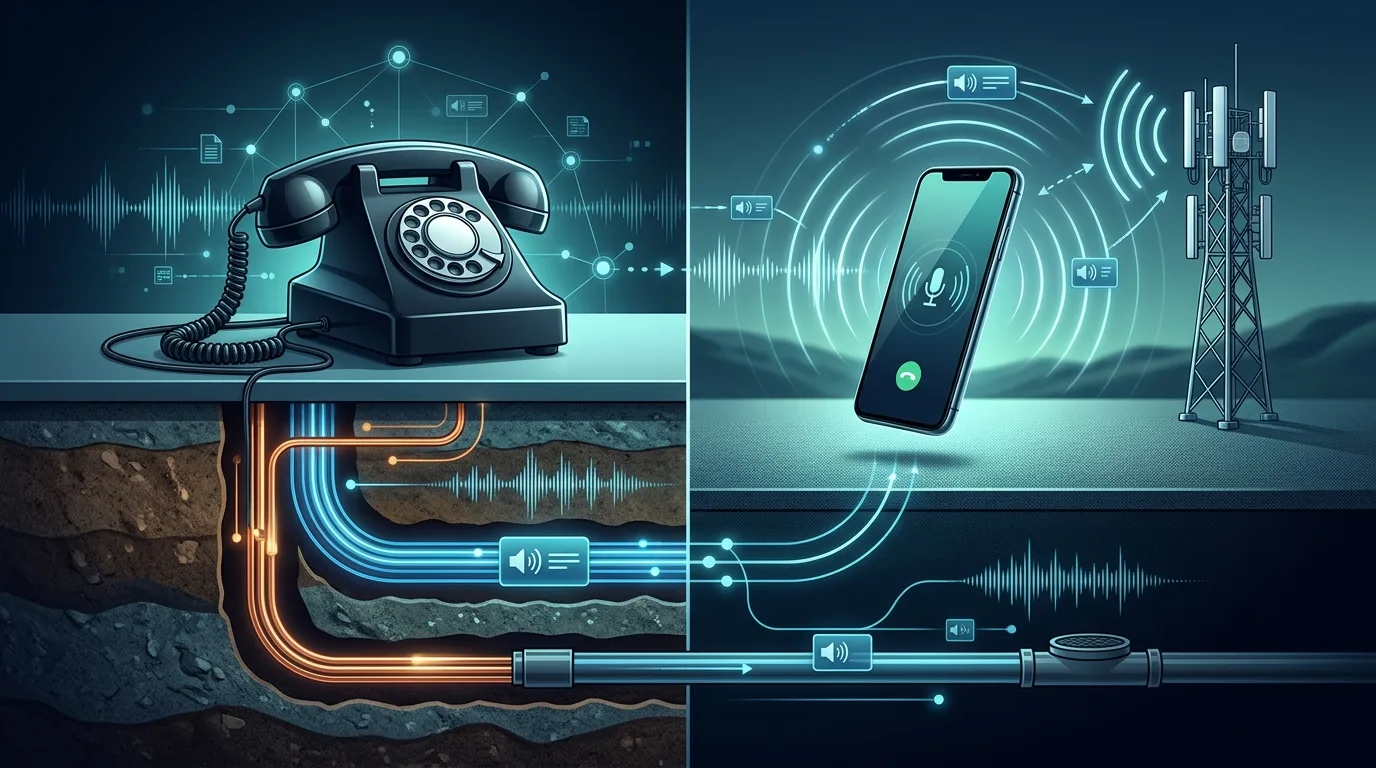
The main difference between landline and mobile phones is the connection from your device to the network. A traditional landline reaches a telephone exchange through a fixed cable, historically a copper pair. A mobile phone connects over radio to a nearby cellular base station. Once the voice enters the wider telecommunications network, however, both types of call may cross digital switches, fibre-optic cables, internet-protocol transport and connections between operators.
This means the familiar picture of a landline using “wires” while a mobile call travels “through the air” is only partly right. A mobile call generally has a wireless last hop, but much of its journey can still be wired. Meanwhile, today's home or office “landline” may be a digital Voice over Internet Protocol (VoIP) service that uses a broadband router instead of the traditional analogue public switched telephone network (PSTN).
To understand landline vs mobile phones, it helps to compare three complete journeys: a call between two traditional landlines, a call between two mobile phones, and a call from a mobile to a landline. We will also look at why modern fixed phones need power backup, how 4G and 5G carry voice, and what actually affects a call's quality.
Landline vs mobile phones: differences at a glance
| Feature | Traditional fixed copper landline | Mobile phone |
|---|---|---|
| Connection from user to network | Fixed copper local loop to telephone equipment | Radio link to a cellular base station |
| Movement while on a call | Limited by a physical connection or local cordless-handset range | Can continue across cells if handover works |
| Primary network dependency | Working subscriber loop, exchange and onward network | Compatible handset, radio coverage, supported voice service and onward network |
| How speech travels | Analogue locally in classic service; digital transport may follow | Encoded digitally over radio, then through operator networks |
| Power considerations | Some corded copper phones can use exchange-supplied power | Handset battery, powered radio sites and operator network needed |
| Typical strengths | Fixed location, stable indoor use when infrastructure is healthy | Portability, wide-area coverage and integrated communications |
| Typical limitations | No meaningful movement beyond connected premises; damaged local loop can disconnect service | Coverage, congestion, interference, battery and device compatibility |
Important exception: A modern digital landline can use VoIP over fibre, cable broadband or another IP connection. It remains a fixed telephone service from the user's perspective but should not be assumed to behave exactly like a traditional exchange-powered copper line. The US Federal Communications Commission (FCC) distinguishes classic local-exchange telephone service from interconnected VoIP, and UK regulator Ofcom documents the transition to digital landlines.
What every voice call has in common
The essential science is similar regardless of the telephone. When someone speaks, changes in air pressure cause a microphone to generate an electrical representation of the voice. A traditional analogue transmitter can send a corresponding electrical pattern. Most modern phones instead sample, encode and compress speech into digital information.
The network handles two related jobs. Signalling establishes and manages the call: it interprets the dialled number, reaches the recipient and recognises when the call is answered or ended. Media transport carries the voice itself. These jobs can use different messages, systems and paths.
At the far end, a receiver decodes the speech information where needed and drives a speaker diaphragm, which generates new sound-pressure waves. A real conversation requires media to travel in both directions, not simply from the caller to the recipient.
The telephone network may convert a signal between analogue and digital formats, or between circuit-switched transport and IP packets, along the route. That is why an old corded handset can still communicate with a modern smartphone when operators provide compatible interconnection services.
Journey 1: how a traditional landline-to-landline call travels
Imagine two homes that use traditional analogue landline services. Their call path can be simplified as:
Caller’s microphone → copper local loop → local exchange → inter-exchange or trunk network → destination exchange → destination copper loop → receiver’s speaker.
- Off-hook detection: Picking up a classic handset changes the loop's electrical state and lets the exchange know the subscriber wants service.
- Dialling: The caller provides a number through rotary pulses or push-button signalling. The exchange interprets the digits.
- Routing: The exchange finds a route to the recipient, either locally or through other exchanges and interconnected operators.
- Alerting: The destination exchange provides ringing or an equivalent call alert to the receiving telephone.
- Conversation: Once the call is answered, the network transports speech in both directions until one party hangs up.
The local loop is the physical link between the subscriber and the provider's local facilities. The wider network can use digital transport even when a handset's local connection is analogue. A landline call does not necessarily require a single uninterrupted copper cable spanning the distance between callers.
Historically, switching could reserve a circuit or time slot for a call. Modern equipment may also convert speech to IP for part of a network's transport while retaining a traditional subscriber interface. The FCC explicitly recognises that intermediate IP transport does not, by itself, make a traditional local exchange customer's service an interconnected VoIP subscription.
Journey 2: how a mobile-to-mobile call travels
Now imagine a subscriber calling another mobile user. A simplified route is:
Caller’s microphone → handset digital encoding → radio link → serving cell site → operator transport and core → receiving operator/core → destination cell site → radio link → receiving phone speaker.
The International Telecommunication Union (ITU) describes a mobile handset as a low-power, two-way radio. The handset uses radio-frequency electromagnetic signals to communicate with a nearby base station, whose equipment connects to the operator's core network. The network then forwards the call towards another mobile subscriber or a fixed telephone destination.
- Access: The mobile phone registers with a suitable cell, subject to operator services and device compatibility.
- Call setup: The network checks the number and service permissions, then routes signalling to the receiving subscriber.
- Paging or alerting: The destination network locates the phone's serving area and alerts the device.
- Voice path: Digitally encoded speech passes over radio near each endpoint and across the operator networks in between.
- Mobility: As either person moves, a handover may shift the active connection to another cell.
The radio portion of this route is often only the local access segment. Cell sites connect to the wider network via backhaul, which might use fibre optics or microwave radio links. Calls can cross several operators and long-distance cables without either phone talking directly to the other's tower.
Journey 3: how a mobile phone reaches a landline
A mobile caller can contact a fixed telephone because telecommunications providers interconnect their networks. A simplified call might travel:
Smartphone → cellular base station → mobile core or voice platform → interconnection gateway → fixed network → local line or IP telephone adapter → landline handset.
Where the mobile and fixed networks use different voice formats or signalling systems, media gateways and associated control systems bridge them. They can translate digitally encoded packet voice into a format required by a traditional circuit-based network, or the reverse. The fixed destination could also be a digital VoIP subscriber, making the interconnection entirely IP-based over portions of the route.
The user still dials a normal phone number. Routing, interconnection agreements, location information and numbering systems help determine where the call goes. This interoperability is more important than whether the final handset looks old-fashioned or modern.
The same principles work in reverse for a landline calling a mobile phone. The destination network is responsible for locating and alerting the subscriber using its available mobile service systems.
Does a landline always use copper wires?
No. This is one of the biggest misconceptions in a modern landline-versus-mobile comparison. A fixed telephone number and handset can be supplied over different underlying networks.
Three arrangements help explain the distinction:
- Traditional copper/PSTN: The house or office connects to a local exchange through copper conductors, with an analogue telephone interface in the classic configuration.
- Digital landline or interconnected VoIP: A telephone or adapter connects to a powered router or optical network terminal, and encoded voice travels in IP packets.
- Business IP phone: A dedicated desk phone may connect over Ethernet or Wi-Fi to a managed enterprise telephony service, with calls reaching other telephone networks through service-provider interconnections.
The UK's Ofcom guidance, updated August 2026 , explains that conventional PSTN equipment is being replaced by digital technology. This is a documented UK transition, not evidence that every country uses the same migration deadline or that analogue landlines have already disappeared worldwide.
A telephone number alone cannot tell a reader whether a particular home has a copper-powered line or a digital voice connection. Ask the provider which system is installed, what equipment it requires and what happens during a power outage.
How 2G and 3G calling differs from 4G and 5G
Mobile networks are often divided into generations, but these labels do not tell the whole story about voice calls.
| Mobile generation | Typical carrier-voice method | Important distinction |
|---|---|---|
| 2G (including GSM) | Digitally encoded voice managed primarily by circuit-switched systems | Radio is digital even though voice uses traditional switching concepts |
| 3G | Often circuit-switched voice alongside packet data | Improved data services did not automatically eliminate circuit voice |
| 4G LTE | VoLTE using an IP-based operator voice service, or fallback where supported | Packet-switched radio access supports standard phone-number calls |
| 5G | VoNR on supported standalone 5G; otherwise VoLTE and relevant fallback arrangements | A phone showing 5G does not guarantee a 5G-native voice call |
The GSMA explains that VoLTE (Voice over LTE) uses the IP Multimedia Subsystem (IMS) to provide a managed packet-based voice service over 4G. A VoLTE call is still a conventional carrier call associated with the phone service, rather than necessarily an app-to-app internet chat.
On supported 5G standalone networks, VoNR (Voice over New Radio) can carry native 5G voice. But some operators and handsets use 4G VoLTE to support calls when a 5G connection is present. Ericsson's technical overview details VoNR and EPS fallback, in which a device can use LTE voice when the deployment does not provide an appropriate 5G-native voice path.
So it is inaccurate to describe all modern mobile voice as either old-fashioned circuit switching or exclusively 5G radio traffic. The real method depends on the network, device and current coverage.
How the networks connect people moving through different places
A fixed landline service is associated with a particular access point. You can pick up a cordless handset and move around a room or property, but the base station of a cordless home phone still connects to the fixed line. That short-range wireless link does not turn the device into a cellular phone.
A mobile device is designed to register with compatible cellular networks and move between coverage cells. Operators can coordinate a handover so an active call continues when its serving cell changes. The GSMA's VoLTE guidance covers intra-LTE handover and supported continuity between LTE and earlier network systems.
Handover can still fail. A phone entering a lift, tunnel or area without suitable radio coverage may lose the connection. The device might also support data access but not the required voice service or fallback arrangement. This explains why a strong-looking data symbol does not guarantee reliable ordinary phone calls.
Which is more reliable: a landline or a mobile phone?
Neither is always more reliable. Reliability depends on the particular service and which part of the system has failed. The comparison must distinguish an exchange-powered copper phone, a digital home phone and a battery-powered mobile handset.
Traditional copper line during a home power cut
Some classic corded copper telephones receive electrical power from the provider's telephone exchange and may continue working when the home loses mains electricity, provided the exchange and connecting network still function. A cordless base station connected to the same line commonly needs local electricity, so it may not offer the same advantage without backup.
Modern digital landline during a power cut
VoIP-based home telephone services generally need a powered router or optical network terminal. Without backup, the service can stop when local power fails even if the fibre connection itself is intact. Ofcom's explanation of emergency access during power outages distinguishes the older exchange-powered copper arrangement from broadband-based voice.
Ofcom's specific UK guidance requires suitable support for some consumers who depend on a fixed line for emergency calling. Those protections are jurisdiction-specific and should not be presented as a universal legal guarantee for all countries.
Mobile phone during a power cut
A charged smartphone can keep working after the electricity in the user's home fails, if nearby mobile sites and their connecting networks remain operational. Cellular infrastructure also requires power, and an extended power failure or damage to backhaul can interrupt service. Batteries and generators may help some sites remain online, but they cannot be assumed to be available everywhere or indefinitely.
In a well-connected location, maintaining two independent ways to call—for example, a suitable fixed service and a mobile phone on a working network—may improve practical resilience. But redundancy only helps when the two services do not share the same point of failure.
Are landline calls clearer than mobile calls?
Not necessarily. Speech quality depends on microphones, speakers, codecs, signal coverage and the whole network route. An older analogue line may have hum, noise or restricted speech bandwidth; a compatible mobile VoLTE call can provide clearer wideband voice. Conversely, a stable wired connection can avoid the weak radio signal and handover problems affecting some mobile calls.
Packet-based voice introduces other engineering issues:
- Latency: the time it takes for speech information to travel and be processed; too much delay makes conversation awkward.
- Jitter: variation in packet arrival times that can cause uneven sound without buffering.
- Packet loss: information arriving too late or not arriving at all, potentially causing clipped or robotic speech.
- Congestion: limited network capacity and competing demand that can degrade call quality if traffic is not managed appropriately.
The ITU-T G.114 recommendation discusses one-way delay and its effect on conversation, while Cisco's explanation of packet voice describes why jitter buffers are used to smooth arriving speech packets. There is no single sound-quality winner across all providers, locations and devices.
SuperEducational's previously published guide to factors affecting internet quality in Latin American regions explores related issues such as connectivity infrastructure and regional performance. Its geography is a separate case study, but the effects of weak infrastructure and limited network capacity are relevant to some IP-based voice services.
What about emergency calls and finding the caller?
When someone calls emergency services, the network must help route the call to the appropriate response system. A traditional fixed line is generally associated with a known service location, whereas a mobile phone can be used in many places and requires other location methods. GPS, network measurements, handset features and provider information may assist, but what data is available varies by country, service and circumstances.
Emergency numbers are also country-specific. For example, the UK's Ofcom guidance describes 999 access and availability of another mobile network in certain emergency situations; that should not be presented as a guarantee that a device without ordinary service can always complete an emergency call worldwide.
Some alarm systems, medical alert devices, fax equipment and building services were designed for traditional analogue telephone characteristics. Ofcom cautions that these devices may require testing or adaptation before a switch to digital landlines. People who depend on such systems should consult both their telephone provider and their alarm or device supplier.
What is the difference between carrier calling, internet calling and Wi-Fi calling?
These services can appear similar on a smartphone, but they use different access and service arrangements.
| Service | Typical way it connects | What the user should understand |
|---|---|---|
| Traditional fixed call | Classic line and exchange | May use an analogue subscriber connection with digital or hybrid transport further on |
| Digital landline | Broadband or other IP connection | Usually requires powered premises equipment |
| Mobile carrier call | Cellular radio plus operator voice network | May use circuit-switched 2G/3G or IP-based VoLTE/VoNR |
| Carrier Wi-Fi calling | Wi-Fi internet access into a supported mobile operator voice platform | Often keeps the mobile number, but depends on provider/device support |
| App-based internet call | Internet access through cellular data or Wi-Fi | May connect app accounts rather than the public telephone-number network |
Interconnected VoIP can connect to ordinary telephone numbers. Other internet calling apps may be limited to their own accounts or require a separate gateway for phone-number calls. The FCC's definitions help distinguish interconnected VoIP from conventional fixed voice service, while the GSMA documents the managed carrier architecture for VoLTE.
Cost comparisons require care. An app call might use a data allowance rather than conventional voice-minute charging, but that does not make all app calls free: internet access, international call rates, subscriptions and roaming may still cost money. Prices should be checked against the actual service plan.
What a telephone number does—and what it does not reveal
A telephone number is used by networks to identify a destination and determine appropriate routing. It is not a direct description of the physical cable, radio frequency, handset model or codec carrying the call.
Landline and mobile services may use national numbering plans, international country codes and provider-controlled routing systems. Interconnection and, where supported, number portability can change the networks involved. Because of this, a number alone should not be used to infer every detail of the call's route, location or technology.
Five common misconceptions
- “Every landline is analogue.” False. Digital landlines and business IP phones can provide fixed-number calling over broadband or managed IP networks.
- “Mobile calls travel through the air all the way to the other phone.” False. The handset-to-cell-site segment uses radio, while the core and long-distance route often use other transport.
- “A mobile call always uses satellites.” False. Ordinary cellular service usually communicates with terrestrial base stations; satellite calling is a separate capability.
- “A phone showing 5G always makes voice calls on 5G.” False. Some 5G services still rely on VoLTE or EPS fallback.
- “Landlines always work in a power cut.” False. Some traditional exchange-powered corded telephones can, but digital lines and cordless equipment often need local power or backup.
Mini classroom investigation: map a telephone call
This paper-based activity helps students see why the phrase “wired versus wireless” does not describe the whole journey.
- Draw a house with a traditional landline, a local telephone exchange and a second house.
- Connect them with lines and label the local loops and exchange-to-exchange network.
- Now draw two smartphones, two cell sites and a central transport network. Use dotted lines for the short radio links and solid lines for possible wired backhaul.
- Draw a third route from one smartphone through a gateway to a landline handset.
- For each route, mark where speech is encoded, where the destination is found and where sound is reconstructed.
- Finally, mark what could fail during a power cut and what might fail while someone travels between cells.
For the activity, use arrows such as “microphone → access network → transport network → receiving access network → speaker”. These are explanatory diagrams, not a claim that every carrier has one fixed architecture. No real wiring or electrical connection is needed.
Frequently asked questions
What is the main difference between landline and mobile phones?
A traditional landline uses a fixed connection to the telephone network, while a mobile phone typically uses radio to reach a nearby cell site. Beyond that first connection, both can use digital transport and interconnect with other networks.
Do mobile calls use wires at all?
Yes. Fibre and other wired links commonly connect cellular sites, core networks, operators and distant destinations. Wireless usually describes the handset's access link, not the complete end-to-end journey.
Can landlines and mobile phones call each other?
Yes, when compatible services and interconnection are available. Operators route the call between networks, and gateways can adapt different signalling or voice transport formats.
Is a digital landline the same as a mobile phone?
No. A digital landline remains associated with a fixed service location, often using broadband equipment. A mobile number normally connects through cellular access and is intended for use across supported coverage areas.
Does a landline work if the internet is down?
A traditional exchange-powered analogue line may not depend on a home broadband router, although it depends on its telephone infrastructure. A VoIP digital landline can be affected by broadband or equipment failure. Check the specific provider's arrangement.
Why can my mobile use data but not complete a call?
Carrier calling can require a supported voice service, IMS registration, VoLTE/VoNR compatibility or a permitted fallback path. Data connectivity alone does not guarantee all calling features will work.
Which type of phone is best for emergencies?
There is no universal answer. Consider your local signal, power supply, fixed-line technology, accessible emergency numbers and backup arrangements. People who rely on alarms or medical devices should ask their providers about compatibility and emergency access.
Why is my voice delayed during an internet or international call?
Long distances, processing, buffering and network congestion can add delay. Packet arrival variation and loss may also affect real-time speech. The exact cause needs evidence from the actual connection rather than assumptions about whether it is a landline or mobile call.
Conclusion: different access networks, one connected telephone system
The comparison between landline and mobile phones begins with how each reaches its network: a fixed line or an airborne radio link. But it does not end there. Local exchanges, cell sites, fibre transport, packet-switched platforms and operator gateways enable the two systems to communicate.
Traditional copper landlines demonstrate the classic switched-circuit model; digital fixed phones show how modern VoIP can replace the subscriber's older connection. Cellular networks add mobility, radio resource management and handovers, while VoLTE and VoNR increasingly handle normal carrier calls as packet-based voice.
Understanding these routes makes it easier to explain why calls can travel across countries, why one technology might fail during an outage, and why neither “wired” nor “wireless” automatically guarantees the clearest or most reliable conversation.
Editorial verification date: 16 November 2026. This is a general science and technology explanation, not network-specific operating guidance. Fixed-telephone migrations, emergency-call rules and mobile voice capabilities vary by country, operator and device.