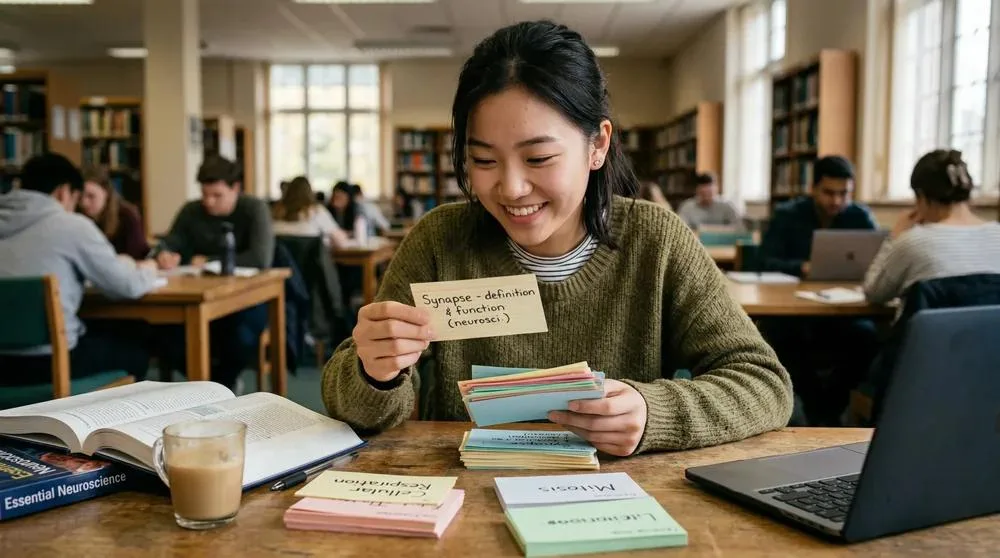
Flashcards have helped students memorise information for generations. Whether learning a new language, revising biology or preparing for professional examinations, a simple question on one side of a card and an answer on the other can make studying more active.
Artificial intelligence is changing how those cards are created.
Today, students can upload lecture notes, textbooks or other learning materials to an AI-powered tool and generate dozens of flashcards within minutes. Traditional flashcards, by contrast, usually require students to select information and write each card themselves.
But does faster flashcard creation lead to better learning?
The answer is not necessarily. Both methods can support effective studying, but the quality of the questions, active recall and regular review matter more than whether a card was generated by AI or written by hand.
This guide compares AI flashcards with traditional flashcards, examines educational research and explains how students can combine both methods for effective exam preparation.
What Are AI Flashcards?
AI flashcards are digital study cards created with assistance from artificial intelligence.
A student might provide a chapter of notes and ask a tool to produce questions covering key definitions, processes and concepts.
For example, a biology student studying photosynthesis could request flashcards covering chlorophyll, light energy, carbon dioxide and glucose.
Depending on the platform, AI can suggest questions, generate answers, organise topics and produce practice activities.
Some tools also track performance or integrate with review systems.
AI-generated cards should not be confused with all digital flashcards. A student can manually create electronic cards without using generative AI, and a handwritten card can be just as useful for active recall.
These are three different approaches:
- AI-generated flashcards: Software proposes the questions and answers.
- Manually created digital flashcards: Students write the content in an application.
- Traditional paper flashcards: Students write or print questions and answers on physical cards.
Understanding the distinction matters when comparing research findings.
What Are Traditional Flashcards?
Traditional flashcards are physical cards containing a question, term or prompt on one side and an answer on the reverse.
Students commonly create them using index cards, paper or card stock.
For example:
Front: What is osmosis?
Back: The net movement of water molecules through a partially permeable membrane from a region of higher water potential to lower water potential.
The student reads the question, attempts an answer from memory and turns over the card to check.
This process is called retrieval practice.
Traditional flashcards are inexpensive, portable and usable without electricity or internet access.
They also allow students to select and organise information while writing the cards.
However, creating hundreds of cards can become time-consuming, and manually organising review schedules requires additional effort.
AI Flashcards vs Traditional Flashcards: Key Differences
The two approaches share the same basic purpose but differ in how students produce, organise and review learning materials.
| Feature | AI flashcards | Traditional paper flashcards |
|---|---|---|
| Creation | AI generates drafts from prompts or sources | Student writes or prints cards |
| Preparation time | Usually faster for large sets | More manual effort |
| Accuracy | Requires checking generated questions and answers | Depends on the student's sources and accuracy |
| Personalisation | Prompts and some tools offer adjustable difficulty | Students directly select and customise questions |
| Review scheduling | Some platforms automate reminders and spacing | Student manages review manually |
| Internet or electricity | May be required for generation or access | Not required |
| Distractions | Digital notifications or other apps may interfere | Generally fewer device-related distractions |
| Costs | Free allowances or paid subscriptions may apply | Paper, pens and printing costs |
| Editing | Often quick to change or regenerate | Cards can be rewritten or replaced |
Neither approach automatically guarantees better examination performance.
What Does Research Say About Flashcards and Memory?
Educational research provides stronger evidence for how flashcards are used than for declaring one format universally superior.
Active Recall Helps Strengthen Learning
A landmark 2008 study by Jeffrey Karpicke and Henry Roediger, published in Science, investigated retrieval practice and longer-term retention.
The researchers found that repeated testing contributed substantially to later recall.
This helps explain why flashcards can be useful: students repeatedly attempt to retrieve information rather than merely reread it.
The principle applies whether the question appears on a phone, computer or paper card.
Spaced Repetition Is Important
A 2013 review by Dunlosky and colleagues examined ten widely used learning techniques.
The researchers identified practice testing and distributed practice—spreading learning across multiple sessions—as broadly useful.
Students can implement spaced repetition with paper cards by separating them into groups according to how confidently they remember each answer.
Digital applications can automate aspects of that scheduling.
However, automation does not eliminate the need to study consistently.
Studies Comparing Formats Show Mixed Results
A 2025 study involving 90 adolescent English-language learners in Iran compared digital flashcards, paper flashcards and conventional word lists. The researchers reported stronger vocabulary learning and retention outcomes for the digital-flashcard group in that setting.
Another 2025 investigation of AI-assisted vocabulary cards found that the traditional-card group performed better on a delayed test, despite an initial advantage for the AI-assisted group.
These results should not be interpreted as a universal verdict. The studies differed in participants, subjects, instructional materials and how the cards were designed.
Importantly, research on digital flashcards is not necessarily research on AI-generated flashcards.
AI Flashcards Can Save Time Without Guaranteeing Better Grades
A 2026 study published in BMC Medical Education investigated AI-generated learning materials used by pre-clerkship medical students.
The researchers reported that 74% of surveyed AI-flashcard users perceived time savings.
However, AI-flashcard use was not associated with a clear, statistically significant improvement in examination outcomes in the studied setting.
The researchers also identified one hallucination among 21 evaluated flashcards, even after optimising the generation process.
These findings suggest a practical trade-off: AI can reduce preparation time, but the output still requires checking, and saved time does not automatically translate into stronger learning.
Five Advantages of AI Flashcards
1. Faster Creation From Learning Materials
Students can generate draft cards from lengthy notes instead of manually writing every question.
For example, Quizlet's AI Flashcard Generator supports creating flashcards from uploaded or pasted materials.
This can be helpful when several subjects need revision within a limited period.
2. Easier Revision of Large Topics
AI can organise a lengthy topic into smaller question-and-answer units.
A history chapter, for instance, might be divided into chronology, causes, consequences and important figures.
Students should still review the selection because generated cards may omit examinable material or emphasise less important details.
3. Adjustable Question Difficulty
Some AI study tools let users request beginner, intermediate or advanced questions.
Google's Gemini Notebook flashcard features support difficulty selection and custom instructions.
This flexibility can help students progress from definitions to explanations and application questions.
4. Integration With Study Applications
Digital study applications can include progress tracking, automatic review scheduling and different question formats.
Anki , for example, supports scheduled review and the FSRS scheduling algorithm.
Anki is primarily a spaced-repetition platform, not inherently an AI flashcard generator. Students can create cards manually or import appropriately prepared content.
5. Convenient Editing and Organisation
AI-generated digital sets can often be edited, reorganised and grouped by subject.
This makes correcting or replacing a question easier than rewriting an entire physical card.
Five Advantages of Traditional Flashcards
1. Greater Control Over Content
When students create cards themselves, they decide which concepts deserve attention.
This selection process can encourage them to identify the main ideas rather than accept an automatically generated list.
However, the benefit depends on thoughtful card creation, not handwriting alone.
2. Fewer Digital Distractions
Paper flashcards do not display social media alerts, incoming messages or unrelated applications.
For learners who frequently lose focus while using phones, that simplicity may be valuable.
3. No Internet Connection Required
Traditional flashcards can be used in classrooms, libraries and locations with unreliable connectivity.
They are particularly practical for students who cannot depend on continuous internet access.
4. Flexible Visual Learning
Students can draw diagrams, label structures and arrange physical cards into groups.
For example, a chemistry learner can draw molecular structures, while a geography student can practise identifying map features.
Some digital tools offer similar visual capabilities, but paper remains a straightforward alternative.
5. Low Ongoing Technology Costs
Physical cards do not require a software subscription.
Although stationery and printing have costs, a learner can begin with ordinary paper.
Which Method Works Best for Different Students?
The right choice depends on the subject, study environment and learning preferences.
| Student or situation | Recommended approach |
|---|---|
| Learning vocabulary or terminology | Either method with regular retrieval practice |
| Reviewing hundreds of definitions | Digital cards with review scheduling |
| Studying without reliable internet or electricity | Traditional paper cards |
| Preparing from lengthy lecture notes | AI-generated drafts, carefully checked |
| Easily distracted by devices | Traditional cards or a distraction-free study mode |
| Practising diagrams and handwritten labels | Paper cards or suitable digital drawing tools |
| Revising for exams across several subjects | Hybrid approach |
Flashcards are especially useful for information that can be tested through focused questions.
They are less sufficient on their own for extended essays, mathematical problem-solving, laboratory skills or evaluating complex arguments.
Those activities require additional practice in the formats students will encounter during assessments.
For a broader overview of useful applications, see SuperEducational's beginner's guide to AI tools for studying .
How to Create Better AI Flashcards: A Practical Method
AI-generated cards become more useful when students treat them as editable learning materials.
Step 1: Start With Reliable Sources
Use the correct syllabus, teacher-approved notes or reputable textbooks.
Avoid relying on an AI tool's general knowledge when an examination requires specific terminology or explanations.
Step 2: Request Focused Questions
Ask for one main idea per card.
Long answers containing several unrelated facts are harder to review and evaluate.
Step 3: Check Every Answer
Compare generated responses with your source materials.
Look for incorrect definitions, misleading simplifications, missing conditions and invented information.
SuperEducational's article, AI Can Sound Certain and Still Be Wrong , explains why confident AI-generated statements should not be accepted automatically.
Step 4: Edit Cards Into Your Own Words
Replace unclear explanations with wording you understand.
Remove duplicate questions and add examples where necessary.
Step 5: Practise Without Looking
Read the front of each card and attempt the answer before revealing it.
After reviewing your response, decide whether you recalled the information accurately.
Step 6: Review the Cards Again Later
Return to difficult cards more frequently and revise stronger cards periodically.
An AI-generated study schedule can support this process. SuperEducational's guide to creating a personalised exam revision plan provides a structured method.
A Copy-and-Paste AI Flashcard Prompt
Students can use this prompt in an AI assistant that accepts text or uploaded learning materials.
Act as an educational flashcard assistant.
Using only the study notes I provide, generate 20 flashcards for [subject and education level].
Create one clear question per card, with a concise, accurate answer.
Cover important definitions, processes and relationships.
Include a mixture of basic recall and explanation questions.
Do not invent facts or claim to quote sources that are not provided.
Flag any information that is missing, ambiguous or potentially inaccurate.
Present the cards in a two-column table labelled Question and Answer.
I will verify every card against my official learning materials before studying.
This prompt is a starting point, not a guarantee of accuracy.
The Hybrid Method: Combine AI and Traditional Flashcards
For many learners, the most practical approach is to combine the strengths of both formats.
For example, a student preparing for biology examinations could:
- Read the relevant chapter and identify learning objectives.
- Use AI to generate 20 draft flashcards.
- Verify and correct the answers.
- Transfer particularly difficult concepts onto handwritten cards.
- Review both sets using active recall.
- Repeat difficult questions over the following days.
- Complete independent exam-style questions to check deeper understanding.
This workflow uses AI to reduce preparation work while preserving independent reasoning.
It also allows students to discover whether they genuinely understand a concept or have merely memorised a short answer.
What Students Should Avoid
Generating more cards is not the same as learning more material.
Students should avoid creating hundreds of unreviewed cards, memorising incorrect explanations or revealing answers before attempting recall.
They should also consider privacy before uploading lecture documents, classmates' information or restricted educational materials.
UNESCO's guidance on generative AI in education emphasises data protection, appropriate use and human oversight.
When an AI-generated statement seems questionable, follow SuperEducational's practical guide to verifying information online .
Frequently Asked Questions
Are AI flashcards better than handwritten flashcards?
Not necessarily. AI can make card creation faster, while traditional flashcards offer direct control and fewer digital distractions. Learning depends heavily on question quality, retrieval practice and regular review.
Can AI flashcards help with examination preparation?
Yes. They can support revision of terminology, definitions and key concepts. However, students should also practise full examination questions, written explanations and problem-solving.
Are AI flashcard generators free?
Some platforms provide free features or limited access, while advanced capabilities may require subscriptions. Availability and limits vary by service.
Is writing flashcards by hand better for memory?
Writing information thoughtfully may support learning, but research on handwritten notes should not be treated as direct proof that handwritten flashcards always outperform digital ones.
How often should students review flashcards?
Review material repeatedly over time, with additional attention to difficult cards. There is no single schedule that works for every learner or subject.
Conclusion: Which Flashcards Should Students Choose?
AI flashcards and traditional flashcards are not competing solutions that require every student to choose one permanently.
AI-powered tools can reduce preparation time, organise study materials and support large-scale revision. Traditional cards provide simplicity, direct control and an accessible way to study without digital distractions.
Both can encourage effective learning when students actively recall answers, verify information and return to difficult material.
The best flashcards are the ones that help you remember accurate information, recognise misunderstandings and apply what you have learned.
Rather than choosing technology for its own sake, students should choose the method—or combination of methods—that makes consistent, independent learning easier.