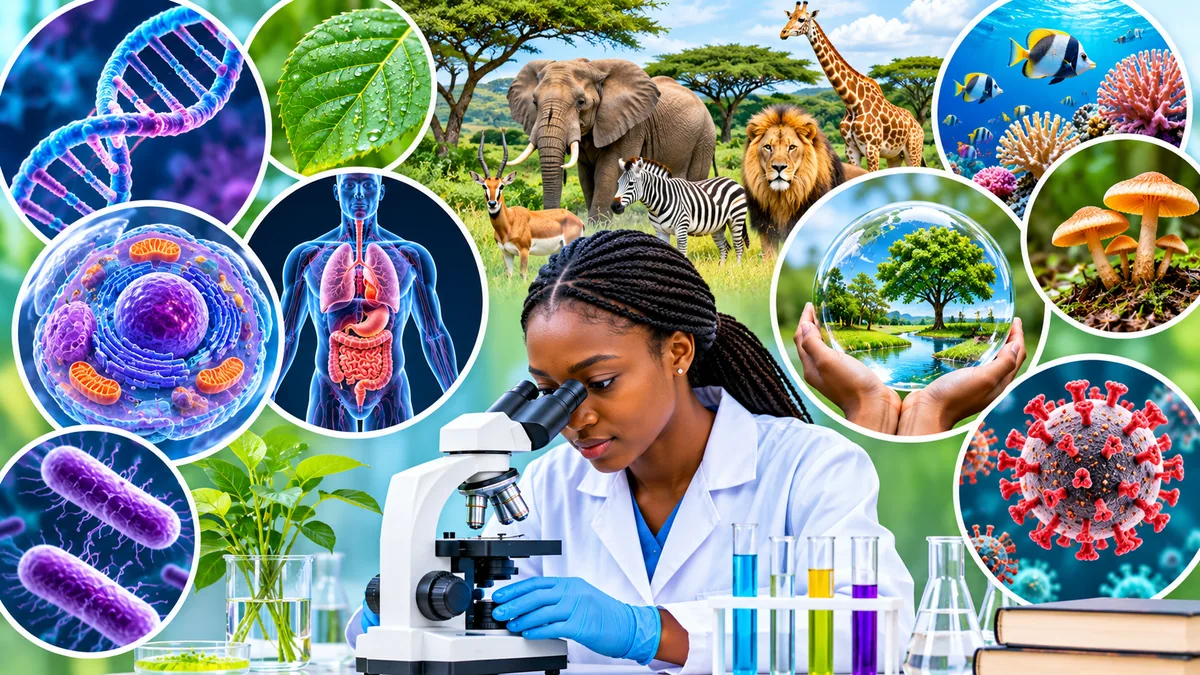
Biology is the scientific study of life and living organisms. It investigates how organisms are built, how they obtain and use energy, how their characteristics are passed to future generations, how they evolve, and how they interact with their surroundings. From a single bacterium to an elephant, a forest or the human body, biology connects processes that seem very different through shared scientific principles.
But biology is not only the study of animals and plants. It also examines cells, DNA, microorganisms, human physiology, biodiversity and the relationships that keep ecosystems functioning. Biology explains why a cut can heal, how a seed becomes a plant, why infectious diseases spread, and how living populations respond to environmental change.
This guide answers what is biology in simple terms, introduces its major branches and provides practical examples from healthcare, agriculture, food, conservation and technology. It also includes a comparison chart, the levels of biological organisation, a safe classroom experiment, study pathways and a short knowledge quiz. Its scientific foundation is the open textbook OpenStax Biology 2e , alongside the National Human Genome Research Institute and the World Health Organization .
What is biology? A simple definition
The word biology comes from Greek roots associated with life and study. In modern science, biology covers the structure, function, growth, development, reproduction, inheritance, evolution and environmental relationships of organisms. A biologist might count birds in a wetland, study the chemistry inside a cell or compare DNA sequences to investigate relatedness.
Unlike memorising animal names, doing biology means asking testable questions and using evidence to answer them. A student might observe that seedlings near a window grow differently from seedlings in a darker place. A researcher might investigate how those differences relate to light, water and growth. Biology supplies both the concepts and the methods for testing explanations.
Biology overlaps with chemistry, physics, mathematics, geography and computer science. For example, biochemistry studies molecules that participate in life, while bioinformatics combines biological questions with computation. No single branch can explain every question about an organism in isolation.
What makes something living? Seven characteristics of life
Living things exhibit a collection of related characteristics. These are helpful principles, not a perfect checklist where every individual must display every characteristic at every moment. For instance, a person who cannot reproduce remains alive, and a dormant seed may show little obvious activity while retaining the potential to grow.
- Cellular organisation: All recognised cellular organisms consist of one or more cells, from single-celled bacteria to large multicellular animals.
- Energy use and metabolism: Organisms obtain and transform energy and matter to maintain biological processes; photosynthesis and cellular respiration are two important examples.
- Growth and development: Organisms can change in size, structure and function according to inherited instructions and environmental conditions.
- Response to the environment: Organisms detect or respond to conditions such as light, heat, chemicals and physical contact.
- Regulation and homeostasis: Living systems regulate internal conditions within ranges compatible with life; regulation is dynamic, not a guarantee that conditions never change.
- Reproduction and inheritance: Biological populations continue through reproduction and the transmission of genetic information, even though some individual organisms are infertile.
- Evolution: Inherited variation and changing frequencies of traits across generations produce evolutionary change in populations.
OpenStax's themes of biology describes these connected properties, including organisation, energy processing, homeostasis and evolution. Evolution acts across generations in populations; it does not mean an individual animal chooses to evolve a useful body part.
Are viruses alive?
Viruses are an important boundary case. A virus carries genetic information and can evolve, but it is not a cell and cannot independently reproduce through ordinary cell division or maintain its own full metabolism. It must use a suitable host cell to make more viruses. Scientists discuss how viruses should be placed in definitions of life, but there is broad agreement on their dependence on host cells. See OpenStax's introduction to viruses .
The levels of organisation in biology: from molecules to the biosphere
Biologists study life at different scales because a phenomenon that makes sense at one level may require an explanation at another. A cell is the basic unit of cellular life, but cells contain molecules and structures studied by biochemists and molecular biologists.
| Level | Meaning | Example |
|---|---|---|
| Molecule | Chemical structure involved in biological processes | DNA, glucose or a protein |
| Organelle | Specialised cell structure | Mitochondrion or chloroplast |
| Cell | Basic unit of a cellular organism | Bacterium, nerve cell or leaf cell |
| Tissue | Cooperating cells with related functions in multicellular organisms | Muscle tissue or plant xylem |
| Organ | Structure made of tissues with a particular function | Heart or leaf |
| Organ system | Interacting organs, where this organisational level applies | Digestive system |
| Organism | An individual living entity | Mango tree, human or bacterium |
| Population | Members of one species in a defined area | Frogs of one species in a pond |
| Community | Interacting populations of different species | Plants, fungi, insects and birds in a woodland |
| Ecosystem | Community and its nonliving environment | Mangrove swamp and its water, soil and organisms |
| Biosphere | The zones of Earth in which life exists | All connected ecosystems on the planet |
These levels are an educational map, not a claim that every organism has every tier. A bacterium has no tissues or organs. Cell theory states that living organisms contain one or more cells and that new cells arise from existing cells. Ecology connects individual organisms with populations, communities and ecosystems.
Major branches of biology: definitions and examples
There is no single official list of exactly five, ten or twenty branches. Some fields are classified by organism (such as botany or zoology), some by scale and process (such as genetics or physiology), and others by application (such as biotechnology). Many overlap.
| Branch | What it studies | Real-life question or example |
|---|---|---|
| Botany | Plants and plant processes | Why do crops grow differently in shade? |
| Zoology | Animals and their diversity | How do birds migrate? |
| Microbiology | Microorganisms including bacteria and microscopic fungi | Which microbes ferment food or cause infection? |
| Cell biology | Cells and their internal organisation | How do cells divide or repair damage? |
| Molecular biology | Biological processes involving DNA, RNA and proteins | How is genetic information used to make a protein? |
| Genetics | Inheritance and variation | How can an inherited trait run in a family? |
| Genomics | Whole genomes and their interactions | What can many DNA variants reveal about risk or ancestry? |
| Ecology | Relationships among organisms and environments | What happens when a habitat loses pollinators? |
| Evolutionary biology | Descent, variation and change across generations | How does resistance evolve in a population? |
| Anatomy | Structure of organisms and their parts | What do the chambers of the heart look like? |
| Physiology | How living structures function | How is body temperature regulated? |
| Biochemistry | Chemical processes in living systems | How do enzymes help release energy from food? |
| Immunology | Immune systems and host defence | How does immune memory support vaccination? |
| Taxonomy and systematics | Naming, identifying and classifying organisms by relationships | How are whales related to other mammals? |
| Biotechnology | Using biological systems and methods to develop products | How is insulin produced using engineered cells? |
| Bioinformatics | Computational analysis of biological information | How can software compare thousands of DNA sequences? |
This chart is a beginner's guide rather than a rigid hierarchy. Other important specialities include marine biology, mycology (fungi), virology (viruses), parasitology (parasites), developmental biology, neuroscience and epidemiology. Some of these are closely connected with medicine or public health, and their names may differ across universities.
Botany and zoology: plants and animals
Botany explores how plants grow, obtain resources, reproduce, respond to their surroundings and evolve. It supports research on soil management, food crops, forests and conservation. For example, a plant biologist may compare crop varieties under different rainfall conditions or study how leaf structure affects photosynthesis.
Zoology examines animals, including their anatomy, behaviour, physiology, classification, evolution and ecological roles. It includes work on insects, fishes, mammals and many other groups. Students exploring this branch can continue with SuperEducational's published guide to animal classification, vertebrates and invertebrates , which covers the relationships among major animal groups.
A wildlife researcher might study migration using animal tracking, while a marine biologist might measure coral reef changes. These are examples of biological research rather than separate rules determining where one discipline ends.
Microbiology, cell biology and molecular biology: life at small scales
Microbiology investigates microscopic life, including bacteria and many single-celled eukaryotes. Related disciplines study viruses, which are non-cellular infectious particles. Microbiology explains how certain microbes cause illness, decompose materials and participate in food production.
Cell biology focuses on cells—the basic building blocks of organisms. Scientists investigate membranes, organelles, signalling, growth and division. Molecular biology asks how DNA, RNA, proteins and other molecules work together within cells. For example, learning how DNA instructions are expressed helps explain why some genetic changes alter protein function.
These fields often work together. Understanding antibiotic resistance involves microbiology, bacterial genetics and molecular mechanisms. A helpful foundational source is OpenStax's introduction to studying cells .
Genetics and genomics: inheritance, DNA and variation
Genetics studies the inheritance of traits, the roles of genes and how variations influence organisms. Genomics studies genomes more broadly, including many genes and their relationships with one another and the environment. They are connected fields but not synonyms. The National Human Genome Research Institute explains that distinction.
An example is sickle cell disease, which is associated with inherited changes affecting haemoglobin. Genetics helps explain inheritance patterns; cell biology helps explain how affected red blood cells behave; physiology and medicine help explain clinical consequences. Readers can explore SuperEducational's published explanation of sickle cell genetics, symptoms and care . Learning the genetics does not replace clinical testing or personalised healthcare.
Modern genomics also raises privacy, consent and equity questions. Genetic results require careful interpretation: a particular variation does not always determine an outcome, especially for traits influenced by many genes and environmental factors. The WHO genomics overview recognises the scientific potential as well as ethical and governance issues.
Ecology and evolutionary biology: living systems over time
Ecology studies how organisms interact with one another and with light, water, temperature, soil and other environmental features. An ecological study might ask how changing rainfall affects plant growth, how pollution influences aquatic life or how pollinators support crop production.
Evolutionary biology explores inherited change in populations through time. Mechanisms include natural selection, genetic drift, mutation and gene flow. Evolution helps explain both the diversity of organisms and the shared characteristics inherited from common ancestors. It does not mean that an individual adapts its genes because it needs to, or that evolution always produces a universally “better” organism.
OpenStax presents evolution as a central unifying framework of biology, while its ecology chapter describes organismal, population, community and ecosystem studies.
Anatomy, physiology and biochemistry: how bodies work
Anatomy describes physical structures; physiology explains what those structures do. Looking at the shape of a lung is anatomy; studying how oxygen moves into blood is physiology. Both are relevant to veterinary medicine, healthcare and understanding how organisms function.
Biochemistry investigates the chemistry behind living processes. Enzymes help reactions occur in cells; nutrients are transformed into molecules used for energy, growth and maintenance. A student studying digestion may draw on all three fields: the organs involved, the processes they perform and the molecules they process.
Biology also links physiology with environmental conditions. For instance, when people exercise, the cardiovascular and respiratory systems respond to increased demand. These responses can be studied and measured, but an educational example cannot be used to diagnose an individual's health.
Real-life examples of biology in everyday life
| Everyday setting | Biology involved | Why it matters |
|---|---|---|
| Growing food | Plant physiology, genetics, soil ecology | Improving crop resilience, yields and resource use |
| Vaccination and infectious disease | Immunology, microbiology, molecular biology | Understanding disease agents and immune protection |
| Preparing fermented foods | Microbiology and biochemistry | Learning how microbes and enzymes change food |
| Preventing mosquito-borne disease | Parasitology, entomology, ecology | Interrupting pathogen transmission by vectors |
| Protecting mangroves and coral reefs | Ecology, marine biology, conservation science | Understanding biodiversity and ecosystem change |
| Understanding inherited conditions | Genetics, cell biology, physiology | Explaining how genetic variation can affect health |
| Analysing DNA data | Genomics, bioinformatics, statistics | Finding patterns in biological datasets |
| Producing medicines | Biotechnology, biochemistry, cell biology | Developing and testing biological products |
Biology in agriculture and food security
Biology helps farmers and researchers understand plant varieties, insects, soil microorganisms and diseases affecting crops. Integrated pest management combines ecological observation with several control strategies to reduce damage while limiting unnecessary pesticide use. The Food and Agriculture Organization (FAO) describes integrated pest management as an ecosystem-based approach to crop protection.
Consider cassava or maize: a plant's growth depends on inherited traits and conditions such as water, soil nutrients and pests. Biologists can test which conditions affect the crop rather than assume every yellow leaf has the same cause. Such research also supports more sustainable food production.
Biology in healthcare and public health
Medicine applies biological knowledge about pathogens, immune responses, organs and genetics. For example, vaccines rely on immune responses, while antimicrobial treatments target features of particular infectious agents. The WHO One Health framework draws attention to connections among human, animal, plant and environmental health. This matters for zoonotic infections, food systems and antimicrobial resistance.
Biology is indispensable to healthcare, but biology and medicine are not the same discipline: clinical care also requires professional training, diagnosis, patient communication, ethics and health-system knowledge.
Biology in conservation and climate science
Scientists may survey how many species live in a forest, measure whether coastal habitats are recovering or study which species are sensitive to temperature and water changes. Marine biologists use satellite and field observations to investigate ocean life. SuperEducational's published article on how ESA's FLEX mission measures photosynthesis from space shows how plant physiology and remote sensing connect.
Conservation decisions require evidence because ecosystems include interacting living and nonliving components. A healthy habitat can support pollination, water quality and food webs, but changes can affect species differently.
How do biologists study living things?
Biology uses observation, classification, measurement, experiments, modelling and analysis. A useful investigation begins with a clear question, a hypothesis that can be tested and a method suited to the question. An experiment may include a comparison group and defined variables, but not every biological study can or should be a controlled laboratory experiment. Field surveys, historical evidence, genome comparisons and mathematical models also contribute.
Suppose students ask: “Does the amount of light affect seedling growth?” They can compare seedlings of the same species grown under different safe light conditions while trying to hold water, soil, seed type and pot size constant. They should use several plants per group, measure height at consistent times and record limitations. This does not prove light is the only cause of growth differences, and a result should not be generalised from just one seedling.
Consider using these steps:
- Ask: What difference are we testing?
- Predict: State an evidence-based expectation, such as seedlings may show different growth under the two light conditions.
- Design: Define the independent variable (light conditions) and dependent measure (such as height), plus controls.
- Observe: Record measurements over time and do not change results to fit expectations.
- Analyse: Compare group data, look for variation and consider alternative explanations.
- Report: Explain what the observations support, what they cannot establish and what should be tested next.
Use familiar, non-toxic plants and ordinary household supplies. Do not culture unknown bacteria, handle animal tissues or perform medical tests as unsupervised school experiments. OpenStax's scientific-method chapter explains questions, hypotheses, controls and variables.
Why is biology important to society?
Biology helps us understand health, by investigating infections, genetics and the functioning of human bodies. It supports food production, by improving how crops are grown and disease is managed. It contributes to conservation, by showing how populations and ecosystems change. It also advances technology through biotechnology, biological data analysis and the study of molecules.
Biology can inform decisions, but it cannot automatically settle every policy or ethical question. The introduction of a biological technology may raise issues of cost, access, privacy or environmental impact. Good decisions therefore combine reliable biological evidence with appropriate social, legal and ethical analysis.
How to study biology: a beginner-to-advanced roadmap
A student does not need to memorise every species or cell component before asking questions. Start with a few organising concepts and learn how examples fit them. The following sequence can be adapted to a school syllabus, an adult learning plan or university prerequisites.
| Stage | Core topics | What to practise |
|---|---|---|
| 1. Foundations | Characteristics of life, cells, scientific enquiry | Explain why a seed, rock and virus differ biologically |
| 2. Cell processes | Membranes, metabolism, photosynthesis, respiration | Trace matter and energy through a simple system |
| 3. Inheritance and evolution | DNA, genes, variation, natural selection | Explain a trait and how inherited differences can change populations |
| 4. Organisms and ecology | Plants, animals, microbes, populations and ecosystems | Build a food web or compare related organisms |
| 5. Specialisation | Physiology, molecular biology, ecology, microbiology, genomics | Investigate one question using evidence and suitable methods |
| 6. Advanced study | Statistics, laboratory or field methods, data analysis, research ethics | Critically read a paper or design and evaluate a project |
Useful starting resources include OpenStax Biology 2e and Khan Academy Biology . For school exams, align practice with the relevant official syllabus, define technical terms in your own words and practise interpreting diagrams and unfamiliar examples. Biology also benefits from basic numeracy for graphs, percentages, measurement and statistics.
Possible future directions include biological research, laboratory science, agriculture, conservation, bioinformatics, teaching and healthcare-related fields. Degrees, licences and specialist qualifications differ across countries and employers; a biology course alone does not qualify someone to practise medicine.
Quick biology quiz: test your understanding
- What is biology? A. Study of rocks only B. Scientific study of life C. Study of stars only
- What is the basic unit of a cellular organism? A. Cell B. Organ system C. Ecosystem
- Which branch mainly studies plants? A. Zoology B. Botany C. Immunology
- What does genetics investigate? A. Inheritance and variation B. Only weather C. Only animal behaviour
- What is an ecosystem? A. One animal B. Living community plus its nonliving environment C. A DNA molecule
- Which statement about evolution is most accurate? A. Individuals evolve because they want to B. Populations change genetically across generations C. Every species always becomes more complex
- Which branch combines computing with biological data? A. Bioinformatics B. Botany only C. Anatomy only
- Why should a seedling experiment use several plants in each group? A. To reduce the effect of individual variation B. To guarantee the hypothesis C. To make recording optional
Quiz answers explained
- B: Biology studies life and living organisms.
- A: The cell is the fundamental structural and functional unit of cellular life.
- B: Botany investigates plants.
- A: Genetics examines inheritance and biological variation.
- B: Ecosystems include organisms and their physical surroundings.
- B: Evolution is about heritable change across generations in populations.
- A: Bioinformatics uses computational methods to analyse biological information.
- A: Replication helps reveal natural variability and improves the usefulness of a comparison.
Frequently asked questions about biology
What is biology in one sentence?
Biology is the scientific study of living organisms, from their cells and genes to their evolution and relationships with the environment.
What are the three main branches of biology?
A traditional school-level introduction often names botany, zoology and microbiology. Modern biology includes many additional overlapping branches, such as cell biology, genetics, ecology and biochemistry; there is no universally fixed list of only three.
What are five important branches of biology?
Five helpful examples are botany, zoology, microbiology, genetics and ecology. The choice is educational rather than an official ranking of which branches are most important.
Is biology only about humans and animals?
No. It also studies plants, fungi, microorganisms, ecosystems and molecular processes shared across living systems.
Is a virus a living organism?
Viruses are non-cellular infectious particles that depend on host cells for replication. Their relationship to definitions of life is debated, but they are not cells and cannot independently divide like bacteria.
How is biology different from chemistry?
Biology focuses on living systems; chemistry investigates matter and chemical transformations. Biochemistry brings the fields together by studying chemical processes in organisms.
Why is biology important in medicine?
It provides knowledge about the human body, pathogens, immune responses and genetics, which supports research, diagnostics and the development of treatments. Clinical medicine additionally requires specialised professional training and patient care.
Can I study biology without being good at mathematics?
Yes, you can start with biological concepts while improving maths skills. At higher levels, graphs, ratios, statistics and data analysis become increasingly important, so building quantitative confidence helps.
What are simple examples of biology in everyday life?
Seed germination, food fermentation, wound healing, breathing, vaccination, crop protection and pollination are all real-life biological processes or applications.
Conclusion: biology connects the microscopic and the living world
Understanding what biology is begins with a simple definition—the study of life—but it quickly leads to a connected picture of cells, genes, energy, organisms, ecosystems and evolution. Its many branches allow scientists to investigate different scales and questions while drawing on shared principles.
For a learner, the most useful next step is to choose one real question and identify the biology behind it: why a crop grows, how an inherited trait appears, what microbes do in food or how wildlife responds to environmental change. Biology becomes easier to understand when facts are tied to evidence, mechanisms and the world around us.
Editorial note: General science sources checked 17 November 2026. Branch categories are introductory, not a fixed universal taxonomy. Health-related examples are educational and not medical advice.