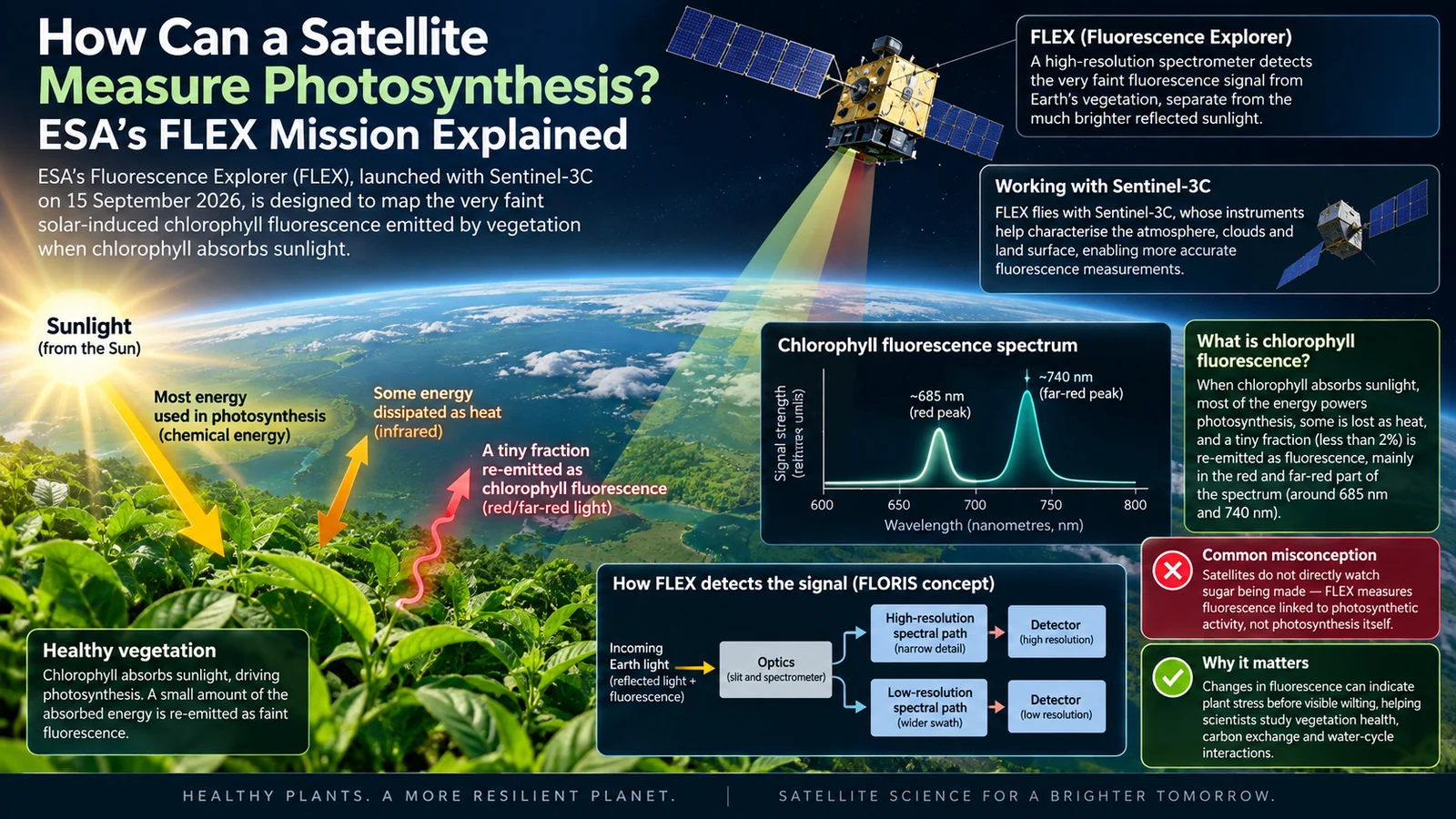
Plants absorb sunlight and use part of that energy to drive photosynthesis. But not all absorbed energy becomes chemical energy. Some is released as heat, and a small fraction is re-emitted as a faint red and far-red glow called chlorophyll fluorescence.
ESA’s Fluorescence Explorer (FLEX), launched with Copernicus Sentinel-3C on 15 September 2026, was designed to measure that glow from orbit. Its key instrument, the Fluorescence Imaging Spectrometer (FLORIS), separates this extremely weak signal from the much brighter sunlight reflected by Earth.
Does FLEX directly measure photosynthesis?
No. FLEX does not watch plants manufacture sugar. Instead, it measures solar-induced chlorophyll fluorescence, an optical signal linked to the way chlorophyll handles absorbed light. Because that signal changes with plant condition and environmental stress, scientists can use it as an indicator related to photosynthetic activity.
What happens to sunlight inside a leaf?
Once chlorophyll absorbs light, the energy has several possible fates. Much of it can support the photochemical reactions that drive photosynthesis. Some is safely dissipated as heat, while a small fraction is emitted again as fluorescence.
ESA explains that, under favourable conditions, roughly 80% of absorbed light can support photosynthetic processes, with the remainder dissipated as heat and/or fluorescence. The balance changes as environmental conditions affect plant function.
Why does chlorophyll fluorescence have two main peaks?
Chlorophyll fluorescence is strongest in the red and far-red parts of the spectrum. Photosystem II contributes a prominent feature around 685 nanometres, while Photosystem I contributes strongly in the far-red with a peak near 740 nanometres.
These wavelengths matter because they allow spectrometers to isolate a signal that is physically linked to how plants are processing absorbed sunlight.
How can a satellite detect such a faint glow?
The difficulty is that fluorescence is much weaker than ordinary reflected sunlight. FLORIS therefore uses precise spectroscopy rather than conventional colour imaging.
Light from Earth enters the instrument and is focused by telescope optics. It is then divided into dedicated spectral paths. A high-resolution path is optimised for the narrow features needed to retrieve fluorescence, while a lower-resolution path records complementary atmospheric and reflectance information. Sensitive detectors convert the separated light into digital measurements.
Why does FLEX fly with Sentinel-3 observations?
FLEX is designed to work in tandem with Copernicus Sentinel-3. Sentinel-3 measurements help characterise land surfaces, clouds and the atmosphere. Combining those data with FLEX observations improves scientists’ ability to interpret the vegetation signal.
This is important because the light measured from orbit has travelled through the atmosphere, where gases, aerosols and clouds can alter the spectrum before it reaches the satellite.
What can fluorescence reveal about plant stress?
Plants can change the way they use absorbed light before obvious visible symptoms appear. Drought, heat and other stresses can alter the balance between photochemistry, heat dissipation and fluorescence. That makes fluorescence useful for studying vegetation condition and stress.
FLEX is designed for large-scale monitoring rather than diagnosing individual plants. Its observations can reveal spatial and temporal patterns across crops, forests and other ecosystems.
How does this connect to the carbon cycle?
Photosynthesis removes carbon dioxide from the atmosphere and stores carbon in plant material. Better information about photosynthetic activity can therefore improve understanding of carbon exchange between vegetation and the atmosphere.
The mission is also relevant to the water cycle because plant photosynthesis, stomatal behaviour and water loss through transpiration are closely linked.
A useful analogy
Imagine a machine powered by incoming energy. Most of the energy does useful work, some escapes as heat, and a tiny amount leaks out as a coloured glow. Measuring that glow does not directly measure every internal process, but changes in it can reveal how the machine is operating. FLEX applies a similar idea to vegetation.
Common misconception
Misconception: satellites directly watch sugar being made during photosynthesis.
Reality: FLEX measures fluorescence linked to photosynthetic activity. Scientists combine that signal with other observations and models to infer how vegetation is functioning.
Why this matters in practice
Global fluorescence observations can help researchers study plant stress, vegetation productivity, carbon exchange and interactions between vegetation and the water cycle. Because changes in fluorescence can occur before obvious visible damage, the measurements can add information that standard imagery alone may miss.
Key takeaways
- FLEX measures solar-induced chlorophyll fluorescence, not photosynthesis directly.
- The fluorescence spectrum contains important features near about 685 nm and 740 nm.
- FLORIS uses spectroscopy to separate the weak fluorescence signal from bright reflected sunlight.
- Sentinel-3 observations provide complementary land and atmospheric information.
- Fluorescence can help scientists investigate vegetation health, stress, carbon exchange and water-cycle interactions.
FAQs
What does FLEX stand for?
FLEX stands for Fluorescence Explorer. It is one of ESA’s Earth Explorer missions.
What is FLORIS?
FLORIS is the Fluorescence Imaging Spectrometer carried by FLEX. It is designed specifically to detect and map faint vegetation fluorescence.
Why can’t an ordinary camera do the same job?
The fluorescence signal is tiny compared with reflected sunlight. FLEX needs specialised spectral resolution to distinguish the fluorescence contribution from the brighter background.
Can FLEX identify stress before leaves visibly wilt?
Changes in fluorescence can occur before some visible symptoms. At the landscape scale, this can help scientists detect changes in plant function that conventional imagery may not reveal as early.