Sickle cell disease (SCD) is a group of inherited blood disorders that affect haemoglobin, the protein inside red blood cells that carries oxygen. In the most common form, abnormal haemoglobin can cause red blood cells to become rigid and sickle-shaped under certain conditions. These cells can break down earlier than normal and can obstruct small blood vessels, contributing to anaemia, episodes of severe pain and complications affecting organs throughout the body.
SCD is not contagious, and it is not caused by something a person did. It is inherited through genes passed from parents to children. Modern care can reduce complications and improve quality of life, but treatment must be individualised by qualified healthcare professionals.
This article provides general health education, not a diagnosis or personal treatment plan. Anyone with possible symptoms, a family history of SCD, or questions about testing or treatment should speak with an appropriate healthcare professional.
What is sickle cell disease?
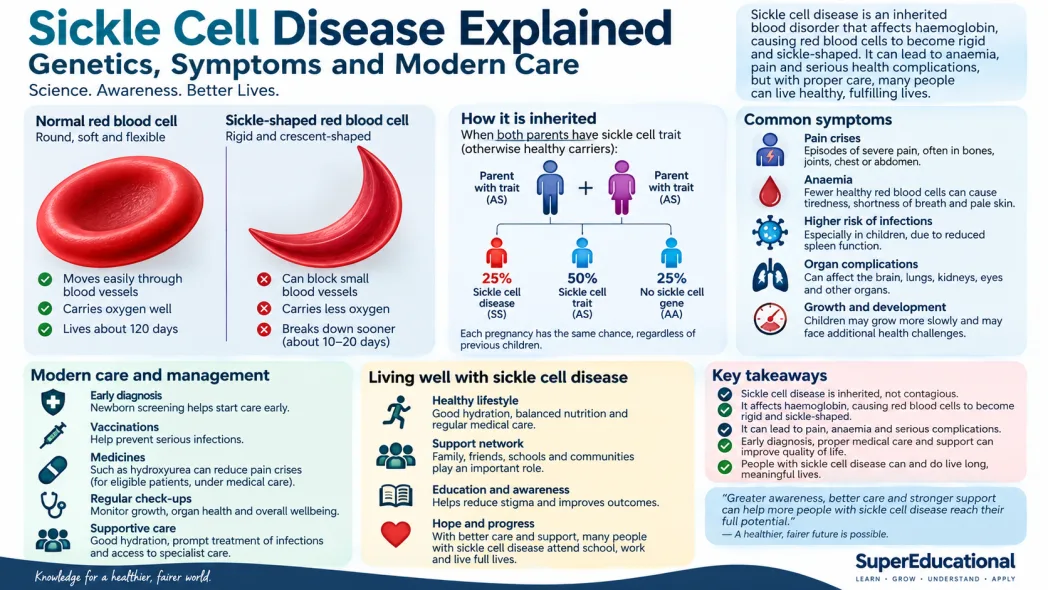
Red blood cells normally have a flexible, disc-like shape that helps them move through very small blood vessels. They contain haemoglobin, which binds oxygen in the lungs and helps transport it around the body.
In sickle cell disease, a person inherits haemoglobin variants that change the properties of haemoglobin. The best-known variant is haemoglobin S, often written as HbS. When HbS releases oxygen, it can form long, rigid structures inside the red blood cell. This makes the cell less flexible and can distort it into a curved or sickle-like shape.
These changes matter for two main reasons:
- Red blood cells can break down too early. This can lead to chronic haemolytic anaemia, meaning the body has fewer circulating red blood cells than it needs.
- Rigid cells can obstruct small blood vessels. Reduced blood flow can cause episodes of severe pain and can damage tissues and organs.
SCD includes several genetic forms. Sickle cell anaemia, often called HbSS, occurs when a person inherits an HbS gene from each parent. Other forms include HbSC disease and sickle beta-thalassaemia, which involve HbS together with another abnormal haemoglobin or beta-globin variant.
What is sickle cell trait?
Sickle cell trait is not the same as sickle cell disease. A person with sickle cell trait typically inherits one HbS gene and one usual haemoglobin A gene, written as HbAS.
According to the US Centers for Disease Control and Prevention (CDC), people with sickle cell trait usually do not have the symptoms of sickle cell disease, although rare complications can occur under extreme conditions. The main importance of the trait is genetic: a person can pass the HbS gene to a child.
How is sickle cell disease inherited?
SCD follows an autosomal-recessive pattern for the classic HbSS form. That means a child generally needs to inherit an HbS gene from both parents to have sickle cell anaemia.
If both parents have sickle cell trait (HbAS), every pregnancy has the same probabilities:
- 25% chance of a child with sickle cell anaemia (HbSS)
- 50% chance of a child with sickle cell trait (HbAS)
- 25% chance of a child with neither SCD nor sickle cell trait (HbAA)
These probabilities reset for every pregnancy. Having one child with one outcome does not change the probability for the next child.
Inheritance can be more complex when one parent has HbS and the other has another haemoglobin variant such as HbC or beta-thalassaemia. Genetic counselling and laboratory testing can help families understand their specific situation.
Why do sickle-shaped cells cause problems?
Healthy red blood cells are highly flexible. That flexibility allows them to squeeze through capillaries that can be narrower than the cells themselves.
Sickled cells are stiffer. When enough of them become trapped in small vessels, blood flow can slow or stop in part of a tissue. This process is called vaso-occlusion and is an important cause of painful episodes, often called pain crises or vaso-occlusive crises.
At the same time, sickled red blood cells are more fragile than ordinary red blood cells and may be destroyed much sooner. The body tries to replace them, but destruction can outpace production, producing chronic anaemia.
Common symptoms and complications
SCD affects people differently. Some have frequent severe complications, while others experience a milder course. Symptoms and risks can change over a lifetime.
Common problems can include:
- Anaemia: fewer healthy red blood cells can lead to fatigue, weakness or shortness of breath.
- Pain episodes: blocked blood flow can cause sudden, sometimes severe pain in bones, joints, the chest, abdomen or other areas.
- Swelling of hands and feet: this can occur in young children when blood flow is reduced in small bones.
- Increased infection risk: damage to the spleen can reduce the body's ability to fight certain bacterial infections.
- Acute chest syndrome: a serious lung complication that can involve chest pain, fever and breathing difficulty.
- Stroke: disrupted blood flow in the brain is an important risk in some people with SCD.
- Damage to organs: the kidneys, lungs, eyes, bones and other organs can be affected over time.
- Growth or development problems: chronic anaemia and other complications can affect growth in some children.
Symptoms such as severe pain, breathing difficulty, neurological symptoms, or high fever can require urgent medical assessment. General online information should never be used to decide whether an emergency can wait.
How is sickle cell disease diagnosed?
SCD is diagnosed with blood testing that identifies the types of haemoglobin a person has. In countries with newborn screening programmes, babies may be tested shortly after birth so care can begin before serious complications develop.
Testing can also identify sickle cell trait. This can be important for people planning a family because the result helps clarify possible inheritance patterns.
A screening result may need confirmation and interpretation by trained healthcare professionals, especially because several different haemoglobin variants can produce different forms of SCD.
Why early diagnosis matters
Early diagnosis gives families and healthcare teams time to put preventive care in place. This can include vaccination, infection-prevention strategies, education about warning signs, regular medical follow-up and monitoring for complications.
The World Health Organization's 2026 guideline for children and adolescents with SCD emphasises diagnosis, prevention and clinical management across childhood and adolescence. WHO describes SCD as the most common inherited blood disorder worldwide and a major cause of preventable childhood death and disability, particularly in low- and middle-income countries.
Why infections can be more dangerous
The spleen plays an important role in removing certain bacteria from the bloodstream. In many people with SCD, repeated blockage of blood vessels damages the spleen, sometimes from early childhood.
This is one reason vaccination and infection prevention are central parts of care. Healthcare teams may recommend specific vaccines and, for some children, preventive medicines according to local clinical guidance.
The exact schedule or medicine should be determined by a qualified clinician rather than copied from a general article, because recommendations depend on age, country, medical history and the individual form of SCD.
What treatments are used today?
There is no single treatment plan that is appropriate for every person. Care may involve several strategies, including preventive care, pain management, blood transfusion, disease-modifying medicines and, for selected patients, potentially curative therapies such as stem-cell transplantation or certain gene therapies.
Hydroxyurea
Hydroxyurea is one of the most established disease-modifying medicines for SCD. The US National Heart, Lung, and Blood Institute says it can reduce red-cell sickling and help prevent serious complications such as pain crises and acute chest syndrome.
WHO's 2026 paediatric guideline includes a strong recommendation for hydroxyurea in children and adolescents with sickle cell anaemia from 9 months to 19 years, regardless of clinical severity. However, hydroxyurea requires medical supervision, appropriate dosing and monitoring. It should never be started, stopped or adjusted based on an online article.
Blood transfusion
Blood transfusions can be used in specific situations, such as severe anaemia, some acute complications, or stroke prevention for certain high-risk patients. Repeated transfusions have their own risks and require specialist monitoring.
Stem-cell transplantation and gene therapy
Blood and bone-marrow transplantation can be curative for some people, but it is not suitable or available for everyone and carries significant risks. Gene therapies have also become available in some settings for selected patients, but access, eligibility, cost and long-term follow-up remain important considerations.
These are specialist treatments, not routine choices that can be evaluated safely without a clinical team.
What changed in 2026?
On 1 September 2026, WHO announced a new effort to expand access to lifesaving SCD treatment and care for children. WHO said SCD contributed to an estimated 81,100 deaths among children under five in 2021 and that nearly 80% of cases occur in sub-Saharan Africa.
The initiative connects updated clinical guidance with work to improve access to quality-assured, child-friendly medicines, including age-appropriate hydroxyurea formulations. WHO also highlighted persistent inequities in early diagnosis, comprehensive care and access to disease-modifying treatment.
The significance is not that a single new medicine suddenly changed SCD care. Rather, WHO is trying to close the gap between treatments that are known to help and the reality that many children still cannot access them consistently.
Common misconceptions
- “Sickle cell trait is a mild form of sickle cell disease.” No. Trait is a different genetic state, usually involving one HbS gene and one usual haemoglobin gene.
- “A person can catch sickle cell disease from someone else.” No. SCD is inherited, not contagious.
- “Every person with SCD has the same symptoms.” No. Severity and complications vary substantially between individuals.
- “If both parents have trait, every child will have SCD.” No. For two HbAS parents, each pregnancy has a 25% chance of HbSS disease.
- “Modern treatment means the disease no longer needs regular follow-up.” No. SCD requires ongoing medical care even when a person feels well.
Practical health-literacy questions to ask
If SCD or sickle cell trait is relevant to you or your family, useful questions for a healthcare professional may include:
- What haemoglobin type did the laboratory test identify?
- Does this result show sickle cell disease, sickle cell trait or another haemoglobin variant?
- What preventive care is recommended at this age?
- Which symptoms should prompt urgent medical attention?
- Is genetic counselling appropriate for our family?
- What monitoring is needed for medicines or transfusion therapy?
These questions can improve understanding without replacing professional assessment.
Key takeaways
- Sickle cell disease is a group of inherited disorders involving abnormal haemoglobin.
- Rigid sickled red blood cells can break down early and can obstruct small blood vessels.
- Sickle cell trait is not the same as sickle cell disease.
- If both parents have HbAS sickle cell trait, each pregnancy has a 25% chance of HbSS sickle cell anaemia, a 50% chance of trait and a 25% chance of neither.
- Early diagnosis, infection prevention, specialist follow-up and disease-modifying treatment can reduce complications.
- WHO's 2026 initiative aims to improve access to quality care and child-friendly medicines, especially in high-burden settings.
Frequently asked questions
Is sickle cell disease genetic?
Yes. It is inherited through haemoglobin-related gene variants passed from parents to children.
Is sickle cell trait the same as sickle cell disease?
No. People with trait usually have one HbS gene and one usual haemoglobin gene and generally do not have the disease itself.
Can sickle cell disease be diagnosed at birth?
Yes. Newborn screening programmes can identify SCD early, although availability varies by country and health system.
Can people with sickle cell disease live into adulthood?
Yes. Outcomes have improved substantially where early diagnosis, preventive care, specialist monitoring and effective treatments are available, although serious health risks remain and access to care is unequal.
Does hydroxyurea cure sickle cell disease?
No. Hydroxyurea is a disease-modifying medicine that can reduce complications for many patients, but it is not a universal cure and requires medical supervision.
Authoritative references
- World Health Organization — WHO moves to expand access to lifesaving sickle cell treatment and care for children
- World Health Organization — Management of sickle-cell disease in children and adolescents
- US Centers for Disease Control and Prevention — What Is Sickle Cell Trait?
- US National Heart, Lung, and Blood Institute — Sickle Cell Disease: Treatment
Suggested next learning step: learn how haemoglobin carries oxygen, why red blood cells are normally flexible, and how inherited haemoglobin variants produce different sickle cell conditions.