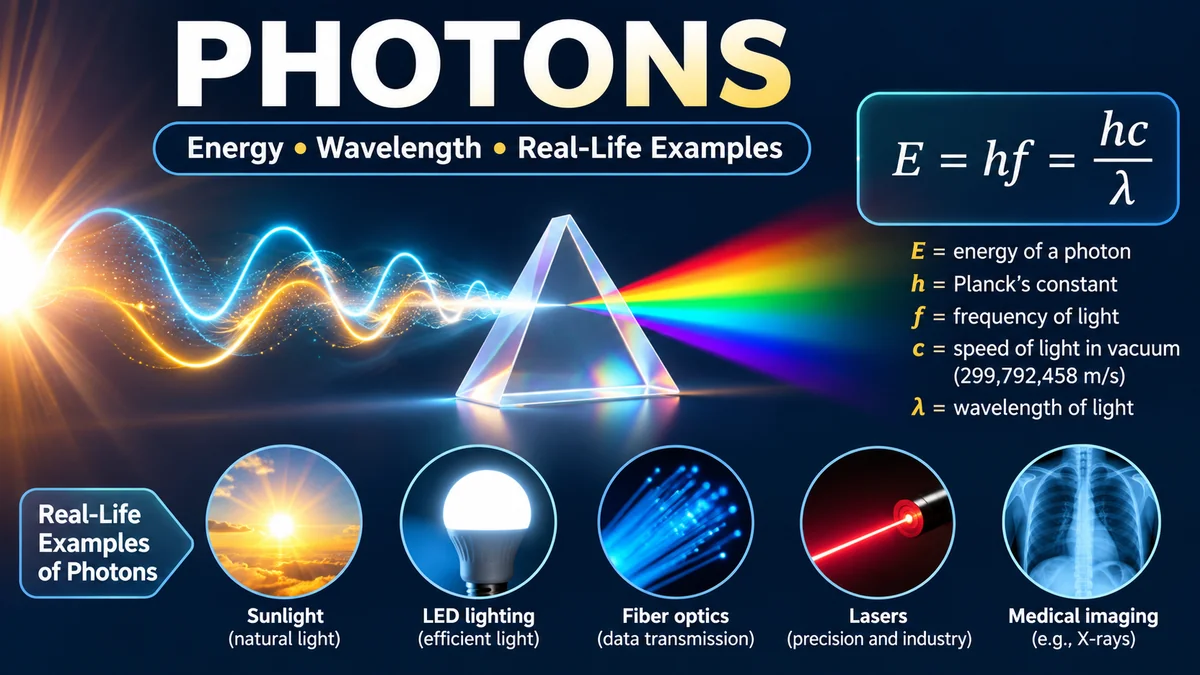
Photons are the smallest discrete units, or quanta, of electromagnetic radiation. Every beam of visible light—from sunlight to a smartphone screen—can be described in terms of photons. Radio waves, microwaves, infrared, ultraviolet, X-rays and gamma rays also consist of electromagnetic radiation whose energy is exchanged in photons. Each photon has energy determined by its frequency: E = hf = hc/λ.
Understanding photons connects ordinary experiences, such as seeing colours and using LED bulbs, to quantum physics, solar power, medical imaging and modern communications. This guide explains the definition, key properties, formulas, worked calculations and real-life applications without assuming advanced mathematics.
What Is a Photon? A Simple Definition
A photon is a quantum of the electromagnetic field: an individual unit of energy and momentum associated with light or other electromagnetic radiation. The word quantum means that exchanges of energy occur in discrete amounts, rather than in arbitrarily small fractions of an individual photon. A photon is not a tiny, coloured bead travelling along a drawn wavy line; quantum theory gives it behaviour that cannot be represented completely by either an ordinary particle or a classical wave.
Physicists describe the photon as an elementary, electrically neutral particle with zero rest mass. It is also the carrier of electromagnetic interactions in quantum field theory. A freely travelling photon moves through a vacuum at the speed of light, exactly 299,792,458 metres per second. It has no rest frame in which it can sit still.
The US Department of Energy's photon explainer describes why discrete packets of electromagnetic energy are essential for understanding the interaction of light with matter.
Important Properties of Photons
- Zero rest mass: photons do not have a non-zero invariant (rest) mass, but they do carry energy and momentum.
- No electric charge: a photon is electrically neutral.
- Energy depends on frequency: higher-frequency electromagnetic radiation has higher-energy photons.
- Momentum: light can exert a small pressure when it interacts with a surface.
- Wave–particle behaviour: light displays interference and diffraction but is detected through individual quantised interactions.
- Electromagnetic spectrum: photons occur in all regions of the spectrum, not just visible light.
These properties explain both the coloured glow of an aurora and the specialised detectors used to distinguish energetic radiation. For a related application, read SuperEducational's article on why auroras glow green, red and purple .
Are Photons Waves or Particles?
Photons are quantum objects that show features associated with both waves and particles. When light passes through two narrow openings, it can produce an interference pattern characteristic of waves. Yet a sufficiently sensitive detector records localised events, sometimes one photon at a time. Over many detections, the familiar interference pattern can emerge.
Neither the image of a solid marble nor the idea of energy continuously spread everywhere provides a complete description. In quantum mechanics, the experimental arrangement determines which properties are measured and how results are predicted.
Historically, Max Planck introduced the energy-quantum idea in 1900 while studying thermal radiation. In 1905, Albert Einstein used light quanta to explain key features of the photoelectric effect. Later experiments further established quantum descriptions of electromagnetic radiation. For an accessible overview, see NASA's guide to light and matter .
Photon Formulas: Energy, Frequency, Wavelength and Momentum
Four relationships cover most introductory photon calculations. They are especially useful when radiation propagates through a vacuum and wavelength is expressed as its vacuum wavelength.
1. Photon Energy: E = hf
E = hf
Here, E is the energy of one photon in joules (J), h is Planck's constant, and f is the radiation's frequency in hertz (Hz). The constant is exactly h = 6.62607015 × 10⁻³⁴ J·s. Doubling a photon's frequency doubles its energy.
2. Frequency and Wavelength: c = fλ
c = fλ
c is the speed of light in a vacuum, f is frequency and λ (lambda) is wavelength in metres. In vacuum, wavelength and frequency are inversely related: a shorter wavelength corresponds to a higher frequency. When light travels through a material, use its speed and wavelength in that medium for the wave relation; its frequency is unchanged at an ordinary stationary interface.
3. Photon Energy from Wavelength: E = hc/λ
Combining the preceding equations gives E = hc/λ for the vacuum wavelength. This is often the easiest formula when a problem supplies the wavelength of a laser or visible light. For instance, blue light has a shorter wavelength, and therefore greater energy per photon, than red light.
4. Photon Momentum: p = E/c = h/λ
Although its rest mass is zero, a photon has momentum. The magnitude of that momentum in vacuum is p = E/c = h/λ, where p is measured in kilogram-metres per second (kg·m/s). Momentum transfer allows light to exert radiation pressure and contributes to technologies such as light-driven sails.
These equations are presented in OpenStax University Physics, Chapter 6 . The precise values of Planck's constant and the speed of light are published by the US National Institute of Standards and Technology (NIST) .
Quick Formula Table
| Quantity to find | Formula | What you need |
|---|---|---|
| Energy of one photon | E = hf | Frequency, f |
| Energy from wavelength | E = hc/λ | Vacuum wavelength, λ |
| Frequency | f = c/λ | Vacuum wavelength, λ |
| Vacuum wavelength | λ = c/f | Frequency, f |
| Photon momentum in vacuum | p = h/λ | Vacuum wavelength, λ |
| Approximate photon count per second | N/t = P/E | Monochromatic optical power, P |
What Units Are Used for Photon Energy?
In the International System of Units (SI), energy is measured in joules (J). For a single visible-light photon, that value is extremely small. Scientists also use the electronvolt (eV), with the exact conversion 1 eV = 1.602176634 × 10⁻¹⁹ J.
A practical shortcut is E (eV) ≈ 1240 / λ (nm), where wavelength is in nanometres (nm) and denotes the vacuum wavelength. This approximation follows directly from the exact constants. Remember that 1 nm = 10−9 m; incorrect unit conversion is a common source of errors.
Worked Photon Formula Examples
Example 1: Find the Energy of a 500 nm Photon
Suppose green light has a vacuum wavelength of 500 nm. First convert to metres: 500 nm = 5.00 × 10⁻⁷ m.
E = hc/λ = (6.62607015 × 10⁻³⁴)(299792458) / (5.00 × 10⁻⁷) ≈ 3.97 × 10⁻¹⁹ J.
In electronvolts: E ≈ 3.97 × 10⁻¹⁹ / 1.602176634 × 10⁻¹⁹ ≈ 2.48 eV. The corresponding frequency is approximately 6.00 × 10¹⁴ Hz.
Notice how the same photon can be described by wavelength, frequency or energy. These quantities are connected, not separate kinds of light.
Example 2: Does Blue or Red Light Have More Energy?
Compare blue light at 450 nm with red light at 650 nm. Using E (eV) ≈ 1240/λ (nm):
- Blue photon: 1240/450 ≈ 2.76 eV.
- Red photon: 1240/650 ≈ 1.91 eV.
The blue photon has more energy per photon because its wavelength is shorter. This does not mean a dim blue lamp necessarily delivers more total energy each second than a bright red lamp: brightness and power also depend on how many photons are emitted.
Example 3: Calculate the Momentum of a Photon
For the 500 nm photon above, p = h/λ = (6.62607015 × 10⁻³⁴) / (5.00 × 10⁻⁷) ≈ 1.33 × 10⁻²⁷ kg·m/s.
This is very small for one photon, but enormous numbers of photons can transfer measurable momentum to matter.
Example 4: Photoelectric Effect and the Work Function
In the photoelectric effect, a photon can eject an electron from a material if its energy exceeds a minimum energy called the work function, symbolised by φ. In the simple one-photon model, Kmax = hf − φ.
Imagine 400 nm light shining on a surface with a work function of 2.20 eV. A 400 nm photon has approximately 3.10 eV. The largest possible kinetic energy of an emitted electron is 3.10 − 2.20 = 0.90 eV. If the photon energy were below the work function, no photoelectrons would be emitted by that single-photon process, no matter how intense the light became.
OpenStax explains the experimental evidence for the photoelectric effect, including why the threshold frequency matters.
Example 5: How Many Photons Are in a Beam?
Imagine an idealised monochromatic 500 nm laser delivering 1 milliwatt (0.001 watt) of optical power. Each photon carries about 3.97 × 10⁻¹⁹ joules, so:
Photons per second = P/E ≈ 0.001 / (3.97 × 10⁻¹⁹) ≈ 2.52 × 10¹⁵.
That is roughly 2.5 quadrillion photons every second. The estimate assumes the stated power belongs to light of that wavelength. For a light source with many wavelengths, photon counts depend on its spectral distribution.
Where Do Photons Fit in the Electromagnetic Spectrum?
Visible light is only a small part of a much wider electromagnetic spectrum. All of the regions below involve photons, but their frequencies and energies differ:
| Region | Typical relative photon energy | Familiar example |
|---|---|---|
| Radio waves | Very low | Broadcasting and wireless signals |
| Microwaves | Low | Microwave ovens and radar |
| Infrared | Below visible light | Thermal cameras and remote controls |
| Visible light | Intermediate | Eyesight, lamps and displays |
| Ultraviolet | Above visible light | Sunlight and UV lamps |
| X-rays | High | Medical radiography |
| Gamma rays | Usually very high | Radioactive processes and astrophysics |
The human eye typically detects light over approximately 380–700 nm, although the precise edges vary with conditions and the observer. Visible violet photons therefore generally carry more energy than visible red photons. NASA provides a useful introduction to the visible spectrum and the full electromagnetic spectrum . X-ray and gamma-ray classifications can overlap in energy; their physical origins can also matter when naming them.
Real-Life Examples of Photons
1. Sunlight and Human Vision
The Sun emits radiation spanning many wavelengths. Visible photons that are reflected or scattered from objects enter our eyes and can be absorbed by light-sensitive molecules in retinal cells. Signals produced by those cells help the brain construct what we see. Objects appear different colours because they absorb, reflect or transmit different mixtures of wavelengths.
2. Photosynthesis in Plants
Photosynthesis begins when pigments such as chlorophyll absorb photons. The absorbed energy initiates electron-transfer processes that ultimately help plants and other photosynthetic organisms convert light energy into chemical energy. The process is more complex than a single photon becoming a molecule of sugar. Research described by Berkeley Lab has experimentally examined the effects of individual absorbed photons on early photosynthetic steps.
3. Solar Panels
A solar photovoltaic cell absorbs incoming photons in a semiconductor. Some absorbed photons create mobile charge carriers, which the cell's internal electric field can help separate and collect as electric current. Not every photon is absorbed, and not all absorbed energy becomes usable electricity. The US Department of Energy's photovoltaic primer explains these steps.
Note the distinction: in an ordinary solar cell, electrons are generally mobilised within the semiconductor. They need not be ejected out into vacuum as in the classic metal-surface photoelectric experiment.
4. LED Bulbs and Smartphone Screens
Light-emitting diodes (LEDs) produce light when electrons and holes recombine in a semiconductor and release energy as photons. Different semiconductor materials and designs help create different colours. Some white LEDs use a blue or ultraviolet-emitting source plus phosphors that convert some of its light to other wavelengths. Modern displays use controlled light emission to create coloured images. For further background, see the Department of Energy's explanation of LEDs .
5. Fibre-Optic Internet and Laser Communications
Optical fibres guide light through glass or other transparent materials. By rapidly varying the transmitted optical signal and measuring it at the receiving end, communication systems encode and recover information. The light may travel inside a fibre or through free space; both approaches involve electromagnetic radiation. NASA explains how optical communication uses light to send information across long distances.
Traditional mobile and radio communication also involves electromagnetic radiation, but generally at much lower photon energies. SuperEducational's guide to how landlines and mobile networks work explores the communications context.
6. Cameras and Light Sensors
Digital cameras use photosensitive semiconductor pixels. When incoming photons are absorbed, their energy can create charges that electronic circuits measure. The pixel's signal is then processed into an image. In low light, the limited number of arriving photons contributes to the statistical noise that photographers recognise as graininess.
7. X-Rays and Medical Imaging
X-ray photons have enough energy to penetrate some materials and are attenuated differently by different tissues. Detectors record the transmitted pattern to help form medical images. Because X-rays are ionising radiation, medical examinations use established safety procedures and justified exposure. The US Food and Drug Administration's X-ray imaging guidance explains the benefits and risks.
Specialised photon detectors are also important outside hospitals, including nuclear monitoring and astronomy. Learn more in SuperEducational's article on how quantum sensors distinguish X-rays and gamma rays .
How Are Photons Created, Absorbed or Scattered?
Photons are emitted when a physical system loses energy through electromagnetic radiation. Examples include an excited atom transitioning to a lower-energy state and a semiconductor emitting light. Photons are absorbed when their energy is transferred to matter, such as a pigment in a leaf or a pixel in a camera. They can also be scattered, changing direction and sometimes energy after an interaction.
These processes help explain why the sky is blue, why certain gases produce characteristic spectral lines and how astronomers learn what distant stars contain. NASA's spectroscopy explainer describes how patterns of absorbed and emitted light reveal information about matter.
Common Misconceptions About Photons
- “Only visible light has photons.” False. All electromagnetic radiation can be described in terms of photons.
- “A photon has no mass, so it has no momentum.” False. Photons have zero rest mass but non-zero energy and momentum.
- “Brighter light always contains more energetic photons.” Not necessarily. Brightness can increase because more photons arrive, even when each has the same energy.
- “A blue photon is always moving faster than a red photon.” In vacuum, both travel at the same speed, c. Their energies and frequencies differ.
- “Solar panels work by throwing electrons off their surfaces.” Usually inaccurate. Photovoltaic devices collect mobile charge carriers generated inside a semiconductor.
Practice Questions About Photons
- Which has greater energy per photon: 450 nm light or 650 nm light? Answer: 450 nm light, because its wavelength is shorter.
- What is the frequency of 600 nm light in vacuum? Answer: f = c/λ ≈ 5.00 × 10¹⁴ Hz.
- Can a photon carry momentum without rest mass? Answer: Yes; in vacuum, p = E/c.
- What happens to a photon's energy if its frequency doubles? Answer: It doubles because E = hf.
- Why does increasing light intensity not overcome a photoelectric threshold when the photon frequency is too low? Answer: It increases photon number, not the energy of each photon in the basic one-photon process.
Students can develop further investigations by following SuperEducational's guide to designing a fair science experiment , ensuring that wavelength, intensity and other variables are considered separately.
Frequently Asked Questions
What is a photon in simple words?
A photon is one discrete quantum of electromagnetic radiation. Photons are how light transfers energy and momentum in individual interactions with matter.
What is the main formula for photon energy?
The fundamental relationship is E = hf. In vacuum it can also be written as E = hc/λ.
Is a photon the same as an electron?
No. An electron is an electrically charged particle with non-zero rest mass. A photon is electrically neutral, has zero rest mass and is the quantum of electromagnetic radiation.
Can photons travel through empty space?
Yes. Unlike sound waves, electromagnetic radiation requires no material medium. Free photons travel through a vacuum at the speed of light.
Do photons have colour?
Colour is a perception produced by the visual system. Individual visible photons have frequencies or wavelengths that influence perceived colour, but many perceived colours result from mixtures of different wavelengths.
Conclusion: Why Photons Matter
Photons connect quantum theory to everyday life. They make vision possible, deliver energy from the Sun, help plants capture light, enable solar cells and LED displays, carry information through optical systems and reveal details inside the human body. The essential relationships are straightforward: E = hf, c = fλ, E = hc/λ and p = h/λ in vacuum. Learning what each symbol means—and carefully converting units—makes the calculations manageable.
Editorial verification: 25 November 2026. This educational article draws on physics resources from NIST, NASA, OpenStax, the US Department of Energy, the US FDA and Berkeley Lab. Figures in worked examples are calculated from exact SI constants and rounded for clarity.