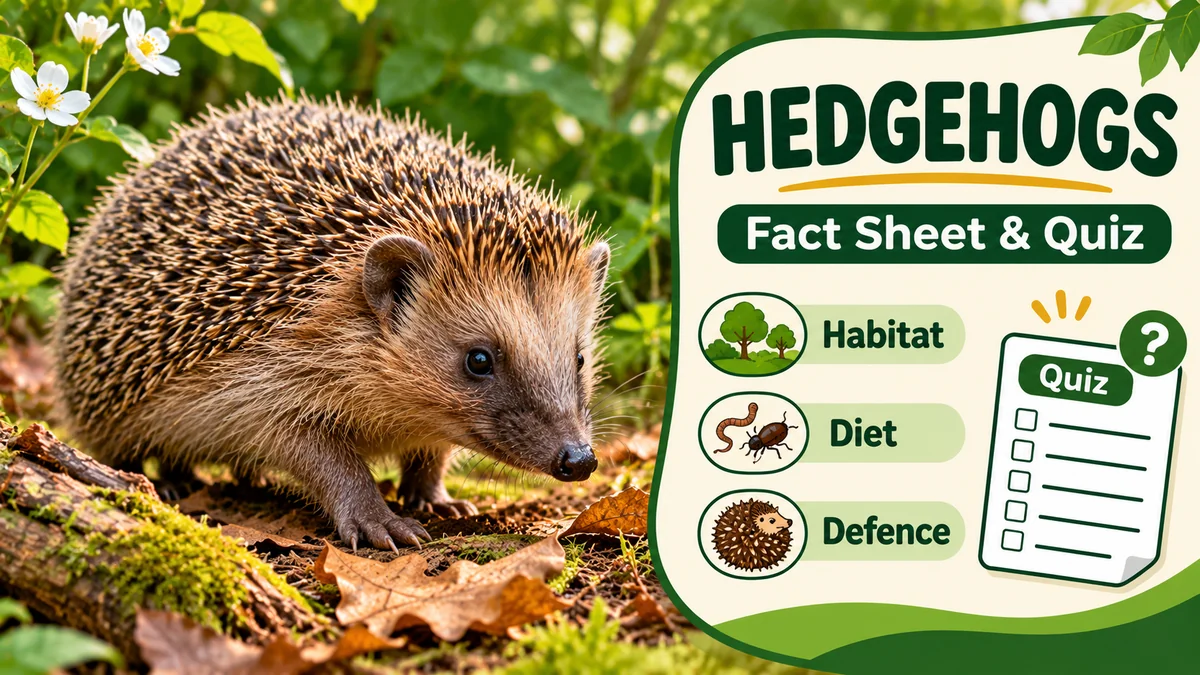
Hedgehogs are small mammals with protective spines, sensitive noses and fascinating ways of surviving in different habitats. They are mainly active after dark, many eat beetles and other invertebrates, and European hedgehogs may hibernate through colder months. Baby hedgehogs are called hoglets. But not every hedgehog species lives in Europe or hibernates, and their conservation needs depend on where they occur.
This hedgehog classroom fact sheet and quiz with answers turns those ideas into a ready-to-use science lesson. Students can read the facts, learn eight biology words, complete 24 questions, check a fully explained answer key and try two safe classroom activities. The material is aimed mainly at upper-primary and lower-secondary learners, but the scientific explanations are useful for curious readers of any age. It complements, rather than repeats, SuperEducational's separate hedgehog habitat and behaviour guide.
Lesson overview and learning objectives
| Lesson element | Suggested approach |
|---|---|
| Target learners | Upper-primary and lower-secondary; adapt reading difficulty as needed |
| Suggested time | 40–60 minutes, with optional extension activities |
| Materials | This fact sheet, notebooks, pencils, optional species photographs and map |
| Scientific themes | Mammals, adaptations, food webs, habitats, life cycles and conservation |
| Assessment | 24 questions, one point each, followed by discussion of explanations |
By the end of the lesson, students should be able to classify a hedgehog as a mammal, describe at least three adaptations, distinguish a habitat from a diet, explain what happens during hibernation, identify the meaning of hoglet, and discuss why conservation advice differs between native and introduced populations. They should also practise checking whether a scientific statement applies to one species or to all hedgehogs.
Hedgehogs classroom fact sheet: 12 essential facts
| Fact | Student-friendly explanation |
|---|---|
| 1. Animal group | Hedgehogs are mammals in the family Erinaceidae, not rodents or reptiles |
| 2. Natural range | Different hedgehog species are native to parts of Europe, Africa and Asia |
| 3. Habitat | Depending on species: woodland edges, hedgerows, gardens, grassland, scrub or drier areas |
| 4. Food | Many eat ground-dwelling invertebrates, especially beetles, worms and caterpillars |
| 5. Activity | Many are nocturnal, meaning they are most active at night |
| 6. Spines | Stiff, modified hairs made mainly of keratin help defend the body |
| 7. Defensive response | Strong muscles help hedgehogs curl up to protect vulnerable body parts |
| 8. Do they shoot spines? | No; the spines are attached to their skin |
| 9. Young | Baby hedgehogs are called hoglets and depend on their mothers |
| 10. Hibernation | West European hedgehogs often hibernate in winter; patterns vary among species |
| 11. Conservation | West European hedgehogs were assessed as Near Threatened globally in 2024 |
| 12. Introduced populations | European hedgehogs brought to New Zealand can threaten native wildlife |
The People's Trust for Endangered Species (PTES) and the San Diego Zoo Wildlife Alliance provide background on hedgehog anatomy, diet and behaviour. This fact sheet draws many examples from the West European hedgehog (Erinaceus europaeus), so it states when a fact may not apply to all species.
Meet the hedgehog: what makes it a mammal?
Hedgehogs belong to the class Mammalia. Like other mammals, mothers produce milk for their young. Spiny hedgehogs form part of the family Erinaceidae in the order Eulipotyphla, along with more distant relatives such as shrews and moles in the same order. Although a hedgehog looks somewhat like a tiny porcupine, porcupines are rodents; hedgehogs are not.
The most noticeable adaptation is the coat of spines, which are modified hairs. They contain keratin, a structural material also present in human hair and nails. When threatened, a hedgehog can raise its spines and roll into a ball. That exposes spines rather than the soft belly. The animal cannot launch its spines at an attacker, and its protective ball does not make it safe from cars or every predator. For a wider classification activity, see SuperEducational's animal classification guide .
Where do hedgehogs live, and what do they eat?
A habitat is the environment where an animal finds food, shelter and opportunities to reproduce. West European hedgehogs may inhabit woodlands, gardens, hedgerows and field edges. Some African and Asian hedgehogs occupy open scrubland or dry habitats instead. Saying that every hedgehog lives in a British garden would therefore be misleading.
Hedgehogs are primarily invertebrate feeders. A West European hedgehog often searches leaf litter and soil for beetles, earthworms, caterpillars and earwigs, although it may eat other available foods. Its long snout and good sense of smell help it find prey, particularly at night. The Woodland Trust and PTES describe the species' natural diet and preferred habitats.
Important classroom distinction: a food web is a network of feeding relationships, not simply a list of what one animal eats. Hedgehogs consume invertebrates and can themselves be prey for certain larger animals. Their lives therefore connect plant communities, soil organisms, predators and human land use.
What is hedgehog behaviour like?
Many hedgehogs are nocturnal: they leave shelter to forage after dark and rest through much of the day. They are commonly solitary, apart from courtship and a mother caring for hoglets. If frightened, a hedgehog may puff or curl up; if investigating an unusual smell, it can display self-anointing, spreading frothy saliva on its spines. Scientists have not established one definitive explanation for this unusual behaviour, so students should not confuse an observation with a proven purpose.
West European hedgehogs typically hibernate during colder months when insect food is less available. During hibernation their body functions slow to conserve energy, although they may wake periodically. Do not assume all African or Asian hedgehog species follow the same winter calendar. The British Hedgehog Preservation Society explains hibernation in the European species.
Hoglets: the hedgehog life cycle
A baby hedgehog is called a hoglet. In West European hedgehogs, mothers often produce litters of about four or five young, though numbers and timing vary. Newborn hoglets are blind and deaf, and pale spines begin to appear soon after birth. They are dependent on the mother, who nurses and protects them in a hidden nest.
According to the RSPCA , young European hedgehogs may begin accompanying their mother out of the nest around four weeks of age and become independent at approximately eight weeks. These are approximate developmental stages, not exact dates for every animal. Discovering a nest does not justify moving or handling the hoglets for a classroom demonstration.
Conservation: why location changes the answer
In October 2024, the IUCN announced that the West European hedgehog had been moved to Near Threatened on its global Red List. Habitat loss, roads and intensive land use contribute to concern. In places where hedgehogs are native, connecting suitable patches of shelter and food can help them move safely. In Britain, the British Hedgehog Preservation Society recommends small, appropriately placed fence openings of roughly 13 × 13 cm to connect gardens, as well as checking long vegetation before cutting.
However, European hedgehogs were introduced to New Zealand, where they can prey on native invertebrates and other animals. The New Zealand Department of Conservation treats them as introduced pests in relevant settings. This makes a powerful ecology lesson: protecting a species in its native range is not the same as encouraging it to spread where it harms native ecosystems.
Do not handle wild hedgehogs for experiments. Never give them cows' milk, which can cause digestive upset. If a hedgehog seems injured or very weak, contact local wildlife professionals; daytime activity alone is not always a sign of illness, especially when a nursing mother is foraging. The RSPCA injury advice explains when expert help may be needed.
Eight science words to remember
| Word | Meaning |
|---|---|
| Mammal | An animal from the group whose mothers produce milk for their young |
| Habitat | The place and conditions where an organism normally lives |
| Adaptation | An inherited feature or behaviour that improves survival or reproduction in a setting |
| Nocturnal | Most active during the night |
| Invertebrate | An animal without a backbone, such as an insect or earthworm |
| Hibernation | An extended low-energy state used by some animals during difficult seasons |
| Hoglet | A baby hedgehog |
| Conservation | Protection and management of species, habitats and ecosystems |
Hedgehogs classroom quiz: 24 questions
Instructions: Work without looking at the answer key. Questions 1–10 are multiple choice, questions 11–16 are true or false, and questions 17–24 need short written answers. Give yourself one point per question, for 24 points total. This is a classroom learning check, not a standardised examination.
Part A: multiple-choice questions (1–10)
- What kind of animal is a hedgehog? A. Reptile; B. Mammal; C. Bird; D. Fish.
- Which statement describes hedgehog spines? A. They are feathers; B. They are made of metal; C. They are modified hairs; D. They shoot at enemies.
- Which is a typical food for West European hedgehogs? A. Beetles and earthworms; B. Grass alone; C. Fish from the ocean; D. Tree bark alone.
- What does “nocturnal” mean? A. Lives in water; B. Only eats plants; C. Always sleeps; D. Usually active at night.
- What is a baby hedgehog called? A. Leveret; B. Hoglet; C. Tadpole; D. Chick.
- Which place is within the natural range of some hedgehog species? A. Antarctica; B. The Moon; C. Africa; D. Every Pacific island.
- What usually happens during European hedgehog hibernation? A. Metabolism slows to save energy; B. All spines disappear; C. The animal becomes a reptile; D. It breathes underwater.
- Which part of the body helps find invertebrates? A. Wings; B. Fins; C. Antennae; D. Sensitive snout and sense of smell.
- What is the 2024 global IUCN assessment of the West European hedgehog? A. Extinct; B. Near Threatened; C. Domesticated; D. Not an animal.
- Why might hedgehogs be a concern in New Zealand? A. They are native to Antarctica; B. They only eat rocks; C. They were introduced and can harm native wildlife; D. They cannot eat invertebrates.
Part B: true or false (11–16)
- All hedgehogs are native to Britain.
- Hedgehogs can shoot their spines like arrows.
- A hedgehog may curl into a ball when frightened.
- Some hedgehogs do not follow the same hibernation pattern as European hedgehogs.
- Newborn West European hoglets already live independently of their mothers.
- Conservation advice should take into account whether an animal is native or introduced.
Part C: short-answer and reasoning questions (17–24)
- Name two habitats in which hedgehogs may be found.
- Give two examples of invertebrates a hedgehog might eat.
- Explain how spines and curling into a ball can work together as a defence.
- Why is “all hedgehogs hibernate every winter” an unreliable statement?
- Describe one way a hedgehog contributes to a food web.
- Why is it unsafe to remove a nest of hoglets for a school display?
- A class reads that hedgehogs should be protected in Britain but controlled in parts of New Zealand. Explain why both statements can be reasonable.
- Describe one ethical, non-invasive classroom activity that could help students learn about hedgehogs.
Hedgehog quiz answers and explanations
Teachers should accept scientifically accurate equivalent wording. Where a student gives an evidence-based explanation rather than simply guessing, use the answer discussion to reinforce reasoning.
| No. | Answer | Explanation |
|---|---|---|
| 1 | B — Mammal | Mothers produce milk for their young |
| 2 | C — Modified hairs | Spines contain keratin and remain attached |
| 3 | A — Beetles and earthworms | Both are part of the species' invertebrate-rich diet |
| 4 | D — Usually active at night | That is the meaning of nocturnal |
| 5 | B — Hoglet | Hoglet is the common name for a baby hedgehog |
| 6 | C — Africa | Several hedgehog species are native to Africa |
| 7 | A — Metabolism slows | Hibernation helps conserve energy |
| 8 | D — Snout and smell | Hedgehogs locate prey by investigating scents |
| 9 | B — Near Threatened | IUCN changed the West European hedgehog's global assessment in 2024 |
| 10 | C — Introduced species | Hedgehogs can prey on native wildlife in New Zealand |
| 11 | False | Hedgehogs are native across parts of Europe, Africa and Asia |
| 12 | False | They cannot launch or shoot spines |
| 13 | True | Curling protects vulnerable body parts |
| 14 | True | Hibernation varies with climate and species |
| 15 | False | Hoglets need milk, warmth and maternal protection |
| 16 | True | Introduced animals can harm local ecosystems |
Suggested answers for questions 17–24:
- Habitat: Woodland edges and gardens; alternatively hedgerows, grassland, scrub or suitable dry habitats, depending on species.
- Food: Beetles and earthworms, or caterpillars and earwigs, are suitable examples.
- Defence: The animal raises its hard spines and curls so the softer underside becomes less exposed.
- Species difference: Hedgehog species live in different climates; some warm-region species have different seasonal resting behaviour.
- Food web: A hedgehog eats invertebrates and may itself be eaten by a predator; both connect it to other organisms.
- Wildlife welfare: Disturbing a nest could separate dependent hoglets from the mother, harm them or cause serious stress.
- Conservation context: In Britain hedgehogs are native and declining, while in New Zealand introduced hedgehogs can harm native species.
- Safe learning: Use verified photographs, compare habitat maps, research wildlife-agency sources or model a food web on paper—without touching wild animals.
Marking guide and differentiated teaching tips
| Score out of 24 | Suggested interpretation |
|---|---|
| 21–24 | Strong understanding: ready for evidence-based extension questions |
| 17–20 | Good grasp: revisit one or two concepts |
| 12–16 | Developing: re-read the fact sheet and discuss examples |
| 0–11 | Needs support: use visuals, vocabulary cards and guided practice |
These bands are only teacher suggestions, not scientifically validated test thresholds. For younger pupils, use questions 1–16 and picture-based vocabulary. For older learners, require sources for claims about hibernation and conservation, and ask them to distinguish West European hedgehogs from other species.
Two classroom activities: no wildlife handling needed
Activity 1: adaptation matching (10–15 minutes)
Give students four cards labelled spines, strong sense of smell, curled body, winter hibernation, and four function cards labelled defence against some predators, locating prey, protecting the soft underside, conserving energy during food shortages. Ask students to match each trait or behaviour to its most relevant function. Then ask which features are shared broadly and which, such as winter hibernation, depend on species and climate. The learning goal is to connect structure, behaviour and survival.
Activity 2: compare two conservation sources (15 minutes)
Provide the IUCN hedgehog status announcement and New Zealand Department of Conservation's hedgehog page . Students answer: Who published each source? Which place or population does it describe? Is the hedgehog native or introduced there? What evidence supports each management recommendation? The correct conclusion is that conservation decisions are local and evidence-dependent, not contradictory merely because the species is treated differently in two places.
For a broader animal-science exercise, students can place the hedgehog in SuperEducational's animal classification chart , identifying it as a vertebrate mammal and its beetle prey as an invertebrate.
Frequently asked questions
How many questions are in this hedgehog quiz?
There are 24: ten multiple-choice questions, six true-or-false statements and eight short-answer or reasoning questions. A complete teacher answer key follows the quiz.
What age group is the fact sheet for?
The material is written mainly for upper-primary and lower-secondary students, but it can be simplified or expanded for different ages.
Do hedgehogs have poisonous spines?
Hedgehog spines are primarily a mechanical defence, not a venom-injection system. Wild animals may still carry parasites or pathogens, so students should not handle them.
Do all hedgehogs hibernate?
No. European hedgehogs commonly hibernate in cold seasons, while the seasonal behaviour of hedgehogs in other environments varies by species and conditions.
What should I do if I see a hedgehog outdoors in the daytime?
Do not assume every daytime sighting is an emergency. A healthy nursing mother may forage in daylight. A clearly injured, weak, disoriented or fly-covered animal needs advice from a qualified wildlife rehabilitator or veterinarian.
Conclusion
This hedgehogs classroom fact sheet and quiz with answers is designed to develop more than factual recall. By connecting spines, smell, diet, habitat, hoglet development and hibernation, students practise explaining how animals survive. The conservation activities also demonstrate why sound science considers species, geography and evidence before recommending action.
Complete the questions, review the worked answers and compare sources rather than memorising assumptions. That combination of curiosity and careful reasoning is the foundation of meaningful wildlife education.