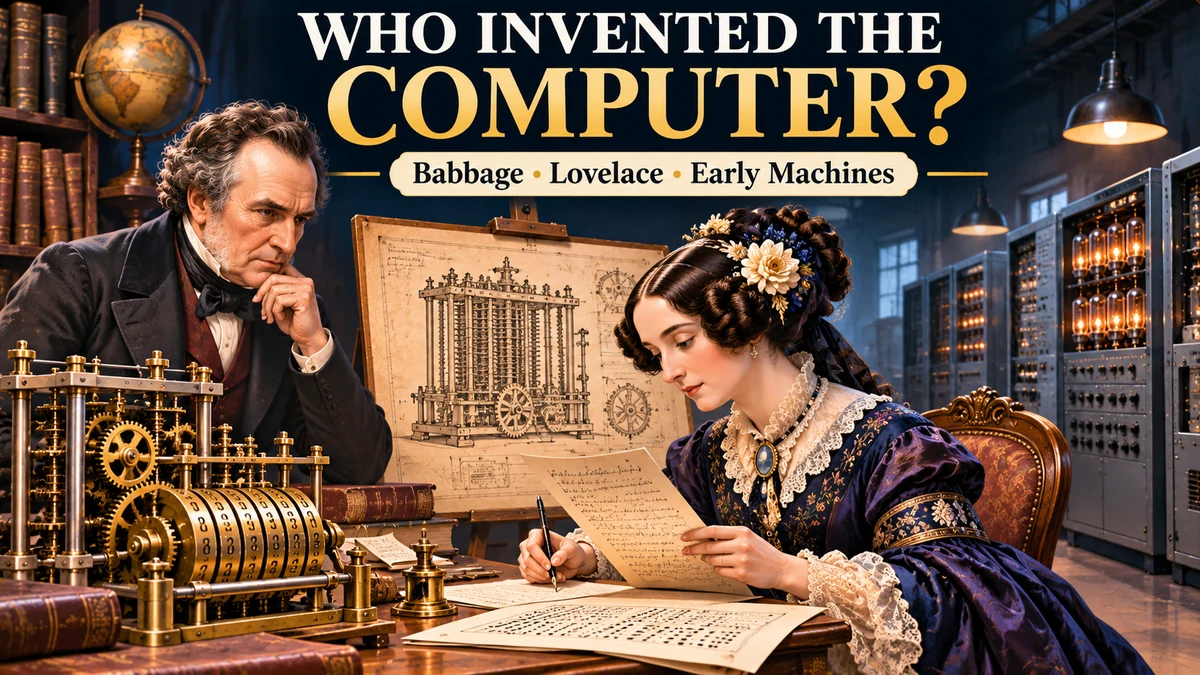
Who invented the computer? Charles Babbage is often called the “father of the computer” because he designed the Analytical Engine, a programmable, general-purpose mechanical machine, in the nineteenth century. Ada Lovelace helped explain its wider possibilities and published a detailed algorithm intended for it in 1843. But Babbage's Analytical Engine was never completed, and the first working electronic computers emerged many decades later through the efforts of different inventors and teams.
That makes the honest answer more interesting than one inventor's name. From the abacus and mechanical calculators to Konrad Zuse's Z3, the Atanasoff–Berry Computer, Colossus, ENIAC and the Manchester Baby, different machines were “first” in different ways. This educational guide explains who invented the computer, what Babbage and Lovelace actually achieved, and how historians distinguish an invention from a working machine.
Who invented the computer? The short answer
There is no single inventor of every kind of computer. The answer depends on the definition:
| What counts as the invention? | Major contributor or machine | Important qualification |
|---|---|---|
| Early tools for calculation | Abacus and other counting devices, developed across ancient societies | Not programmable computers and not attributable to one known modern inventor |
| Automatic mechanical calculation | Blaise Pascal, Gottfried Wilhelm Leibniz and other inventors | Specialised arithmetic devices, not universal computers |
| General-purpose programmable mechanical design | Charles Babbage's Analytical Engine, from the 1830s | The proposed machine was never completed |
| Early published program for a proposed computer | Ada Lovelace's 1843 Analytical Engine notes | Program was intended for an unbuilt machine; credit and collaboration require care |
| Working program-controlled electromechanical digital computer | Konrad Zuse's Z3, 1941 | Used relays, not modern electronic processor chips |
| Early special-purpose electronic digital calculation | Atanasoff–Berry Computer, developed around 1939–1942 | Not a general-purpose programmable computer |
| Large-scale programmable electronic system for codebreaking | Colossus, operational in 1944 | Specialised wartime machine |
| Electronic, general-purpose computing | ENIAC, publicly unveiled in 1946 | Originally programmed with switches and cables |
| Electronic stored program successfully executed | Manchester Baby, 21 June 1948 | Experimental system, not the first commercial personal computer |
The Computer History Museum's examination of competing “firsts” makes the essential point: saying “first computer” without a specific definition can turn an informative historical question into a misleading contest.
What does “computer” actually mean?
Today a computer is generally understood as a machine that can process information according to instructions. But calculation, automation, programmability, electronics and stored programs are different ideas. A calculator can carry out arithmetic without being a general-purpose programmable machine. A programmable device can use mechanical gears or electrical relays rather than modern transistors. A working electronic computer can use external switches or cables to hold its instructions rather than keeping them in electronic memory.
In earlier centuries, the word computer often meant a person who calculated mathematical tables. Such workers made important contributions to astronomy, navigation, engineering, government and science. The shift from a job performed by people to an automated machine unfolded gradually, rather than appearing in a single workshop on a single day.
For students, there are three useful questions to ask of every candidate: Was it built and working? Could it be programmed for different tasks? Where did it store its instructions? The answers help distinguish a brilliant design from a functioning modern-style computer.
Before Babbage: early calculating devices and mechanical ideas
The abacus and ancient calculation
The abacus and related counting boards helped people perform arithmetic centuries before electronic technology. Different forms appeared across societies, and no one modern inventor can be named as their sole creator. An abacus is an important predecessor, but it does not independently execute a stored sequence of instructions. People operate it according to mathematical rules.
Pascal, Leibniz and calculating machines
In the 1640s, Blaise Pascal designed a mechanical adding machine commonly called the Pascaline. Gottfried Wilhelm Leibniz later developed the stepped-reckoner concept, intended to support operations including multiplication. These designs brought gears and automatic carrying into calculations. The Mathematical Association of America's exhibit on early calculating machines documents surviving examples and replicas.
They were significant innovations, yet the ability to add or multiply mechanically is not the same as being able to run a general set of instructions. This distinction would become central to Babbage's later designs.
Jacquard's punched-card loom
In the early nineteenth century, the Jacquard loom used sequences of punched cards to control woven patterns. It was a textile machine, not a digital computer, but it demonstrated an influential idea: instructions could be encoded in a reusable physical medium. This concept helped inspire ways of controlling later calculating and computing machinery.
Charles Babbage: why is he called the father of the computer?
Charles Babbage (1791–1871) was an English mathematician and inventor frustrated by errors in hand-calculated mathematical tables. Tables were vital for navigation, astronomy, engineering and other activities, and mistakes could spread when figures were copied or printed. Babbage sought to automate the process so that mechanical steps could calculate and prepare reliable numerical results. The Computer History Museum's Babbage history explores his ambitions and the practical difficulties he faced.
Babbage's Difference Engine: a specialised calculator
In 1822, Babbage proposed a machine that became known as the Difference Engine. It was designed to generate mathematical tables using finite differences, a method that allows some numerical calculations to be produced mainly through repeated addition. The machine's columns of gears represented and manipulated numbers automatically.
Despite substantial work and government support, Difference Engine No. 1 was not completed as Babbage originally intended. Engineering challenges, expense and disagreements slowed the project. Crucially, even a completed Difference Engine would have been special-purpose: it could automate a particular kind of calculation, but it was not a broadly programmable general-purpose computer.
The Analytical Engine: the larger invention
During the 1830s, Babbage moved towards the far more ambitious Analytical Engine. It was intended to follow instructions and carry out different kinds of mathematical operations, using design features recognisable in later computers:
- The “store”: a proposed place for holding numerical values, comparable in concept to memory.
- The “mill”: the calculating unit, somewhat analogous to a processor.
- Punched-card control: a way to specify operations and values.
- Repeated and conditional operations: principles of controlling the order of computation.
- Output mechanisms: planned ways to record or print results.
This is why Babbage's reputation as a computing pioneer rests most strongly on the Analytical Engine, not simply the Difference Engine. The Computer History Museum's account of the engines contrasts the specialised calculation machinery with the more general-purpose proposal.
But there is a vital historical qualification: Babbage never completed a functioning Analytical Engine. Parts and trial models were built, and detailed plans survive, but the complete machine did not run programs in the nineteenth century. The Science Museum's Analytical Engine trial model is physical evidence of engineering work, not proof that an entire general-purpose computer operated.
Ada Lovelace: what did she contribute to computing?
Ada Lovelace (1815–1852), an English mathematician, became closely involved in explaining the potential of Babbage's Analytical Engine. Her 1843 work is one of the most important surviving publications in the early history of programming. Lovelace translated an article about the proposed machine by Luigi Menabrea and added a much longer series of notes of her own.
Note G and the Bernoulli-number algorithm
Among those notes was a detailed table of operations for computing Bernoulli numbers on the proposed Analytical Engine. This is why Lovelace is often described as the first computer programmer or, more carefully, as the person who published one of the earliest detailed programs for a general-purpose computer design. The Computer History Museum's Lovelace collection and Science Museum biography document the 1843 notes.
However, the machine was not completed, so the algorithm was not executed on a working Analytical Engine during Lovelace's lifetime. Babbage also developed computing procedures and contributed to their shared intellectual work. Historians discuss who produced particular calculations and how the notes were assembled. Avoiding the claim that Lovelace invented the entire computer by herself does not diminish her documented mathematical and explanatory achievements.
Why her broader vision matters
Lovelace recognised that a programmable engine might manipulate symbols representing things other than numerical quantities, so long as those things could be expressed through appropriate rules. She considered possibilities beyond straightforward arithmetic. This conceptual insight anticipated a broad feature of modern computers: the same machine can work with text, pictures, sound and many kinds of data when those data are encoded and processed according to instructions.
The Science Museum's examination of Lovelace explains why her vision of general-purpose symbolic processing is historically important. It is best understood as a contribution to the intellectual foundations of computing, rather than as proof that she foresaw every modern application.
Did Babbage ever build a working computer?
No complete Analytical Engine was finished in his lifetime. This does not mean all Babbage's designs were impossible. The Science Museum in London used his later plans for Difference Engine No. 2 to build a working calculating section completed in 1991; the printing mechanism was added in 2002. This reconstruction demonstrated the feasibility of his mechanical calculating design.
The distinction matters: the twentieth- and twenty-first-century reconstruction was a Difference Engine, a specialised calculator, not a completed version of Babbage's much more ambitious general-purpose Analytical Engine. The Science Museum collection record confirms both completion stages.
Early working computers: who actually built them?
After Babbage and Lovelace, inventors developed new methods of processing information. Punched-card tabulators, mathematical models, relay machines and electronic circuits each helped move computation closer to practical computers.
Herman Hollerith and punched-card processing
Herman Hollerith developed electromechanical equipment used to process information for the 1890 United States census. Punched cards were valuable for handling large volumes of data. This was an important link between mechanical calculating systems and industrial data processing, but it was not a general-purpose stored-program computer.
Alan Turing and the theory of computation
In 1936, Alan Turing described an abstract model of computation capable of representing algorithmic procedures. The Turing machine is a mathematical idea, not a physical computer that rolled off an assembly line. His work helped clarify what it means for a method to be computable, and his later career included codebreaking and practical computer design. The Stanford Encyclopedia of Philosophy's modern history of computing gives this theory an appropriate place in the wider story.
Konrad Zuse and the Z3 (1941)
Konrad Zuse built the Z3 in Germany in 1941. It was a working program-controlled digital calculator using electromechanical relays, often credited as the first functioning general-purpose program-controlled digital computer. It was not a modern electronic machine with vacuum tubes or semiconductor chips. The German Patent and Trade Mark Office documents the Z3's development.
Atanasoff and Berry's electronic calculator
John Vincent Atanasoff and Clifford Berry developed the Atanasoff–Berry Computer (ABC) in the United States around 1939–1942. It used important electronic techniques for solving systems of linear equations. Its claim to an early electronic digital milestone is significant, but it was not a generally programmable computer. The Computer History Museum's ABC exhibit makes that limitation clear.
The ABC also featured in a major US patent dispute involving ENIAC-related claims. That legal history should not be mistaken for a simple scientific verdict naming one person as the inventor of every modern computer.
Tommy Flowers and Colossus (1944)
Tommy Flowers and a team working with British wartime codebreakers developed Colossus, an electronic system used at Bletchley Park for specialised cryptanalytic work. The first machine was operational in early 1944. Its electronic circuits and ability to be configured for particular tasks made it a major milestone, but it was not a general-purpose stored-program computer like a modern PC. The National Museum of Computing describes how Colossus operated and what it was designed to do.
Eckert, Mauchly and the ENIAC team (1946)
J. Presper Eckert and John Mauchly led the design of ENIAC, an electronic numerical computer developed during the Second World War and publicly unveiled in 1946. It was much more flexible in its calculation tasks than Colossus, though its original programming involved configuring switches and cables rather than typing software into a modern operating system.
Designers were not the only inventors of working computer practice. Six women who became ENIAC's original programmers—including Jean Jennings Bartik, Betty Snyder Holberton and Kathleen McNulty—developed ways to make its complex hardware execute useful computational tasks. The IEEE Computer Society's account of the women of ENIAC documents this foundational programming work. It is misleading to credit an early computer's success only to its hardware designers.
Manchester Baby and stored-program computing (1948)
The Manchester Small-Scale Experimental Machine, nicknamed the Baby, ran an electronically stored program on 21 June 1948. Rather than relying entirely on externally configured wiring or punched tape, it demonstrated that instructions could be held in electronic memory and executed by the machine. This was a milestone for the stored-program architecture that underpins most modern computers. The University of Manchester's history department record identifies F. C. Williams and Tom Kilburn among the principal developers.
Computer invention timeline: the essential dates
| Date or period | Person or machine | Contribution |
|---|---|---|
| Ancient societies | Abacus and counting devices | Manual arithmetic aids |
| 1640s | Blaise Pascal | Geared mechanical arithmetic machine |
| Early 1800s | Jacquard loom | Punched-card control of machine operations |
| 1822 | Charles Babbage | Proposal for the Difference Engine |
| 1830s | Babbage's Analytical Engine | General-purpose programmable mechanical design |
| 1843 | Ada Lovelace | Published detailed notes and Bernoulli-number algorithm |
| 1890 | Herman Hollerith | Census punched-card tabulation |
| 1936 | Alan Turing | Abstract theory of computable procedures |
| 1941 | Konrad Zuse's Z3 | Working relay-based programmable digital computer |
| 1939–1942 | Atanasoff–Berry Computer | Special-purpose electronic calculation |
| 1944 | Colossus | Electronic programmable wartime codebreaking system |
| 1946 | ENIAC unveiled | Large-scale electronic general-purpose computing |
| 1948 | Manchester Baby | Successful electronically stored program |
| 1991 and 2002 | Difference Engine No. 2 reconstruction | Babbage's later mechanical calculation design demonstrated in working form |
Why “the first computer” is not one simple invention
Technology often develops through successive contributions. One person invents a mathematical technique, another designs a mechanism, a skilled team builds machinery, and programmers discover how to make it useful. Some inventions remain drawings; others are built for specific jobs and only later evolve into general-purpose systems.
Consider three examples. The Analytical Engine was a remarkably advanced design, but was not completed. The Z3 was a working programmable relay machine, but did not use electronic vacuum-tube circuits as its principal logic. The Manchester Baby demonstrated electronic stored-program execution, but was not a widely sold personal computer. All deserve recognition, yet none alone explains everything that followed.
Historical evidence also has limits. Original plans, Lovelace's printed notes, preserved components, technical reports and reconstructed machines establish different kinds of claims. A modern recreation can test whether a design is feasible; it cannot prove that a complete working version existed a century earlier. A patent ruling can settle a legal dispute without settling every possible definition of technological priority.
How did these inventions lead to computers we use today?
Modern desktop computers, laptops and smartphones share important ideas with Babbage's proposed architecture: instructions control a processor, data are held in memory, and devices receive input and produce output. But today's systems also depend on transistors, integrated circuits, microprocessors, operating systems, storage and networks developed by many other engineers and researchers over the past century.
Lovelace's insight that programmable machines could manipulate symbols beyond simple quantities is especially relevant. Modern software works with pictures, music, language and AI models because information can be represented digitally and processed according to instructions. Students can explore the underlying mathematical reasoning in SuperEducational's guide to mathematics and its applications , and see one contemporary application in its guide to AI tools for studying .
Five common myths about who invented the computer
- Myth 1: Babbage built the first fully working laptop-sized computer. He designed pioneering mechanical engines; the general-purpose Analytical Engine was not completed.
- Myth 2: Lovelace invented the computer hardware by herself. She contributed influential mathematical and explanatory work to Babbage's proposed machine; she did not construct its hardware.
- Myth 3: Ada's 1843 algorithm ran on a real Analytical Engine. The machine was unbuilt, so the published procedure was not executed on it during her lifetime.
- Myth 4: ENIAC was the first machine ever used for calculation. Calculating devices and programmable machines existed before it; ENIAC's importance depends on its electronic and general-purpose characteristics.
- Myth 5: Computer history belongs to one genius. Its development depended on mathematicians, inventors, craftspeople, hardware engineers, programmers and many collaborators.
Classroom activity: decide who deserves the title “inventor”
Divide learners into five groups representing Babbage, Lovelace, Zuse, the ENIAC team and Manchester's stored-program team. Give each group the question: “What was invented, and was it a design, an algorithm or a functioning machine?” They should find one museum or university source, write a one-sentence claim, then identify one limitation.
For example, a Babbage group might argue that he conceived a general-purpose programmable mechanical computer but acknowledge that the machine was not completed. A Lovelace group might discuss an early published computer algorithm while recognising that it was not run on the proposed device. A Manchester group can point to a verified 1948 stored-program demonstration. The point is not to declare a single winner; it is to learn how precise definitions and historical evidence shape an answer.
Frequently asked questions
Who is called the father of the computer?
Charles Babbage is commonly called the father of the computer because his Analytical Engine anticipated general-purpose programmable computing. The title recognises a foundational design, not the completion of a modern electronic PC.
Did Ada Lovelace invent the first computer?
No. She made important contributions to the description and potential programming of Babbage's proposed Analytical Engine. She is widely celebrated for her 1843 notes and Bernoulli-number procedure.
Who was the first computer programmer?
Ada Lovelace is commonly given this title because her 1843 publication includes a detailed algorithm for the proposed Analytical Engine. Historians also examine Babbage's earlier unpublished work and the collaborative development of the notes, so “first published program for the proposed machine” is more precise than an unqualified claim of sole priority.
What was the first electronic computer?
It depends on the requirements. The Atanasoff–Berry Computer was an early special-purpose electronic digital calculator; Colossus was an early large-scale programmable electronic machine for codebreaking; ENIAC became an influential electronic general-purpose computer.
Was ENIAC invented by one person?
No. J. Presper Eckert and John Mauchly led its design, but engineers, technicians and pioneering programmers—including six women—were essential to making the system work.
What made the Manchester Baby special?
It successfully ran an electronically stored program on 21 June 1948, demonstrating a core principle of modern computing.
Did the first computers use electricity?
Not all. Earlier calculating machines used beads, gears or mechanical relays. Later electronic computers relied on components such as vacuum tubes and, eventually, semiconductors.
Conclusion
Who invented the computer? The most accurate answer is that Charles Babbage pioneered the design of a programmable general-purpose mechanical computer, Ada Lovelace published influential early programming work, and a succession of engineers and programming teams made working digital computers possible. Their achievements were different and complementary.
The story of computing is therefore not a single moment of invention. It is an accumulation of ideas, designs, experimental machines and practical systems. Knowing which “first” is being claimed is the key to giving a historically accurate answer.