You have probably seen it.
A full Moon begins rising behind trees, buildings, or distant hills and appears enormous.
A few hours later, the same Moon is high in an empty sky and somehow seems much smaller.
It is tempting to assume that something in Earth's atmosphere magnifies the Moon near the horizon.
But that is not what is happening.
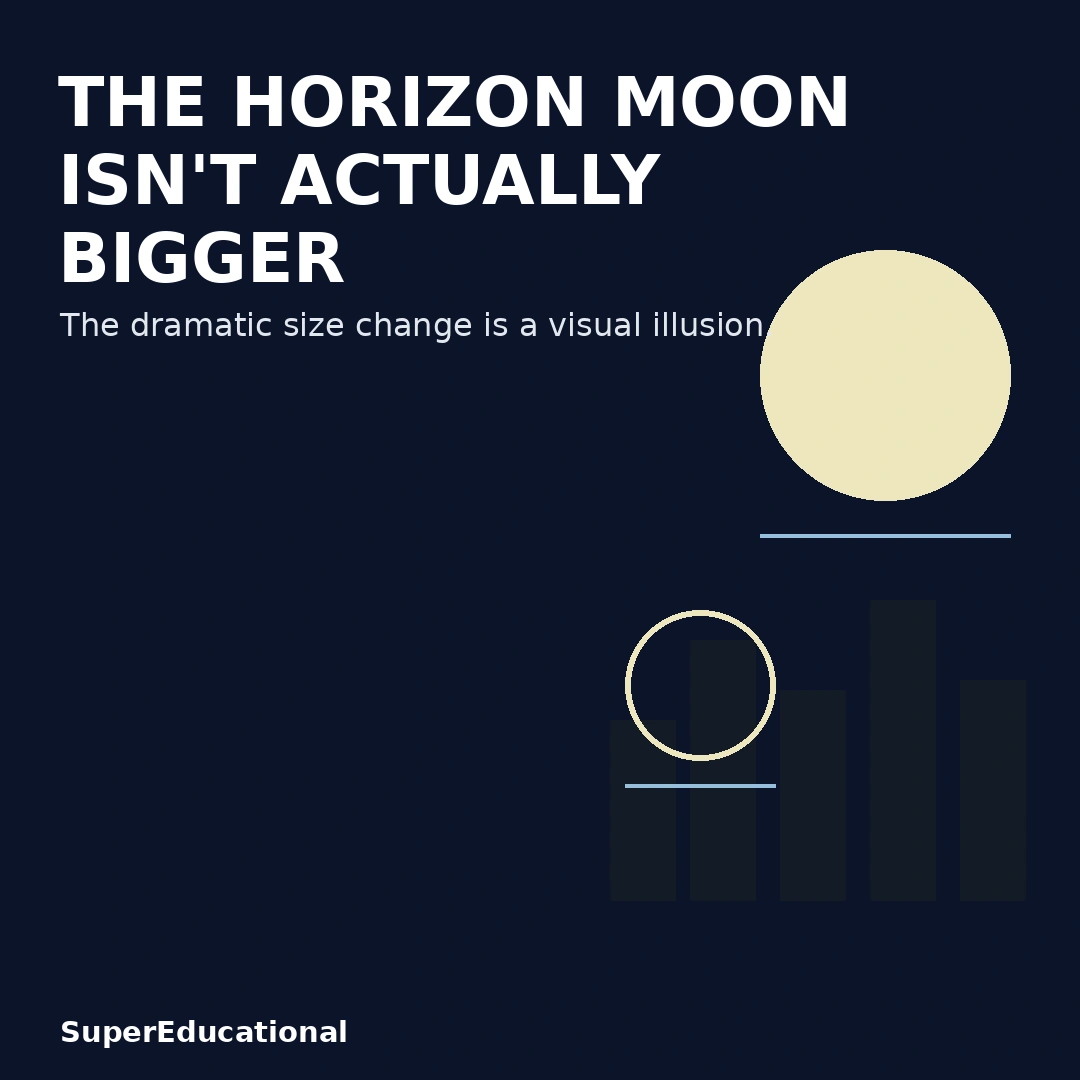
The Moon has barely changed its apparent width.
Your perception has.
The phenomenon is known as the Moon illusion, and it provides a fascinating example of how the brain interprets the world rather than simply measuring it.
The Moon Doesn't Suddenly Grow Near the Horizon
NASA notes that photographs provide a straightforward way to test the effect.
Take a picture of the Moon near the horizon.
Later, when the Moon is high in the sky, photograph it again using the same imaging setup and zoom.
Compare the horizontal diameter of the Moon in both photographs.
They are essentially the same.
That means the enormous-looking horizon Moon is not actually producing a dramatically larger image on your camera sensor—or on the retina of your eye.
The perceived enlargement happens somewhere in the process through which the brain interprets that visual information.
You Can Test the Illusion Yourself
You do not necessarily need sophisticated equipment.
NASA suggests several simple demonstrations.
One is to hold your finger at arm's length and compare your fingernail with the Moon when it looks huge near the horizon.
Try the same comparison later when the Moon is high overhead.
Its angular size will remain essentially the same.
A camera makes the demonstration even clearer because it removes some of the brain's subjective interpretation.
The photograph does not experience the illusion.
You do.
So Why Does the Moon Look Bigger?
This is where the story becomes more interesting.
Scientists still do not have one universally accepted explanation that completely accounts for the Moon illusion.
NASA notes that despite people observing the effect for thousands of years, there is still no single definitive explanation for why the brain perceives the horizon Moon as so much larger.
Several proposed explanations involve the way our visual system interprets:
- Distance
- Apparent size
- Depth
- Perspective
- Objects in the foreground
- The shape and scale of the surrounding landscape
The illusion may therefore involve several perceptual processes rather than one simple trick.
The Horizon Gives Your Brain Context
One important difference between a rising Moon and a Moon high overhead is everything surrounding it.
Near the horizon, you may see the Moon beside:
- Buildings
- Trees
- Mountains
- Telephone poles
- Roads
- Distant landscapes
These familiar objects provide visual information about scale and distance.
High in the sky, much of that context disappears.
The Moon is surrounded mainly by empty sky.
Our brains therefore interpret the two scenes differently even though the Moon's angular size has barely changed. NASA notes that foreground objects and our expectations about distance near the horizon are among the factors considered in explanations of the illusion.
Your Brain Doesn't Simply Measure the Image
This points to a broader fact about vision.
Your eyes collect light.
Your brain has to interpret what that light means.
When looking at the world, the brain constantly makes judgments about:
- How far away something is
- How large it probably is
- Whether one object is in front of another
- How lighting affects colour
- What parts of a scene belong together
Usually, those shortcuts work remarkably well.
But illusions reveal situations where our perception differs from a straightforward physical measurement.
The Moon illusion is one particularly dramatic example.
You can know intellectually that the Moon has not doubled in apparent width and still look at the horizon and think:
“That Moon is huge.”
Knowing about the illusion does not necessarily make it disappear.
Is the Atmosphere Doing Anything?
Yes—but not what many people assume.
Earth's atmosphere can affect the appearance of a Moon near the horizon.
Atmospheric refraction can slightly distort it.
NASA notes that a very low Moon can appear somewhat squashed vertically because Earth's atmosphere behaves like a weak lens, bending light differently near the horizon.
But this does not explain the dramatic impression that the Moon has become enormous.
In fact, NASA's photographic comparison shows that the Moon's longest horizontal diameter remains essentially unchanged.
So:
Atmospheric distortion is real.
Atmospheric magnification is not the explanation for the Moon illusion.
But the Orange Colour Is Real
There is another change near the horizon that is not merely an illusion.
The Moon really can appear more yellow, orange, or reddish when it is rising or setting.
Why?
Its light has to travel through a longer path in Earth's atmosphere before reaching your eyes.
As that light travels through more air, shorter blue and violet wavelengths are scattered more strongly.
More of the longer yellow, orange, and red wavelengths remain in the direct light reaching you.
That is closely related to the same atmospheric physics that gives us reddish sunsets.
Dust, smoke, pollution, and other particles can sometimes make the effect even stronger.
So when you see an enormous orange Moon on the horizon, two different phenomena are happening:
The enormous size → mainly perception
The orange colour → atmospheric physics
What About a Supermoon?
There is another source of confusion.
The Moon's distance from Earth really does change.
Its orbit is not a perfect circle.
When a full Moon occurs relatively close to Earth, it is commonly described as a supermoon.
That can make its apparent diameter genuinely somewhat larger than when the Moon is farther away.
But that is a different phenomenon from the Moon illusion.
A supermoon can still experience the Moon illusion.
And an ordinary full Moon can look enormous on the horizon even when it is not particularly close to Earth.
So:
Supermoon → genuine change related to distance
Moon illusion → perceived change related to visual interpretation
They should not be confused.
Why Do Giant-Moon Photographs Look So Dramatic?
You may have seen photographs showing a gigantic Moon behind a building, mountain, person, or city skyline.
Those images are not necessarily fake.
But photography can exaggerate the relationship between the Moon and foreground objects.
NASA explains that photographers often use long telephoto lenses while standing far from the foreground subject.
The lens magnifies the entire distant scene, making both the landscape and Moon appear large within the frame.
This can produce breathtaking images of a giant-looking Moon behind a landmark.
The Moon itself has not suddenly grown.
It is a consequence of perspective, distance, and lens choice.
A Simple Experiment for the Next Full Moon
The next time you see a huge Moon rising, try this experiment.
Step 1
Look at the Moon while it is close to the horizon.
Notice how large it seems.
Step 2
Take a photograph.
Keep track of your camera's zoom setting.
Step 3
A few hours later, photograph the Moon again when it is higher in the sky using the same zoom.
Step 4
Compare the Moon's horizontal diameter in both images.
The result may surprise you.
Your memory says:
“The first Moon was enormous.”
Your photograph says:
“They are almost the same size.”
That difference is the Moon illusion in action.
One View, Three Areas of Science
Part of what makes a rising Moon so interesting is how many scientific ideas appear in a single observation.
Astronomy
The Moon is orbiting Earth, and its true distance and apparent angular diameter change somewhat during its orbit.
Atmospheric physics
Moonlight travelling through more atmosphere near the horizon experiences stronger scattering and refraction, contributing to warmer colours and slight distortion.
Neuroscience and perception
Your brain interprets the Moon as much larger near the horizon even though its measured apparent width remains essentially unchanged.
One ordinary view of the evening sky therefore connects the physics of light, the geometry of the Solar System, and the workings of the human mind.
Why It Matters
The Moon illusion reveals something much bigger than a curious fact about astronomy.
It reminds us that seeing is not the same thing as measuring.
Our eyes provide information.
Our brains interpret it.
Most of the time, that interpretation gives us an extremely useful representation of reality.
But sometimes the brain's assumptions about distance, context, and scale produce an experience that differs from physical measurements.
So the next time a giant full Moon rises above the horizon, enjoy the view.
Just remember:
The Moon didn't suddenly become bigger.
Your brain made it look that way.