When it comes to protecting your hearing, volume is only part of the story.
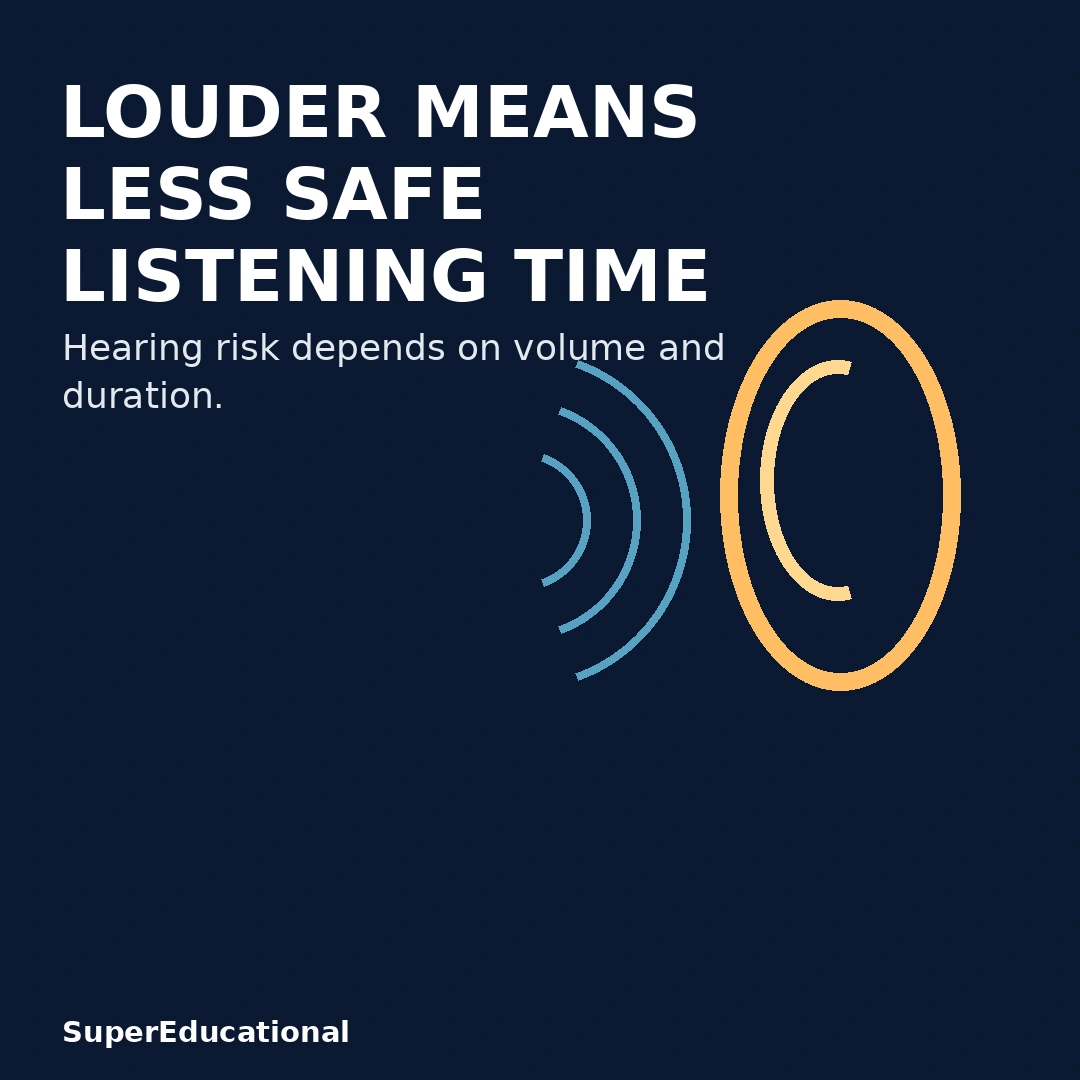
Your ears are affected by both how loud a sound is and how long you are exposed to it.
A sound that may be relatively safe for several hours can become harmful much more quickly when the volume increases.
That means listening safely is not simply about asking:
“Is this too loud?”
You should also ask:
“How long have I been listening?”
How Loud Sound Can Damage Your Hearing
Deep inside the inner ear is a snail-shaped structure called the cochlea.
The cochlea contains sensory hair cells that help convert sound vibrations into electrical signals. Those signals travel through the auditory nerve to the brain, where they are interpreted as sound.
Repeated or prolonged exposure to excessive noise can damage these delicate structures. In humans, damaged sensory hair cells do not regenerate, which is why noise-induced hearing loss can become permanent.
Loud sound exposure can also contribute to tinnitus, which may be experienced as ringing, buzzing, or other sounds in the ears.
The Louder the Sound, the Less Time You Can Safely Listen
This relationship is one of the most important things to understand about hearing protection.
According to the World Health Organization's safe-listening guidance, adults can listen to an average sound level of around 80 decibels (dB) for up to 40 hours per week.
Increase that sound level to 90 dB, however, and the corresponding safe-listening time falls to approximately four hours per week.
That's a dramatic difference.
Sound level | WHO safe-listening time |
|---|---|
80 dB | Up to 40 hours/week |
85 dB | About 12 hours 30 minutes/week |
90 dB | About 4 hours/week |
95 dB | About 1 hour 15 minutes/week |
100 dB | About 20 minutes/week |
These figures illustrate an important principle:
As sound gets louder, safe exposure time falls rapidly.
“It Wasn't Loud for Very Long” Isn't Always Reassuring
People sometimes assume that a brief exposure cannot cause hearing damage.
That is not necessarily true.
A moderately loud sound may require repeated or prolonged exposure before damage develops, but an extremely intense sound can potentially cause immediate hearing injury.
Noise-induced hearing loss can result from a single very loud event — such as an explosion — as well as from repeated exposure to loud music, machinery, sporting events, concerts, headphones, or other noisy environments.
So hearing risk depends on several factors:
- How loud the sound is
- How long you hear it
- How often the exposure occurs
- How close you are to the sound source
A useful rule is:
Too loud + too long + too close = greater risk to your hearing.
Headphones Can Be Part of the Problem
Headphones and earbuds are not automatically harmful.
The problem is how loudly and how long they are used.
WHO recommends keeping personal listening devices at no more than around 60% of maximum volume and, where sound-level monitoring is available, aiming to remain below an average of 80 dB.
Well-fitting or noise-cancelling headphones can also help in noisy environments because they may reduce the temptation to keep increasing the volume simply to hear audio over background noise.
Simple Ways to Protect Your Hearing
You do not have to stop enjoying music, concerts, entertainment, or other activities you love.
The goal is to reduce unnecessary exposure.
Turn the volume down
A small reduction in volume can significantly increase the amount of time you can listen more safely.
Take listening breaks
Give your ears periods away from loud sound, especially during prolonged listening sessions.
Move away from loudspeakers
Distance matters.
At concerts, parties, sporting events, and other noisy environments, avoid standing unnecessarily close to speakers or other powerful sound sources.
Use hearing protection
Earplugs or appropriate hearing protectors can help reduce exposure in loud environments such as concerts, industrial workplaces, sporting events, or when using noisy equipment.
Monitor your sound exposure
Some smartphones, smartwatches, headphones, and apps can estimate environmental or headphone sound levels.
Use these tools to understand how much sound you are being exposed to rather than relying entirely on whether the volume feels uncomfortable.
Pay Attention to Warning Signs
Hearing damage can develop gradually, which means you may not immediately recognise that anything has changed.
Possible warning signs following loud sound exposure can include:
- Ringing or buzzing in the ears
- Sounds seeming muffled
- Difficulty following conversations
- Needing to increase the volume on devices
- Difficulty hearing certain higher-pitched sounds
If these problems persist, consider having your hearing assessed by a qualified healthcare professional.
Why It Matters
Noise-induced hearing loss is largely preventable.
But protecting your hearing requires thinking about sound exposure, not just sound volume.
A level that may be acceptable for a longer period at 80 dB is not equivalent to listening for the same amount of time at 90, 100, or 110 dB.
The louder the sound becomes, the less time your ears can safely tolerate it.
So whether you're using headphones, attending a concert, working around machinery, or spending time in another noisy environment, remember:
Lower the volume. Limit the time. Increase your distance when possible. Protect your ears before the damage is done.