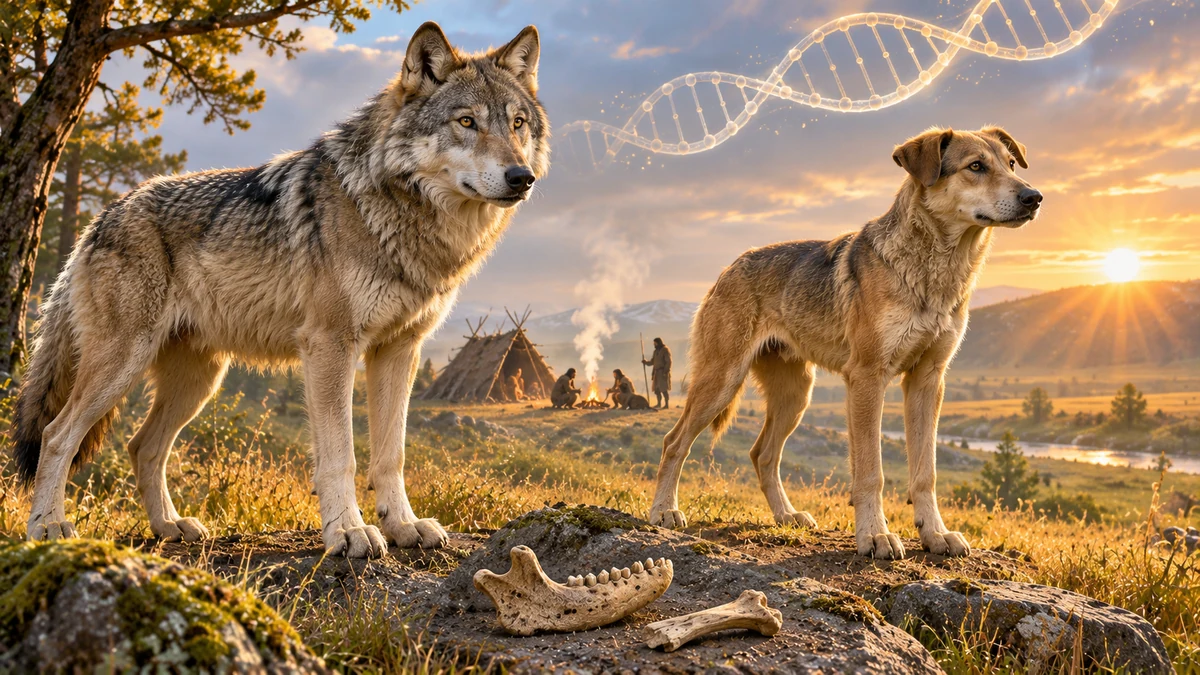
How did dogs evolve from wolves? Domestic dogs evolved from ancient grey-wolf populations over many generations during the last Ice Age. As some wolves and humans began living in closer proximity, evolutionary changes in behaviour, reproduction and eventually anatomy helped produce the ancestors of domestic dogs. The exact route remains uncertain: no scientist has identified one living wolf population that was definitively “the first dog”, and the story cannot be reduced to a single person taming a wolf.
The strongest new clues come from ancient DNA. Two studies published in Nature in March 2026 confirmed dog ancestry in remains from Pınarbaşı, Türkiye, about 15,800 years old, Gough's Cave, England, about 14,300 years old, and Kesslerloch, Switzerland, about 14,200 years old. By the Late Palaeolithic, dogs were already present in widely separated parts of western Eurasia—long before agriculture spread through the region. These are the oldest securely identified dog genomes currently described in those studies, not necessarily the moment domestication began. Read the two original papers: Dogs were widely distributed across western Eurasia during the Palaeolithic and Genomic history of early dogs in Europe .
Understanding how dogs evolved from wolves requires combining fossil anatomy, archaeological context, DNA comparisons and observations of living animals. Each answers a different question. This guide explains the discoveries, the leading hypotheses and the limits of the evidence without treating uncertain reconstructions as established facts.
Dog evolution from wolves: the key facts
| Question | Evidence-based answer |
|---|---|
| What did dogs evolve from? | Ancient grey-wolf populations, not one known population of wolves living today. |
| When did dogs first appear? | Securely identified dog DNA exists from about 15,800 years ago; domestication probably began earlier. |
| Where did domestication happen? | The exact geographic origin is unresolved; ancient-wolf and early-dog ancestry spans multiple Eurasian regions. |
| Was there one domestication event? | Shared early dog ancestry is well supported, but the contributions of different wolf populations and later gene flow complicate the question. |
| What evidence is strongest? | Directly dated ancient genomes interpreted alongside skeletal measurements and archaeological context. |
| Were dogs living with farmers first? | No. Dog ancestry is documented among human hunter-gatherer societies well before farming. |
| Did all dogs become friendly at once? | No. Domestication describes changes over many generations, with behaviour and appearance varying among populations. |
1. Are dogs descended from modern wolves?
Domestic dogs belong to the canid family, which includes wolves, coyotes, jackals and foxes. They are commonly classified as Canis familiaris or as the domestic subspecies Canis lupus familiaris. Both treatments reflect their extremely close evolutionary relationship to the grey wolf, Canis lupus. For a basic introduction to vertebrates and animal families, see SuperEducational's published animal-classification guide .
But the phrase “dogs evolved from wolves” is often misunderstood. It does not mean that a modern grey wolf simply changed into a golden retriever. Dogs and today's wolves share older wolf ancestors, and their populations have evolved along partly separate paths. Many ancient wolf populations became extinct, and neither modern wolves nor modern dogs are unchanged replicas of their Ice Age ancestors.
Genomic reviews show that dogs and wolves have remained closely related enough for occasional interbreeding after domestication. Their ancestry is therefore more like a branching tree with some later connections than a neat straight line from a single wolf to a modern breed. A Nature Reviews Genetics review of the canine genome explains this complex demographic history.
2. What did the March 2026 discoveries reveal?
On 25 March 2026, scientists announced genetic findings that moved back the earliest unambiguous dog-DNA evidence by thousands of years. The first Nature study examined canid remains from Pınarbaşı in Türkiye, about 15,800 years old, and Gough's Cave in Somerset, England, about 14,300 years old. The research also investigated later dogs from Serbia. Genetic analysis placed the oldest specimens within dog ancestry, separating them from wolves more reliably than skeletal appearance alone. The Natural History Museum's report describes their significance.
A companion study used genome-wide capture methods on a broad collection of ancient dog and wolf remains. It identified an approximately 14,200-year-old dog from Kesslerloch, Switzerland, showing ancestry linked to later dogs across the world. The original research paper also shows why some older proposed dog fossils need re-evaluation.
These results suggest that recognisable dog populations already occupied western Eurasia during the Late Upper Palaeolithic. The individuals from different regions were genetically related, implying a deeper shared history. But the oldest sequenced animal is not necessarily the first dog ever born: older dogs may have existed without leaving DNA that survived or has yet been recovered.
3. Timeline: from ancient wolf populations to domestic dogs
| Period | What the evidence shows | Confidence or caveat |
|---|---|---|
| More than 30,000 years ago | Some European and Asian canid skulls were proposed to be “proto-dogs”. | Several have since been assigned genetically to extinct wolves; not secure proof of domestication. |
| Last Ice Age, before 15,800 years ago | An ancestral wolf-to-dog divergence and some form of domestication must have occurred. | Timing, location and precise mechanism remain uncertain. |
| About 15,800 years ago | Dog ancestry identified at Pınarbaşı, Türkiye. | Ancient genetic identification reported in 2026. |
| About 14,300 years ago | Dog ancestry identified at Gough's Cave, Britain. | Ancient genetic identification reported in 2026. |
| About 14,200 years ago | Early dog at Kesslerloch, Switzerland; related to other dog lineages. | Genome analysis reported in 2026. |
| Roughly 14,000 years ago | A dog-like animal buried with people at Bonn–Oberkassel, Germany. | Strong archaeological evidence of human–dog association; nuclear genome unavailable in the 2026 analysis. |
| After farming spread | Some dog populations developed dietary and regional genetic changes, while people selected animals for particular functions. | These later changes should not be confused with the first domestication. |
| Recent centuries | Many standardised modern dog breeds were created through deliberate selection. | Modern breed history is much younger than dog domestication. |
The timeline deliberately separates secure dated specimens from models of earlier events. It is more accurate than assigning domestication one confident date such as “10,000 years ago”.
4. Fossil evidence: why do early dogs and wolves look so similar?
Archaeologists examine skull shape, jaw dimensions, teeth, limb bones, wear patterns and burial context to identify ancient canids. In some archaeological settings, relatively short muzzles or different tooth spacing have been considered possible dog-like traits. However, wolf populations also varied in size and skull shape during the Ice Age. An unusual-looking skull is not automatically a domesticated animal.
The problem becomes clear at sites such as Goyet in Belgium and Předmostí in Czechia. Some remains dating back more than 25,000 or 30,000 years were proposed as extremely early dogs based on shape. Genomic analysis discussed in the 2026 Nature study shows that several ancient canids from these earlier claims instead belonged to extinct wolf populations. Another 2026 investigation found that some dog-like DNA reported from earlier archaeological layers reflected later deposition or contamination. The record is valuable, but its interpretation has changed.
The Bonn–Oberkassel burial in Germany offers different evidence. A dog-like canid was buried with humans, and pathological signs have been interpreted as evidence of care during illness. This suggests a close human–animal relationship by roughly 14,000 years ago. Yet care and burial do not reveal how or where the very first steps of domestication took place. A fossil and a genome must be interpreted together rather than one automatically replacing the other.
5. Ancient DNA: how do scientists tell a dog from a wolf?
Ancient DNA can survive in teeth and bones under favourable conditions. Researchers extract tiny genetic fragments, sequence them and compare them with data from ancient wolves, later dogs and present-day canids. They also examine whether the DNA really belongs to the specimen and whether it could come from modern contamination.
Modern techniques can enrich fragments characteristic of a target animal, sometimes making low-DNA samples usable. The 2026 European study described an enrichment approach that could distinguish dog and wolf ancestry in 141 of 216 sampled remains. Statistical analyses then estimated how individuals were related, which wolf lineages contributed ancestry and whether populations changed as people moved. Read the study's methods and results .
DNA is powerful but not magical. It often tells us which lineage an animal belonged to more confidently than what it looked like, whether it lived in a person's shelter or how affectionate it was. Archaeology supplies the missing context—dates, settlements, tools, food remains and burials. Science is strongest when different forms of evidence support a compatible explanation.
6. Where did dogs first evolve? East versus west Eurasia
The geographical origin of dog domestication is still debated. Studies have proposed different areas of Eurasia, partly because wolf populations moved widely and because the oldest available samples are unevenly distributed. A 2022 Nature study of ancient wolves found that dogs were generally closer genetically to ancient eastern Eurasian wolves than to western wolf populations. It also detected extra ancestry in dogs from the Near East and Africa related to wolves of southwestern Eurasia.
That combination prompted a dual-ancestry model. But two ancestral wolf contributions are not automatically proof of two independently domesticated dog populations. A second contribution can also result from interbreeding between dogs and local wolves after domestication. Crucially, none of the sampled ancient wolves was an exact match for dogs' inferred ancestors.
The March 2026 European genomic study refined this discussion by finding that the earliest European dogs could be explained through ancestry related to the eastern progenitor source; an independent western domestication event was not required by those data. Other results still show local wolf-related gene flow at different times. The evidence favours caution: the precise origin remains unknown, and the number of initial domestication events is not finally settled. See the updated 2026 genomic model .
7. How might humans and wolves have started living together?
Scientists investigate several possible scenarios. One proposes that relatively tolerant wolves scavenged around human camps, gradually benefiting from food opportunities and reduced conflict. Another emphasises wolves and people encountering each other during hunting, possibly leading to cooperative relationships or the raising of young animals. Other models combine human selection and natural selection across many generations.
These are hypotheses, not film-like historical scenes recorded by witnesses. The fossil record does not reveal who first approached whom, whether people deliberately fed wolves or whether relationships developed in one community or multiple places. Early humans and wolves both hunted large animals in Palaeolithic environments, but that ecological overlap alone cannot prove a specific domestication mechanism.
Domestication also is not the same as taming. Taming changes the behaviour of an individual through experience. Domestication involves inherited changes across generations in a population that reproduces in a new ecological and social setting. Even if humans raised a friendly wolf pup, that single event would not by itself create the domesticated dog lineage.
8. What changed in dogs' bodies during evolution?
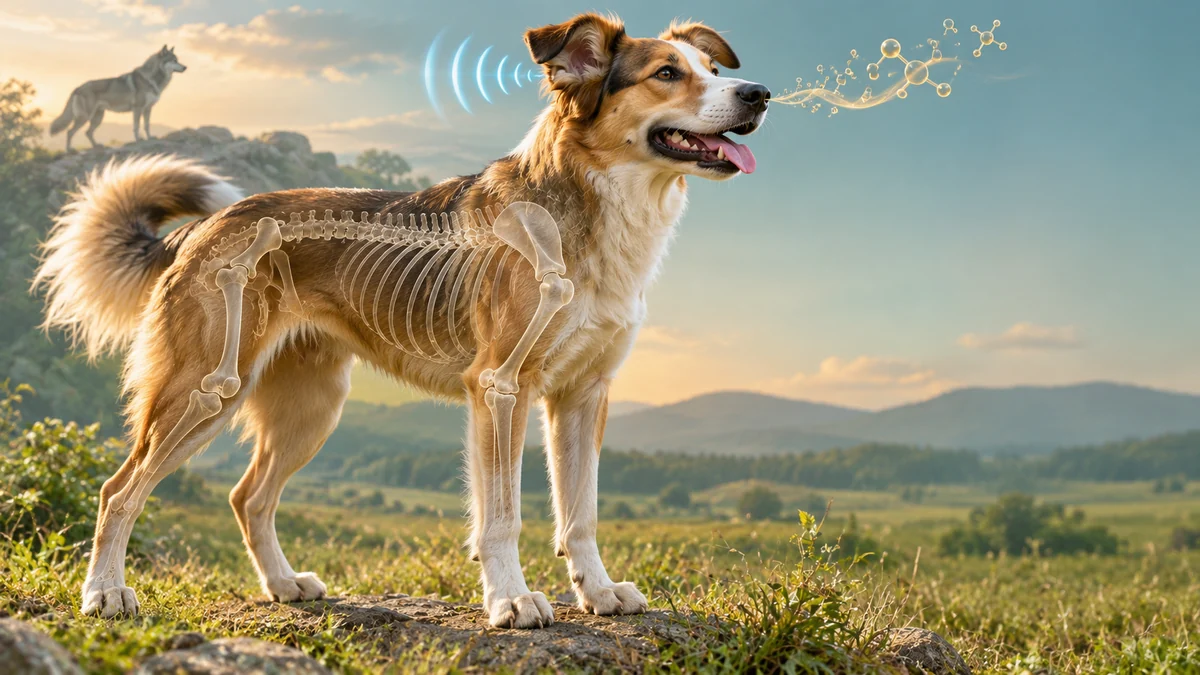
Dogs and wolves share the basic anatomy of canid mammals: four limbs, digitigrade paws, teeth adapted for gripping and cutting, an acute sense of smell and a similar underlying skeleton. Over evolutionary time—and especially during later selective breeding—dogs developed a remarkable range of body sizes, skull shapes, ear forms, coat colours and tail types.
Some early changes may have involved behaviour and tolerance of human proximity before the dramatic appearance differences familiar from modern breeds. Skull measurements alone cannot place every prehistoric canid on a simple wolf-to-dog ladder. Nor did all domesticated dogs automatically acquire floppy ears, curled tails or shortened snouts. These features vary widely and may have emerged through different genetic and selective processes.
In recent centuries, humans created many distinct breeds for herding, retrieving, guarding, hunting and companionship. A review of canine genomic history describes how breed formation introduced new genetic bottlenecks and strong selection, often long after the first domestic dogs.
9. Did domestication make dogs friendlier and smarter than wolves?
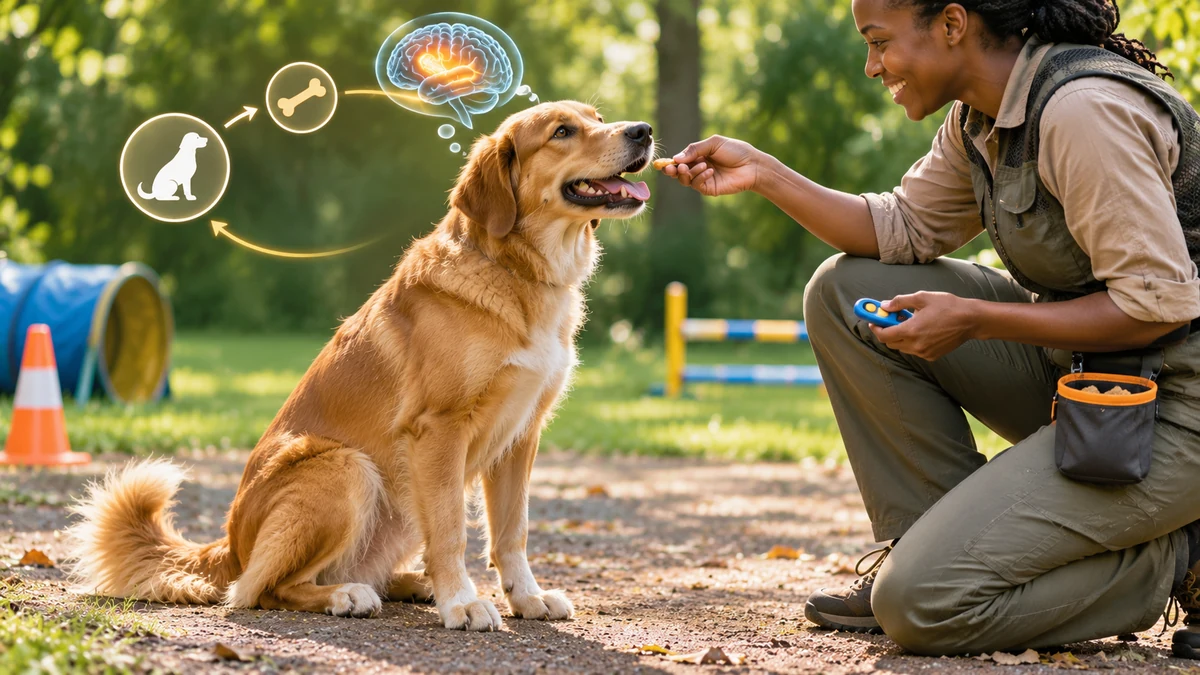
Dogs often attend readily to human gestures, voices and routines. Controlled experiments have found that dog puppies can show early tendencies to approach unfamiliar humans and follow certain human pointing signals more than similarly aged, intensively socialised wolf puppies. A 2021 Current Biology study compared 44 dog puppies and 37 wolf puppies across several tasks and found differences in human-directed communication.
However, this is not evidence that wolves are unintelligent or that every dog is better at every social task. Wolves have sophisticated social relationships, cooperation and problem-solving abilities of their own. A 2022 review comparing dogs and wolves cautions against simplistic claims that dogs are universally less aggressive or more socially skilled in all settings.
The responsible conclusion is that dogs evolved special relationships and forms of communication suited to living with humans. Training, early experiences and individual temperament still shape behaviour. A pet dog does not have a fixed “wolf personality” waiting to emerge, and human-directed friendliness should not be confused with an absence of fear or defensive behaviour.
10. Did dogs evolve to eat different food?
Modern dogs are nutritionally more flexible than their wolf ancestors, though both belong to the order Carnivora. Genetic research has identified differences in genes involved in starch digestion, especially AMY2B, which encodes pancreatic amylase. Some domestic dog populations carry more copies of this gene than wolves, helping explain adaptation to food sources associated with humans.
A foundational 2013 Nature study identified genomic regions associated with dog domestication and starch metabolism. Later research linked increased AMY2B copy numbers particularly with populations in agricultural settings. That timing matters: dogs existed before farming, so adaptations linked to high-starch diets are not evidence that grain-fed farmers necessarily created the first dogs. See the study on prehistoric agriculture and dog diet .
Dogs still need nutritionally complete food suited to life stage and health; ancient genetic history does not justify an improvised diet or a universal claim that all dogs can digest every starch equally well.
11. Did dogs and wolves keep interbreeding?
Yes, to varying degrees and in different regions. Once domestic dogs became a recognisable lineage, some continued to exchange genetic material with wolves. This is called gene flow or admixture. It is one reason the family tree has interconnected branches and why a single modern genetic marker rarely identifies a unique ancient ancestor.
A large 2025 genomic study of dog–wolf admixture analysed thousands of canid genomes and detected traces of later wolf ancestry in many modern dogs. Researchers reported that a majority of the sampled breed dogs had detectable, generally small contributions. That does not mean these dogs had a recent wild wolf parent or that their behaviour can be predicted simply from a tiny ancestry percentage.
Gene flow complicates ancestry reconstruction, but it also demonstrates that evolutionary histories are not always tidy species-by-species separations. Scientists distinguish the ancestral wolf population that gave rise to dogs from later wolves that contributed smaller amounts of DNA.
12. Why don't researchers agree on one domestication date?
There are several different clocks. Genetic divergence estimates when ancestral populations began becoming distinct; archaeological dog remains establish when a particular dog lived; and human–dog burials or settlements provide evidence of a relationship. These events need not have happened simultaneously.
Even genetic dates have uncertainty because the rate of mutation, ancient population structure, sample preservation and later gene flow affect estimates. Fossils can be difficult to classify when early dogs and wolves looked alike. The oldest surviving example is a minimum confirmed age for the lineage, not the year an evolutionary process started.
Before the 2026 discoveries, articles often said the oldest unequivocal dog DNA came from only about 10,900 years ago. The Pınarbaşı and Gough's Cave genomes changed that minimum. As additional ancient remains are discovered and securely analysed, the timeline may shift again. Changing an estimate in response to stronger evidence is how science progresses.
13. Wolf versus dog: which traits are inherited and which are learned?
| Trait | Shared or inherited foundation | Role of domestication and experience |
|---|---|---|
| Smell and hearing | Both canids have specialised sensory systems. | Individual differences, training and selection influence performance. |
| Pack or social communication | Wolves and dogs both use rich social signals. | Human living environments change which signals are useful or reinforced. |
| Human pointing response | Canids can attend to social information. | Dogs often show early human-oriented responses; experience also matters. |
| Body size and coat | Many genes influence anatomy. | Recent breed selection dramatically increased visible variation. |
| Food use | Both retain carnivorous ancestry. | Some dogs developed greater starch-digestion capacity. |
| Fear of unfamiliar people | Temperament has biological and developmental components. | Early experience and individual history strongly shape responses. |
The comparison shows why dog evolution cannot be described as a universal loss of “wildness”. It involved population changes and new ecological relationships, followed by continued adaptation, learning and breeding.
14. Common myths about how dogs evolved from wolves
| Myth | What scientific evidence supports |
|---|---|
| “Dogs descended from wolves alive today.” | They descended from ancient wolf populations related to, but not identical with, modern wolves. |
| “The first dog appeared exactly 10,000 years ago.” | Secure dog genetic evidence is at least 15,800 years old; the start of domestication was earlier and remains uncertain. |
| “A 30,000-year-old wolf-like skull proves dogs existed then.” | Several very old proposed dogs have been genetically identified as extinct wolves. |
| “Researchers know the first village where wolves became dogs.” | The precise geographic origin is not established. |
| “Two ancestral wolf contributions prove two separate domestications.” | They might also reflect wolf–dog gene flow after one initial process. |
| “People domesticated dogs only after agriculture began.” | Dog DNA predates farming by thousands of years. |
| “Every dog is naturally more intelligent than a wolf.” | Dogs and wolves have different behavioural strengths; findings depend on tasks and experience. |
| “Breeds such as pugs and huskies existed in the Ice Age.” | Many modern standardised breeds were created comparatively recently. |
15. Classroom activity: how to evaluate evidence for dog evolution
This safe research exercise needs no animal handling. Create three columns headed fossil and archaeology, ancient DNA, and living-animal behaviour. Under each, write what researchers can learn and what that evidence cannot establish by itself.
- Plot the dates of Pınarbaşı (15,800 years ago), Gough's Cave (14,300), Kesslerloch (14,200) and the approximate Bonn–Oberkassel dog burial (14,000) on a timeline.
- Read the abstract or summary of the first 2026 Nature paper . Identify which remains were genetically classified as dogs.
- Compare an older “30,000-year-old proto-dog” claim with the newer genome-based interpretation. Explain why appearance may mislead.
- Write two possible human–wolf interaction hypotheses and mark both as unproven reconstructions.
- Conclude with one established fact and one unanswered question—for example, “dogs existed 15,800 years ago” versus “where exactly did domestication begin?”
Discussion: Why is the oldest known dog not necessarily the first dog? Can two ancestral wolf populations contribute to dogs without two independent domestication events? How can an archaeology conclusion change when DNA technology improves? These questions teach the difference between evidence, inference and uncertainty.
Frequently asked questions
Did dogs actually evolve from wolves?
Yes. Genome comparisons show that domestic dogs arose from ancient grey-wolf ancestry. Their immediate ancestral populations have not been identified as any one wolf population living today.
When did wolves become dogs?
The transformation took place over many generations, not on one day. The earliest securely identified dog genomes reported in the March 2026 studies date to roughly 15,800 years ago, so the domestication process must have begun earlier.
Where did dogs first evolve?
The exact region is unknown. Genetic models suggest contributions from ancient Eurasian wolf populations, with evidence for eastern ancestry and later regional mixing, but no confirmed single birthplace.
What is the oldest confirmed domestic dog?
Among the oldest secure genetic identifications currently reported is a canid from Pınarbaşı, Türkiye, about 15,800 years old. Other well-supported early examples include Gough's Cave in Britain and Kesslerloch in Switzerland.
Were dogs domesticated before agriculture?
Yes. Dog DNA from Late Palaeolithic hunter-gatherer contexts predates the widespread adoption of agriculture in western Eurasia.
Did people tame wolf pups to make the first dogs?
It is a possible scenario, but not a proven historical account. A population becomes domesticated through inherited changes across generations; taming one individual is different.
Are huskies more closely related to wolves than other dogs?
Some breeds have genetic histories or appearances that resemble wolves in particular ways, but all domestic dogs share ancient wolf ancestry. A wolf-like appearance does not prove a recent wolf ancestor, and no breed is simply a living prehistoric dog.
Why do dogs understand human pointing better than wolves?
Some experiments show dog puppies are more inclined to approach people and respond to pointing in particular tasks. This may reflect domestication-related social adaptation, but performance varies and does not mean wolves cannot learn from humans.
Could dogs and wolves still have puppies together?
They can interbreed, and genetic evidence shows historical gene flow. That fact does not make modern pets equivalent to wild wolves or eliminate their distinct domestication history.
Did dogs evolve because humans fed them grain?
No evidence establishes grain feeding as the original cause of domestication. Dogs existed before agriculture; increases in some starch-digestion genes are more closely associated with later dietary changes in certain populations.
Conclusion: the evidence points to an ancient, complex partnership
The best answer to how dogs evolved from wolves is not a single dramatic taming event. It is an Ice Age evolutionary process involving ancient wolf ancestry, human relationships, changes in populations and later genetic mixing. Fossils and burials illuminate early contact; genomes trace ancestry; and behavioural research helps us understand how dogs adapted to living with people.
The landmark March 2026 ancient-DNA discoveries establish dogs by about 15,800 years ago and reveal related populations across western Eurasia long before farming. Yet scientists are still investigating the original place, exact timing and detailed pathway of domestication. Knowing both what has been demonstrated and what remains uncertain is the most accurate way to tell the story of the dog.
References and further reading
- Nature (2026) — Dogs Were Widely Distributed Across Western Eurasia During the Palaeolithic .
- Nature (2026) — Genomic History of Early Dogs in Europe .
- Natural History Museum (2026) — Oldest Evidence of Domestic Dogs .
- University of Oxford (2026) — Oldest Genetic Evidence of Domestic Dogs .
- Nature (2022) — Grey Wolf Genomic History Reveals a Dual Ancestry of Dogs .
- Science (2020) — Origins and Genetic Legacy of Prehistoric Dogs .
- PNAS (2025) — A Legacy of Genetic Entanglement with Wolves Shapes Modern Dogs .
- Nature Reviews Genetics (2017) — Demographic History, Selection and Functional Diversity of the Canine Genome .
- Nature (2013) — The Genomic Signature of Dog Domestication Reveals Adaptation to a Starch-Rich Diet .
- Heredity (2016) — Diet Adaptation in Dog Reflects Spread of Prehistoric Agriculture .
- Science Advances (2022) — The Evolution of Dog Diet and Foraging: Insights from Archaeological Canids in Siberia .
- Current Biology (2021) — Cooperative Communication with Humans Evolved to Emerge Early in Domestic Dogs .
- Biological Reviews (2022) — Comparing Wolves and Dogs: Current Status and Implications .
- Annual Review of Animal Biosciences (2025) — An Evolutionary Perspective on Dog Behavioral Genetics .