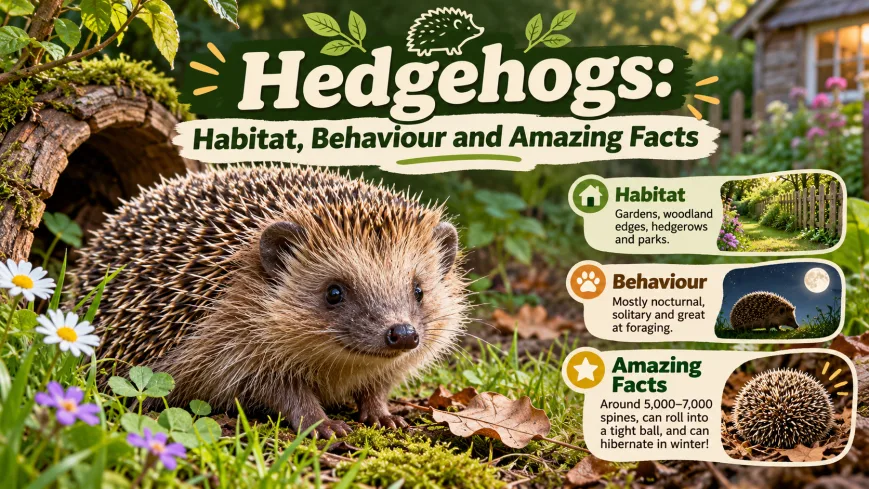
Hedgehogs are small, spiny mammals found naturally across parts of Europe, Asia and Africa. They are best known for curling into a defensive ball, but their lives are much richer than their prickly appearance suggests. Many search for beetles, earthworms and other invertebrates after dark; some spend cold winters in hibernation; and mothers raise vulnerable young called hoglets in carefully hidden nests.
Not every hedgehog behaves in the same way. A West European hedgehog in a British garden has different seasonal challenges from an African four-toed hedgehog in a warm savanna. This guide explains hedgehog habitat, behaviour, diet, reproduction, defences and conservation while separating well-supported facts from popular myths. It also includes practical guidance for observing these animals without disturbing them.
Hedgehog facts at a glance
| Fact | What to know |
|---|---|
| Animal group | Mammal; order Eulipotyphla; family Erinaceidae; spiny hedgehogs belong to subfamily Erinaceinae |
| Natural distribution | Parts of Europe, Africa and Asia |
| Introduced distribution | West European hedgehogs have been introduced to New Zealand |
| Food | Primarily invertebrates, including beetles, earwigs, caterpillars and worms; other foods vary |
| Activity | Often nocturnal and usually solitary outside mating and maternal care |
| Key defence | Stiffened spines and the ability to curl into a protective ball |
| Young | Hoglets; commonly around four or five per litter in European hedgehogs |
| Hibernation | Common in colder-climate species where conditions require it, not universal |
| Conservation | Species-specific; the West European hedgehog was assessed as Near Threatened in 2024 |
These are general patterns, not guarantees for every species. In a 2025 scientific review, researchers described 19 recognised species of spiny hedgehogs across five genera, while noting continuing taxonomic and conservation research. A different figure in an older book may reflect changes in species classification rather than a simple factual mistake.
What kind of animal is a hedgehog?
A hedgehog is a mammal, not a rodent, porcupine or miniature pig. Spiny hedgehogs belong to the subfamily Erinaceinae within Erinaceidae. The same wider family includes less-spiny relatives often called gymnures or moonrats. Although porcupines also carry spines, they are rodents from a different evolutionary lineage; the similarity is an example of different animals evolving comparable defences.
Like other mammals, hedgehog mothers produce milk for their offspring. Their scientific classification places them within Eulipotyphla, an order that also includes moles and shrews. Students interested in these distinctions can explore SuperEducational's guide to vertebrates, invertebrates and major animal groups .
The San Diego Zoo Wildlife Alliance's hedgehog profile describes their bodies, defensive adaptations, diet and geographical variation.
Where do hedgehogs live? Habitats around the world
Hedgehogs need enough food and places to rest or nest. Depending on the species, they can occupy hedgerows, grasslands, woodland edges, gardens, scrubland and dry savanna. Their native range covers parts of Europe, Africa and Asia. There are no living hedgehog species native to the Americas or Australia, although people have introduced some elsewhere.
European hedgehogs: hedgerows, parks and gardens
The West European hedgehog (Erinaceus europaeus) lives in a varied landscape of vegetation and shelter, including woods, field margins, parks and gardens. Fallen leaves, undergrowth, logs and hedges can provide both insect prey and nesting material. A tidy lawn without connected cover is usually less useful than a habitat containing different plants and undisturbed corners. The Woodland Trust's species guide identifies gardens, woodland edges and hedgerows as typical habitats.
African hedgehogs: savanna and dry-country adaptations
Several hedgehog species are native to Africa. The four-toed or African white-bellied hedgehog (Atelerix albiventris) occupies parts of sub-Saharan Africa, including savannas and other suitable open habitats. It faces a different pattern of temperature and food availability from the British hedgehog. It should not automatically be described as spending every winter in a long European-style hibernation. Even within warm regions, an animal's activity can change when food, heat or dry conditions become challenging.
Asian hedgehogs: from scrub to semi-desert
Species such as the long-eared hedgehog (Hemiechinus auritus) live across parts of Asia and nearby regions, often in relatively open or dry terrain. Their ear size, foraging habits and seasonal behaviour differ from those of woodland hedgehogs. Taxonomists have also recognised additional species in Asian genera, which is why it is better to describe their diversity than assign all hedgehogs one body size or habitat.
Hedgehogs introduced to New Zealand
West European hedgehogs were introduced to New Zealand by people. There, the animal is not a native conservation priority in the same way as in Britain: introduced hedgehogs can affect native invertebrates and the eggs of ground-nesting birds. The IUCN Global Invasive Species Database documents these concerns. This illustrates why “protect hedgehogs everywhere” is not a sound ecological rule without knowing the location.
Why are hedgehogs covered in spines?
A hedgehog's back is covered with stiff spines made from modified hairs containing keratin. The soft face, underside and legs are not similarly protected. When frightened, specialised muscles lift the spines and help the animal curl into a ball so that many vulnerable body parts are tucked away.
Sources give different spine counts depending on the animal and method of counting: the British Hedgehog Preservation Society describes roughly 5,000–7,000 spines on an average adult, while the San Diego Zoo gives a lower approximate range for its hedgehog overview. Both illustrate that the animal has thousands of spines, not one exact number for every hedgehog.
Hedgehogs do not shoot their spines. The spines remain attached to the body, although some may fall out naturally. Curling is effective against certain threats but offers no protection against cars, habitat destruction or every predator. Animals such as badgers may be capable of overcoming a curled hedgehog.
Hedgehog behaviour: what do they do all night?
Snuffling, searching and foraging
Many hedgehogs are nocturnal, travelling and finding food after dark while spending much of the day in a nest or sheltered spot. They have an excellent sense of smell and useful hearing, which help them locate food and detect movement. A hedgehog may investigate leaf litter, undergrowth and damp soil with its snout, pausing to sniff and listen. Its vision is relatively less important to foraging than those other senses.
Solitary lives and noisy encounters
European hedgehogs are generally solitary except when mating or when a mother is caring for young. They may still meet at food sources or travel through overlapping areas. During courtship, an interested male may circle a female repeatedly, sometimes accompanied by snuffling and other audible noises. Puffing, hissing or huffing can occur when the animal is alarmed. Those sounds should be read alongside the situation rather than treated as a fixed animal language.
The strange behaviour called self-anointing
Sometimes a hedgehog encounters a new smell, produces frothy saliva and spreads the foam over its spines. This is known as self-anointing. Scientists have proposed functions involving scents, defence or other responses, but the exact purpose has not been established conclusively. The San Diego Zoo describes the behaviour and some proposed explanations. It is an example of why an observation and an explanation should be kept separate.
Do hedgehogs hibernate?
Some hedgehogs hibernate; not all species follow the same seasonal pattern. West European hedgehogs often enter hibernation during colder months when food becomes scarce. In a state of hibernation, metabolism and body temperature decrease and energy use is reduced. An animal may wake periodically and move between nests; hibernation is not necessarily one uninterrupted sleep.
In Britain, hibernation often takes place broadly from autumn into spring, but weather and local conditions influence dates. Leaf piles, log stacks, dry nests and other sheltered places can serve as resting sites. Animals in warmer or drier environments may have different seasonal resting strategies, so it is misleading to suggest that all hedgehogs hibernate every winter.
The British Hedgehog Preservation Society advises care around leaf piles and garden bonfires because hedgehogs can hide or hibernate in them. If a resting animal has been disturbed, avoid experimenting with care yourself: seek advice from a local wildlife rescue organisation where needed.
What do hedgehogs eat?
Hedgehogs eat a varied diet, but many are primarily insect-eaters and other invertebrate predators. Common foods for West European hedgehogs include beetles, caterpillars, earwigs, earthworms and other small ground-dwelling creatures. Depending on species and availability, they may also eat small amounts of other animal or plant material. They are better described as opportunistic foragers than as animals that survive entirely on slugs or fruit.
The Woodland Trust's 2026 feeding guide explains the difference between a natural diet and food people sometimes put out. For wild hedgehogs in places where supplementary feeding is appropriate, the British Hedgehog Preservation Society recommends fresh water and suitable meat-based hedgehog food or meaty cat or dog food. Never offer cows' milk: it can upset their digestion. Bread is not an appropriate substitute for a nutritious diet.
Feeding is not always harmless, however. It can concentrate animals and alter behaviour, and advice differs by country and species. Improving habitat to support natural invertebrate food is a more durable conservation measure than trying to replace the animal's diet with leftovers.
Baby hedgehogs: how hoglets grow up
Baby hedgehogs are commonly called hoglets. In European hedgehogs, mating usually occurs in warmer months and pregnancy lasts around four weeks. A mother often gives birth to about four or five young, though litter sizes vary. Hoglets begin life with their eyes closed and depend completely on the mother; their first pale spines emerge shortly after birth.
According to the RSPCA's wildlife guide , young European hedgehogs start accompanying their mother to forage at about four weeks of age and become independent around eight weeks, although development is not identical for every animal.
A nest with hoglets is particularly vulnerable to disturbance. If you discover one under a shed, in a compost heap or among leaves, do not move the family or handle the young merely to photograph them. If an animal is visibly injured, orphaned or in immediate danger, consult an experienced wildlife rehabilitator rather than attempting to raise it at home.
How long do hedgehogs live?
Lifespan varies by species, habitat and whether the animal is wild or under expert care. The Woodland Trust says that a West European hedgehog commonly survives about two to three years in the wild, although some individuals may reach seven years. By comparison, the San Diego Zoo describes a wider group-level range that includes different species and animals in professional care. Do not use a captive maximum as the typical lifespan of every wild hedgehog.
Roads, predation, illness, parasites, food shortages and the hazards of first winter all affect survival. For a wider look at why life expectancy differs among mammals and other animal groups, SuperEducational's science of animal longevity offers useful context.
Are hedgehogs endangered? Conservation and threats
Conservation status is species-specific and location-specific. In October 2024, the IUCN changed the West European hedgehog (Erinaceus europaeus) from Least Concern to Near Threatened. The IUCN's 2024 announcement identifies intensifying agriculture, roads and urban development among the pressures contributing to declines.
New research adds nuance. A British Trust for Ornithology-linked study published in 2026 analysed multiple British surveys and found serious declines in rural populations, while some urban abundance measures showed modest increases. The figures are not interchangeable measures of every hedgehog in Britain, much less all hedgehogs worldwide. Conservation plans need to account for differences between landscapes.
Fragmented habitats can isolate feeding and nesting sites. Vehicle collisions, intensive mowing, unsafe garden chemicals, loss of hedges and certain predators add to the risks. Some species in Asia and Africa face different local threats, including habitat conversion. Where hedgehogs have been introduced and become invasive, the conservation objective may instead be to protect native wildlife.
How can people help hedgehogs safely?
In regions where hedgehogs are native and local conservation guidance supports it, practical steps include:
- Keep wild corners. Let some leaves, logs, native plants and low vegetation provide natural shelter and invertebrate habitat.
- Connect gardens where appropriate. The British Hedgehog Preservation Society suggests a roughly 13 × 13 cm opening at the base of fences to allow European hedgehogs to travel, provided it is safe and permitted.
- Check before cutting or burning. Inspect long grass, compost heaps and unlit bonfire piles for hidden animals; do not burn a pile without moving and checking it first.
- Make ponds escapable. Provide a gently sloping edge, ramp or secure exit to prevent accidental drowning.
- Use chemicals cautiously. Avoid unnecessary pesticides and other garden products that can harm wildlife or its prey.
- Control pets and reduce road risks. Keep dogs away from known nesting areas, especially at night, and slow down where wildlife may cross roads.
- Ask experts before intervening. A hedgehog active in daylight is not automatically ill—a nursing mother may be foraging—but one that is weak, staggering, injured or covered in flies needs urgent advice from a wildlife rescue professional.
For country-specific instructions, see the British Hedgehog Preservation Society's gardening advice and local wildlife authorities. Never move an introduced or invasive species to a new habitat in the name of conservation.
10 amazing facts about hedgehogs
- Their spines are modified hairs. They are primarily keratin rather than separate detachable weapons.
- They do not throw their spines. A hedgehog raises them and curls up when threatened.
- They are not porcupines. Similar spines evolved in distant mammal lineages.
- Many are active after dark. Smell and hearing guide much of their foraging.
- They can self-anoint. Some spread frothy saliva on their spines after encountering a new scent; the reason is not fully settled.
- Baby hedgehogs are called hoglets. European hoglets are born dependent on their mothers.
- Not all hedgehogs hibernate. Climate and species strongly influence their seasonal activity.
- They can live in cities. Connected gardens and vegetated spaces may provide food and cover.
- New Zealand hedgehogs are introduced. Their effects on native wildlife make them a different management concern.
- West European hedgehogs are Near Threatened. This status reflects a 2024 IUCN reassessment, not an extinction risk identical across every hedgehog species.
Frequently asked questions about hedgehogs
Are hedgehogs dangerous?
They generally avoid people, but their spines can prick skin and wild animals may carry pathogens or parasites. It is best not to handle them; consult a qualified wildlife professional if a hedgehog needs help.
Can hedgehogs swim?
Some hedgehogs can swim, but that does not make deep-sided ponds safe. Provide an exit ramp and never place a hedgehog in water to test its swimming ability.
Do hedgehogs really eat slugs?
They may eat slugs and snails, but studies and wildlife guides identify beetles, worms, caterpillars and other invertebrates as important parts of the diet. They should not be treated as guaranteed pest-control machines.
Do all hedgehogs live in Britain?
No. Hedgehogs are native to parts of Europe, Asia and Africa, with substantial differences among species. New Zealand also has introduced hedgehogs.
Can hedgehogs be kept as pets?
Some people keep domestically bred African-type hedgehogs under local laws, but husbandry is specialised and legal restrictions vary. A wild European hedgehog should not be taken home and treated as a pet.
Why might a hedgehog appear in daylight?
Daytime activity has several possible explanations, including a nursing mother collecting food. But an animal that looks weak, injured, disoriented or otherwise unwell needs prompt expert assessment.
Conclusion
Hedgehogs combine an extraordinary defensive coat with keen senses, mostly nocturnal habits and a close relationship with the habitats around them. Their food, behaviour and seasonal rhythms differ across European, African and Asian species. Learning those distinctions reveals why spines, hibernation and even human garden management have different significance in different environments.
The most useful conservation lesson is not simply that hedgehogs are charming wildlife: it is that protecting the right habitat in the right place matters. Careful observation, reliable scientific information and species-specific advice help people appreciate hedgehogs without disturbing the animals or overlooking the needs of local ecosystems.