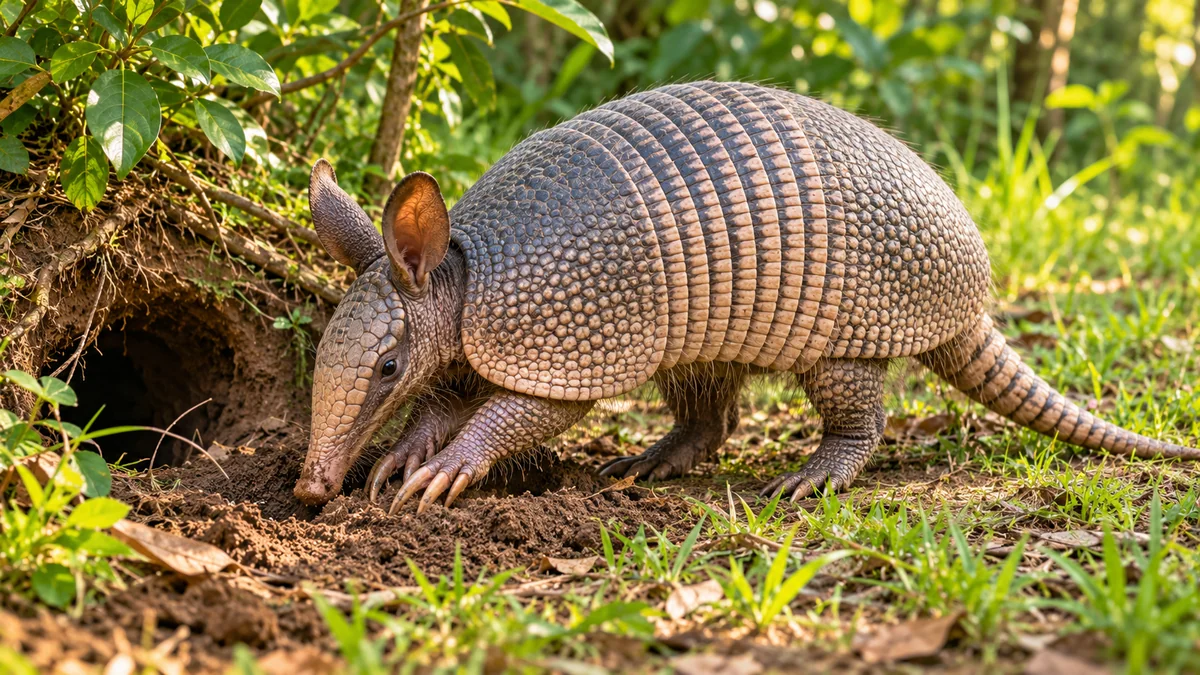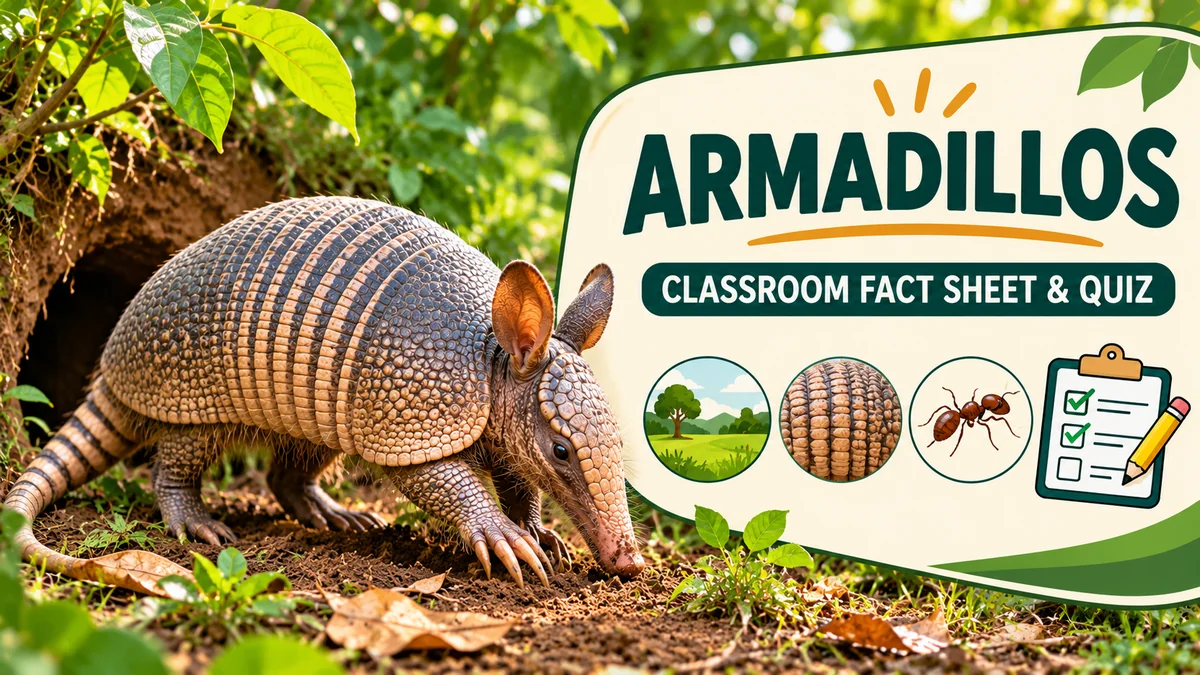
What are armadillos? Armadillos are mammals native to the Americas, best known for their hard-looking armour, powerful digging claws and habit of searching for insects in soil and leaf litter. They are related to sloths and anteaters—not turtles or reptiles. They are an excellent classroom example of how an animal's body, behaviour and habitat work together to help it survive.
This armadillo classroom fact sheet and quiz brings the science into a ready-to-use learning activity. Begin with the short facts, study the vocabulary, then answer 20 questions covering classification, habitat, diet, adaptations and conservation. A complete answer key and two evidence-based activities follow. Students can use the article independently, while teachers can adapt it for upper-primary and lower-secondary lessons.
Learning objectives: what students should know
After this lesson, learners should be able to:
- Classify an armadillo as a mammal and identify its close living relatives.
- Describe where armadillos live and what many species eat.
- Explain how armour, claws, smell and burrows support survival.
- Distinguish a fact about one species from a claim about all armadillos.
- Answer comprehension questions using evidence from reliable wildlife sources.
- Suggest a safe and respectful way to protect or observe wild armadillos.
Armadillo fact sheet: 12 essential facts
| Question | Student-friendly fact |
|---|---|
| 1. What kind of animal is it? | A mammal in the order Cingulata, within a larger group called Xenarthra |
| 2. Where is it from? | The Americas: different species live in North, Central and South America |
| 3. What does its name mean? | “Little armoured one,” from Spanish |
| 4. What covers its body? | Protective bony plates under a keratin-rich outer covering |
| 5. What does it eat? | Many species eat ants, termites, grubs and other invertebrates |
| 6. How does it find food? | A sensitive nose and strong front claws help it sniff and dig |
| 7. Where does it shelter? | Many dig burrows in soil; resting habits differ among species |
| 8. When is it active? | Many are active at night or at cooler times, but the pattern varies |
| 9. Can it roll into a ball? | Only certain three-banded species can form a tightly closed ball |
| 10. How do young develop? | Like other mammals, mothers give birth and nurse their offspring |
| 11. What is unusual about nine-banded armadillos? | They typically produce four genetically identical young from one fertilised egg |
| 12. Why do they matter? | Their digging and burrows influence soils and create shelter for other animals |
According to the IUCN SSC Anteater, Sloth and Armadillo Specialist Group , current taxonomy recognises 25 living armadillo species, and the number can change when research revises species boundaries. A learner should therefore avoid memorising older species totals as permanent facts.
Meet the animal: classification, armour and relatives
Why an armadillo is a mammal
Armadillos have a striking shell, but their anatomy and reproduction place them among the mammals. Female armadillos produce milk for their young. Their armour contains bony pieces called osteoderms, which grow in the skin and are covered by a keratin-rich layer. Unlike a tortoise shell, armadillo armour usually includes movable bands that allow bending.
Armadillos belong to Cingulata and share the larger xenarthran lineage with anteaters and sloths. The San Diego Zoo Wildlife Alliance explains their flexible bands, digging claws and mammalian behaviour. To place them on the animal family tree, read SuperEducational's introduction to animal classification .
Why most armadillos cannot curl into a ball
A common cartoon shows every armadillo curling into a ball. In reality, most species escape by running, digging or pressing themselves low against the ground. The southern three-banded armadillo has specialised armour that allows it to tuck its limbs, head and tail into an almost completely closed ball. The Smithsonian National Zoo describes that adaptation. The widely known nine-banded armadillo cannot do the same.
Habitat, diet and behaviour: how armadillos survive
Habitat means the place where an animal lives and finds the resources it needs. Armadillos occur in grasslands, wooded areas, scrub, savannas and other habitats throughout the Americas. Their distribution depends on the species, climate, soil and available food. Soft enough soil is especially valuable for the many species that dig.
Diet means what an animal eats. Many armadillos feed primarily on insects and other invertebrates. Ants, termites, beetle larvae and grubs are important foods, although some species also consume fruit, eggs or other items. Digging for food is called foraging. The Texas Parks and Wildlife Department documents the diet and habitat of the nine-banded armadillo.
Behaviour includes how an animal moves, finds food and responds to danger. Many armadillos live largely alone and change their activity times when temperature changes. A burrow can shelter the animal from weather or predators. When an old burrow is abandoned, another creature may use it. Large species such as the giant armadillo can create especially important shelters: the IUCN specialist group reports observations of at least 26 other vertebrate species using giant armadillo burrows.
Species spotlight: three very different armadillos
| Species | Best-known fact | What it teaches |
|---|---|---|
| Nine-banded armadillo | Typically gives birth to four identical offspring | Reproduction differs among species |
| Southern three-banded armadillo | Can close into a defensive ball | Body structure supports specialised defence |
| Giant armadillo | Digs large burrows used by other wildlife | An animal can act as an ecosystem engineer |
These examples are species-specific. It would be incorrect to say that all armadillos give birth to quadruplets, that all roll into balls or that all make giant burrows. The SuperEducational animal classification chart can help learners practise grouping animals without overlooking differences within a group.
Vocabulary box: eight words to know
| Term | Meaning |
|---|---|
| Mammal | A member of the animal group whose females produce milk to nourish young |
| Adaptation | A feature or behaviour that helps an organism survive or reproduce |
| Habitat | The natural place or environment in which an organism lives |
| Invertebrate | An animal without a backbone, such as an insect or earthworm |
| Osteoderm | A bony plate formed within the skin |
| Burrow | A hole or tunnel in the ground used by an animal |
| Foraging | Searching for and gathering food |
| Conservation | Actions taken to protect species, habitats and natural systems |
Classroom quiz: 20 armadillo questions
Student instructions: Read the fact sheet first. For questions 1–8, choose one answer. For questions 9–14, decide whether the statement is true or false. For questions 15–20, write a short response of one or two sentences. Each question is worth one point, for a possible score of 20 points. Do not read the answer key until you have finished.
Part A: multiple-choice questions (1–8)
- Which animal group includes armadillos? A. Reptiles; B. Mammals; C. Birds; D. Amphibians
- Where do wild armadillos naturally occur? A. Only Africa; B. Only Europe; C. The Americas; D. Antarctica
- What is unusual about armadillo armour? A. It is made only of feathers; B. It contains bony plates; C. It is a removable shell; D. It is made of wood
- Which food is commonly eaten by many armadillos? A. Large fish; B. Ants and other invertebrates; C. Grass only; D. Seaweed
- Which armadillos are best known for closing into a defensive ball? A. Every armadillo; B. Certain three-banded armadillos; C. Only giant armadillos; D. No armadillo species
- What is unusual about nine-banded armadillo litters? A. They hatch from eggs; B. They always contain 20 young; C. The father carries them; D. They typically contain four genetically identical young
- What is one important use of an armadillo burrow? A. Flying; B. Shelter and protection; C. Producing sunlight; D. Swimming
- Which animals are close living relatives of armadillos? A. Sloths and anteaters; B. Turtles and crocodiles; C. Penguins and ostriches; D. Frogs and salamanders
Part B: true or false (9–14)
- Every armadillo species lives in the United States.
- Abandoned armadillo burrows can provide shelter for other animals.
- Temperature can affect when an armadillo is active.
- The giant armadillo is the smallest living armadillo species.
- Armadillos are reptiles because they have protective plates.
- Different armadillo species can occupy different habitats.
Part C: short-answer questions (15–20)
- Name one habitat in which an armadillo may live.
- Name two kinds of food armadillos may eat.
- Explain how an armadillo's nose and claws can help it obtain food.
- Why is the statement “all armadillos roll into balls” incorrect?
- Describe the unusual reproduction of the nine-banded armadillo.
- Describe one safe way people can observe or help protect wild armadillos.
Answer key: armadillo quiz answers and explanations
Teachers can use this key to mark work. For short answers, accept scientifically correct responses that express the same idea even when wording differs.
| Question | Correct answer | Why |
|---|---|---|
| 1 | B — Mammals | Female armadillos nurse their young with milk |
| 2 | C — The Americas | Armadillos are native to the Americas |
| 3 | B — Bony plates | Osteoderms help form the protective covering |
| 4 | B — Ants and other invertebrates | Many armadillos feed largely on insects |
| 5 | B — Certain three-banded armadillos | The ball-forming defence is species-specific |
| 6 | D — Four genetically identical young | Nine-banded armadillos typically show polyembryony |
| 7 | B — Shelter and protection | Burrows protect animals from danger and weather |
| 8 | A — Sloths and anteaters | They share the xenarthran lineage |
| 9 | False | Most armadillo species occur farther south in the Americas |
| 10 | True | Other species can reuse armadillo shelters |
| 11 | True | Heat or cold can shift foraging times |
| 12 | False | The giant armadillo is the largest living armadillo |
| 13 | False | Armadillos are mammals, regardless of their armour |
| 14 | True | Armadillos occupy different environments by species |
Suggested responses to questions 15–20:
- Habitat: A forest, grassland, scrubland or savanna is a valid example; match the choice to a species when possible.
- Food: Examples include ants and termites, or beetle larvae and grubs.
- Finding food: Its sensitive nose locates food by smell, while strong claws dig into soil or insect nests.
- Rolling: Most species cannot close into a ball; that skill belongs to certain three-banded armadillos.
- Reproduction: The nine-banded armadillo usually has four genetically identical young that develop from one fertilised egg.
- Wildlife care: Observe from a distance, do not touch or feed the animal, protect habitat, or keep pets away.
Marking guide: Give one point for each correct answer. A score of 18–20 suggests strong understanding; 14–17 shows a good foundation with some points to review; 10–13 suggests another reading; fewer than 10 means students may benefit from guided discussion and a second attempt. These classroom bands are suggestions, not standardised assessment thresholds.
Two classroom activities to deepen understanding
Activity 1: match the adaptation to its function (10 minutes)
On separate cards, write armour, claws, nose, burrow. On another set, write protection, digging, locating food, shelter. Ask learners to match each body feature or structure to its main function and explain why it makes sense. Higher-level students can identify overlap: digging claws may help both food gathering and shelter construction. The exercise teaches that one trait can have more than one ecological role.
Activity 2: investigate an animal claim (15 minutes)
Write on the board: “All armadillos roll into a ball.” Invite students to label it as fact, misconception or uncertain claim. They should find evidence in the Smithsonian three-banded armadillo fact sheet and a nine-banded armadillo resource , then correct the sentence to say: “Some three-banded armadillos can roll into a tightly closed ball, but most armadillos cannot.” Ask what changed when a universal statement was replaced with a species-specific one.
What about armadillo conservation?
Different species face different threats. Habitat loss, hunting and vehicle collisions can affect populations, especially rare species. The IUCN specialist group lists the giant armadillo as Vulnerable, while its pink fairy armadillo account lists that species as Data Deficient: scientists lack sufficient evidence to estimate its extinction risk confidently. This is an important distinction in conservation education.
Wild animals should not be captured for projects, brought into classrooms or fed for photographs. Students can learn from verified photographs, museum exhibits and wildlife organisations without disturbing any animal.
Frequently asked questions about armadillos
Are armadillos mammals or reptiles?
Armadillos are mammals. Their bony protective armour does not change their classification.
Do all armadillos have nine bands?
No. Band counts differ between species and individuals. The common name of the nine-banded armadillo is not an exact count for every animal.
What do armadillos eat?
Many feed on ants, termites, larvae and other invertebrates. Diet varies by species and environment.
How should teachers use this quiz?
Assign the fact sheet first, give students time to answer the 20 questions without the key, then discuss the explanations and revisit any misconceptions. The activities can serve as extension work.
Conclusion
Armadillos make a memorable classroom subject because their armour, digging habits, food choices and unusual reproduction illustrate key scientific ideas: classification, adaptation, habitat, behaviour and biodiversity. The essential lesson is that armadillos are not all alike. Checking species-specific evidence is just as important as remembering facts. Use the quiz, answer key and activities to practise both science knowledge and careful reasoning.