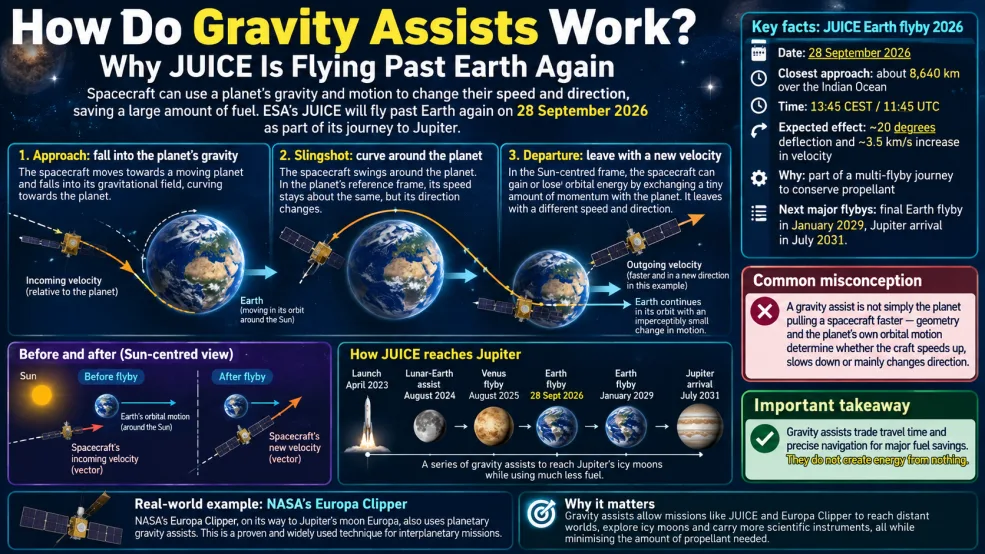
On 28 September 2026, ESA's Jupiter Icy Moons Explorer — JUICE — is due to sweep past Earth again on its long journey to Jupiter. The encounter is not a detour or a return home. It is a carefully calculated gravity assist.
ESA expects the spacecraft to pass about 8,640 kilometres above Earth over the Indian Ocean at approximately 11:45 UTC. The encounter should bend JUICE's trajectory by about 20 degrees and increase its velocity by roughly 3.5 kilometres per second, setting up the next stage of its interplanetary journey.
What is a gravity assist?
A gravity assist is a close planetary flyby designed to change a spacecraft's velocity — its speed, direction, or both. The spacecraft falls into the planet's gravitational field, curves around the moving planet and then departs on a new trajectory.
The important word is moving. A planet is travelling around the Sun while the encounter happens. In a Sun-centred reference frame, the spacecraft can exchange a tiny amount of momentum and orbital energy with the planet.
Does gravity create free energy?
No. A gravity assist does not create energy from nothing. Momentum and energy are exchanged between the spacecraft and planet. Because a planet is enormously more massive than a spacecraft, the corresponding change in the planet's motion is imperceptibly small, while the spacecraft can experience a useful change.
Why reference frames matter
Imagine watching the flyby from Earth. Ignoring propulsion and other small effects, the spacecraft approaches, accelerates as it falls towards Earth, swings around, then slows as it climbs away. Its speed far before and far after the encounter is approximately the same relative to Earth, although its direction changes.
Now view the same event from the Sun. Earth itself has a large orbital velocity. By approaching and leaving with the right geometry, the spacecraft's velocity vector relative to the Sun can change substantially. This is the source of the familiar “slingshot” effect.
Can a gravity assist slow a spacecraft down?
Yes. Mission designers choose the encounter geometry according to the required trajectory. A flyby can increase heliocentric speed, reduce it, or mainly redirect the spacecraft. Venus and Mercury missions, for example, often use gravity assists to remove orbital energy so they can travel closer to the Sun.
Why does JUICE need several flybys?
Reaching Jupiter directly with the required mass would demand a large amount of propellant and launch energy. Gravity assists let mission planners trade extra travel time and extremely precise navigation for major fuel savings.
JUICE launched in April 2023. It completed the first-ever lunar–Earth gravity assist in August 2024, flew past Venus in August 2025, and returns to Earth in September 2026. Another Earth flyby is planned for January 2029 before arrival at Jupiter in July 2031.
What happens during the September 2026 Earth encounter?
ESA says JUICE's closest approach is expected over the Indian Ocean. Earth's gravity will redirect the spacecraft by around 20 degrees and produce a roughly 3.5 km/s velocity increase appropriate for its next solar orbit. Small navigation errors can grow enormously over interplanetary distances, so teams track the spacecraft carefully before and after the encounter.
Gravity assists are standard interplanetary engineering
JUICE is not unusual in using planetary flybys. NASA's Europa Clipper, another mission travelling to the Jupiter system, also uses gravity assists. Earlier missions including Voyager, Galileo, Cassini and many others have used the same underlying physics.
Common misconception: “The planet simply pulls the spacecraft faster”
That explanation is incomplete. The spacecraft speeds up while falling towards a planet and slows while climbing away. The lasting change comes from the encounter geometry combined with the planet's own orbital motion. Depending on the geometry, the spacecraft can speed up, slow down or mainly change direction in the Sun-centred frame.
A simple analogy
Think of a moving train and a ball. If the ball interacts elastically with the moving train, its motion relative to the ground can change because the train itself carries momentum. A planetary encounter is governed by gravity rather than a physical collision, but the analogy helps illustrate why the motion of the planet matters.
Why not carry more fuel instead?
Propellant has a compounding cost: fuel needed later must itself be accelerated earlier. Gravity assists can therefore make missions possible with smaller launch vehicles or allow spacecraft to carry more scientific instruments instead of additional propellant.
Key takeaways
- A gravity assist changes a spacecraft's velocity using a close encounter with a moving planet.
- It does not create energy from nothing; momentum and orbital energy are exchanged with the planet.
- Encounter geometry determines whether the spacecraft speeds up, slows down or mainly changes direction.
- JUICE's 28 September 2026 Earth flyby is expected to bend its path by about 20 degrees and change its velocity by about 3.5 km/s.
- Gravity assists trade travel time and navigational complexity for substantial propellant savings.
Frequently asked questions
Does the planet noticeably slow down when a spacecraft gains energy?
In principle its motion changes, but a planet is so much more massive that the effect is extraordinarily small.
Does the spacecraft use its engines during a gravity assist?
The main trajectory change comes from gravity, although missions can use small manoeuvres before or after a flyby to fine-tune the path.
Why doesn't JUICE fly straight to Jupiter?
A direct trajectory capable of delivering the required spacecraft mass would demand much more launch energy and propellant. Multiple assists provide a more practical route.
When will JUICE reach Jupiter?
ESA currently plans for arrival in July 2031, after another Earth flyby in January 2029.
References
- European Space Agency, JUICE Earth flyby mission information, September 2026.
- NASA, mission resources explaining planetary gravity assists and Europa Clipper's trajectory.