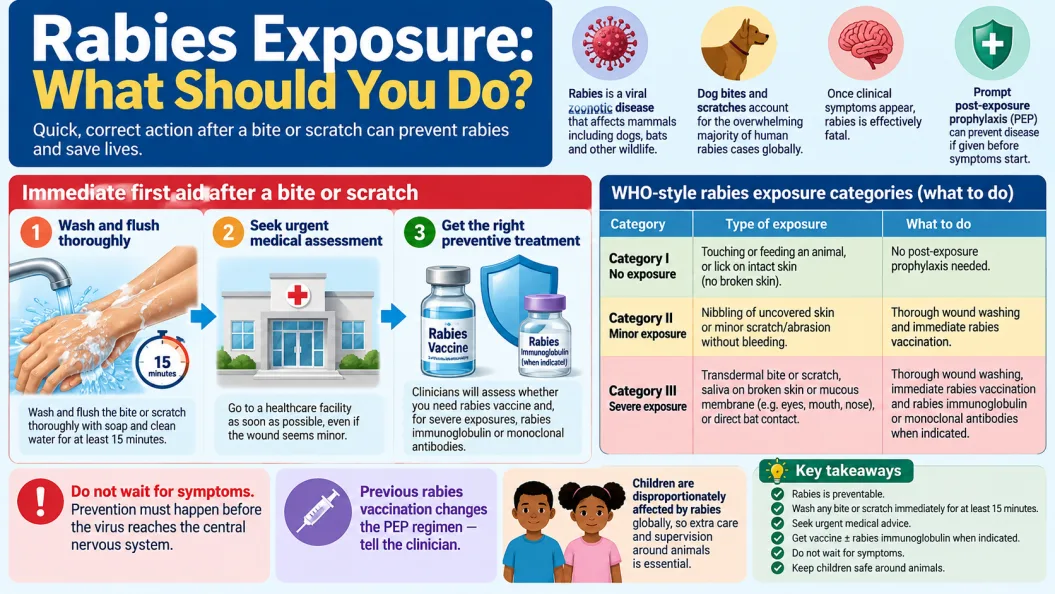
A bite or scratch from an animal that could carry rabies needs prompt attention, even when the wound looks small. Rabies is preventable when appropriate post-exposure care is given before the virus reaches the central nervous system, but once clinical symptoms develop the disease is effectively fatal.
The safest response is straightforward: wash the wound immediately and thoroughly, then seek professional medical assessment as soon as possible.
First: wash and flush the wound for at least 15 minutes
The World Health Organization recommends immediately washing and flushing bite and scratch wounds thoroughly with soap or detergent and plenty of water for about 15 minutes. This is an important part of post-exposure prophylaxis (PEP), not merely ordinary wound cleaning.
After washing, seek medical care promptly. Do not wait to see whether the animal becomes ill before obtaining professional advice unless public-health or veterinary professionals specifically direct that approach for the situation.
What is rabies?
Rabies is a viral zoonotic disease that affects the central nervous system of mammals, including humans. It is transmitted through infected saliva, most commonly through bites, but scratches or saliva contacting broken skin or mucous membranes can also constitute exposure.
Globally, dogs are responsible for the overwhelming majority of human rabies transmission. WHO also reports that children under 15 account for a large share of deaths, making rapid recognition and adult supervision especially important after a child's animal exposure.
How WHO classifies rabies exposure
Not every interaction with an animal is the same. WHO uses exposure categories to guide management.
Category I: no exposure
Examples include touching or feeding an animal, or an animal licking intact skin. When a reliable history confirms that the skin was intact, WHO classifies this as no exposure and PEP is not required.
Category II: exposure requiring vaccination
This includes nibbling of uncovered skin or minor scratches and abrasions without bleeding. WHO recommends immediate wound washing and prompt rabies vaccination.
Category III: severe exposure
This includes single or multiple transdermal bites or scratches, saliva contaminating broken skin or mucous membranes such as the eyes or mouth, and direct contact with bats. Management includes immediate wound washing, prompt vaccination and, when indicated, rabies immunoglobulin or approved monoclonal antibodies.
What is post-exposure prophylaxis?
PEP is preventive treatment given after a possible rabies exposure but before disease develops. Depending on the exposure and the person's vaccination history, it can include thorough wound care, a course of rabies vaccine and rabies immunoglobulin or monoclonal antibodies.
A healthcare professional should determine the appropriate regimen. Availability and recommended products can vary by country, and factors such as immune status and previous vaccination matter.
Why rabies immunoglobulin may be needed
For certain severe exposures in people who have not previously received appropriate rabies vaccination, rabies immunoglobulin provides ready-made antibodies while the vaccine stimulates the person's immune system to produce its own response. Clinicians administer it according to established protocols, including treatment around the wound when appropriate.
What if you were vaccinated against rabies before?
Tell the clinician. Previous rabies vaccination changes the PEP regimen. CDC guidance, for example, does not recommend rabies immunoglobulin for people who were previously appropriately vaccinated, although vaccine doses may still be required after an exposure.
Do not wait for symptoms
This is the most important misconception to avoid. Rabies prevention works before clinical disease develops. Once the virus reaches the central nervous system and symptoms appear, rabies is effectively fatal. A person should therefore seek assessment based on the exposure, not on whether they currently feel ill.
What about the animal?
Do not put yourself or others at further risk trying to capture an aggressive or wild animal. Depending on the species and local public-health rules, professionals may arrange observation, testing or other veterinary measures. The appropriate approach differs between countries and between dogs, cats, bats and wildlife.
Special considerations for children
Children may not report a small bite or scratch, particularly if they fear getting into trouble. After contact with an unfamiliar, unvaccinated, sick or unusually behaving mammal, an adult should calmly check for wounds and obtain appropriate professional advice. Teach children not to handle unfamiliar or wild animals.
Common misconceptions
“The wound is tiny, so there is no risk.” Wound size alone does not determine whether an exposure is significant.
“I can wait for symptoms.” No. Effective prevention must occur before clinical rabies develops.
“Every animal touch requires injections.” No. WHO distinguishes between Category I contact and genuine Category II or III exposures.
“Vaccination means wound washing is unnecessary.” No. Thorough immediate wound washing is itself an important component of PEP.
Practical checklist after a possible exposure
- Move to safety without creating another exposure.
- Wash and flush bites or scratches thoroughly with soap and water for at least 15 minutes.
- Seek urgent professional medical assessment.
- Tell the clinician what animal was involved, where the incident occurred and whether the contact involved broken skin or mucous membranes.
- Tell them whether you have previously received rabies vaccination.
- Follow the recommended vaccine schedule and any other prescribed treatment completely.
Key takeaways
- Rabies is preventable after exposure when appropriate PEP is provided promptly.
- Wash possible exposure wounds thoroughly for at least 15 minutes.
- Seek professional assessment rather than deciding the exposure category yourself.
- Category II and III exposures require prompt preventive management.
- Previous rabies vaccination changes the treatment regimen.
- Never wait for rabies symptoms before seeking care.
Frequently asked questions
Can a scratch transmit rabies?
Yes, some scratches can constitute rabies exposure, particularly when skin is broken and infectious saliva may be involved. WHO's categories distinguish minor abrasions from deeper transdermal injuries.
Can I get rabies from saliva on intact skin?
WHO classifies licking of intact skin as Category I, which is not an exposure. Saliva contacting broken skin or mucous membranes is different and can be Category III.
Is rabies vaccine safe after exposure?
Modern rabies vaccines are widely used for PEP. A clinician can discuss the appropriate product, schedule and individual medical considerations.
What should I do after a bat contact?
Seek professional assessment promptly. WHO treats direct bat contact as a severe exposure because bites or scratches can be difficult to recognise.
Authoritative references
- World Health Organization, Rabies fact sheet, updated 17 September 2026.
- World Health Organization, rabies post-exposure prophylaxis guidance.
- US Centers for Disease Control and Prevention, Rabies Post-exposure Prophylaxis Guidance, updated 10 September 2026.
This article provides general education and does not replace individual medical or public-health assessment. If you may have been exposed to rabies, seek professional care promptly.