A supernova can briefly become extraordinarily bright, but the explosion itself is only the beginning of a much longer story. After the initial flash fades, fast-moving stellar debris and a powerful blast wave continue travelling through the surrounding interstellar medium. The evolving structure is called a supernova remnant.
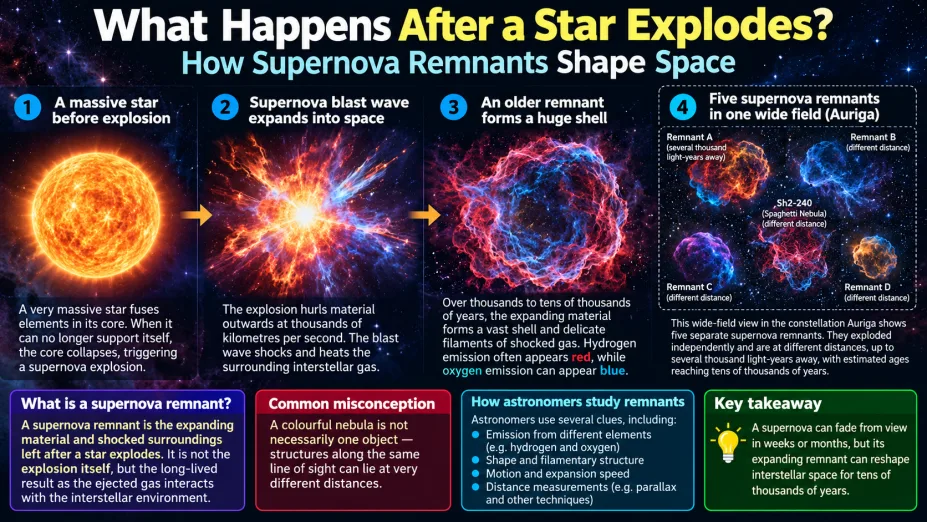
A striking wide-field view highlighted by NASA on 24 September 2026 shows five separate supernova remnants in the direction of the constellation Auriga. They can appear together in the same patch of sky even though the explosions happened independently and the remnants lie at different distances.
What is a supernova remnant?
A supernova remnant is the expanding material and shocked surroundings left after a stellar explosion. It is not the explosion itself. The visible remnant develops as ejected material races outward and transfers energy to gas and dust between the stars.
From explosion to expanding blast wave
When a star explodes as a supernova, material can be expelled at thousands of kilometres per second. The outward-moving ejecta drive a shock wave into surrounding interstellar gas. A shock is a rapid change in pressure, density and temperature that can heat and compress the gas it crosses.
Early in a remnant's life, the ejected stellar material is especially important. As the expanding shell sweeps up more of its surroundings, the interaction with the interstellar medium increasingly shapes what astronomers observe.
Why do old remnants form shells and filaments?
A blast wave expands in three dimensions, so an old remnant can develop a huge shell. Seen from Earth, parts of that shell may look like arcs, loops and delicate threads rather than a perfect circle. Differences in surrounding gas density, magnetic fields, cooling and viewing geometry can make the structure highly irregular.
The Auriga field includes Sh2-240, commonly called the Spaghetti Nebula, whose tangled filaments make the nickname easy to understand.
Why do the filaments glow?
Shocked gas can emit light at characteristic wavelengths associated with particular atoms and ions. Astronomical images often map those emissions into colours that make structures easier to study. In the featured Auriga observation, hydrogen emission contributes red structures while oxygen emission contributes blue.
These colours are scientifically useful, but readers should not assume that every astronomical image reproduces exactly what unaided human eyes would see. Filters, exposure times and colour mapping are often chosen to reveal physical information.
Five remnants can overlap in the sky without touching
A two-dimensional sky image does not directly show depth. Two nebulae can overlap along our line of sight while actually being separated by hundreds or thousands of light-years. NASA's Auriga example contains five independent remnants at different distances, reaching up to several thousand light-years away, with estimated ages extending to tens of thousands of years.
This is a useful reminder that apparent proximity on a photograph is not necessarily physical proximity in space.
How do astronomers study supernova remnants?
Astronomers combine several kinds of evidence. Emission from different elements reveals properties of the gas; the remnant's shape shows how the blast interacts with its surroundings; repeated observations can reveal expansion and motion; and distance measurements help determine the true physical scale. Observations at radio, infrared, visible, ultraviolet, X-ray and gamma-ray wavelengths can reveal different components and energies.
Why supernova remnants matter
Supernovae inject energy and chemically enriched material into interstellar space. Their expanding shocks can heat, compress and stir surrounding gas. Studying remnants therefore helps astronomers understand how matter and energy circulate through galaxies and how the environments between stars evolve.
Common misconception: a colourful nebula is one object
Not necessarily. Structures in the same image can lie at very different distances. Astronomers need measurements beyond apparent position and colour before concluding that separate-looking structures are physically connected.
A practical science lesson: images need interpretation
An astronomical image is evidence, but interpreting it requires physics and measurement. Ask: Which wavelengths were recorded? What do the colours represent? How far away is each structure? Is apparent overlap also physical overlap? Has motion been measured? Those questions turn a beautiful image into a scientific investigation.
Key takeaways
- A supernova remnant is the long-lived expanding aftermath of a stellar explosion.
- Blast waves shock and heat surrounding interstellar gas.
- Older remnants can form enormous shells and intricate filaments.
- Emission from elements such as hydrogen and oxygen helps astronomers map the gas.
- Objects that overlap in a sky image can be physically unrelated and lie at very different distances.
- A supernova may fade from view quickly, while its remnant can evolve for tens of thousands of years.
Frequently asked questions
Is a supernova remnant the same thing as a supernova?
No. A supernova is the explosive event. The remnant is the expanding material and shocked environment that remain and evolve afterwards.
Does every supernova leave a neutron star or black hole?
No. Core-collapse supernovae can leave compact remnants such as neutron stars or black holes, while thermonuclear Type Ia supernovae arise through a different process and do not leave the same kind of compact stellar core.
Why can a remnant remain visible for so long?
The expanding shock continues interacting with surrounding material long after the original flash has faded, heating and exciting gas over a growing region.
Are the five Auriga remnants part of one explosion?
No. They are separate remnants from independent explosions seen along broadly the same direction in the sky.
Reference
NASA Astronomy Picture of the Day, Supernova Remnants in Auriga, 24 September 2026.