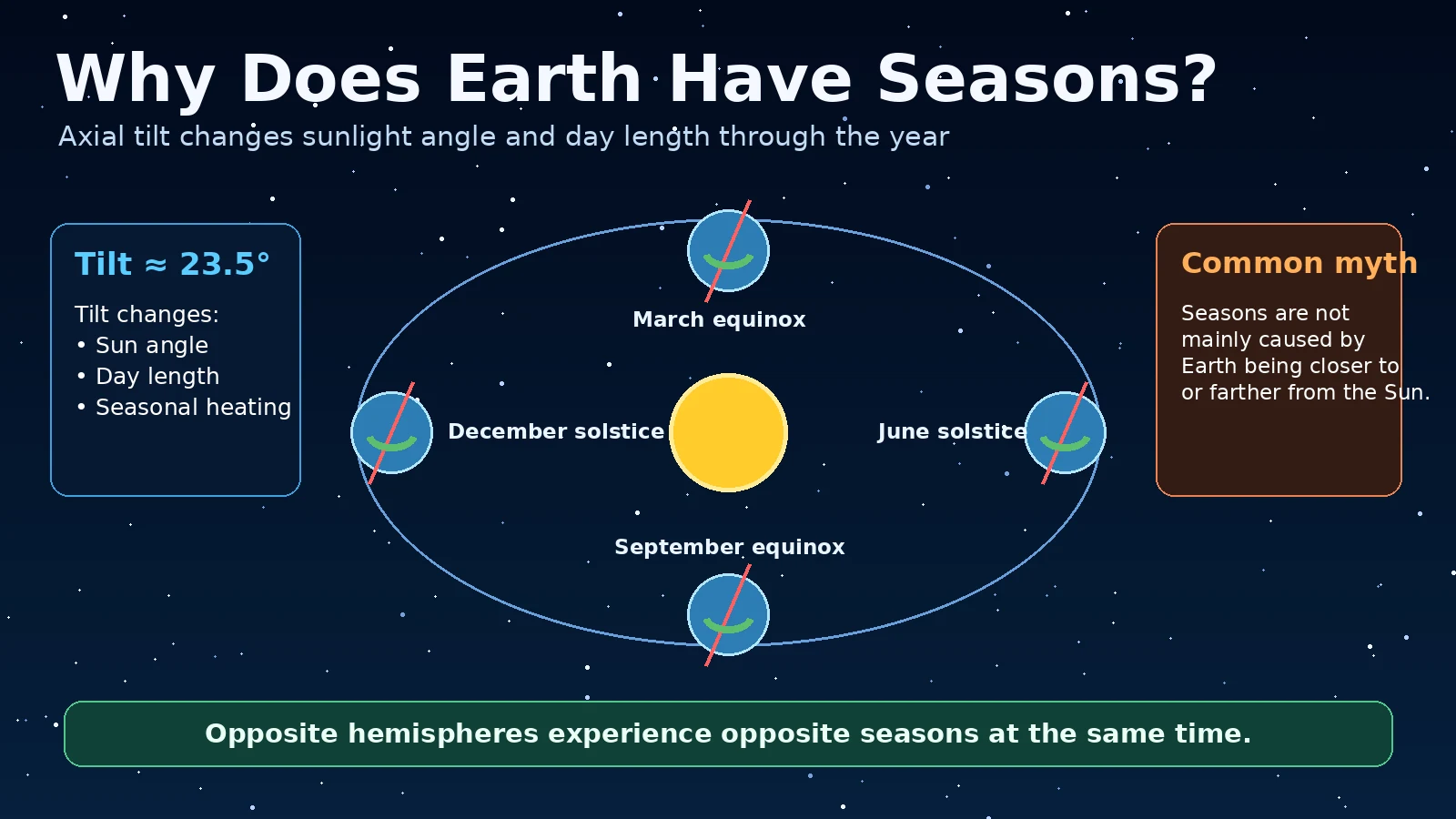
Summer feels warmer and winter colder, so it is tempting to imagine that Earth simply moves much closer to the Sun in summer. That explanation is wrong. The main cause of the seasons is Earth’s axial tilt.
NASA’s EPIC camera, operating aboard the DSCOVR mission far from Earth, provides a striking way to see the seasonal geometry: the apparent position of continents shifts through the year as Earth’s tilted axis maintains its orientation while the planet orbits the Sun.
How tilted is Earth?
Earth’s rotation axis is tilted by about 23.5 degrees relative to the plane of its orbit. As Earth travels around the Sun, one hemisphere is tilted more towards the Sun for part of the year and more away from it roughly six months later.
Why does tilt change temperature?
Tilt changes two important things: the angle at which sunlight reaches the surface and the number of daylight hours. When the Sun is higher in the sky, its energy is concentrated over a smaller surface area. Longer days also provide more time for incoming solar energy. Together these effects produce the seasonal cycle.
Why are the hemispheres opposite?
When the Northern Hemisphere tilts towards the Sun, the Southern Hemisphere tilts away. That is why June brings summer to much of the north but winter to much of the south. Around December, the situation reverses.
What are solstices?
The solstices occur near the points when one hemisphere is tilted most strongly towards or away from the Sun. They correspond to the greatest annual contrast in day length: around the June solstice the Northern Hemisphere has its longest days, while around the December solstice it has its shortest.
What are equinoxes?
Near the March and September equinoxes, neither hemisphere is tilted strongly towards the Sun. The Sun is directly above the equator at the equinox, and day and night are close to equal in length. Atmospheric refraction and the way sunrise and sunset are defined mean they are not necessarily exactly 12 hours everywhere.
Does Earth’s distance from the Sun matter?
Earth’s orbit is slightly elliptical, so its distance from the Sun does vary. But this is not the main driver of the seasons. One simple clue is that the hemispheres experience opposite seasons at the same time even though both are essentially the same distance from the Sun.
What does EPIC see?
The Earth Polychromatic Imaging Camera aboard DSCOVR views the sunlit Earth from around 1.5 million kilometres away. Comparing images around solstices and equinoxes makes the seasonal change in Earth’s orientation visually apparent.
Common misconception
Misconception: summer happens because Earth is closer to the Sun. Reality: axial tilt changes sunlight angle and day length, producing opposite seasons in the two hemispheres.
Key takeaways
- Earth’s axis is tilted by about 23.5 degrees.
- The tilt changes solar angle and daylight duration through the year.
- The Northern and Southern hemispheres therefore experience opposite seasons.
- Earth’s changing distance from the Sun is not the primary cause of the seasons.
FAQs
Would Earth have seasons without axial tilt?
Seasonal contrasts caused by tilt would be dramatically reduced, although other factors could still produce regional and orbital variations.
Why do seasons lag behind the solstices?
Land, oceans and atmosphere take time to warm and cool, so average temperatures commonly reach their seasonal extremes after the maximum or minimum daylight point.