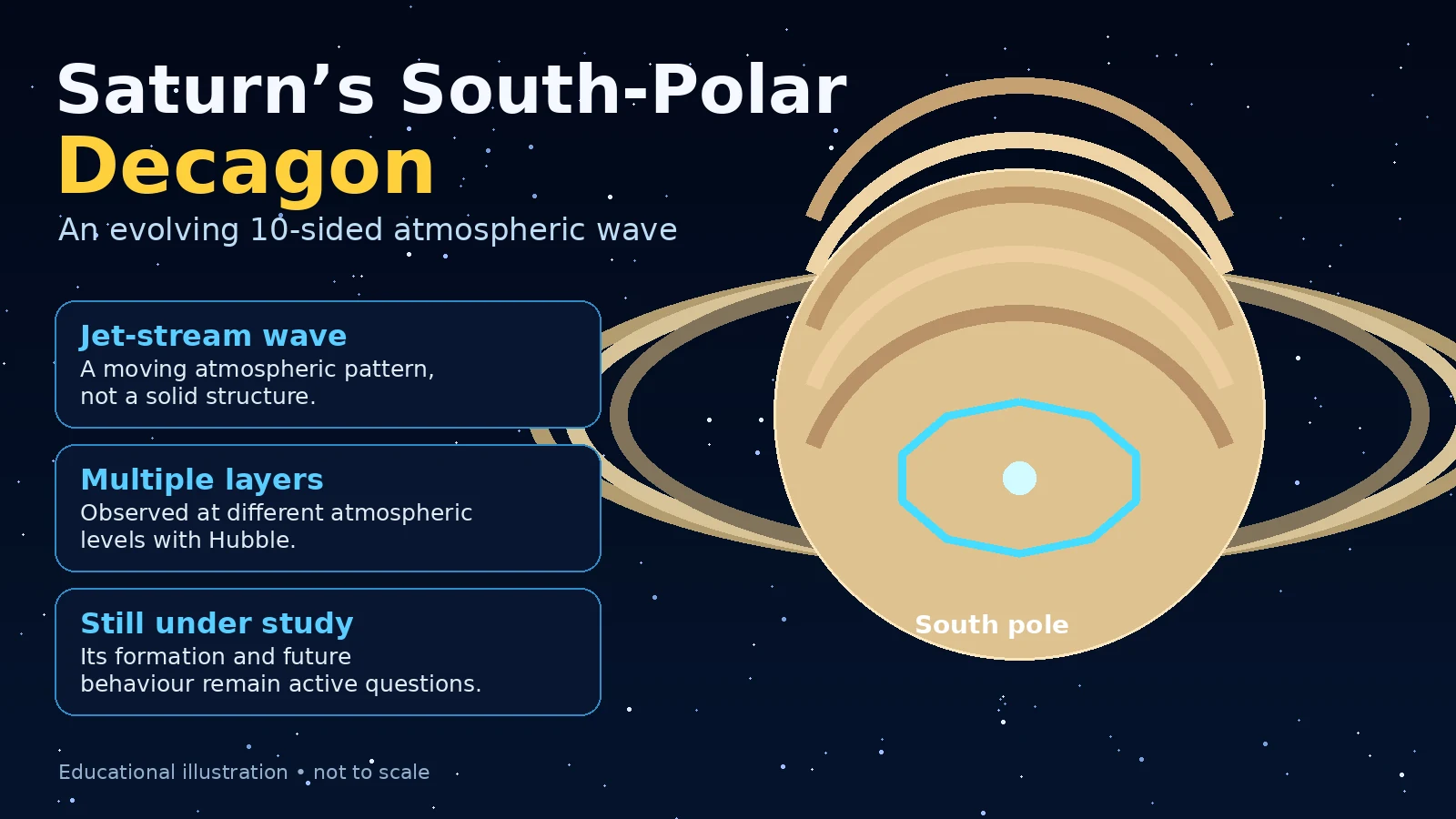
Saturn has long been famous for the giant hexagon surrounding its north pole. Now astronomers have identified another striking polygonal pattern: an evolving 10-sided atmospheric wave around the planet’s south pole.
The discovery is scientifically valuable not because Saturn has somehow grown a rigid geometric structure, but because the pattern offers a rare opportunity to watch a large atmospheric wave develop inside a powerful jet stream.
What did astronomers discover?
NASA/ESA Hubble Space Telescope observations show a giant decagonal wave encircling Saturn’s south pole. Researchers traced subtle evidence of the structure back to 2023, while ground-based observations helped draw attention to the feature as it became clearer.
The wave is embedded in a strong jet stream and appears at several atmospheric levels. Different Hubble wavelengths probe different altitudes, helping researchers test whether the feature is merely a cloud pattern or part of a deeper atmospheric structure.
How can an atmosphere make a polygon?
A jet stream is a fast-moving band of atmospheric flow. Waves can travel through and interact with such flows. Under some conditions, a wave pattern can organise a circulating jet into a shape that appears to have regularly spaced sides. The sides are therefore not solid boundaries: they are part of a moving fluid system.
Saturn’s north-polar hexagon is the best-known example. Laboratory experiments and atmospheric modelling show that rotating fluids and jets can support persistent wave patterns, although the precise origin and future of the new southern decagon remain under study.
How is the decagon different from the northern hexagon?
The northern hexagon has been observed for decades. The southern feature appears to be comparatively new or newly strengthened. Researchers have found no evidence that the south-polar pattern has the same long-term stability, so it would be premature to call it a permanent counterpart.
Why does this matter?
Planetary atmospheres are natural laboratories for fluid dynamics. Watching a large wave develop can help scientists test models of jet streams, rotating atmospheres and vertical atmospheric structure. Continued Hubble and Webb observations may reveal whether the decagon stabilises, changes its number of sides or disappears.
Common misconception
Misconception: Saturn has a solid 10-sided object at its pole. Reality: the decagon is a wave pattern in a moving atmosphere.
Key takeaways
- Hubble observations reveal an evolving 10-sided atmospheric wave around Saturn’s south pole.
- The pattern is associated with a powerful jet stream and extends through multiple atmospheric layers.
- It resembles Saturn’s northern hexagon in being polygonal, but its history and behaviour are different.
- Scientists do not yet know whether the decagon will become long-lived.
FAQs
Is Saturn’s decagon permanent?
Scientists do not yet know. Continued observations are needed to determine its lifetime and stability.
Why are different wavelengths useful?
They probe different atmospheric altitudes, helping scientists investigate the vertical structure of the wave.