Scientists often identify radioactive materials by studying the energies of the photons they emit. The pattern can work rather like a spectral fingerprint. But there is a complication: X-rays from a radioactive element can fall in the same energy region as gamma rays, so the signals may overlap.
In September 2026, researchers led by the US National Institute of Standards and Technology (NIST) reported much more precise measurements of X-ray emissions from uranium, plutonium and neptunium using superconducting transition-edge sensors. The improved reference measurements can help scientists separate overlapping spectral contributions and make nuclear-material accounting more precise.
First: what are X-rays and gamma rays?
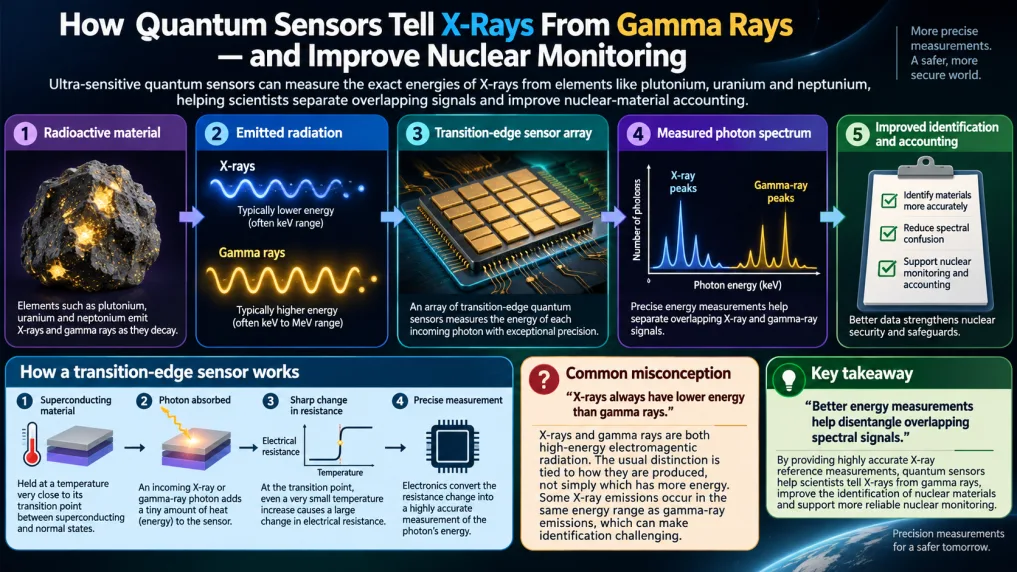
X-rays and gamma rays are both electromagnetic radiation: packets of light called photons. A common misconception is that every X-ray must have less energy than every gamma ray. In practice, their energy ranges can overlap. The names are usually associated with how the radiation is produced rather than a universal energy boundary.
That overlap matters in spectroscopy. If an X-ray line lies close to a gamma-ray line, a detector with insufficient energy resolution may have difficulty telling how much of the measured signal belongs to each contribution.
What is a transition-edge sensor?
A transition-edge sensor, or TES, is a highly sensitive thermal detector. Its sensing film is superconducting and is operated extremely close to the narrow transition between the superconducting state and the ordinary resistive state.
When a photon is absorbed, it deposits a tiny amount of energy as heat. Near the transition, even that minute temperature rise produces a sharp, measurable change in electrical resistance. Electronics read the change and researchers infer the energy deposited by the photon.
The important teaching idea is simple: photon energy becomes a tiny temperature change, which becomes an electrical signal that can be measured precisely.
Why energy resolution matters
Imagine trying to identify two neighbouring lines drawn with a thick marker. They may blur together. Replace the thick marker with a very fine pen and the two lines become easier to distinguish. Energy resolution plays a similar role in spectroscopy.
NIST reports that its TES measurements reduced the uncertainty in the relevant X-ray energies to between one-third and one-eighth of previous values. Better reference values make it easier to account for X-ray contributions when analysing gamma-ray spectra.
What did the researchers measure?
The team measured X-ray emissions from uranium, plutonium and neptunium in the energy region where those emissions can interfere with gamma-ray measurements. The work was reported in Physical Review Letters.
This is important because nuclear monitoring often relies on characteristic radiation patterns to determine which materials are present and, in appropriate measurement systems, their isotopic composition. If overlapping X-rays are not characterised accurately, they can make interpretation harder.
How the measurement process works
- A radioactive material emits radiation. Its spectrum can contain characteristic X-ray and gamma-ray features.
- Photons reach the TES array. An absorbed photon deposits energy in a sensor.
- The sensor warms by a tiny amount. Because it is operated near its superconducting transition, its resistance responds strongly.
- Electronics measure the response. The signal is used to determine the photon's energy.
- Researchers build an energy spectrum. High energy resolution helps distinguish nearby spectral features.
- More accurate reference data improve analysis. Known X-ray contributions can be separated more reliably from gamma-ray signals.
Why this can improve nuclear monitoring
Precise spectroscopy supports nuclear-material accountancy and safeguards: the scientific task of measuring and tracking nuclear material in facilities. According to NIST, improved X-ray measurements allow analysts to filter out obscuring X-ray contributions and evaluate nuclear materials more precisely.
The advance is therefore not that a sensor has discovered a new kind of radiation. It is that researchers can measure already-known spectral features with substantially better accuracy, reducing an important source of uncertainty.
Where else are transition-edge sensors useful?
TES technology is useful beyond nuclear-material measurements. NIST describes transition-edge sensors as energy-resolving detectors that can operate across a broad range of photon energies. High-resolution TES spectroscopy has also been developed for synchrotron science, atomic physics and astrophysical research.
The underlying advantage is broadly reusable: when scientists need to distinguish spectral features that are very close together, a detector with excellent energy resolution can reveal information that a lower-resolution instrument may blend together.
Common misconceptions
“Gamma rays are always more energetic than X-rays.”
Not necessarily. Their energy ranges overlap. Origin is the more useful conventional distinction: X-rays are generally associated with electronic processes, while gamma rays are associated with nuclear transitions and related nuclear processes.
“The sensor directly identifies an element by name.”
No. The sensor measures quantities such as photon energy. Scientists then interpret the resulting spectrum using physical models and reference data.
“Quantum sensor” means the detector is a quantum computer.
No. A TES exploits superconducting physics and can measure individual photon energies with very high sensitivity, but it is not performing quantum computation.
Practical analogy: sharpening a barcode
A useful analogy is a barcode scanner. If neighbouring bars are blurred, identification becomes less reliable. A higher-resolution scanner distinguishes the bars more clearly. Similarly, improved spectral resolution and more accurate reference energies help researchers distinguish radiation features that would otherwise overlap.
Key takeaways
- X-rays and gamma rays are both electromagnetic radiation, and their energy ranges can overlap.
- A transition-edge sensor measures photon energy through the tiny heating and resistance change produced when a photon is absorbed.
- NIST-led researchers made improved X-ray energy measurements for uranium, plutonium and neptunium.
- More accurate X-ray reference data help disentangle overlapping X-ray and gamma-ray spectral signals.
- The result can support more precise nuclear-material monitoring and accounting.
Frequently asked questions
Can an X-ray have more energy than a gamma ray?
Yes. The two categories have overlapping energy ranges, so energy alone does not provide a universal dividing line.
Why must a transition-edge sensor be so cold?
The superconducting film must be held near its superconducting transition, where a very small temperature change causes a large and measurable resistance response.
Does a TES measure only X-rays?
No. Transition-edge sensors have been developed for energy-resolved detection across a broad range of photon energies, with designs tailored to different scientific applications.
Why do overlapping spectral lines cause problems?
If two radiation features are too close for an instrument to resolve cleanly, their signals can blend. Higher-resolution measurements and accurate reference energies make separating the contributions easier.
Authoritative references
- National Institute of Standards and Technology (NIST), “NIST-Developed Quantum Sensors Improve Nuclear Monitoring”, 10 September 2026.
- K. D. Irwin and G. C. Hilton, “Transition-Edge Sensors”, NIST publication record.
- NIST research on high-resolution X-ray spectroscopy using transition-edge sensor arrays.
This article explains the measurement science at a general educational level. It does not provide instructions for handling radioactive materials.