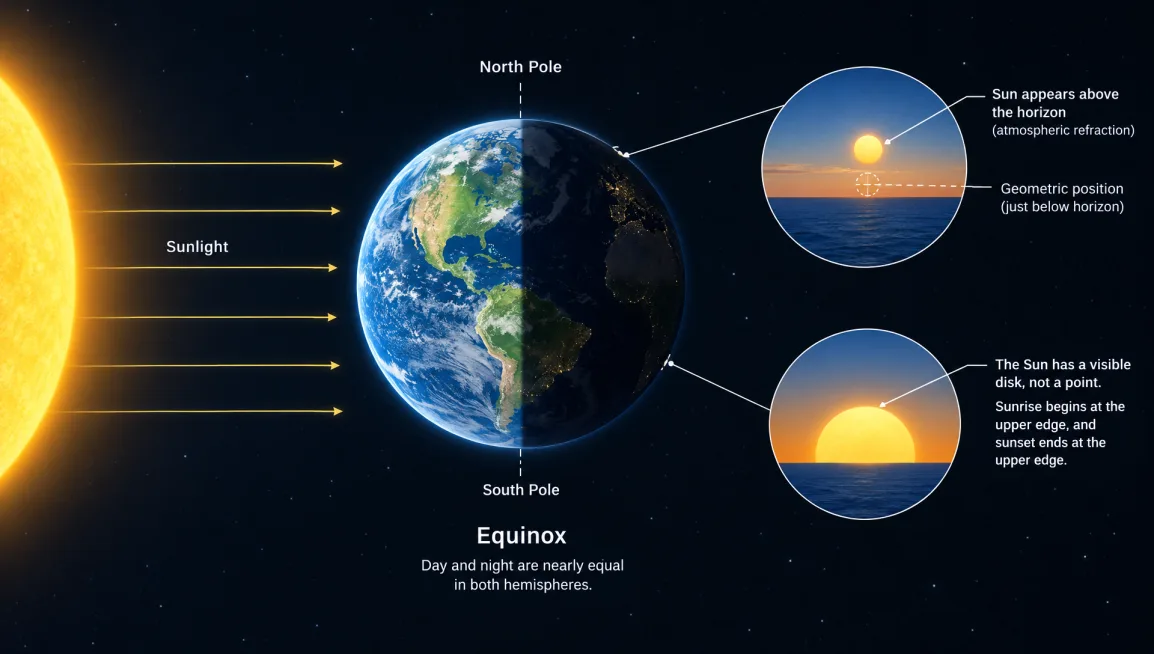
An equinox does not usually give every place on Earth exactly 12 hours of daylight and 12 hours of darkness. The astronomical event itself is precise: it is the moment when the centre of the Sun crosses Earth’s equatorial plane. But the way we define sunrise and sunset, the fact that the Sun appears as a disc rather than a point, and the bending of light through the atmosphere all add extra daylight.
For the September 2026 equinox, NASA gives the moment as 00:05 UTC on 23 September 2026. At that moment, neither hemisphere is tilted towards the Sun more than the other, so sunlight is distributed almost evenly between the Northern and Southern Hemispheres.
What is an equinox?
Earth’s axis is tilted by about 23.5 degrees relative to its orbit around the Sun. As Earth travels around the Sun, that tilt causes the Northern and Southern Hemispheres to receive changing amounts of direct sunlight during the year.
Twice each year, around March and September, Earth reaches a position where its axis is tilted neither towards nor away from the Sun. At those moments, the centre of the Sun crosses the plane of Earth’s equator. Those moments are the equinoxes.
The March equinox begins astronomical spring in the Northern Hemisphere and astronomical autumn in the Southern Hemisphere. The September equinox does the reverse: it begins astronomical autumn in the north and astronomical spring in the south.
The word equinox comes from Latin roots meaning “equal night”. That name captures an important idea, but it can also create a common misconception: day and night are not normally exactly equal on the calendar date of the equinox.
Why are day and night not exactly 12 hours each?
There are two main reasons.
1. Sunrise and sunset use the edge of the Sun, not its centre
The Sun is not a point of light. In the sky, it has a visible circular disc.
Sunrise is normally defined as the moment the upper edge of the Sun first becomes visible above the horizon. Sunset is the moment the upper edge finally disappears below the horizon.
This matters because the centre of the Sun can still be below the horizon when sunrise is declared, and it can already be below the horizon when sunset is declared. The time required for the Sun’s full disc to move across the horizon adds a few extra minutes to the measured length of the day.
2. Earth’s atmosphere bends sunlight
The second effect is atmospheric refraction. Refraction is the bending of light as it passes through materials of different densities. Near the horizon, sunlight passes through a long path in Earth’s atmosphere, and the atmosphere bends the light slightly.
As a result, the Sun can appear to be above the horizon even when its geometric position is already a little below it. We therefore see the Sun slightly earlier in the morning and slightly later in the evening than we would on an airless Earth.
NASA and the US National Weather Service both identify the Sun’s visible disc and atmospheric refraction as reasons the equinox does not produce a perfect 12-hour/12-hour split.
So what is actually equal at the equinox?
The important equality is not a stopwatch-perfect division of daylight and darkness at every location. The key astronomical geometry is that the Sun crosses Earth’s equatorial plane, and the Northern and Southern Hemispheres receive nearly equal illumination.
If the Sun were a point, if sunrise and sunset were measured from the centre of that point, and if Earth had no atmosphere to bend light, the day-night split would be much closer to an exact 12 hours.
Real observations include the Sun’s finite size and the effects of the atmosphere, so measured daylight is usually a little longer.
What is an equilux?
The day when daylight and night are closest to 12 hours each is sometimes called the equilux. Unlike an equinox, an equilux is not one single global instant. Its date depends on latitude and local sunrise and sunset conditions.
At many mid-latitude locations, the closest approach to equal day and night occurs a few days before or after the equinox. The exact date changes because the length of daylight changes at different rates at different latitudes.
Near the equator, daylight remains close to 12 hours throughout the year, but even there atmospheric refraction and the Sun’s visible disc mean the measured sunrise-to-sunset period can be slightly longer than 12 hours.
Why latitude changes the result
Latitude affects how quickly the Sun’s apparent path crosses the horizon. Near the equator, the Sun generally rises and sets at a steeper angle. At higher latitudes, its path can meet the horizon at a shallower angle, so sunrise and sunset take longer and day length changes more strongly with the seasons.
This is why the date on which a location experiences its closest balance between day and night is not the same everywhere.
Does the equinox happen at different times in different countries?
The equinox is one astronomical event, so it happens at the same instant worldwide. What changes is the local clock time and, in some places, even the local calendar date.
NASA places the September 2026 equinox at 00:05 UTC on 23 September. In a time zone west of UTC it may still be 22 September, while locations east of UTC will already be on 23 September.
This is similar to a globally observed eclipse or spacecraft event: there is one physical moment, but clocks around the world label that moment differently.
Does the equinox cause the seasons?
The equinox marks a point in Earth’s seasonal cycle, but the deeper cause of the seasons is Earth’s axial tilt, not Earth being much closer to or farther from the Sun.
As Earth orbits the Sun, the tilt changes the angle at which sunlight reaches each hemisphere and changes the number of daylight hours. Around the June solstice, the Northern Hemisphere is tilted most strongly towards the Sun and receives its longest days. Around the December solstice, the Southern Hemisphere is tilted most strongly towards the Sun. The equinoxes occur between those extremes.
Common misconceptions
- “Equinox means exactly 12 hours of day and 12 hours of night everywhere.” Not quite. The balance is close, but the Sun’s disc and atmospheric refraction usually make daylight slightly longer.
- “The equinox lasts all day.” The equinox is a specific astronomical moment. We often call the whole calendar day “the equinox” for convenience.
- “The September equinox means autumn everywhere.” It marks astronomical autumn in the Northern Hemisphere and astronomical spring in the Southern Hemisphere.
- “The seasons happen because Earth moves much closer to or farther from the Sun.” The main cause is Earth’s axial tilt and the resulting changes in sunlight angle and day length.
How to observe the idea yourself
You do not need a telescope. Around the equinox, record your local sunrise and sunset times for several days. Compare the total daylight time before, during and after the equinox. You should see the day length moving through a value close to, but not necessarily exactly, 12 hours.
You can also watch where the Sun rises and sets. Around the equinoxes, sunrise is close to due east and sunset is close to due west for most observers, although local terrain, the horizon and atmospheric conditions can affect what you actually see.
Key takeaways
- An equinox is the moment when the centre of the Sun crosses Earth’s equatorial plane.
- The September 2026 equinox occurs at 00:05 UTC on 23 September, according to NASA.
- Day and night are only approximately equal on an equinox.
- The Sun’s visible disc adds daylight because sunrise starts when its upper edge appears and sunset ends when its upper edge disappears.
- Atmospheric refraction makes the Sun appear above the horizon for a little longer.
- The closest local balance between day and night may occur a few days away from the equinox and depends on latitude.
Frequently asked questions
Is the equinox exactly 12 hours of daylight?
Usually not. Most locations receive slightly more than 12 hours of measured daylight because of the Sun’s visible size and atmospheric refraction.
What is the difference between an equinox and an equilux?
An equinox is a precise astronomical moment when the Sun crosses Earth’s equatorial plane. An equilux is a commonly used term for a local date when day and night are closest to equal in length.
Why are the seasons opposite in the two hemispheres?
Because Earth’s axis is tilted. When the Northern Hemisphere is tilted more towards the Sun, the Southern Hemisphere is tilted more away from it, and vice versa.
Does everyone experience the equinox on the same date?
The physical event happens at the same moment worldwide, but local time zones can place that moment on different calendar dates.
Authoritative references
- NASA Science — Embracing the Equinox
- US National Weather Service — Why Do We Have the Seasons?
- NASA Science — Basics of Space Flight: Reference Systems and Equinoxes
- Timeanddate — Why Equinox Day and Night Are Not Exactly Equal
Suggested next learning step: learn how Earth’s 23.5-degree axial tilt produces the solstices, seasonal changes in daylight and opposite seasons in the Northern and Southern Hemispheres.