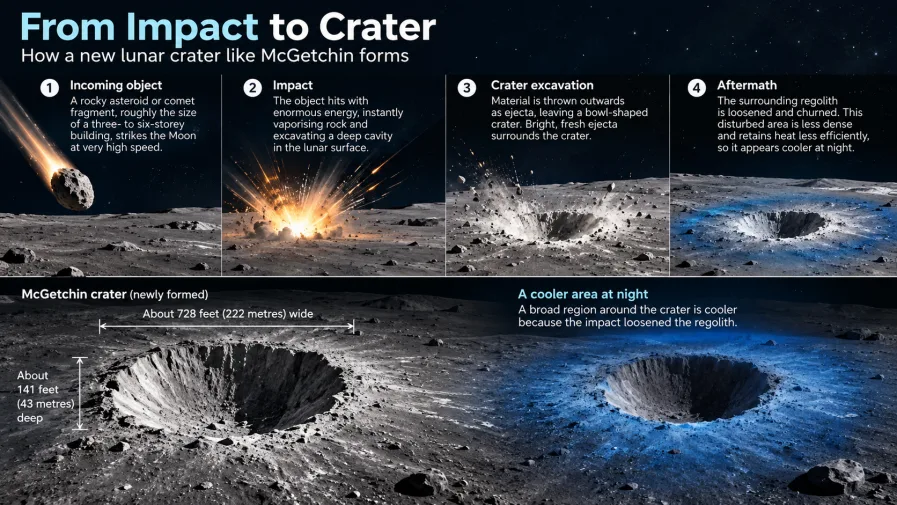
A fresh impact crater is more than a hole in the Moon. When a fast-moving asteroid or comet fragment strikes the lunar surface, the collision releases enormous energy in a fraction of a second. Rock is fractured, heated and excavated; debris is thrown outward as ejecta; and the surrounding layer of loose lunar material, called regolith, can be disturbed far beyond the crater rim.
The newly identified McGetchin crater gives scientists an unusually clear real-world example of that process. NASA’s Lunar Reconnaissance Orbiter (LRO) found that the crater formed between 11 April and 22 May 2024 on the Moon’s eastern limb. It is about 222 metres (728 feet) wide and about 43 metres (141 feet) deep. NASA says the object that formed it was probably an asteroid or comet fragment roughly the size of a three- to six-storey building.
Because spacecraft had photographed the site both before and after the impact, scientists can study a fresh crater almost from the moment it formed. That makes McGetchin useful not only as a current discovery, but also as a lesson in impact physics, lunar geology and how scientists detect change on an airless world.
First: what is an impact crater?
An impact crater is a depression formed when an object travelling at high speed collides with a solid surface. On the Moon, the incoming object might be an asteroid fragment, a comet fragment or another piece of space debris.
The key point is speed. At planetary-impact velocities, an object does not simply land and push soil aside. Its kinetic energy is transferred extremely rapidly into the target surface. That energy drives shock waves through the rock, crushes and fractures material, excavates a cavity and throws debris outward.
The Moon is covered with impact craters because it has been struck repeatedly throughout Solar System history. Unlike Earth, it has no thick atmosphere to burn up many small incoming objects before they reach the ground, and it has no rain, rivers, oceans or plate tectonics to erase most old craters quickly.
How a lunar crater forms, step by step
1. An object approaches at very high speed
The incoming body carries kinetic energy because it has mass and velocity. Since kinetic energy increases with the square of velocity, a relatively modest-sized object moving extremely fast can release a very large amount of energy on impact.
For McGetchin, researchers have not described the impactor as an object that was directly watched hitting the Moon. Instead, the crater was identified later from changes in orbital images. NASA says the impactor was probably a comet or asteroid fragment roughly comparable in size to a three- to six-storey building.
2. The impact compresses and fractures the surface
At the instant of collision, intense pressure propagates into both the projectile and the lunar surface. Material near the impact point is compressed, heated and broken apart. Some material can melt or vaporise, while larger volumes are fractured and accelerated away from the impact site.
This initial contact and compression stage is extremely brief. Most of the visible crater develops during the excavation that follows.
3. Material is excavated to make the crater
The impact drives material upward and outward, creating a growing cavity. For a relatively simple crater such as McGetchin, the final shape is broadly bowl-like.
The crater is much wider than the object that made it because the collision transfers energy into a volume of lunar material far larger than the projectile itself. This is why crater diameter cannot be treated as the same thing as impactor diameter.
McGetchin measures about 222 metres across and roughly 43 metres deep. Its unusually fresh condition lets scientists examine the immediate products of crater excavation before billions of tiny impacts and exposure to the space environment gradually modify the surface.
4. Ejecta spreads around the crater
Ejecta is rock and dust thrown out of a crater during an impact. Some ejecta lands close to the rim, forming a blanket around the crater. Other debris can travel much farther.
Fresh ejecta can appear brighter than older surrounding terrain because newly exposed lunar material has not yet been darkened as much by long exposure to space weathering. In wide-angle orbital imagery, that contrast can help a new impact stand out.
The Lunar and Planetary Institute reports that McGetchin is surrounded by a bright ejecta blanket extending hundreds of metres from the rim. NASA’s broader observations show that the impact altered the surface much farther away than the obvious crater itself.
What is lunar regolith?
The Moon’s upper surface is covered by regolith: a layer of broken rock, dust and fragments produced largely by billions of years of impacts. It is not ordinary soil in the Earth sense because it was not made by plants, water and biological processes.
Repeated impacts continually grind, mix and overturn the lunar surface. Large collisions excavate deep material, while countless smaller impacts churn the upper layers over time.
Regolith matters to lunar science because it records part of the Moon’s impact history and affects how heat moves through the surface. It also matters to exploration because astronauts, landers and rover wheels interact directly with it.
Why is there a cold spot around McGetchin?
One of the most interesting findings came from Diviner, LRO’s thermal instrument. NASA reports that scientists found a roughly 4-mile-wide area around McGetchin that is about 16°F, or roughly 9°C, cooler at night than surrounding terrain.
The crater itself is only a small part of that region. Researchers interpret the larger cold spot as evidence that the impact disturbed and loosened the regolith over a much wider area.
Looser, less-dense regolith does not retain heat as efficiently as more compact material. During the lunar day it is warmed by sunlight, but after sunset the disturbed surface cools more quickly. Thermal instruments can therefore reveal physical changes that may not be obvious in ordinary visible-light photographs.
This is an important lesson in remote sensing: scientists often learn more by combining different types of observations. A camera can reveal shape, brightness and surface texture, while a thermal instrument can reveal differences in how material stores and releases heat.
How did scientists find a crater that formed in 2024?
McGetchin was not discovered because someone watched the collision happen. It was found by comparing images of the Moon taken at different times.
NASA says Robert Wagner, an image-processing specialist working with LRO Camera data, was performing a routine quality check on 24 October 2025 when a large bright feature with a dark halo stood out in a change-detection map.
The method involved stacking and comparing large sets of Wide-Angle Camera images. Areas that had not changed appeared broadly similar, while differences in brightness and surface appearance became easier to notice. The process produces many false alarms because shadows and illumination can shift, so potential changes must be checked carefully.
Once the feature was recognised as a likely impact, scientists used sharper Narrow-Angle Camera observations to measure the crater and examine its surroundings in much greater detail.
Why can scientists narrow the impact to a few weeks?
The answer is a basic scientific method: establish a before and an after.
If one image shows an undisturbed surface and a later image shows a new crater, the impact must have happened between those observations. By examining the best available image dates, researchers constrained McGetchin’s formation to the period between 11 April and 22 May 2024.
This approach is similar to time-lapse monitoring on Earth. Scientists may not observe the event directly, but repeated measurements can reveal when a change must have occurred.
Why is McGetchin scientifically unusual?
LRO has identified many new impact craters, but McGetchin is exceptional because of its size. NASA describes it as the largest newly formed crater yet discovered during modern spacecraft monitoring of the Solar System.
Researchers estimate that an impact of roughly this scale occurs on the Moon only about once a century or longer. The Lunar and Planetary Institute gives an estimate of about once every 130 years for a crater of this size.
Its scientific value comes from having detailed observations from both before and after formation. Scientists can examine what the terrain looked like before impact, what changed immediately afterwards, how far ejecta travelled and how the thermal properties of the surrounding regolith were altered.
Why does a fresh crater help us understand old craters?
Most large lunar craters formed long before humans existed. Over time, later impacts and space weathering soften sharp features, darken exposed material and modify ejecta patterns.
A very young crater provides a starting point. Scientists can compare its fresh appearance with older craters to understand how impact features evolve. It can also test models of how ejecta spreads, how regolith is disturbed and how crater shape depends on the material beneath the surface.
McGetchin formed near a boundary between different kinds of lunar terrain, which gives researchers another opportunity to study how local geology affects crater excavation.
What does this mean for future Moon exploration?
The finding is relevant to more than geology. Future lunar missions need to understand the physical properties of the ground on which landers, rovers, habitats and other equipment may operate.
If an impact can loosen regolith across an area much larger than the visible crater, it can change bearing strength, thermal behaviour and surface texture beyond the most obvious damage. That does not mean McGetchin presents an immediate threat to a particular mission. Instead, it improves scientists’ understanding of the processes that shape the lunar environment.
Long-term observations also help researchers estimate how often impacts of different sizes occur. Those rates are useful for assessing risk to equipment and infrastructure on the Moon.
Common misconceptions
- “A crater is about the same size as the asteroid that made it.” No. The impact transfers energy into the surface and excavates a crater many times wider than the projectile.
- “The Moon no longer changes.” The Moon is geologically quieter than Earth, but impacts continue to modify its surface.
- “Scientists watched McGetchin form.” They did not. The impact window was reconstructed from before-and-after observations.
- “The blue cold spot in thermal graphics means there is ice.” Not in this case. The reported nighttime cooling is linked to disturbed, lower-density regolith that loses heat more efficiently.
- “Only the crater itself is affected.” McGetchin shows that an impact can alter surface properties far beyond the rim.
Key takeaways
- McGetchin crater formed between 11 April and 22 May 2024 and was discovered later using LRO imagery.
- The crater is about 222 metres wide and 43 metres deep.
- A high-speed impact excavates material, forms a cavity and spreads rock and dust outward as ejecta.
- The surrounding lunar regolith can be loosened and churned far beyond the crater rim.
- Thermal observations revealed a roughly 4-mile-wide region that is cooler at night because disturbed regolith retains heat less efficiently.
- Before-and-after spacecraft observations let scientists reconstruct recent changes even when nobody directly observed the impact.
Frequently asked questions
What made McGetchin crater?
NASA says the most likely cause was an asteroid or comet fragment roughly the size of a three- to six-storey building.
How old is McGetchin crater?
Researchers constrained its formation to between 11 April and 22 May 2024 by comparing observations taken before and after the surface changed.
Why is the area around the crater colder at night?
The impact loosened and decompacted surrounding regolith. The disturbed material retains heat less efficiently, so it cools faster during the lunar night.
Does the cold spot mean the impact uncovered water ice?
No evidence cited in the McGetchin studies says the cold spot is caused by exposed ice. The reported explanation is a change in the physical properties of the regolith.
How often does an impact this large happen?
NASA describes it as roughly a once-in-a-century event on the Moon; research summaries place the expected interval at about 130 years for a crater of this scale.
Authoritative references
- NASA Science — NASA’s Moon Orbiter Spots New, ‘Once-in-Century’ Moon Crater
- Lunar and Planetary Institute — NASA’s LRO Discovers a New 222-m Diameter Lunar Crater
- Science Advances — A new 222-m diameter lunar crater
- Science Advances — New lunar crater reveals extensive distal regolith modification
Suggested next learning step: compare simple and complex impact craters, then explore how scientists use crater counts to estimate the relative ages of planetary surfaces.