The latest Programme for International Student Assessment (PISA) results raise an important question: why are average reading and mathematics scores falling across many OECD education systems?
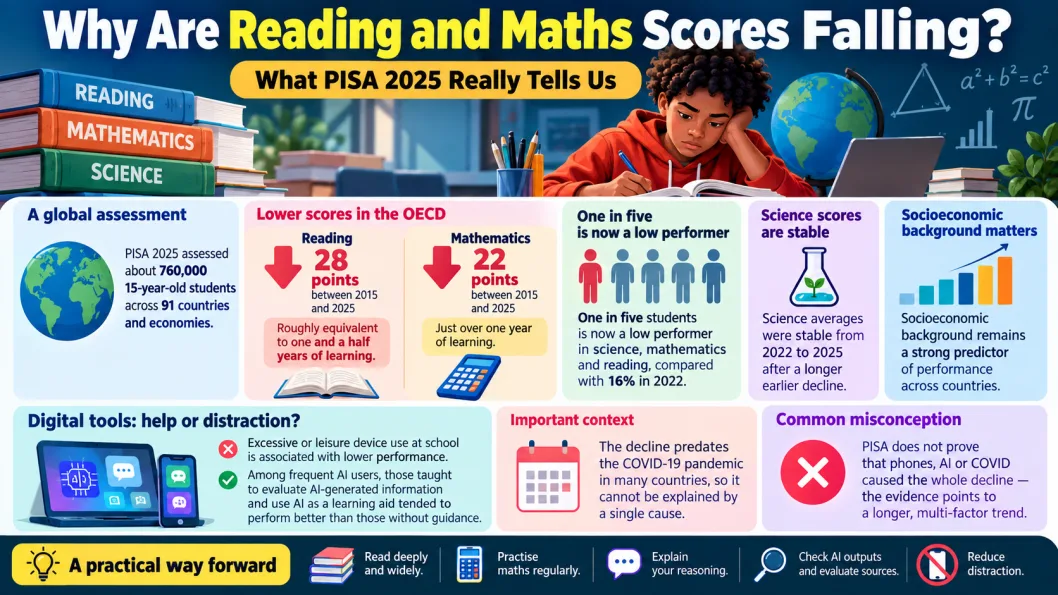
PISA 2025 assessed more than 760,000 15-year-old students across 91 countries and economies. Across OECD countries, average reading performance fell by 28 points between 2015 and 2025, while mathematics fell by 22 points. The OECD describes those changes as roughly one and a half years of learning in reading and just over one year in mathematics.
What is PISA?
PISA is an international assessment organised by the OECD. It samples 15-year-olds and tests how well they can apply knowledge and skills in science, mathematics and reading. It is not simply a memory test and it does not test every student in a country. The 2025 sample represented about 33 million 15-year-olds.
What changed in 2025?
Reading and mathematics reached their lowest OECD-average levels recorded by PISA. Science was more resilient: the OECD average was broadly stable between 2022 and 2025 after a longer earlier decline. Around one in five students across OECD countries was a low performer in all three core subjects, up from 16% in 2022.
Why does the reading decline matter?
Reading is more than decoding words. Modern literacy requires learners to compare sources, evaluate credibility, connect ideas and reflect on information. Those abilities become even more important when search engines, social media and generative AI can produce enormous quantities of information quickly.
Did COVID-19 cause the whole decline?
No. The pandemic disrupted schooling, but the OECD notes that weakening performance predates COVID-19 in many countries. That means the long-term trend cannot responsibly be reduced to one event.
What about phones, screens and AI?
Digital technology can help or hinder learning depending on how it is used. PISA data show associations between excessive or leisure device use at school and poorer performance. At the same time, the OECD reports that frequent AI users who had been taught to evaluate AI-generated information and use AI as a learning aid tended to perform better than frequent users without such guidance.
This is an important distinction: an association does not prove that a device or AI tool caused a student's score. Home background, teaching quality, prior knowledge, motivation, school resources and many other factors can interact.
Socio-economic background still matters
Across OECD countries, advantaged students scored substantially higher in science than disadvantaged students. The gap narrowed from 2022 to 2025, but the OECD says this was largely because performance among advantaged students declined rather than because disadvantaged students made equivalent gains.
A practical learning response
The results support a balanced approach rather than a technology ban or an AI-first classroom. Learners still need strong foundations: sustained reading, regular mathematics practice, explaining reasoning, checking sources and revisiting mistakes. Digital tools are most useful when they support those habits rather than replace them.
Common misconceptions
“PISA proves phones or AI caused falling scores.” It does not. PISA can identify patterns and associations, but the overall decline is multi-factor and began before widespread generative AI use.
“Every country is getting worse.” No. Some education systems improved in particular subjects, showing that the overall OECD trend is not universal.
“A PISA score tells us everything about education.” No single assessment captures every educational goal. PISA is valuable for comparing specific competencies and trends, but it should be interpreted alongside other evidence.
Key takeaways
- PISA 2025 was the largest PISA assessment to date.
- OECD-average reading and mathematics performance fell substantially between 2015 and 2025.
- The decline predates COVID-19 in many countries.
- Socio-economic differences remain important.
- Purposeful digital and AI literacy can support learning, while distraction can work against it.
Frequently asked questions
How often is PISA conducted?
PISA normally operates in cycles, allowing researchers to compare performance over time.
Does a 28-point decline mean every student lost the same amount of learning?
No. It is a change in an international population average. The “years of learning” comparison is an approximate way of communicating its scale, not a literal measurement of every individual learner.
Should students stop using AI?
The findings do not support that conclusion. A stronger lesson is to teach students how to question AI outputs, verify evidence, explain their own reasoning and use digital tools deliberately.
References
- OECD, PISA 2025 Results (Volume I): Future-Ready Students, 8 September 2026.
- OECD, “PISA 2025: Students’ reading and mathematics performance declined sharply across the OECD”, 8 September 2026.