Look at the ocean from a beach and it may seem as though the water is simply moving backwards and forwards with the waves.
On a planetary scale, something much larger is happening.
Vast streams of seawater are continuously travelling through the world's oceans. Some flow near the surface. Others move slowly through the deep ocean. Some stretch across entire ocean basins, while smaller currents form along coastlines and around islands.
Together, these movements form an enormous circulation system connecting distant regions of Earth.
And ocean currents transport far more than water.
They move heat, nutrients, oxygen, marine organisms, sediments, pollutants and floating debris. They influence climate, weather, fisheries, shipping and even where some marine ecosystems flourish.
An ocean current is therefore not simply water flowing from one place to another.
It is part of a connected Earth system involving the ocean, atmosphere, climate, geology and living world.
What Is an Ocean Current?
An ocean current is a relatively continuous movement of seawater in a particular direction.
Currents occur at many scales.
Some operate mainly near the ocean's surface, while others move through deep layers thousands of metres below.
According to NOAA, ocean currents can be generated by several processes, including:
- wind;
- differences in seawater density;
- gravity;
- tides; and
- events such as storms.
Large-scale surface circulation is strongly influenced by global wind patterns, Earth's rotation and the shape of continents. Deep circulation is strongly affected by density differences associated with temperature and salinity.
Understanding those two broad forms of circulation helps explain much of what the ocean is doing.
1. Surface Currents: When Wind Moves the Ocean
Many major surface currents begin with the atmosphere.
As winds blow across the ocean, friction transfers some of the wind's energy to the water.
But the resulting water does not simply travel in a perfectly straight line.
Earth itself is rotating.
That rotation produces an apparent deflection known as the Coriolis effect.
In the Northern Hemisphere, large-scale moving water is deflected towards the right relative to its direction of travel.
In the Southern Hemisphere, it is deflected towards the left.
Continents then act as enormous barriers, redirecting the moving water.
The combined effects of:
wind + Earth's rotation + continental boundaries
help create some of the great circulating current systems visible on maps of the world's oceans.
Ocean Gyres: Giant Rotating Current Systems
Many major surface currents belong to enormous rotating systems known as gyres.
NOAA identifies five major subtropical ocean gyres:
North Atlantic Gyre
South Atlantic Gyre
North Pacific Gyre
South Pacific Gyre
Indian Ocean Gyre
A gyre is not one enormous whirlpool.
It is a large interconnected system of currents circulating around an ocean basin.
The Gulf Stream, for example, forms part of the North Atlantic Subtropical Gyre.
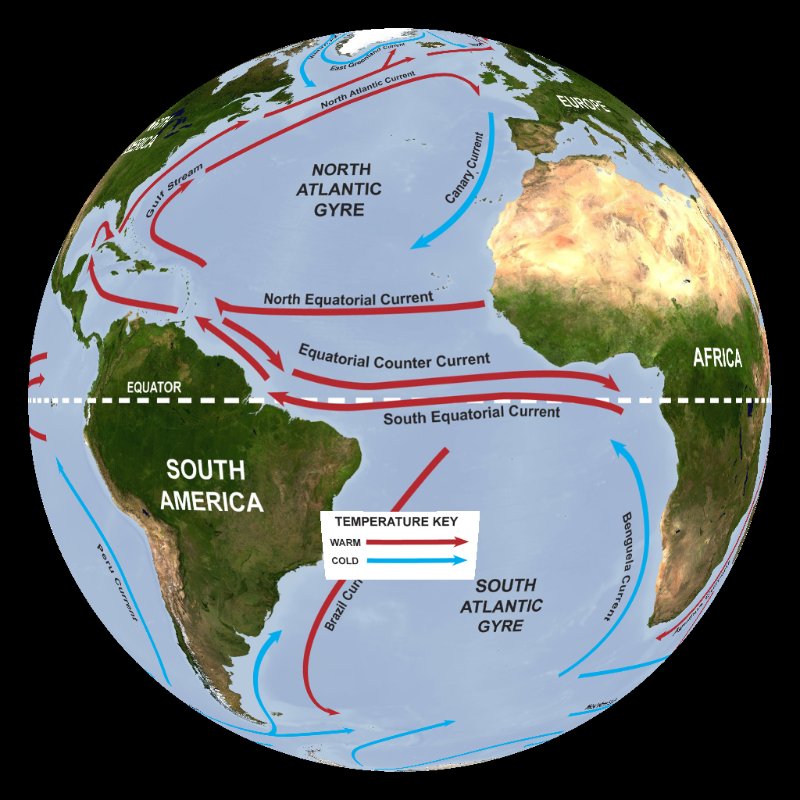
Large wind-driven current systems called gyres circulate water through the major ocean basins.
2. Deep Ocean Circulation: Temperature and Salt Matter
Wind is only part of the story.
Far below the surface, enormous quantities of water also move through the ocean.
An important driver of this circulation is density.
Seawater density changes with temperature and salinity.
Generally:
colder seawater is denser than warmer seawater
and, under comparable conditions:
saltier seawater is denser than fresher seawater.
When seawater becomes sufficiently cold and dense in certain high-latitude regions, it can sink into deeper layers.
That water can then become part of a much larger deep-ocean circulation system.
This density-related circulation is commonly described using the term thermohaline circulation:
thermo = temperature
haline = salt or salinity
NOAA describes the global ocean conveyor as a combination of deep thermohaline circulation and wind-driven surface currents.
The “Global Conveyor Belt”
You may see global ocean circulation illustrated as a giant conveyor belt.
The comparison is useful because water moves between ocean basins and between the surface and deep ocean over very long periods.
But the actual ocean is much more complicated than a single continuous pipe.
It contains:
eddies, mixing, regional currents, upwelling, sinking water, wind-driven circulation and interactions with seafloor and continental geography.
The “conveyor belt” is therefore best understood as a simplified picture of a very complicated three-dimensional circulation system.
Why Ocean Currents Matter
The most important thing about currents is not simply that seawater moves.
It is what moves with it.
Ocean Currents Redistribute Heat
Earth does not receive solar energy evenly.
Tropical regions receive more intense solar energy than polar regions.
Without atmospheric and oceanic circulation, that difference would produce even more extreme temperature contrasts between low and high latitudes.
The ocean acts as an enormous heat reservoir.
Warm tropical water can be transported towards higher latitudes, while colder water moves towards lower latitudes and through deeper circulation.
NOAA describes ocean currents as a major mechanism for redistributing heat around the planet, helping moderate Earth's regional climate.
This is one reason the climate of a coastal region cannot be understood by latitude alone.
Two places located at similar latitudes may experience different climates partly because of the ocean and atmosphere surrounding them.
The Gulf Stream: A Famous Example
One of the world's best-known currents is the Gulf Stream.
It is a powerful western boundary current in the North Atlantic.
Warm water flows northwards past Florida and along the eastern coast of North America before the wider North Atlantic circulation continues towards the northeast Atlantic.
The Gulf Stream is part of the much larger North Atlantic circulation system rather than an isolated river flowing through the sea.
Does the Gulf Stream Keep Europe Warm?
You will often hear a simplified statement:
“Europe is warm because of the Gulf Stream.”
There is truth behind the idea, but the complete climate system is more complicated.
The Gulf Stream and broader Atlantic circulation transport large quantities of heat northwards. Heat transferred from the ocean to the atmosphere contributes to the relatively mild climate of Western Europe.
But European climate is not controlled by the Gulf Stream alone.
Atmospheric circulation, prevailing winds, proximity to the Atlantic Ocean, latitude and other climate processes also matter.
A better statement is therefore:
North Atlantic ocean circulation is an important contributor to Western Europe's climate, operating together with the atmosphere and other geographic factors.
NOAA and the UK Met Office both describe the Gulf Stream and wider Atlantic circulation as important mechanisms for transporting heat towards Europe.
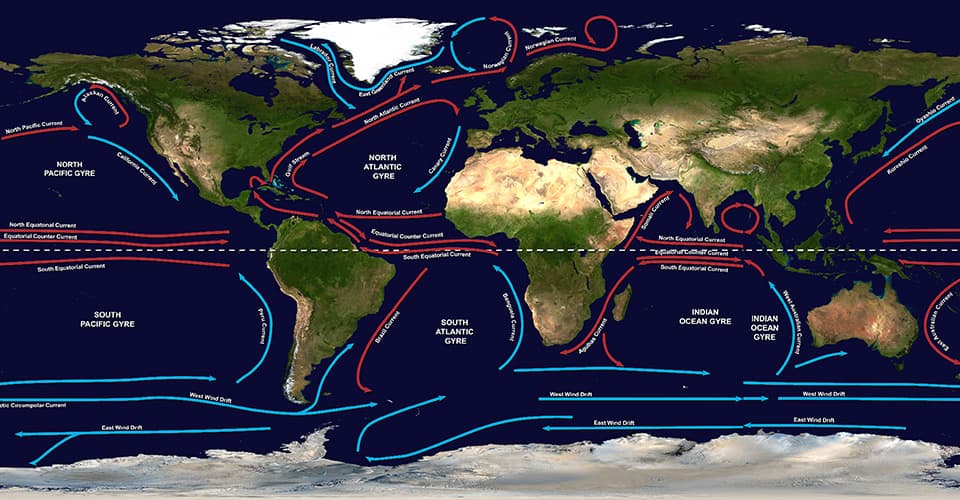
Ocean circulation contributes to regional climate — but it works together with the atmosphere.
Currents Can Bring Nutrients Up From the Deep
Heat is not the only important substance transported through the ocean.
Currents also redistribute nutrients.
One particularly important process is called upwelling.
What Is Upwelling?
In some coastal regions, winds push surface water away from the coast.
Water from deeper layers then rises to replace it.
That deeper water is often colder and rich in nutrients.
When those nutrients reach sunlit surface waters, they can support the growth of phytoplankton — microscopic photosynthetic organisms that form a crucial foundation of many marine food webs.
Phytoplankton can then support:
zooplankton → small fish → larger fish → seabirds and marine mammals.
NOAA notes that some of the world's important fishing grounds are associated with persistent coastal upwelling, including regions off western Africa and South America.
This means a physical movement of seawater can ultimately influence how much marine life an ecosystem can support.
Currents Help Shape Marine Ecosystems
Marine organisms do not live in a motionless environment.
Currents can influence:
where nutrients accumulate;
where plankton grow;
where larvae are transported;
where fish find food;
how marine species migrate; and
how different populations become connected.
Some organisms actively use currents during migration.
Others, especially plankton and larvae, may be transported long distances by the moving water.
A change in circulation can therefore alter far more than temperature.
It can change the ecological connections between different parts of the ocean.
Currents Move Pollution Too
Unfortunately, currents do not distinguish between useful and harmful material.
They can transport:
plastic waste;
oil;
chemical contaminants;
floating debris; and
other pollutants.
A bottle entering the ocean near one coastline may eventually travel hundreds or even thousands of kilometres from its original source.
NOAA notes that surface currents can transport floating marine debris over long distances.
This is one reason marine pollution is often an international problem.
Waste released in one location does not necessarily remain there.
Why Plastic Accumulates in Ocean Gyres
Ocean gyres are sometimes incorrectly described as enormous solid “islands of rubbish”.
That is misleading.
Large-scale circulating currents can concentrate floating debris in particular regions of the ocean, but the material is spread across very large areas and includes countless small fragments.
The gyre itself is the current system, not the rubbish.
Plastic happens to accumulate within parts of those circulating systems.
Ocean Currents Affect Navigation
For centuries, sailors have understood that travelling with or against a current can significantly affect a voyage.
The same principle remains relevant today.
Currents affect:
shipping;
fuel consumption;
travel time;
coastal navigation;
search-and-rescue operations;
oil-spill response; and
the predicted movement of objects lost at sea.
NOAA collects current information partly because understanding water movement is important for safe navigation, emergency response and coastal management.
Modern satellites, drifting buoys, autonomous instruments and computer models allow scientists to observe these movements with much greater precision than early navigators ever could.
Currents Connect the Ocean and Atmosphere
Perhaps the most important idea is that the ocean does not operate independently of the atmosphere.
The two systems continuously exchange:
heat
water
momentum
gases
and energy.
Warm ocean surfaces can transfer heat and moisture into the atmosphere.
Winds generated by atmospheric pressure differences then push against the sea surface and influence currents.
Those currents move heat elsewhere.
The changed sea-surface temperatures can then influence the atmosphere again.
So the relationship works in both directions:
ATMOSPHERE → OCEAN
and
OCEAN → ATMOSPHERE
This continual interaction is fundamental to Earth's weather and climate system.
Ocean Currents Also Matter to the Carbon Cycle
The ocean is also a major component of Earth's carbon cycle.
Circulation helps transport dissolved carbon between the surface and deeper parts of the ocean.
When water sinks, some carbon associated with that water can be carried away from direct contact with the atmosphere for long periods.
Deep circulation therefore participates not only in moving heat, but also in redistributing chemical substances throughout the ocean. NOAA describes deep-water formation as one of the processes capable of carrying carbon into the ocean interior.
What Is the AMOC?
Another term frequently encountered in discussions of ocean circulation is the Atlantic Meridional Overturning Circulation, or AMOC.
It is a large system of Atlantic Ocean currents involving northward transport in upper ocean layers and southward movement of colder, deeper water.
The Gulf Stream is related to this wider Atlantic circulation, but the Gulf Stream and AMOC are not interchangeable names for exactly the same thing.
The Gulf Stream is a specific strong western boundary current.
AMOC describes a much broader overturning circulation system.
NASA and NOAA monitor this circulation because changes in its strength can affect the redistribution of heat through the Atlantic.
That distinction is important because headlines sometimes incorrectly treat:
Gulf Stream = AMOC = entire global conveyor belt
as though all three terms meant exactly the same thing.
They do not.
What Determines Seawater Density?
Density is important enough to deep-ocean circulation that it is worth understanding the concept clearly.
Density describes how much mass is contained within a given volume.
In seawater, temperature and salinity strongly influence that density.
Cold water tends to be denser than warmer water.
Adding dissolved salt generally increases seawater density.
That means cold, salty water can become particularly dense and sink beneath less-dense water.
This process contributes to deep-water formation in parts of the global ocean.
Ocean Currents Are Not Permanent Rivers
Maps often make ocean currents appear like fixed blue and red roads through the sea.
Reality is much more dynamic.
Currents can:
shift position;
change strength;
produce eddies;
interact with other currents;
vary seasonally; and
respond to changing winds, temperatures and salinity.
The arrows on a world map represent broad patterns.
The actual ocean is continuously changing.
Why Scientists Monitor Ocean Circulation
Scientists track currents because changes in circulation can affect many connected systems.
Monitoring helps researchers understand:
climate;
sea-surface temperature;
marine ecosystems;
fisheries;
weather;
hurricane environments;
sea-level patterns;
movement of marine debris; and
long-term changes in Earth's climate system.
Scientists use satellites, drifting instruments, moorings, research ships and computer models to observe the ocean.
NOAA notes that drifting instruments can directly track surface currents while simultaneously recording environmental measurements such as sea-surface temperature.
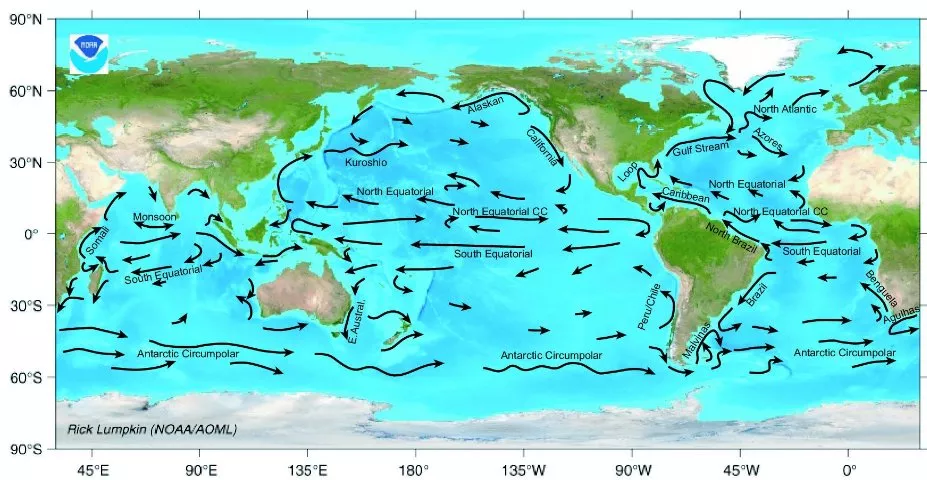
The Bigger Lesson
Ocean currents demonstrate one of the most important principles in Earth science:
The planet's systems are connected.
A wind blowing over the Pacific can move surface water.
That moving water can cause deeper nutrient-rich water to rise.
Those nutrients can support phytoplankton.
The phytoplankton can feed fish.
Those fish can support fisheries and coastal communities.
Elsewhere, warm tropical water transported towards higher latitudes can transfer heat into the atmosphere and influence regional climate.
And floating plastic entering the sea can travel far beyond the country where it was discarded.
One physical process can therefore produce consequences across geography, climate, biology and human society.
Key Takeaway
Ocean currents are not simply streams of seawater moving around a map.
They form part of Earth's planetary circulation system.
They redistribute heat.
They help regulate climate.
They bring nutrients towards the surface.
They connect marine ecosystems.
They influence navigation.
They transport pollutants.
They participate in the carbon cycle.
And they connect the ocean with the atmosphere above it.
So when you look at the sea, remember:
the water in front of you belongs to a system whose movements can connect continents, climates and ecosystems thousands of kilometres apart.