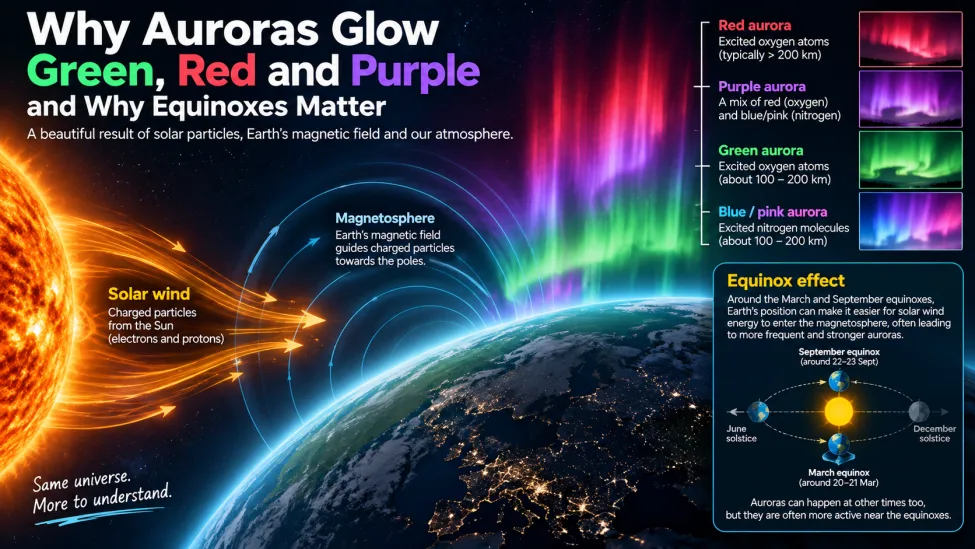
Auroras glow in different colours because energetic particles from space transfer energy to gases in Earth’s upper atmosphere. Oxygen and nitrogen then release that energy as light. The colour depends mainly on which gas is involved, the altitude of the interaction and the energy of the incoming particles.
Green is the most familiar auroral colour, but red, blue, pink and purple can all appear. NASA’s Earth Observatory highlighted a vivid green, red and purple aurora photographed from the International Space Station on 7 September 2026 and published the image on 16 September. NASA also noted that auroral activity is often enhanced around the March and September equinoxes because the geometry between Earth’s magnetic field and the solar wind can make energy transfer into the magnetosphere more favourable.
This makes auroras a useful lesson in several connected ideas: solar wind, magnetic fields, atoms and molecules, atmospheric layers, light emission and the Sun–Earth relationship.
What is an aurora?
An aurora is a natural light display produced in Earth’s upper atmosphere when energetic charged particles are guided into polar regions and collide with atmospheric gases.
The northern lights are called the aurora borealis. The southern lights are called the aurora australis. Both are manifestations of the same physical process.
Auroras are most common at high latitudes because Earth’s magnetic field guides many energetic particles towards regions around the magnetic poles. During stronger geomagnetic activity, the zone of visible aurora can expand farther towards lower latitudes.
Where do the particles come from?
The Sun constantly releases a stream of charged particles called the solar wind. This flow contains mostly electrons and protons and travels through interplanetary space.
Earth is not exposed to the solar wind in the same way as an airless, unmagnetised object. Our planet is surrounded by the magnetosphere, a region dominated by Earth’s magnetic field.
The solar wind pushes and distorts this magnetic environment. Under favourable conditions, energy from the solar wind is transferred into the magnetosphere. Charged particles can then be accelerated along magnetic-field lines towards the upper atmosphere, especially near the polar regions.
When these particles collide with atmospheric atoms and molecules, the collisions can transfer energy to them. The excited atoms and molecules later release that energy as photons — particles of light.
Why does oxygen glow green?
Atomic oxygen is responsible for the most common green aurora.
NASA places this green oxygen emission roughly between 100 and 200 kilometres above Earth. NOAA identifies the important green atomic-oxygen emission near a wavelength of 557.7 nanometres.
At these altitudes, energetic particles collide with oxygen atoms and push their electrons into higher-energy states. When the atoms return towards lower-energy states, they release photons at characteristic wavelengths. One of those wavelengths falls in the green part of the visible spectrum.
That is why large auroral curtains often appear green to both cameras and human observers.
Why can auroras glow red?
Oxygen can also emit red light, but this typically happens higher in the atmosphere.
NASA says red auroral oxygen emission commonly occurs above about 200 kilometres. NOAA identifies an important red oxygen emission near 630.0 nanometres.
At these greater altitudes, the atmosphere is thinner. Excited oxygen atoms can remain in a particular excited state long enough to release red photons before losing that energy in another collision.
This helps explain why red aurora can appear above a lower green layer. During some geomagnetic storms, large red displays can also become visible unusually far from the poles.
What produces blue and pink auroras?
Nitrogen is an important source of blue and pink auroral light.
NASA explains that excited nitrogen at roughly 100–200 kilometres can glow blue or pink depending on the type of nitrogen involved and the energy of the interacting particles. At lower altitudes, nitrogen emissions can contribute reddish-purple or pink tones along the lower edges of an auroral curtain.
The colours are therefore not a simple one-gas-one-colour system. Different gases, molecular states, altitudes and particle energies can contribute at the same time.
Why do some auroras look purple?
Purple is often a combined visual effect rather than one unique auroral emission.
NASA notes that emissions from different gases can overlap. A mixture containing red oxygen light together with blue or pink nitrogen light can appear purple. Cameras may record these combinations particularly clearly because modern sensors can accumulate more light than the human eye perceives in a brief glance.
That is why a photograph may show vivid purple or magenta structure where an observer on the ground saw a subtler colour.
Why does altitude affect aurora colour?
Earth’s atmosphere becomes thinner with altitude, and its composition and collision rates change. These differences affect which excited states survive long enough to emit light.
A useful simplified guide is:
| Approximate altitude | Common contributor | Typical colour |
|---|---|---|
| Above ~200 km | Atomic oxygen | Red |
| ~100–200 km | Atomic oxygen | Green |
| ~100–200 km | Nitrogen | Blue or pink |
| Below ~100 km | Nitrogen contributions | Pink to reddish-purple |
These are broad educational ranges rather than rigid boundaries. Real auroral structures can span hundreds of kilometres vertically, and several emissions can occur at once.
What role does Earth’s magnetic field play?
Without Earth’s magnetic environment, the path of energetic particles towards the atmosphere would be very different.
The magnetosphere interacts continuously with the solar wind. Its field lines provide pathways along which particles can be accelerated into the upper atmosphere. Because of the geometry of Earth’s magnetic field, the strongest routine auroral activity forms broad rings called auroral ovals around the magnetic poles.
When geomagnetic conditions become more disturbed, these ovals can expand, allowing auroras to be visible much farther from the poles than usual.
What makes one night more active than another?
Auroral activity depends strongly on space weather.
The Sun can produce streams of faster solar wind, solar eruptions and coronal mass ejections that alter conditions in interplanetary space. If the magnetic orientation and speed of the arriving solar wind favour strong coupling with Earth’s magnetosphere, more energy can enter the system.
That energy can drive stronger geomagnetic activity and brighter or more widespread auroras.
This is why aurora forecasts look at solar-wind speed, density and the direction of the interplanetary magnetic field rather than simply asking whether the Sun is “active”.
Why can auroras be more common around the equinoxes?
Auroras can occur at any time of year. However, geomagnetic activity shows a recognised seasonal pattern, with activity often enhanced around the March and September equinoxes.
NASA’s September 2026 aurora explainer attributes this partly to the Russell–McPherron effect. The basic idea is that Earth’s orientation relative to the solar wind changes through the year. Around the equinoxes, that geometry can make the interplanetary magnetic field more favourably oriented for transferring energy from the solar wind into Earth’s magnetosphere.
This does not mean an equinox automatically causes an aurora or that auroras only occur in March and September. Solar activity and the magnetic conditions of the arriving solar wind still matter.
The equinox effect changes the likelihood and efficiency of magnetic coupling; it does not guarantee a visible display.
Does the equinox itself produce auroras?
No. An equinox is an astronomical moment when the centre of the Sun crosses the plane of Earth’s equator.
In 2026, NASA gives the September equinox as 23 September at 00:05 UTC.
The connection with auroras is indirect. The seasonal orientation of Earth’s magnetic field relative to the solar wind can favour geomagnetic activity around this period. The light itself is still produced by energetic particles exciting atmospheric gases.
Why are auroras usually seen near the poles?
Earth’s magnetic field guides charged particles towards polar regions, so high latitudes are usually closest to the auroral ovals.
Places in Alaska, northern Canada, Greenland, Iceland, Scandinavia and northern Russia frequently see the aurora borealis. High southern latitudes can see the aurora australis.
During powerful geomagnetic storms, the auroral oval can expand significantly. This allows displays to become visible at lower latitudes for a limited time.
Are northern and southern auroras the same?
They are produced by the same general Sun–Earth interaction, and broad auroral structures can appear in both hemispheres.
However, the two displays are not always perfect mirror images. Earth’s magnetic field is not perfectly symmetrical, and differences in the magnetic environment, solar illumination and atmospheric conditions can affect the details.
Why do auroras move like curtains?
Auroras are not solid objects. They trace regions where energetic particles are entering the atmosphere along magnetic-field structures.
As conditions in the magnetosphere change, the locations and intensity of particle precipitation change too. This produces arcs, rays, curtains, folds and rapidly moving bands.
Perspective also matters. Long auroral rays aligned with magnetic-field lines can look like vertical columns from the ground even though the glowing region extends over a large three-dimensional volume.
Are auroras dangerous to people watching from the ground?
The visible aurora itself is not dangerous to somebody standing outside and watching it.
The broader geomagnetic storms associated with strong auroras can, however, affect technology. Space-weather disturbances can influence radio communications, satellite operations, navigation systems and electrical infrastructure.
This is why agencies such as NOAA’s Space Weather Prediction Center monitor geomagnetic conditions even though the aurora itself is often treated mainly as a beautiful sky event.
Can you predict the exact colour of an aurora?
Not perfectly.
Scientists can explain which emissions are physically possible under particular atmospheric and particle conditions, but a visible display combines altitude, particle energy, gas composition, geomagnetic activity, viewing geometry and camera sensitivity.
Green is common because the green atomic-oxygen emission is strong and occurs at altitudes where auroral particle interactions are frequent. Red may dominate higher structures, while nitrogen can add blue, pink or purple tones.
Common misconceptions
- “Auroras are sunlight reflecting from ice.” No. Auroral light is emitted by excited atmospheric atoms and molecules.
- “Green, red and purple mean completely different types of aurora.” The colours mostly reflect different gases, energy states and altitudes within the same underlying process.
- “Purple is produced by one special purple gas.” Purple can result from overlapping red and blue or pink emissions.
- “Auroras only happen at the equinoxes.” They can occur throughout the year. Geomagnetic activity is simply often enhanced around equinox seasons.
- “The equinox sends particles towards Earth.” The particles come from the Sun. The seasonal geometry can affect how efficiently their magnetic energy couples into Earth’s magnetosphere.
- “A more colourful aurora must be physically stronger.” Colour depends on gas, altitude and particle energy as well as intensity, so colour alone is not a direct measure of storm strength.
How to observe auroras safely
Aurora watching does not normally require special optical equipment. A dark location away from city lights, a clear view towards the expected auroral direction and favourable space-weather conditions are more important.
If you are travelling to observe auroras, ordinary environmental safety matters: cold weather, darkness, remote roads and changing conditions can present greater practical risks than the aurora itself.
For current geomagnetic conditions, use official space-weather services rather than relying only on viral social-media predictions.
Key takeaways
- Auroras form when energetic particles interact with Earth’s magnetosphere and excite gases in the upper atmosphere.
- Atomic oxygen commonly produces green light around 100–200 km altitude and red light at higher altitudes.
- Nitrogen contributes blue and pink emissions, and overlapping colours can appear purple.
- Earth’s magnetic field guides many energetic particles towards polar regions, producing auroral ovals.
- Geomagnetic activity is often enhanced around the March and September equinoxes because Sun–Earth magnetic geometry can favour energy transfer into the magnetosphere.
- Auroras can occur at any time of year; the equinox effect changes probability, not possibility.
Frequently asked questions
Why is green the most common aurora colour?
Green emission from atomic oxygen is strong in an altitude range where auroral particle interactions commonly occur, roughly 100–200 kilometres above Earth.
What causes red aurora?
Red aurora is commonly produced by excited atomic oxygen at higher altitudes, generally above about 200 kilometres.
Why does aurora sometimes look purple?
Purple can appear when emissions overlap, especially combinations of red oxygen light with blue or pink nitrogen light.
Are auroras stronger at the equinox?
Geomagnetic activity is statistically often enhanced around the equinox seasons because Earth’s magnetic orientation can favour stronger coupling with the solar wind. Individual auroral events still depend on actual space-weather conditions.
Can auroras happen near the equator?
Strong geomagnetic storms can push visible auroras much farther from the poles than normal, but sightings near very low latitudes are uncommon.
Authoritative references
- NASA Earth Observatory — Purple Haze Aurora
- NASA Science — Auroras
- NASA Science — Embracing the Equinox
- NOAA Space Weather Prediction Center — Aurora
Suggested next learning step: explore how scientists measure geomagnetic storms and why the direction of the interplanetary magnetic field matters for transferring solar-wind energy into Earth’s magnetosphere.