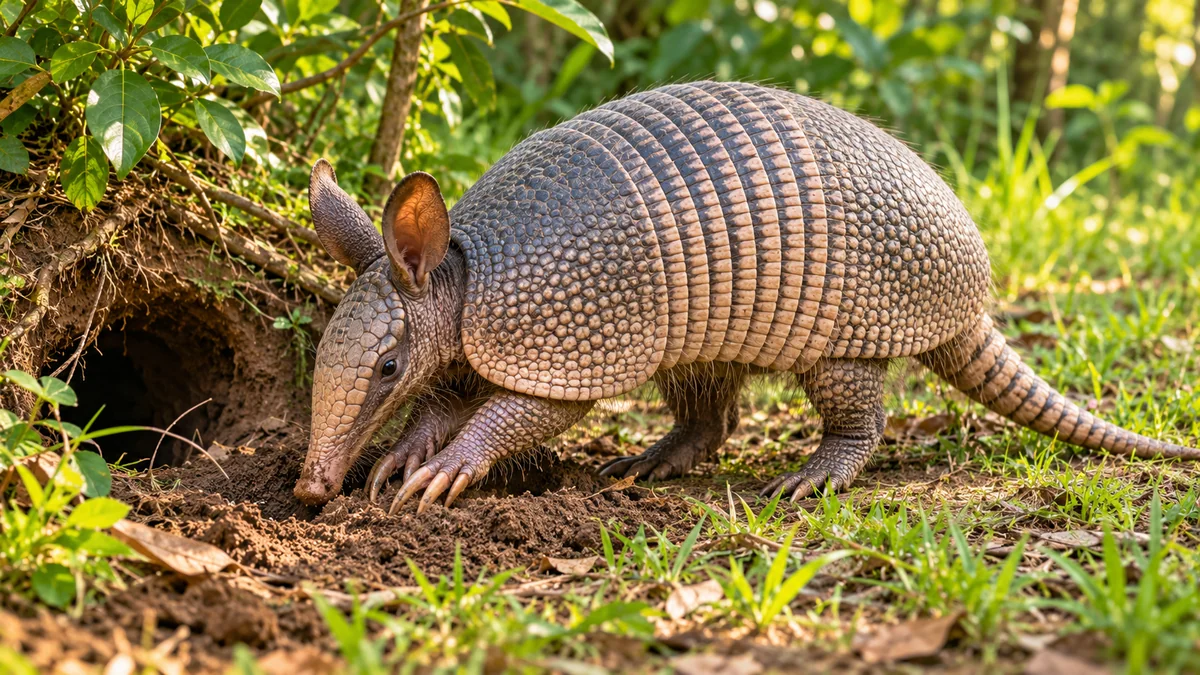
Armadillos are armour-covered mammals native to the Americas, famous for their digging claws, underground burrows and insect-rich diets. Their protective shells make them easy to recognise, but armadillos are more varied than they first appear: some forage through warm grasslands, others live in forests, and a few specialise in life under the soil. Contrary to a popular myth, most armadillos cannot roll into a completely closed ball. That remarkable defence is associated with the two three-banded species.
In this guide, discover where armadillos live, what they eat, how they behave, how their armour works and why some species face conservation threats. We also examine surprising facts, including the nine-banded armadillo's tendency to produce four genetically identical young, and explain why wild armadillos should be observed rather than handled.
What is an armadillo?
An armadillo is a placental mammal belonging to the order Cingulata, within the larger mammalian group Xenarthra. Its living relatives in Xenarthra include anteaters and sloths. Although its shell can resemble reptile scales, an armadillo is a mammal: females nurse their young with milk, and the animal regulates its body temperature, albeit with physiological traits unusual among mammals. To explore this broader classification, see SuperEducational's guide to animal classification .
Scientists recognise roughly two dozen living armadillo species, with precise totals changing as taxonomy is revised. They differ greatly in size, habitat, shape and feeding behaviour. The commonly encountered nine-banded armadillo is one species, not a model for every member of the group. The San Diego Zoo Wildlife Alliance describes the diversity of their armour, habits and ecological niches.
| Quick armadillo fact | Explanation |
|---|---|
| Animal group | Mammal; order Cingulata; part of Xenarthra |
| Natural range | North, Central and South America, depending on species |
| Main foods | Ants, termites, other insects and invertebrates; some species eat additional plant or animal matter |
| Body covering | Keratin-covered bony plates called osteoderms |
| Typical behaviour | Digging, sniffing, foraging and sheltering in or near burrows |
| Can all roll into a ball? | No; this ability is characteristic of three-banded armadillos |
| Common US species | Nine-banded armadillo (Dasypus novemcinctus) |
| Conservation | Varies by species; giant armadillo is listed as Vulnerable |
Where do armadillos live? Habitats and geographic range
Armadillos are native to the Americas. Their range includes tropical and subtropical parts of South America, Central America and, for some species, North America. They are not native wild mammals of Europe, Africa or Asia. However, there is no single “armadillo habitat”: each species needs suitable soil, food, shelter and climatic conditions.
Forests, scrubland and woodland edges
Many species live in wooded or partially wooded environments where leaf litter, roots and damp soil support abundant insects. A foraging armadillo may work along a fallen log or probe a patch of loose soil with its snout. Nine-banded armadillos use a range of habitats, including woodland, brush and grassland. The Texas Parks and Wildlife Department explains that nine-banded armadillos depend on soil soft enough to dig and that abandoned burrows also shelter other wildlife.
Grasslands, savannas and farmland
Other species occupy more open habitats, including savannas and dry grasslands. Vegetation may provide food for insects and cover from predators, while soil moisture determines how easily an armadillo can excavate. Some armadillos venture into farmland or residential gardens while searching for grubs and worms. That activity can leave shallow pits, but these signs alone are not a species-level identification.
Dry and sandy environments
The tiny pink fairy armadillo (Chlamyphorus truncatus) is associated with sandy areas of Argentina and spends much of its life below ground. Its specialised body shape and digging limbs make it far more fossorial—adapted to life underground—than a familiar nine-banded armadillo. The IUCN SSC Anteater, Sloth and Armadillo Specialist Group notes how little is known about this elusive species and its population status.
Where do armadillos live in the United States?
The nine-banded armadillo is the species established in the wild in the United States. It has expanded northward and eastward from its historical US strongholds. A North Carolina Wildlife Resources Commission report documents the species' range expansion through 2024. Sightings are still uneven: an armadillo seen in one state does not mean the animal is equally common everywhere in that state.
How does an armadillo's armour work?
The shell is a biological structure, not a removable suit. It is made of bony plates embedded in the skin, called osteoderms, covered by a keratin-rich outer layer. Keratin is also found in human fingernails and hair. Rigid plates protect parts of the head, back and tail, while flexible bands permit movement between sections.
The armour offers useful protection from bites and scratches, but it does not make an armadillo invulnerable. Its soft underside remains relatively exposed. Most species survive threats by retreating into burrows, digging quickly, running or wedging themselves against the ground. The US National Park Service distinguishes the defence of nine-banded armadillos from ball-rolling three-banded species.
Can armadillos roll into a ball?
Not all armadillos can curl into a sealed ball. The southern three-banded and Brazilian three-banded armadillos can fold their bodies so the head and tail plates help close the shell. Their specialised structure works like a protective enclosure. The Smithsonian's National Zoo describes this defensive ability in the La Plata (southern) three-banded armadillo.
A nine-banded armadillo cannot perform the same trick. Instead, it may run, dig or leap suddenly when startled. Its name is not even a guarantee of precisely nine flexible bands: individuals can have different counts. The number helps identify the species group but should not be treated as a perfect counting test.
What do armadillos eat?
Most armadillos are primarily insectivorous, meaning insects and other small invertebrates make up much of their diet. Depending on species and season, they may eat ants, termites, beetle larvae, grubs, worms and other small creatures. Some supplement this with fruit, plant material, eggs or other available foods. A generic “all armadillos eat only ants” claim would be inaccurate.
Armadillos hunt mainly by smell and touch. A pointed snout helps them locate food under leaves or soil, and sturdy claws let them break into nests or turn over loose ground. Many species have relatively small eyes and limited vision. Their tongue helps gather prey once it has been exposed.
The University of Florida's nine-banded armadillo extension guide describes this species' feeding and its dependence on soils that provide insects and diggable habitat. The giant armadillo (Priodontes maximus) is especially adapted to excavating insect nests, including those of ants and termites, as detailed in the specialist group's species account .
Because wild armadillos have specialised nutritional and environmental needs, feeding them household scraps or trying to keep them as pets is inappropriate.
Armadillo behaviour: digging, sleeping and avoiding danger
Digging burrows and making shelters
Many armadillos excavate underground spaces for resting, shelter from temperature extremes and protection. A burrow may have an entrance concealed by roots or vegetation. Not every pit in a lawn is a sleeping burrow: shallow feeding holes are different from deeper resting shelters. The Texas Parks and Wildlife Department reports that abandoned armadillo burrows provide valuable refuge for other species.
Are armadillos nocturnal?
Many armadillos are active mainly at night, especially where daytime temperatures are high. Yet activity patterns can shift with season, temperature, food and human disturbance. Some are seen foraging in daylight, especially in cooler conditions. “Often nocturnal” is more accurate than “never active during the day”.
Are armadillos social or solitary?
Many armadillos spend much of their adult lives alone, coming together mainly to breed. They may share suitable habitat without behaving as a permanent social group. Mothers care for their dependent young, but family life and litter size differ between species. It is misleading to assume all armadillos form packs or that none ever interact.
Do armadillos jump or swim?
Nine-banded armadillos sometimes spring straight upwards when startled. This defensive reflex becomes dangerous near roads, because leaping can put an animal into the path of a vehicle. The National Park Service's Big Thicket profile discusses this behaviour. Nine-banded armadillos can also cross water, and observations have described both swimming and walking along submerged ground under certain conditions. Neither ability makes them aquatic mammals.
How do armadillos reproduce? The identical-quadruplet surprise
One of the best-known and most surprising armadillo facts concerns the nine-banded armadillo. Females typically give birth to four offspring that develop from a single fertilised egg, a phenomenon called polyembryony. The four young are genetically identical and therefore the same sex. The Texas Parks and Wildlife Department and National Park Service describe this unusual reproductive pattern.
It is important to include the species name: not every armadillo has identical quadruplets. Litters vary markedly among armadillo species, and some typically produce only one young. Nine-banded armadillos also have delayed implantation, so the time from mating to birth is longer than embryonic development alone would suggest. Young are born with relatively soft skin coverings that harden as they develop.
As in other mammals, armadillo mothers nurse their young with milk. Young animals depend on protected shelter and maternal care before they can forage independently.
Five armadillo species worth knowing
| Species | Scientific name | Distinctive characteristic |
|---|---|---|
| Nine-banded armadillo | Dasypus novemcinctus | Widespread in parts of the Americas; usually produces identical quadruplets |
| Southern three-banded armadillo | Tolypeutes matacus | Can close into a ball for defence |
| Brazilian three-banded armadillo | Tolypeutes tricinctus | Specialised curling defence; threatened by habitat change |
| Giant armadillo | Priodontes maximus | Largest living armadillo, powerful digger and important burrow creator |
| Pink fairy armadillo | Chlamyphorus truncatus | Very small, subterranean species with a distinctive pinkish shield |
These examples show why a single photograph or biological fact cannot represent every armadillo. For an introduction to how mammals are grouped, SuperEducational's animal classification chart offers a useful companion activity.
10 amazing facts about armadillos
- The name means “little armoured one”. It comes from Spanish and reflects the animal's protective covering.
- Armadillos are mammals, not reptiles. They give birth to live young and produce milk.
- Their armour contains real bone. The shell consists of osteoderms covered by keratin-rich tissue.
- They are relatives of sloths and anteaters. All belong to the mammalian group Xenarthra.
- Most cannot roll into a ball. Three-banded species have the specialised defence that makes complete closure possible.
- The nine-banded armadillo usually has identical quadruplets. Its four embryos develop from one fertilised egg.
- A “nine-banded” individual does not always have exactly nine bands. Band numbers vary within the species.
- Digging can benefit other wildlife. Disused burrows provide shelter for animals that did not excavate them.
- The pink fairy armadillo spends much of its life underground. Its specialised body plan is very different from a familiar nine-banded armadillo.
- Conservation needs differ between species. A common, expanding nine-banded population tells us little about the security of threatened giant armadillos.
Why are armadillos important to ecosystems?
Armadillos help shape ecosystems through soil disturbance, insect foraging and burrow construction. Digging shifts soil, creates small patches of exposed ground and can influence local vegetation. Their consumption of insects also connects them to complex food webs.
Burrows are particularly important. The giant armadillo creates large underground shelters that other species may later use, making it an ecological engineer. Although some armadillo digging can disturb gardens or agriculture, those local conflicts should not obscure the animals' wider environmental roles. Habitat and species matter when assessing benefits and impacts.
Armadillos and conservation: are they endangered?
There is no single conservation status for all armadillos. Some species have broad distributions, whereas others are rare, poorly studied or threatened by habitat destruction, roads, hunting and other pressures.
For example, the giant armadillo is assessed as Vulnerable on the IUCN Red List; its most recent assessment reported by the Red List was carried out in 2024. See the IUCN giant armadillo assessment . The pink fairy armadillo is classified as Data Deficient, meaning that insufficient evidence is available to establish its extinction risk confidently; this does not mean the species is known to be secure.
Forest conversion, fragmentation and persecution can be significant threats to some populations. The best conservation measures depend on the species and region, but protecting habitat, improving ecological connectivity and reducing unnecessary killing are important priorities.
Are armadillos dangerous to people?
Armadillos generally avoid people and should not be approached or handled. Their claws can injure someone attempting to catch or restrain them, and wildlife can carry infections. In particular, some armadillos in the southern United States can carry the bacteria associated with Hansen's disease (leprosy). The US Centers for Disease Control and Prevention says transmission from armadillos to people is possible but that the risk is very low; most people who have contact with armadillos do not develop the disease.
There is no need to fear an armadillo quietly passing through a landscape. The practical precaution is to avoid handling, eating or disturbing wild animals and to contact a qualified wildlife professional if an animal appears sick or injured. Never attempt to capture an armadillo to demonstrate its behaviour.
How to observe an armadillo responsibly
- Keep your distance. Use binoculars or a camera zoom instead of walking up to the animal.
- Stay clear of burrow entrances. Avoid blocking escape routes or putting hands into holes.
- Keep pets under control. Dogs can injure wildlife or be injured while pursuing it.
- Do not provide food. Feeding can change natural foraging behaviour and attract animals to unsafe places.
- Record observations without interference. Take notes about the habitat, time of day and what the animal was doing, but do not dig into its shelter.
Frequently asked questions about armadillos
Do all armadillos live in South America?
No. Armadillos are native to the Americas, and the nine-banded armadillo also occurs in the United States and across parts of Central America. Other species are more geographically restricted, especially in South America.
Can every armadillo roll into a ball?
No. The ability to close into a protective ball is characteristic of three-banded armadillos. Nine-banded armadillos usually run, dig or otherwise avoid threats instead.
What do armadillos eat?
Many eat mainly ants, termites, beetles, larvae, worms and other invertebrates. Food choices vary among species; some also consume fruits or other available material.
How long do armadillos live?
Longevity varies significantly by species and between wild and captive animals. Instead of applying one lifespan figure to every armadillo, check a reliable species-specific source. Estimates may also differ depending on whether they represent typical survival or a recorded maximum.
Are armadillos related to pangolins?
No, not closely. Both have protective body coverings, but armadillos are xenarthrans related to sloths and anteaters, whereas pangolins belong to a separate mammalian order. Their similar appearance is an example of how different animal groups can evolve comparable adaptations.
Why do armadillos dig holes in gardens?
They may be looking for insects and other invertebrates, or excavating a sheltered resting space. Small surface pits are often feeding signs. Local wildlife authorities can advise on humane ways to prevent conflicts without harming the animal.
Conclusion
Armadillos are far more than mammals with unusual shells. Their bony armour, sensitive snouts, powerful claws and specialised breeding strategies reveal how different species have adapted to life in the Americas. Some rely on underground tunnels; a few can roll into a tight defensive ball; and nine-banded armadillos famously produce genetically identical quadruplets. These traits make armadillos fascinating subjects for understanding mammal evolution, behaviour and ecology.
The best way to appreciate them is to recognise their diversity, protect their habitats and observe them without interference. Learning accurate armadillo facts begins with remembering that what is true of one species may not be true of all.